
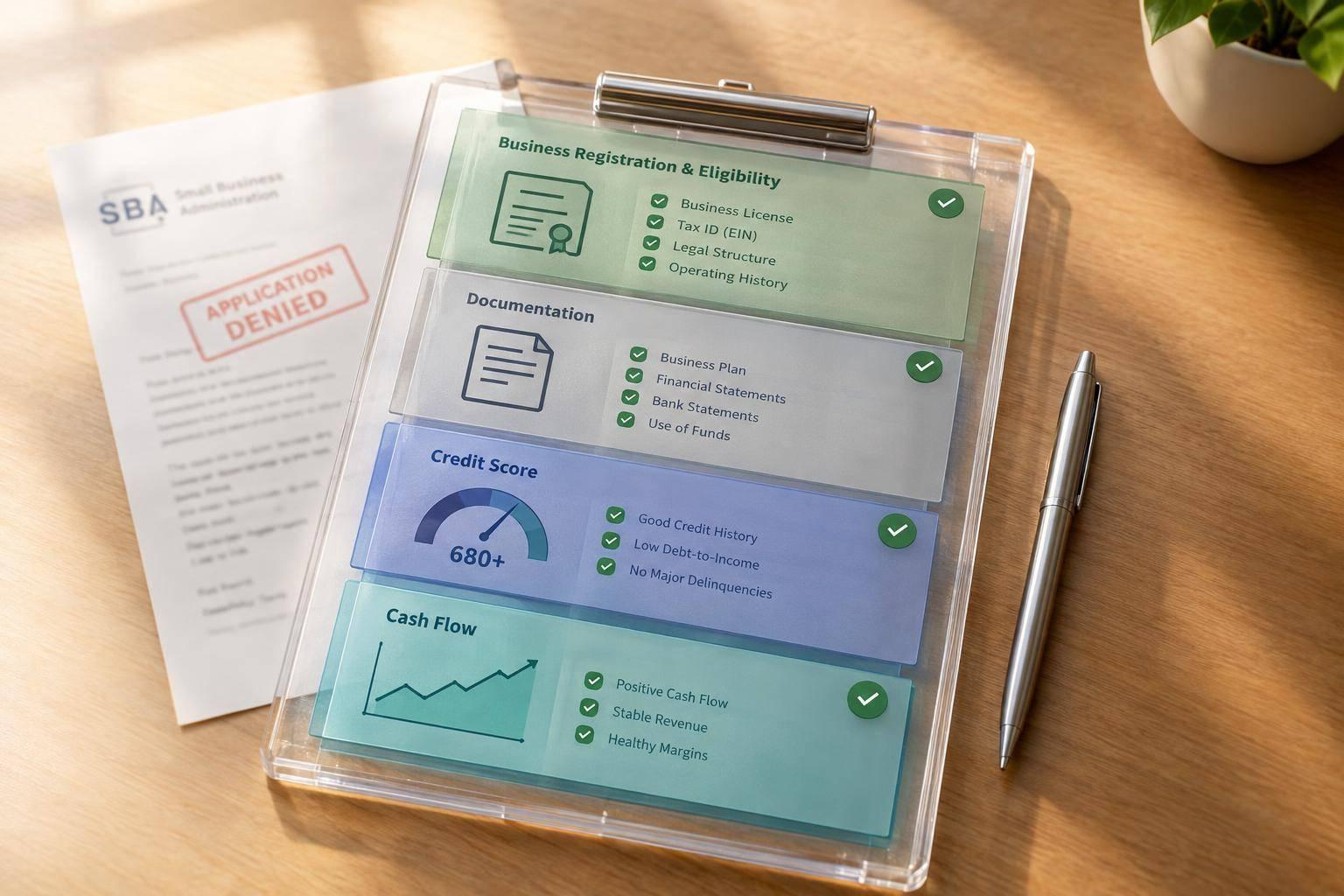
An SBA microloan denial is a reason to check your application – not assume your business can’t qualify. My first step would be to ask the lender for its denial reasons in writing before applying again.
SBA-approved nonprofit lenders issue microloans of up to $50,000, and each sets its own lending standards. The main reasons for denial include:
- Weak cash flow: Your records and forecasts don’t show enough money to cover loan payments.
- Credit or owner-funding gaps: Unresolved debts, limited cash, or missing collateral may fall short of lender rules.
- Incomplete paperwork: Missing records or conflicting figures make your application hard to verify.
- Program or lender restrictions: Your location, business type, loan use, or startup plans may not meet SBA microloan requirements.
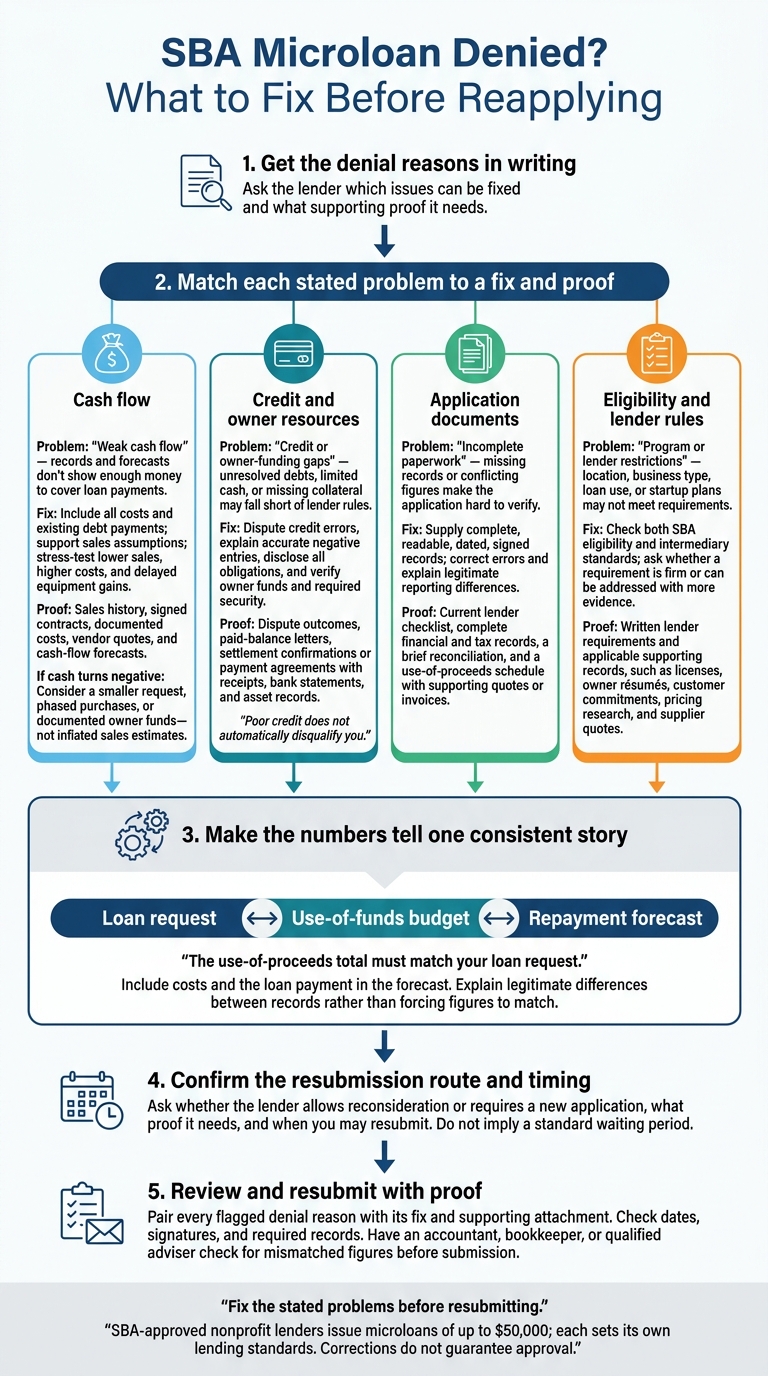
I’d turn each denial reason into a checklist: what needs fixing, what proof to attach, and when the lender will review it again. <u>Fix the stated problems before resubmitting</u> – and make sure your budget, repayment forecast, and loan request agree.
SBA Microloan Denied? What to Fix Before Reapplying
Denied a Business Loan? Do This Next
sbb-itb-1eb586e
Insufficient Cash Flow and Unrealistic Projections
Sales aren’t the same as cash available for repayment. If projected cash won’t cover all obligations, the lender sees a repayment risk – not a growth plan. Timing matters, too: a sale booked today may not bring in cash before a payment comes due.
Find Unsupported Sales Forecasts and Missing Costs
Check whether sales projections line up with sales history, signed contracts, pricing research, or market data. Expected customer volume also needs to fit your staffing and production capacity.
Next, look for missing costs: owner compensation, taxes, insurance, inventory replenishment, rent, software, and existing debt payments. Leaving these out makes repayment look easier than it is. If projected cash barely covers expenses and current debt, another loan payment could create a shortfall.
Support Forecasts With Records and Planned Loan Uses
Prepare monthly or quarterly projections for the first year, including an income statement, balance sheet, cash-flow statement, and capital spending plan. SBA’s business-planning guidance recommends a five-year outlook, with more detail in year one. Ask the intermediary what it requires. Tie each figure to unit sales, prices, capacity, seasonality, and documented costs – not a blanket growth percentage.
| Forecast area | Weak forecast or missing record | Lender concern | Practical fix |
|---|---|---|---|
| Sales | Growth estimate without sales records or contracts | Demand is unproven | Support units and prices with sales history, orders, or market research |
| Costs | Missing payroll taxes, insurance, or inventory costs | Cash is overstated | Check expenses against bills and records |
| Equipment | No vendor quote or production estimate | Return is unclear | Document purchase costs, added capacity, maintenance, and additional gross profit |
| Working capital | Request says only “business needs” | Spending timeline is unclear | Identify inventory, supplies, or payroll needs and collection dates |
| Seasonality | Identical receipts every month | Slow-month shortages may be hidden | Show seasonal receipts using historical patterns and payment terms |
For equipment, include a realistic start date and cost estimate. For working capital, show when you’ll spend the money and when customer payments should arrive.
Stress-test the forecast with lower sales, higher costs, and delayed equipment gains. If cash turns negative, consider a smaller request, phased purchases, or documented owner funds instead of inflating sales estimates to make the numbers work.
If the numbers still don’t support repayment, check whether credit strength or missing records are part of the problem.
Unresolved Credit Issues and Limited Owner Resources
Late payments, collections, defaults, unpaid taxes, and recent hard inquiries can point to repayment risk or pressure from new debt. Leaving out debts can suggest incomplete disclosure, while limited owner resources may fall short of lender requirements. Poor credit does not automatically disqualify you. The intermediary will consider the issue’s age, severity, resolution status, and your ability to repay. If credit or resource concerns caused the denial, address them before reapplying.
Fix Credit Errors and Explain Past Setbacks
Before applying, review your personal and business credit reports. Check account ownership, balances, late-payment dates, collections, and inquiries against your records. Dispute errors with both the credit reporting company and the creditor that provided the information. Include supporting documents, clearly state what needs correcting, and keep proof of the dispute and its outcome.
For accurate negative entries, briefly explain what happened, when it happened, how you resolved or are managing the debt, and what has changed. Attach paid-balance letters, settlement confirmations, or written payment agreements with recent payment receipts. For tax debt, include the IRS or state notice and proof of any active installment agreement.
A written explanation adds context, but it does not override the intermediary’s standards. Include all required payments in your disclosed obligations. Also, be ready to show how you’ll support the business if the lender asks for more security.
Document Collateral, Guarantees, and Owner Funds
After addressing credit issues, ask the intermediary to provide its collateral and personal-guarantee requirements in writing. Collateral and a guarantee are different: collateral gives the lender rights in specified assets after default; a guarantee makes the guarantor personally responsible for repayment. Use titles, invoices, or statements – not estimates – to document asset ownership, value, liens, and equity.
Lenders need proof that you can cover the required equity and any shortfall. Verify your investment with bank statements, canceled checks, capital-contribution records, or paid business invoices. Keep money already invested separate from cash on hand and funds you expect later.
If outside income counts toward repayment, back it up with payroll records, tax returns, or benefit documentation. Identify funds from another person as a gift, equity contribution, or loan, and disclose any repayment obligation. Promised funds do not prove that money is available to use.
Missing or Conflicting Application Documents
Missing pages, blurry scans, outdated records, or conflicting figures can prevent the intermediary from checking ownership, taxes, debt, and loan use. Your application needs to tell one consistent, verifiable story. Strong numbers alone won’t help if the paperwork doesn’t match.
Gather Records and Explain Differences
Ask for the intermediary’s current checklist before you submit. Each lender has its own requirements. Make sure every file is complete, readable, dated, and signed where required.
| Document | Purpose | Common discrepancy | Correction |
|---|---|---|---|
| Identification, formation records, registrations, and licenses | Verify identity, business status, and borrowing authority | Expired ID or mismatched names, addresses, or ownership details | Supply current records and explain amendments |
| Personal and business tax returns | Verify reported income and expenses | Revenue differs from bookkeeping reports | Reconcile reporting periods and accounting methods |
| Business and personal bank statements | Verify cash activity and available funds | Missing pages or deposits that don’t match sales | Provide complete statements and identify transfers or other non-sales deposits |
| Income statement and balance sheet | Show operating results, assets, and liabilities | Undated reports or balances without supporting records | Date reports and reconcile balances to supporting records |
| Debt schedule and personal financial statement | Show obligations and financial position | Outdated balances or missing payments | Update figures using current statements |
| Business plan and projections | Explain operations and repayment assumptions | Forecasts don’t match source records | Attach the source records behind each assumption |
| Purchase quotes, invoices, leases, and major contracts | Verify planned costs and commitments | Requested amounts differ from supporting documents | Update the documents and identify amounts already paid |
Explain legitimate differences – don’t force figures to match. Tax returns, bank statements, and bookkeeping reports may cover different periods or use different accounting methods. Attach a brief reconciliation listing the amount, period, reason, and supporting record. Correct any actual errors in the application.
Document How You Will Use the Loan
Prepare a use-of-proceeds schedule that lists each expense, amount, vendor, supporting quote or invoice, expected purchase date, and business purpose. The total must match your loan request. For recurring costs without vendor quotes, attach a budget showing how you calculated each estimate and the source you used. Label forecast assumptions, including sales volume, prices, payroll, rent, and seasonality.
SBA microloan proceeds generally may cover working capital, inventory, supplies, furniture, fixtures, machinery, and equipment – but not real estate purchases or repayment of existing debt. Check for additional lender restrictions before submitting.
An unclear spending plan makes it harder for the lender to assess repayment. For unusual deposits and expenses, explain the date, amount, source or recipient, purpose, and whether the transaction recurs. Attach proof so one-time transactions don’t distort cash flow.
The lender will also check whether your request meets the program’s rules and its own requirements.
Failure to Meet Program or Lender Requirements
Strong cash flow and clean documents won’t make up for a mismatch with lender rules. SBA eligibility is just the starting point. Approved intermediaries make the final lending decision and apply their own underwriting rules. That means a business can meet SBA basics and still be denied. Your application must meet both sets of requirements.
Check SBA Rules and Intermediary Standards
Confirm that your business operates in the United States, meets applicable SBA size standards, and does not engage in an ineligible activity. Businesses generally must be for-profit, though certain not-for-profit childcare centers also qualify. Then review the intermediary’s requirements.
| Requirement | Intermediary standards to check |
|---|---|
| Service area | Location limits. |
| Industry | Additional industry limits. |
| Credit | Lender-specific credit score and review standards. |
| Business history | Minimum operating history or evidence required for startups. |
| Collateral | Required assets, valuations, and liens. |
| Guarantees | Who must guarantee the loan. |
| Training | Required counseling or training, including deadlines. |
| Business-plan format | Required templates, worksheets, and forecasts. |
| Loan limits | Maximum loan amount and internal cap; the SBA maximum is $50,000. |
| Uses of funds | Additional spending restrictions and disbursement conditions. |
If a requirement is unclear, ask for clarification in writing. Find out whether it comes from the SBA or the intermediary. Also ask whether it’s a firm eligibility condition or a gap you can address with more evidence.
Check Startup Requirements and Loans Above $20,000
Startups need more supporting evidence, and larger microloans get extra scrutiny. For a startup, lenders need proof of owner experience, market demand, and projected revenue. Too little evidence that the business can succeed may lead to denial.
Ask what evidence the intermediary accepts. Prepare résumés, licenses, customer commitments, pricing research, supplier quotes, and month-by-month cash-flow forecasts. Keep signed orders separate from nonbinding letters of intent: signed orders offer firmer support.
For loans above $20,000, you may be denied if you cannot demonstrate either an inability to obtain comparable credit elsewhere at comparable interest rates or a strong chance of success. Ask how the intermediary wants you to document both conditions. Credit-decline letters and other financing offers can support the first; verified sales, signed contracts, realistic margins, and repayment forecasts can support the second.
Before reapplying, gather supporting proof for each unmet requirement.
What to Fix Before Reapplying
Address Each Denial Reason With Proof
Turn the lender’s denial reasons into a resubmission checklist. Get those reasons in writing and ask which issues you can fix. Confirm whether the intermediary allows reconsideration or requires a new application, what proof it needs, and when you can resubmit.
Keep a correction log that pairs each denial reason with the fix and supporting proof. Resubmit only when you’ve documented every flagged item.
Review the Updated Application Before Submission
Before sending the application back, make sure every correction appears in the revised packet. Add a brief response to each denial reason, naming the fix and its supporting attachment. Use the current checklist to check dates, signatures, and required attachments.
Have an accountant, bookkeeper, or qualified adviser check the revised package for mismatched figures before you submit it.
Conclusion: Fix the Denial Reasons Before Applying Again
Before you reapply, use the denial letter as your final checklist. The intermediary makes the credit decision, and standards vary by lender. If you are unsure if this program fits your needs, compare SBA microloans and bank loans to see which is right for you.
Check that your loan request matches your use-of-funds budget and business plan and that supporting records back up the costs. Your forecast should include those costs and the loan payment, with enough cash left to run the business. If the budget, forecast, and lender rules still don’t line up, revise the request before resubmitting.
FAQs
How long should I wait to reapply after a denial?
There’s no set waiting period to reapply for an SBA microloan. Many lenders offer a 30- to 60-day reconsideration window, but you should reapply only when updated documents show you’ve fixed the issues that led to your denial.
Start with your denial notice. Address weaknesses in your credit, cash flow, or business plan, then ask your intermediary whether to request reconsideration or submit a new application.
Will an SBA microloan denial hurt my credit?
Being denied an SBA microloan doesn’t hurt your credit. But applying requires a credit check that results in a hard inquiry, which may cause a small, temporary drop in your credit score.
Lenders review your overall credit profile to judge your ability to repay. That includes your payment history, existing debt, and recent negative marks, such as collections or charge-offs.
How much cash-flow cushion do I need to qualify?
Lenders typically want a debt service coverage ratio (DSCR) of at least 1.15x to 1.25x. That means if your total monthly debt payments are $1,000, your business should have $1,150 to $1,250 in cash flow left after paying other operating expenses.
Plan for at least 12 months of working capital, too. This cash cushion helps cover operating costs and loan payments when business slows down.

Leave a Reply