
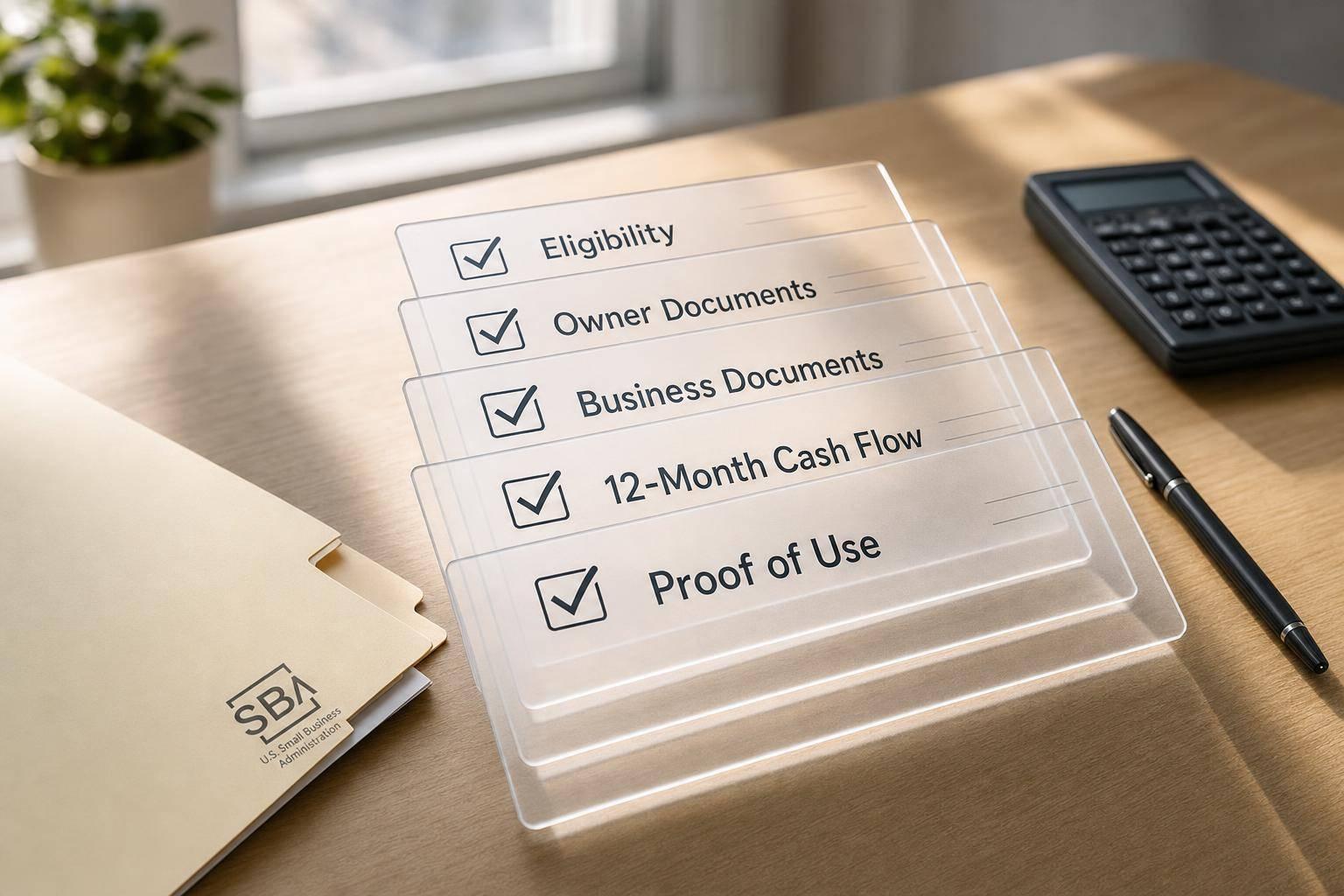
If I want an SBA microloan, I need to show three things fast: I qualify, I know where the money will go, and I can pay it back. That matters because SBA microloans top out at $50,000, often average around $13,000 to $15,000, and startup lenders usually look hard at my personal finances, credit, and plan when my business has little or no track record.
Here’s the article in plain English:
- I first check whether funding your startup business with an SBA microloan fits my needs
- I make sure my loan use is allowed, like working capital, inventory, equipment, or supplies
- I avoid blocked uses like real estate purchases and debt refinance
- I gather owner documents for anyone with 20% or more ownership
- I pull business records like my EIN, formation papers, licenses, and bank account details
- I build a short business plan and 12-month cash flow forecast
- I match every loan dollar to a clear expense with quotes, invoices, or estimates
- I finish the lender’s forms, review all dates and numbers, and fix any mismatch before I submit
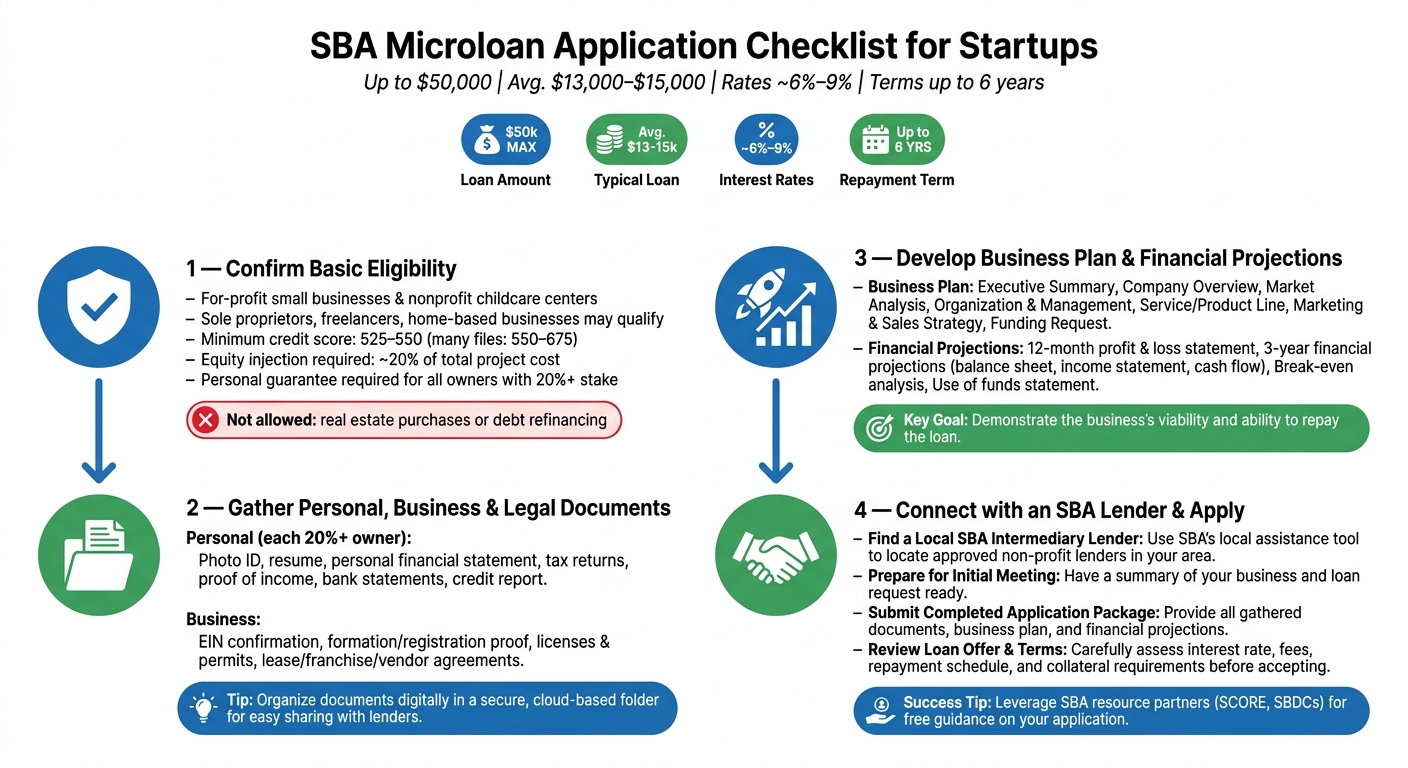
A few numbers stand out. Repayment can go up to 6 years, rates often fall around 6% to 9%, and many startup borrowers may need about 20% down into the project. Also, each 20%+ owner usually has to sign a personal guarantee.
Bottom line: if I submit a clean package with matching numbers, clear projections, and proof for how I’ll spend the funds, I give myself a better shot at approval and cut down on delays.
SBA Microloan Application Checklist for Startups
2025 Ultimate SBA Application Checklist (Free!)
sbb-itb-1eb586e
Checklist 1: Confirm Basic Eligibility Before You Apply
Check eligibility first. It saves time and cuts down on avoidable back-and-forth. A fast review can keep you from putting together a loan package that gets turned down for basic reasons. For startups, this matters even more because lenders look more closely at the owner and the business setup when there isn’t much operating history.
Business Type, Location, and Industry Eligibility
The SBA Microloan Program is open to for-profit small businesses and certain nonprofit childcare centers in the United States. Sole proprietors, freelancers, and home-based businesses may qualify too. In short, the program can work for several business structures.
One thing to avoid: don’t base your request on real estate purchases or debt refinancing.
Most lenders also want to see that your business already has an Employer Identification Number (EIN) and a separate business bank account before you submit an application. Get both in place first.
Owner Credit, Equity Injection, and Credit Review
Since startups don’t have much business history, lenders put more weight on the owner’s credit and cash contribution. Good credit helps. That said, some intermediary lenders will still look at weaker credit. Scores as low as 525 to 550 may be considered, and many files land in the 550 to 675 range.
Startups also usually need an equity injection of about 20% of the total project cost. For a $25,000 loan, that’s about $5,000. If your credit is on the lower side, having that cash ready can help your case. A cosigner with strong income and credit may help as well.
Any owner with a 20% or greater stake in the business must provide a personal guarantee.
Common Red Flags to Resolve Before Applying
Some issues won’t knock you out right away, but they can slow things down or make your file weaker if you leave them unaddressed.
| Red Flag | What to Do Before Applying |
|---|---|
| Foreclosure or bankruptcy | Write a brief explanation letter with context and timeline |
| Low credit | Improve your score first or identify a cosigner |
| No EIN or business bank account | Register your business and open a dedicated account |
| Weak projections | Revise your numbers to reflect realistic startup costs and market conditions |
Check the lender’s rules before you apply. After you clear these issues, you’re ready to pull together the personal, business, and legal documents lenders will want to review.
Checklist 2: Gather Personal, Business, and Legal Documents
Once you’ve confirmed eligibility, the next step is pulling together the paperwork that shows identity, ownership, and legal standing.
Personal Documents for Each Owner With 20% or More Ownership
Each owner with 20% or more ownership should provide:
- A government-issued photo ID
- A resume
- A signed personal financial statement
- Tax returns
- Proof of income
- Personal bank statements
- A current credit report
It’s smart to review your own credit report for errors before you send it in.
You should also include a brief written background statement for each 20%+ owner. If you’ve already invested money into the business, add proof of that equity injection too. And if the lender asks for any background or criminal-history explanation, include that as part of the package.
Business Formation and Legal Records
For the business, gather proof of business registration, your EIN confirmation, and any business licenses or permits. If they apply to your company, add lease agreements, franchise agreements, and major vendor or customer contracts.
These documents help confirm that the business is properly formed and show who owns what.
How to Label and Organize Files Before Submission
Before sending anything, sort your files into clear groups such as personal documents, business legal records, and financial records. Label each file so the lender can check names, ownership percentages, dates, and addresses without extra back-and-forth.
Then review every document for matching details. A small mismatch, like a different address or name format, can slow things down.
Next, organize your plan, financials, and loan-use details so the lender can verify repayment ability.
Checklist 3: Prepare the Business Plan, Financials, and Use of Funds
With your documents in order, the next step is putting together the materials that show a lender how your business runs and how the loan gets paid back. Lenders compare your plan, projections, and funding request side by side, so the numbers and story need to line up.
Business Plan Sections Lenders Expect to See
A solid business plan for an SBA microloan does not need to be long. Aim for 10–20 pages. Lenders care more about a clear, specific plan than extra length.
Your plan should cover:
- Business overview
- Owner background
- Product or service
- Target market
- Competition
- Operations
- Marketing plan
- Growth strategy
- Repayment plan
One detail lenders pay close attention to: applicants who point out real risks in their plan often come across as more believable than those who talk only about upside.
Use the same assumptions in your cash flow forecast. If your plan says sales will grow through local partnerships or online ads, your projections should reflect that exact path.
Financial Records and Startup Projections
For financials, include both personal and business financial statements. If the business is already running, add current cash flow records too.
For projections, prepare monthly cash flow forecasts for at least 12 months, along with sales projections and profit expectations. Spell out the assumptions behind each number. For example, if you expect $8,000 in monthly revenue, explain where that figure comes from. Is it based on signed clients, local demand, past sales, or pricing times expected order volume? That’s what lenders want to see. They are looking for numbers tied to data, not guesses.
"To prove your repayment ability, you can either show your organization’s existing cash flow or your financial projections if your start-up venture hasn’t generated any profits yet." – SBA 50K
Your projections should also match your use-of-funds breakdown. If you say the loan will help you buy equipment, hire part-time help, or build inventory, those costs and the expected return should show up in the forecast.
Use-of-Funds Breakdown With Supporting Proof
Match every loan dollar to a specific eligible expense. A broad line like "equipment and supplies" is too vague. Lenders usually expect a dollar-by-dollar breakdown showing exactly how the loan will be used.
Each item should be backed by vendor quotes, invoices, or written estimates. That proof helps the lender confirm both the amount and the purpose. Also, SBA microloan funds cannot be used to buy real estate or refinance existing debt.
Make sure your use-of-funds list, business plan, and cash flow projections all tell the same story. When the numbers stay specific and consistent across every document, it becomes much easier for a lender to verify repayment
Checklist 4: Complete Lender Forms and Review Before Submission
Lender Application Forms and Certifications
Once your plan, projections, and funding details are locked in, move on to the lender’s forms. At this stage, your main job is simple: finish the lender-specific paperwork and make sure everything says the same thing.
Each intermediary lender has its own application, certification, and signature rules.
Most lenders ask for a standard application form, a credit authorization, and a personal guarantee from every owner who holds 20% or more of the business. That means you should collect signatures from each owner at or above that threshold. Some lenders also ask for lender-specific certifications, plus any required training, coaching, or mentoring forms.
Ask the lender up front whether training, coaching, or mentoring forms are part of the package.
Final Review: Match Every Number and Date Across All Documents
After the forms are done, review the full package line by line. Check that the loan amount, ownership percentages, and dates match across every document.
| Document | Key Data Points to Verify |
|---|---|
| Lender Application | Total loan amount, ownership percentages, business purpose |
| Business Plan | Use-of-funds breakdown, financial projections |
| Financial Statements | Cash on hand, existing debt, and owner obligations |
| Legal Records | EIN, business structure, registered owner names |
Watch ownership percentages closely. They need to match across the application, personal financial statements, and your legal formation documents. Also check that your requested loan amount is the same on every form. If one document shows a different amount, stop and fix it before you submit.
Use MM/DD/YYYY for every date. If one file spells out the date and another uses numbers, make them match so the package looks clean and professional.
Conclusion: A Pre-Submission Checklist for Better Approval Odds
A complete SBA microloan application comes together step by step, even if you are seeking a startup small business loan with bad credit. First, you confirm eligibility. Then you gather personal and legal records, build a business plan with realistic projections, show exactly how the funds will be used, and finish each lender-specific form with care. Each part supports the next.
That last review can catch missing paperwork, date issues, and number mismatches before submission. Run the final check before you send the package in.
FAQs
How long does SBA microloan approval usually take?
SBA microloan approval usually takes one to three months. That said, in many cases, applicants may secure funding in 30 days or less.
The exact timeline depends on the lender. SBA microloans go through nonprofit intermediary lenders, and each one sets its own approval standards and process.
Can I get an SBA microloan with bad personal credit?
Yes, you may still qualify for an SBA microloan even with poor personal credit. These loans come through nonprofit intermediary lenders, so they may look at your full financial picture instead of focusing only on your credit score.
The exact requirements depend on the lender. To give yourself a better shot, show up prepared with a strong business plan, clear financial projections, and a detailed explanation of how you plan to use the funds.
What if I do not have 20% to put down?
A 20% down payment is often requested for startup microloans, but it’s not always required. Some lenders may offer funding with $0 down if you meet their other criteria.
Because SBA microloans are issued through nonprofit intermediary lenders, the rules can vary from one lender to the next. If you don’t have money for a down payment, put your focus on a strong business plan, solid financial projections, and a clear use of funds.
Leave a Reply