
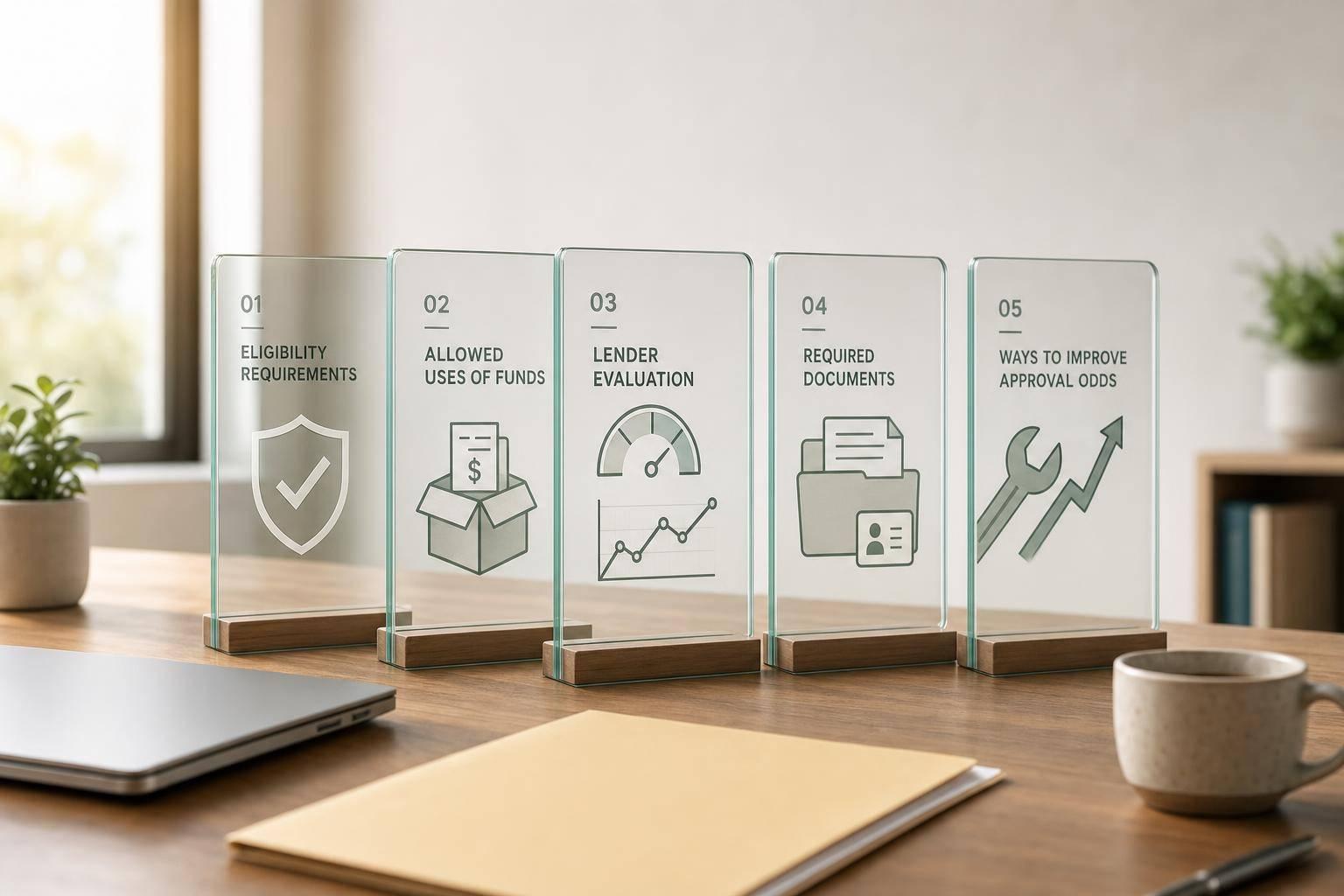
If you want an SBA microloan, focus on three things first: repayment, allowed use of funds, and paperwork. These loans go up to $50,000, but the average loan is about $13,000. Most lenders look at your credit, cash flow, business plan, and whether the money will be used for approved costs.
Here’s the short version:
- You usually need to be a U.S.-based for-profit small business
- Some nonprofit childcare centers may also qualify
- Funds can be used for working capital, inventory, supplies, furniture, fixtures, and equipment
- Funds can’t be used for real estate or debt refinancing
- For loans above $20,000, you may need to show you couldn’t get similar credit elsewhere
- Many microlenders charge about 8% to 13%
- The lender, not the SBA, decides approval
If I were getting ready to apply, I’d make sure my loan purpose is specific, my numbers show a path to repayment, and my file includes tax returns, bank statements, a business plan, and projections. That’s what usually makes or breaks the application.
| What lenders check | What it means for you |
|---|---|
| Credit history | No recent major issues helps |
| Cash flow | You need to show the loan payment fits your budget |
| Business plan | Startups need a clear plan and 3–5 year projections |
| Use of funds | The request must match SBA microloan rules |
| Documents | Missing records can stall or stop approval |
Bottom line: if you can show how the loan will be used, how it will be repaid, and why your file is complete, you’ll be in much better shape before you apply.
How To Find a SMALL SBA loan For Your Startup or Business (Real Example)
sbb-itb-1eb586e
Basic SBA Microloan Eligibility Rules
The SBA Microloan program is for U.S.-based, for-profit small businesses that are legally operating. Some nonprofit childcare centers can also qualify. Your business must meet SBA size standards, and those standards change by industry.
That’s the baseline.
From there, microlenders usually look at a few practical things before they say yes:
- Your credit
- Your cash flow
- Your plan to pay the loan back
Who Can Qualify as a Startup or Small Business
This program is aimed at new startups, newly formed businesses, and existing local businesses that need money to grow.
So if you’re just getting off the ground, you’re not automatically out of the running. In fact, this loan program was built with early-stage businesses in mind.
Business Types and Uses That Do Not Qualify
There are clear limits on how you can use the money. You can’t use SBA Microloan funds to buy real estate or to refinance debt you already have.
Some business types are also usually off-limits, including:
- Speculative ventures
- Gambling-related businesses
If you’re seeking more than $20,000, you may also need to show that you couldn’t get similar credit elsewhere on reasonable terms. Even then, approval isn’t based on business type alone. Microlenders still weigh the full picture before making a lending call.
How Microlenders Review Credit, Cash Flow, and Repayment Ability
After basic eligibility, the process moves into underwriting. At this stage, the microlender makes the final call – not the SBA – by figuring out whether your business can pay the loan back.
Credit History, Personal Guarantees, and Collateral
The SBA doesn’t set a minimum credit score for these loans. Still, lenders want to see a credit record without recent major issues. They look at both personal and business credit reports, with close attention to recent delinquencies, open collections, tax liens, and past bankruptcies.
If your credit file is thin or has some damage, the lender may want extra backup. That can mean collateral or a co-signer. It’s also common for owners with a large stake in the business to sign a personal guarantee. In plain English, that means your personal assets could be at risk if the business can’t repay the loan.
How Lenders Decide Whether Your Business Can Repay the Loan
This is where lenders get practical. Existing businesses are judged mostly on current cash flow. Startups are judged more on projections and whether there’s a believable path to profit.
For an existing business, lenders usually review:
- Bank statements
- Profit and loss statements
- A debt schedule
They use those records to see if your cash flow can handle a new monthly loan payment on top of what you’re already paying.
For startups, lenders lean more on three- to five-year financial projections and the business plan. They’re looking for assumptions that make sense, costs that feel grounded, and a clear story for how the loan will help bring in revenue.
Next, lenders check those figures against your business plan, statements, and projections to make sure the numbers line up.
Required Documents and Eligible Uses of Funds
After a lender reviews your credit and cash flow, the next step is the paperwork behind your application. If your ability to repay looks solid, the lender will want proof to back that up. Microlenders want a plain, complete view of who you are, how your business runs, and how the loan will get paid back.
Documents Most Microlenders Ask For
Most microlenders ask for a government-issued ID, a short personal statement or bio, a resume, and business records like your license, lease, or franchise agreement. These documents help confirm your identity, background, and whether you’re prepared to run the business.
After that, lenders usually dig into your financial records. Be ready to share personal and business tax returns, bank statements from the past two years, a debt schedule, and current financial statements, including profit and loss statements and balance sheets. You should also include proof that you’ve put your own money into the business, such as owner contributions, savings transfers, or paid-in capital.
Your business plan matters here. It should cover your business model, marketing plan, and three- to five-year financial projections. Lenders use that plan to judge whether the business can repay the loan. A weak business plan, missing legal or tax records, or cash flow that doesn’t make sense can slow the process or stop the application altogether.
It also helps to prepare a purpose-of-loan statement that spells out exactly how you’ll use the funds and how that use will support cash flow. If the lender asks for a collateral list or guarantee forms, have those ready too.
Allowed Uses: Working Capital, Inventory, Supplies, Furniture, Fixtures, and Equipment
SBA Microloan funds are meant for day-to-day business needs and growth-related costs. That includes working capital, inventory, supplies, furniture, fixtures, and equipment. They can’t be used to buy real estate or refinance existing debt.
Your loan request should line up with one of the approved uses below. Think of it this way: the clearer the match, the easier it is for a lender to see where the money is going and why it makes sense.
| Eligible Use | What Lenders Want to See |
|---|---|
| Working capital, including payroll, day-to-day expenses, and marketing | Cash flow projections showing the business can support repayment |
| Inventory and supplies, including raw materials, stock, and office supplies | A detailed purpose-of-loan statement and price quotes for items |
| Furniture and fixtures, including desks, shelving, and retail displays | A layout or plan showing how the purchase improves business capacity |
| Equipment, including tools, computers, and heavy machinery | Quotes or invoices for the specific equipment being financed |
Common Approval Problems and How to Fix Them
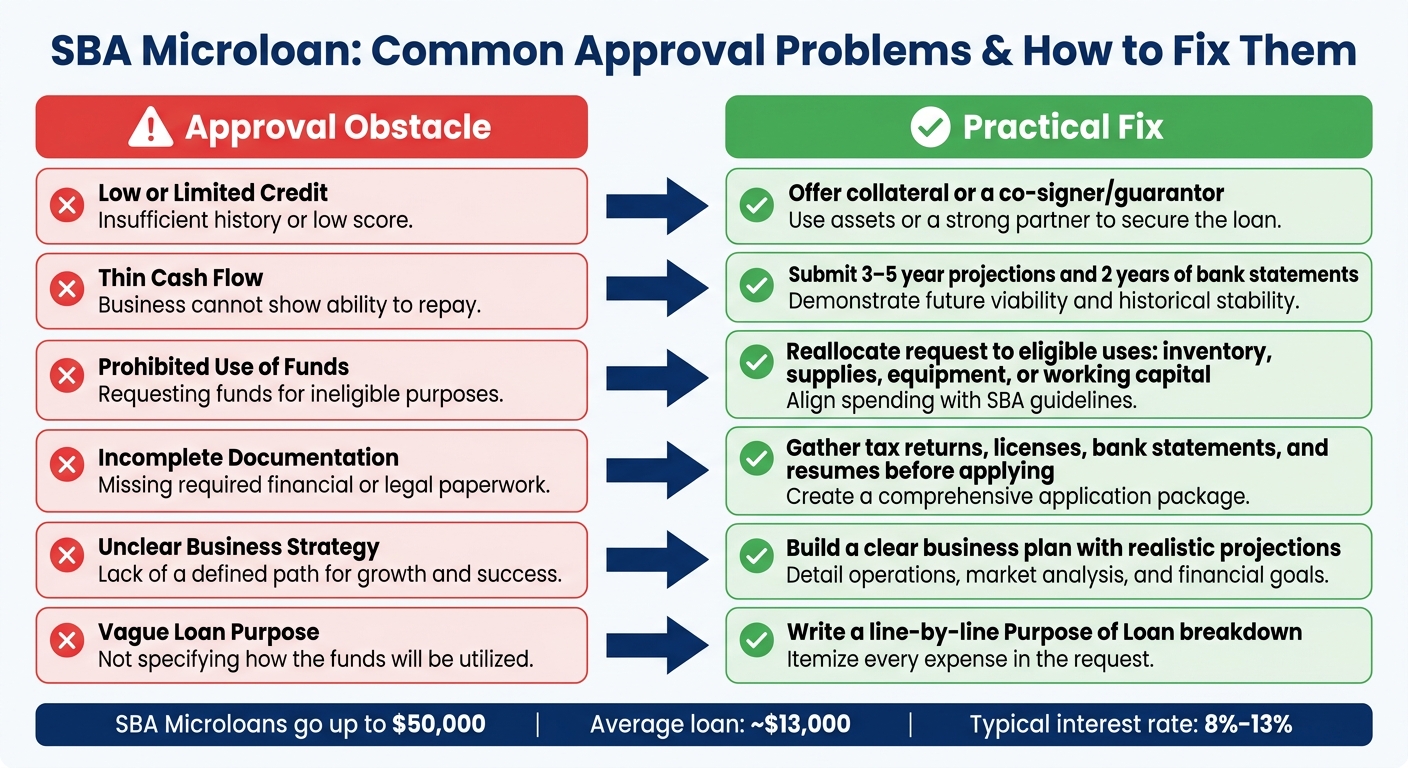
SBA Microloan Requirements: Approval Obstacles & Fixes
The Most Common Reasons Applicants Do Not Qualify
Once a lender reviews your credit, cash flow, paperwork, and loan purpose, a few issues tend to stop the process fast.
One of the biggest problems is thin cash flow. If the lender can’t see a clear way the loan gets paid back, approval gets harder right away. A weak credit history can also get in the way, especially if there’s no collateral and no co-signer or guarantor backing the deal.
Loan purpose matters too. If the funds will be used for something the lender doesn’t allow, that can lead to a denial. And paperwork? That’s where a lot of applications fall apart. Missing items like resumes, tax returns, licenses, and bank statements can delay the file or shut it down altogether.
Then there are the deal-breakers: fraud, false statements, or serious legal issues that still haven’t been resolved.
What to Fix Before Submitting Your Application
The good news is that each problem has a direct fix. Start with the root issue, clean it up, then apply.
If your credit is weak, pull your credit reports and dispute any errors. If the score is still too low, add collateral or bring in a co-signer or guarantor.
If cash flow looks thin, put together 3- to 5-year financial projections based on realistic assumptions. Your business plan should make one thing plain: how the loan will be repaid.
That same idea applies across the board. If the use of funds isn’t allowed, shift the request to approved uses. If your file is missing documents, gather everything before you submit. If your plan feels fuzzy, tighten it up.
| Approval Obstacle | Practical Fix |
|---|---|
| Low or limited credit | Offer collateral or a co-signer or guarantor |
| Thin cash flow | Submit 3–5 year projections and 2 years of bank statements |
| Prohibited use of funds | Reallocate the request to eligible uses like inventory, supplies, equipment, or working capital |
| Incomplete documentation | Gather tax returns, licenses, bank statements, and resumes before you apply |
| Unclear business strategy | Build a clear business plan and realistic projections |
| Vague loan purpose | Write a line-by-line "Purpose of Loan" breakdown |
Conclusion: The Key Requirements to Focus On First
Focus first on repayment, eligible use, and complete documentation.
FAQs
Can I get an SBA microloan with bad credit?
Yes, you may be able to get an SBA Microloan with bad credit or limited credit history.
Many microlenders still check your credit. But they’re often more flexible than banks and may be open to working with borrowers who are rebuilding their credit.
You can strengthen your application by:
- Offering collateral or a co-signer
- Showing that you can repay the loan
- Providing a detailed business plan
Do startups need collateral or a personal guarantee?
Not always. Many lenders don’t ask for collateral on smaller loans. Whether you need collateral or a personal guarantee usually comes down to two things: the loan amount and your credit profile.
If your credit is weak, a lender may ask for collateral or a co-signer. On the flip side, some smaller loans are unsecured, which means you don’t have to put up an asset.
How long does SBA microloan approval usually take?
The approval and funding process for an SBA microloan can take several weeks.
When you apply through SBA50K, the funding timeline is 30 days.
Leave a Reply