

An SBA microloan denial is usually a fixable problem, not a dead end. If your request was denied, I’d do three things first: read the denial letter line by line, match each issue to credit, cash flow, paperwork, collateral, eligibility, or the business plan, and ask the lender what would need to change for approval.
Here’s the short version:
- SBA microloans go up to $50,000
- They can cover working capital, inventory, supplies, furniture, fixtures, machinery, and equipment
- They can’t be used for real estate or paying off old debt
- The SBA does not approve or deny these loans itself; nonprofit intermediary lenders do
- That means one denial does not mean every lender will say no
If I were deciding what to do next, I’d keep it simple:
- If the problem is credit, I’d check all credit reports, fix errors, pay down card balances, and ask if a co-signer would help
- If the problem is cash flow, I’d cut the loan amount, trim costs, and make sure bank deposits and income records match
- If the problem is paperwork, I’d rebuild the file with tax returns, bank statements, a current profit and loss statement, balance sheet, and debt schedule
- If the problem is lender rules like service area or time in business, I’d stop trying to fix the file and apply with a different intermediary
- If the need is very specific, like buying equipment or covering a short cash gap, I’d look at another loan type
A few numbers matter here. If your score is 585 and the lender wants 620, that’s a 35-point gap. If your DSCR is 1.05 and the lender wants 1.25, your cash flow likely does not support the payment yet. That’s the kind of math that should guide your next move.
My rule would be simple: don’t reapply until I can show what changed on paper.
This article breaks down how I’d sort the denial reason, fix the weak spot, and choose between reapplying, switching lenders, or using another funding option.
Why Your Business Loan Was Denied and How to Fix It (DON’T Skip the Third Tip!)
sbb-itb-1eb586e
Read the Denial Notice and Find the Exact Problem
Read the denial notice line by line. Your job is to separate the actual denial reasons from the boilerplate. A lot of notices include stock language, but the lines that matter are the ones that point to the file’s weak spots. If the notice says cash flow can’t support the requested payment, that’s a direct clue. Once you decode the notice, you can fix the right problem instead of taking shots in the dark.
Label Each Denial Reason in Plain Terms
Sort each reason into one of these six categories: eligibility, personal credit, business cash flow, collateral, documentation, or business plan weakness.
| Denial Category | Common Phrases in the Notice | What It Means |
|---|---|---|
| Eligibility | "Use of funds not eligible", "business type not permitted", "outside geographic service area" | Program rules block the application as submitted |
| Personal Credit | "Credit score below minimum", "recent delinquencies or collections" | Your credit profile didn’t meet the lender’s floor |
| Business Cash Flow | "Insufficient debt service coverage", "negative operating cash flow", "unstable income" | The business may not support the monthly payment |
| Collateral | "Collateral coverage insufficient", "no lien available on business assets" | Not enough assets to secure the loan |
| Documentation | "Missing tax returns", "inconsistent financial statements" | The lender couldn’t verify your numbers |
| Business Plan | "Projections unrealistic", "unclear use of funds" | The repayment story didn’t hold up |
If the notice includes numbers, write them down exactly. Those numbers give you the mark you need to clear.
A 585 score against a 620 minimum means you need to close a 35-point gap. A 1.05 DSCR against a 1.25 requirement shows a cash flow shortfall. That’s how you figure out whether the fix is credit, cash flow, paperwork, or the loan amount itself. Each category leads to a specific next step before you resubmit.
Ask the Intermediary What Would Make the File Approvable
Call the loan officer with your six-category list in front of you. Keep the conversation direct. Good questions include: "What are the top two or three changes that would make my application approvable?", "At what loan amount would my current cash flow meet your coverage requirements?", and "Would a co-signer or additional collateral change the outcome?"
If documentation was flagged, ask whether they have a checklist or sample package. If credit is the issue, ask whether a co-signer with enough income and credit would help.
Bring your six-category list to the call and ask the loan officer to respond to each item. That makes it much easier to tell what was missing versus what was simply too weak. Then use those answers to decide what to fix before you apply again.
Fix the Weak Areas Before You Apply Again
Treat the denial reason like a to-do list. Each fix should line up with the reason you were turned down. In most cases, the problem falls into one of three buckets: credit, cash flow, or documentation and business plan issues.
Fix Credit Issues and Fill Documentation Gaps
If the denial pointed to credit, start there. When credit is the main blocker, adding a co-signer or more collateral can help before you submit a new application. Pull your personal credit reports from all three major bureaus – Equifax, Experian, and TransUnion – along with any business credit reports you can access, such as Dun & Bradstreet or Experian Business.
Check for errors first. Look for late payments that were reported wrong, balances that don’t match, or accounts that aren’t yours. Dispute any clear mistakes with each bureau. These fixes often take about 30 days. While that’s in motion, work on the basics: pay down revolving balances to under 30% utilization, bring past-due accounts current, and avoid extra credit applications before you apply again.
For documentation, build a file where every number ties back to a source document. That usually means:
- 2–3 years of personal and business tax returns
- A current year-to-date profit and loss statement and balance sheet dated within 60–90 days of the new application
- 3–6 months of business bank statements
- A debt schedule listing every obligation, monthly payment, and maturity date
Here’s the plain truth: if your P&L, tax returns, and bank deposits don’t line up, lenders will flag the file.
Improve Cash Flow and Request a Smaller Loan if Needed
If the denial cited cash flow, fix that before you reapply. When DSCR is below about 1.15 to 1.25, the numbers usually need work first. The fastest moves are often cutting nonessential expenses, collecting receivables faster, and routing all business income into one business account so lenders can track it clearly.
If that still doesn’t close the gap, ask for a smaller loan amount. A smaller ask that the numbers can support shows you understand what the business can repay.
Tighten the Business Plan and Show Repayment
If the denial came down to the repayment story, revise the plan before sending it back in. The executive summary should spell out your business type, location, what you sell, who buys it, the exact loan amount, and how you plan to repay it. In the use of funds section, break the loan into clear line items such as equipment, inventory, or working capital. Vague phrases like "startup costs" or "general business purposes" tend to trigger red flags.
A strong plan needs to show, not just claim, how the loan will be repaid. Use projections that show the business can cover the debt. If the lender gave you feedback, use it. Then resubmit only when the projections and use of funds are clear.
Once the file is repaired, the next move is deciding whether to reapply or go with a different funding path.
Decide What to Do Next: Reapply, Switch Intermediaries, or Try Another Funding Option
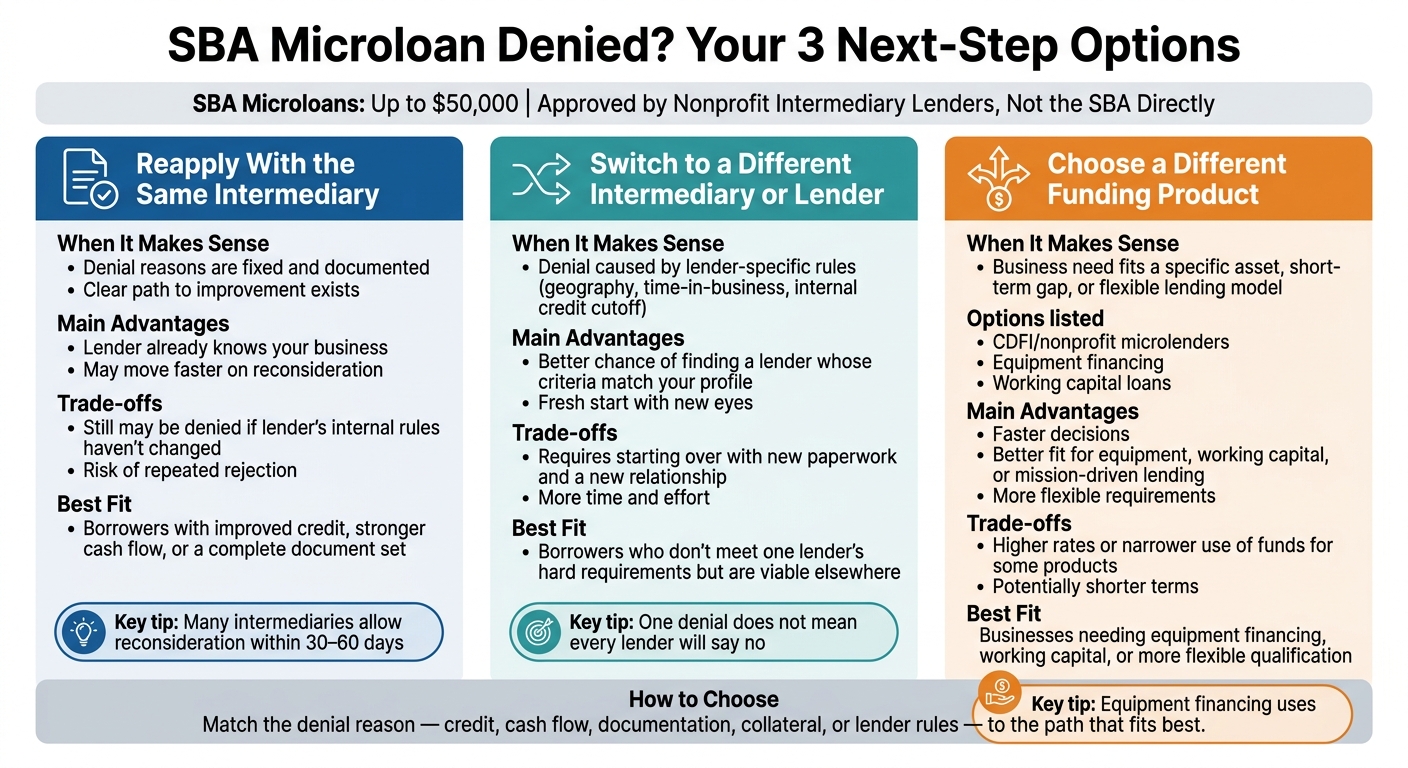
SBA Microloan Denied? Reapply, Switch Lenders, or Choose a Different Product
Use the denial reason to pick your next move: reapply, switch lenders, or use a different funding product. The key is to match the issue you found earlier – credit, cash flow, documentation, collateral, or lender rules – to the option that makes the most sense.
When Reapplying With the Same Intermediary Makes Sense
Reapply with the same intermediary only if you can show clear fixes to the reason for denial.
Start with the denial letter. Many intermediaries allow a reconsideration request within 30–60 days if you have updated information. Once that window closes, you may have to file a brand-new application. Don’t guess here. Ask the intermediary whether they want a reconsideration request or a new file.
That step matters more than it may seem. If you reapply too soon, without a clear paper trail showing what changed, the file can look exactly the same as before.
If cash flow was the main issue, submit a new request only at a loan amount your updated cash flow can support.
When a Different Intermediary or Lender Type Is a Better Fit
Some denials happen because of lender rules, not because your business can’t qualify anywhere.
This route makes sense when the denial came from a rule you can’t fix. For example, if the intermediary has a minimum time-in-business rule, an internal credit cutoff, or a geographic service-area limit, cleaning up your documents won’t change the answer.
In cases like that, the problem is lender-specific, not borrower-specific. That’s your signal to switch.
CDFI loans and nonprofit microlenders can work better for underserved or early-stage businesses because they may use more flexible underwriting and can also offer technical assistance. If you’re buying equipment, equipment financing may be a better match since the equipment itself can secure the loan. If you need to cover a short-term cash flow gap or seasonal expense, working capital loans can move faster, but they often come with higher rates and shorter repayment terms.
Comparison Table: Reapply vs. Switch Lenders vs. Choose a Different Funding Product
| Path | When It Makes Sense | Main Advantages | Trade-offs | Best Fit |
|---|---|---|---|---|
| Reapply with the same intermediary | Denial reasons are fixed and documented | The lender already knows your business and may move faster on reconsideration | Still may be denied if the lender’s internal rules haven’t changed | Borrowers with improved credit, stronger cash flow, or a complete document set |
| Switch to a different intermediary or lender | The denial was caused by lender-specific rules | Better chance of finding a lender whose criteria match your profile | Requires starting over with new paperwork and a new relationship | Borrowers who don’t meet one lender’s hard requirements but are still viable elsewhere |
| Choose a different funding product | The business need fits a specific asset, short-term gap, or flexible lending model | Faster decisions and better fit for equipment, working capital, or mission-driven lending | Higher rates or narrower use of funds for some products | Businesses needing equipment financing, working capital, or more flexible qualification |
Use the table to line up the denial reason with the next step that fits best.
Conclusion: Address the Denial Reason, Then Take the Next Clear Step
A denial letter usually points to something you can fix. Treat it as a starting point, not a final judgment.
Use the denial reasons you already labeled, then call the intermediary. Ask what would make the file eligible for approval and whether the denial came from program rules or from the intermediary’s underwriting rules. Start with the main weak spot first.
Once you fix that core issue, pick the next path based on the denial reason. If the file is close and the problems can be cleared up, reapplying with the same intermediary may make sense. If the denial came from a lender-specific rule you can’t change, another funding option may fit better.
Move fast, but don’t reapply until the file is in better shape.
Fix the reason for the denial, then take the next funding step that fits your numbers.
FAQs
How long should I wait before reapplying?
There’s no set SBA waiting period to apply again for a microloan. The main thing is to fix the issues that led to the denial first.
Start by reviewing your denial notice. Pay close attention to problems tied to your credit, cash flow, or business plan. Then, before you submit a new application, check with the intermediary lender to confirm that your finances and paperwork meet its requirements.
Can I still qualify with bad credit?
Yes. You may still qualify for an SBA microloan with bad credit because nonprofit intermediary lenders often have more flexible requirements than many banks.
Some lenders may look for credit scores between 550 and 675, while others may accept scores as low as 525.
To improve your odds, come prepared with:
- A strong business plan
- A co-signer, if needed
- Collateral, if the lender asks for it
That extra prep can make a big difference, especially when your credit score isn’t where you want it to be.
What if the denial was due to lender rules?
SBA microloan requirements, rates, and terms are set by each nonprofit intermediary lender, so the rules can vary a lot. If your application gets denied, ask the lender for the exact reason.
That matters because another intermediary may be more flexible about things like your credit score, collateral, or how long you’ve been in business. You may also have a better shot next time if you tighten up your business plan, improve your cash flow projections, or apply with a co-signer.

Leave a Reply