

An SBA microloan offers up to $50,000 – but I’d start with what you can repay, not the maximum. Before applying, list your planned expenses and test whether your cash flow can cover the loan payment, even if sales fall 20%.
Here’s what I’d check first:
- Lender and eligibility: You apply through an SBA-approved nonprofit intermediary, which sets its own approval rules. Startups and certain nonprofit childcare centers may qualify.
- Allowed uses: Funds can cover working capital, inventory, equipment, and other approved business costs – not real estate purchases or existing debt.
- Costs and risks: Rates generally range from 8% to 13%, with terms up to 7 years. Ask about fees, collateral, and personal guarantees.
- Application records: Prepare your spending plan, financial records, credit explanations, and repayment forecast. Confirm the lender’s document and training requirements.
My rule: <u>check the full cost and your personal risk before signing</u>. A complete application helps, but approval is never guaranteed.
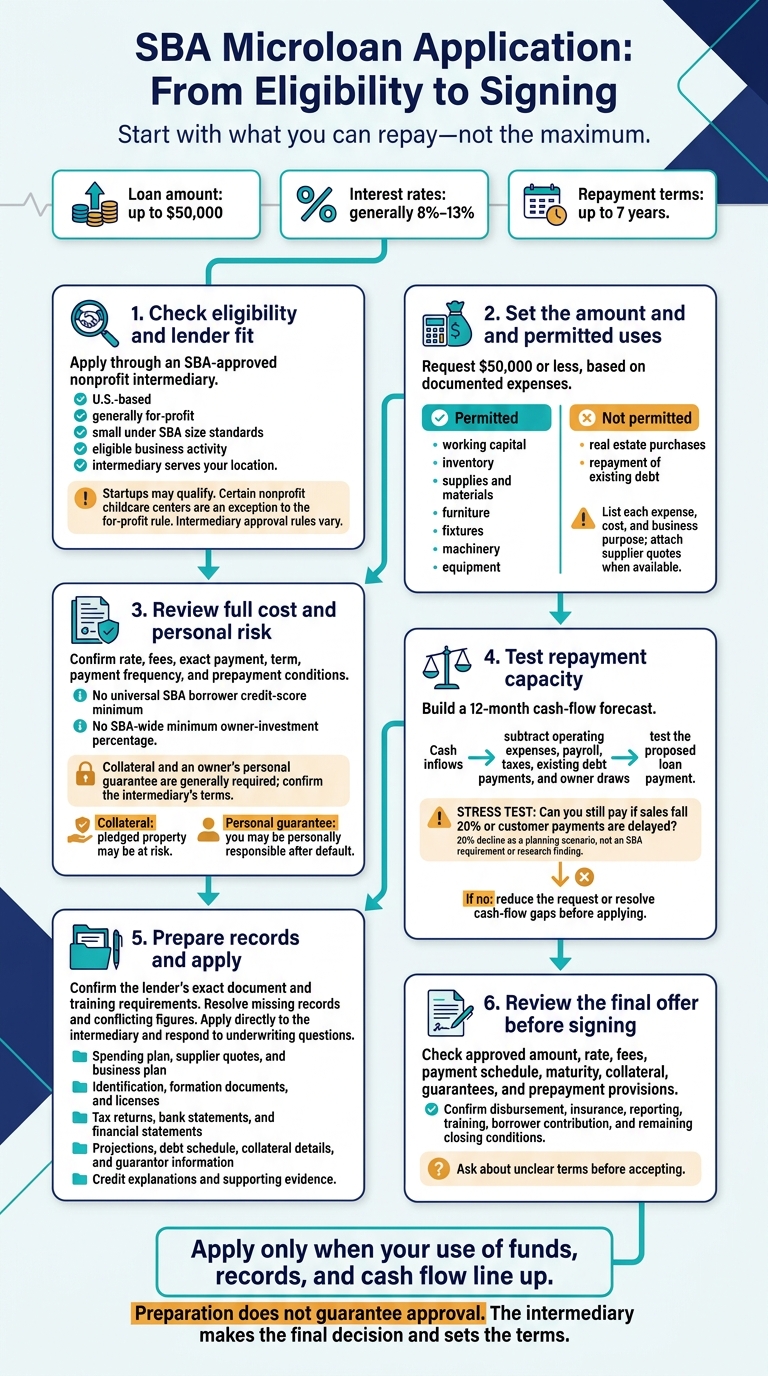
SBA Microloan Application: From Eligibility to Signing
SBA Microloans: A Complete Guide for Startups and Small Businesses
sbb-itb-1eb586e
SBA Microloan Limits, Uses, and Eligibility
SBA microloans are issued through nonprofit intermediary lenders. These lenders underwrite the loan and may offer training or technical assistance. Some require borrowers to take part in that assistance. Before applying, check what the funds can cover and whether your business qualifies.
What You Can Finance With Up to $50,000
You can use the funds for working capital, inventory, supplies and materials, furniture, fixtures, machinery, and equipment. Create a use-of-proceeds budget that lists each expense, its cost, and its business purpose. Include supplier quotes to support purchases.
You can’t use the loan to buy real estate or repay existing debt. The lender determines your final loan amount.
Which Businesses May Qualify
Once you’ve checked your planned expenses, review the business requirements.
Your business generally must be U.S.-based, for-profit, small under SBA size standards, and engaged in an eligible activity. Certain nonprofit childcare centers can qualify as an exception to the for-profit rule. Other nonprofits shouldn’t assume they’re eligible. Also, confirm that the intermediary serves your location and accepts your business activity.
Startups – including businesses that haven’t opened yet – can qualify, but they need a repayment plan. Back yours with a startup budget, market assumptions, projected sales, monthly expenses, and a monthly cash-flow forecast. Even without revenue, you must show how you’ll repay the loan.
Check Your Eligibility Before Gathering Documents
Check for issues that could rule out your business before spending time gathering documents. Mark each item yes or no:
- Is the business operating or preparing to operate in the U.S.?
- Does it meet SBA size standards and organizational requirements?
- Is its business activity eligible?
- Is the request $50,000 or less?
- Are all proposed uses permitted, with no real-estate purchases or existing-debt repayment?
- Can current cash flow or documented projections cover the payments?
- Does the intermediary serve the business’s location?
Resolve any “no” or uncertain answer before moving forward. This check helps you assess whether the loan fits your business and what you can afford to repay. The lender will still review repayment ability, credit, collateral, and guarantee requirements.
Review Credit Requirements and Loan Costs
Once you’ve confirmed eligibility, the next step is to show you can repay the loan and provide any required security.
Credit, Collateral, and Personal Guarantees
Intermediary lenders set their own underwriting standards. Get the lender’s requirements in writing before you apply.
| Factor | Program-wide guidance | What to confirm with the intermediary |
|---|---|---|
| Credit score | No universal SBA borrower credit-score minimum. | Minimum personal or business score, plus how the lender treats limited credit history, delinquencies, or bankruptcy. |
| Collateral | Some form of collateral is generally required. | Accepted assets, required value, and whether the lender places liens on business or personal property. |
| Personal guarantee | An owner’s personal guarantee is generally required. | Which owners must sign and whether the guarantee is full or capped. |
| Owner investment | No SBA-wide minimum owner-investment percentage applies. | Whether a cash injection is required and what counts toward it. |
| Credit history | Weak or limited credit may require supporting documents. | Which documents or alternative records meet underwriting requirements. |
Collateral gives the lender rights to property you pledge. A personal guarantee can make you personally responsible if the business defaults. Before signing, review the promissory note, security agreement, guarantee, fee schedule, and amortization schedule.
Next, check the loan’s full cost – not just its interest rate.
Interest, Fees, and Repayment Terms
SBA microloan interest rates generally range from 8% to 13%, with repayment terms of up to 7 years.
| Loan-cost item | What to confirm before signing |
|---|---|
| Loan amount | How much you’ll receive and whether fees will be deducted from the proceeds. |
| Interest rate | Whether the rate is fixed and whether interest is calculated on the original balance or declining principal. |
| Fees | Packaging, closing, filing, recording, servicing, late-payment, and returned-payment fees. |
| Monthly payment | The exact principal-and-interest payment and a full amortization schedule. |
| Term | The number of months and final maturity date. |
| Payment frequency | Whether payments are monthly, biweekly, or more frequent. |
| Collateral | Every pledged business or personal asset, lien priority, release conditions, and valuation method. |
| Personal guarantee | Which owners must sign and which personal assets could be at risk after default. |
| Prepayment | Any prepayment penalty, minimum interest charge, or other condition for paying off the loan early. |
Use the full cost to compare loans. Then check whether the payments fit your cash flow.
Show How You Will Repay the Loan
Build a 12-month cash-flow forecast backed by sales records, bank statements, invoices or contracts, and a schedule of existing debts. Subtract operating expenses, payroll, taxes, existing debt payments, and owner draws before testing whether you can afford the proposed payment.
Include a downside forecast showing a 20% sales decline or delayed customer payments. Industry experience and owner investment help, but cash flow still matters most.
Explain credit problems plainly: what happened, when it happened, the financial impact, and what has changed. Attach payment histories, proof that accounts are current, or bank statements showing stronger cash reserves. If your credit history is limited, ask which alternative records the lender accepts. Evidence that you’ve addressed the problem carries more weight than a promise that sales will rise.
Prepare and Submit Your Microloan Application
Once you’ve checked eligibility, costs, and your ability to repay, put together an application package that’s ready for the lender to review.
Gather Documents and Prepare Your Business Plan
Set your loan request before filling out forms. Specify the exact amount, list each expense, and attach supplier quotes when available. Your business plan should connect each purchase to your pricing, costs, capacity, break-even point, and repayment sources. Include the owners’ relevant experience and identify who will handle daily operations and finances.
Gather records that support ownership, eligibility, collateral, and your ability to repay. These include identification, formation documents, licenses, personal and business tax returns, personal financial statements, bank statements, balance sheets, income statements, and projections. If requested, include recent pay stubs for owners or guarantors.
You’ll also need leases, contracts, an existing debt schedule, and asset or collateral lists. Ask the intermediary which tax years and statement periods it requires. Use one master spreadsheet and a labeled document folder to keep funding totals and financial figures consistent across the package.
Complete Your Pre-Application Checklist
- [ ] Exact amount: Your request matches the supporting records.
- [ ] Permitted uses: Every expense qualifies.
- [ ] Estimated payment: Your cash-flow forecast includes the lender’s quoted payment.
- [ ] Credit review: You’ve checked credit reports, flagged errors, and documented issues.
- [ ] Complete records: Required documents, collateral details, and potential guarantor information are ready.
- [ ] Realistic projections: Revenue and expenses reflect current operations and the loan payment.
- [ ] Explained gaps: You have written explanations for missing records, losses, unusual deposits, tax issues, and conflicting figures.
Follow the lender’s exact checklist before submitting. Address missing documents and conflicting figures. If your startup doesn’t yet have certain records, ask the intermediary how to proceed. The intermediary lender controls final approval and loan terms.
Confirm Lender Requirements and Apply
Use the SBA’s intermediary-lender resources to find an SBA-approved intermediary that serves your area. Confirm whether your business type and startup qualify, along with credit standards, collateral and personal-guarantee requirements, required documents, fees, and any required training or technical assistance. Ask when processing starts and what could delay funding. Requirements and timelines differ by lender.
Compare your draft application with the lender’s requirements and fix any mismatches before submitting. Apply directly to the intermediary with complete forms and accurate records, then respond promptly to underwriting questions. Keep copies of every revised document, and notify the lender before changing how you’ll use the funds.
Before signing, check the final offer against your request. Review the approved amount, rate, fees, payment schedule, maturity, collateral, personal-guarantee obligations, and prepayment provisions. Confirm disbursement arrangements, insurance, reporting duties, training, any borrower contribution, and all remaining closing conditions. Ask the lender to explain unclear terms before you accept.
Conclusion: Apply When Your Business Is Ready
Give your request one last review before submitting. Apply only when your use of funds, records, and cash flow line up. Check your eligibility, the intermediary’s requirements, and what you could lose through your collateral and personal guarantee.
Test whether you could still make payments if sales dropped or expenses increased. If you couldn’t, reduce the amount you’re requesting. Don’t submit until the numbers work.
Use the readiness checklist to address any gaps before applying. Preparation doesn’t guarantee approval. The SBA-approved intermediary makes the final decision and sets the terms.
FAQs
How much cash cushion should I keep for loan payments?
There’s no set dollar amount or percentage required for a cash cushion. Lenders use your 12-month cash flow projections to assess whether you can afford the loan.
Create a month-by-month forecast using cautious estimates for revenue, operating costs, and the new loan payment. Lenders look for a debt-service coverage ratio of 1.15x to 1.25x. Your forecast should show that you can repay the loan without stretching your business too thin.
What happens if I miss a microloan payment?
SBA microloans come from nonprofit intermediary lenders, so the consequences of a missed payment depend on your lender’s policies. If your business can’t repay the loan, a personal guarantee may put your personal assets – including real estate or vehicles – at risk.
Contact your lender if you expect trouble making payments. Before you apply, keep in mind that lenders focus on cash flow to judge whether your business can cover the monthly payments.
Can I reapply if my microloan application is denied?
Yes, you may be able to reapply. Intermediary lenders manage SBA microloans, and each sets its own criteria and policies. If your application was denied, find out why and address the issue before applying again. That could mean fixing weak cash flow, submitting missing documents, or changing an ineligible use of funds.
You may also strengthen your next application by improving your credit, offering collateral, adding a co-signer, or providing clearer financial projections.
Leave a Reply