
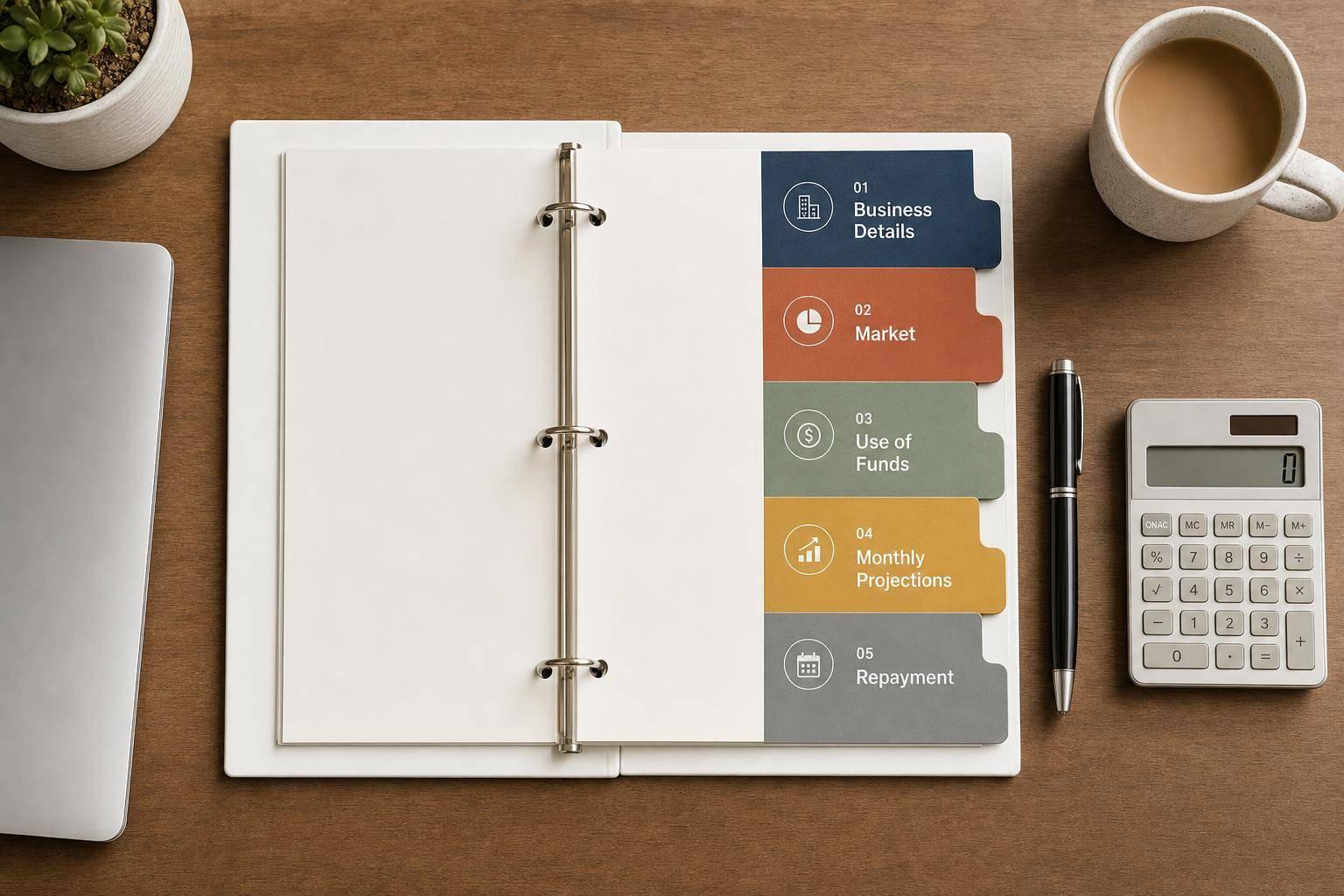
If I want an SBA microloan approved, my business plan needs to answer five simple questions fast: what my business does, who will buy, how I’ll use the money, what the numbers look like, and how I’ll repay the loan.
The SBA Microloan Program can offer up to $50,000, and loan terms often go up to 6 years. That means lenders want a plan that is plain, specific, and tied to cash flow. A vague idea is not enough. I need to show an exact loan amount, allowed uses of funds, monthly projections, and a clear payback plan.
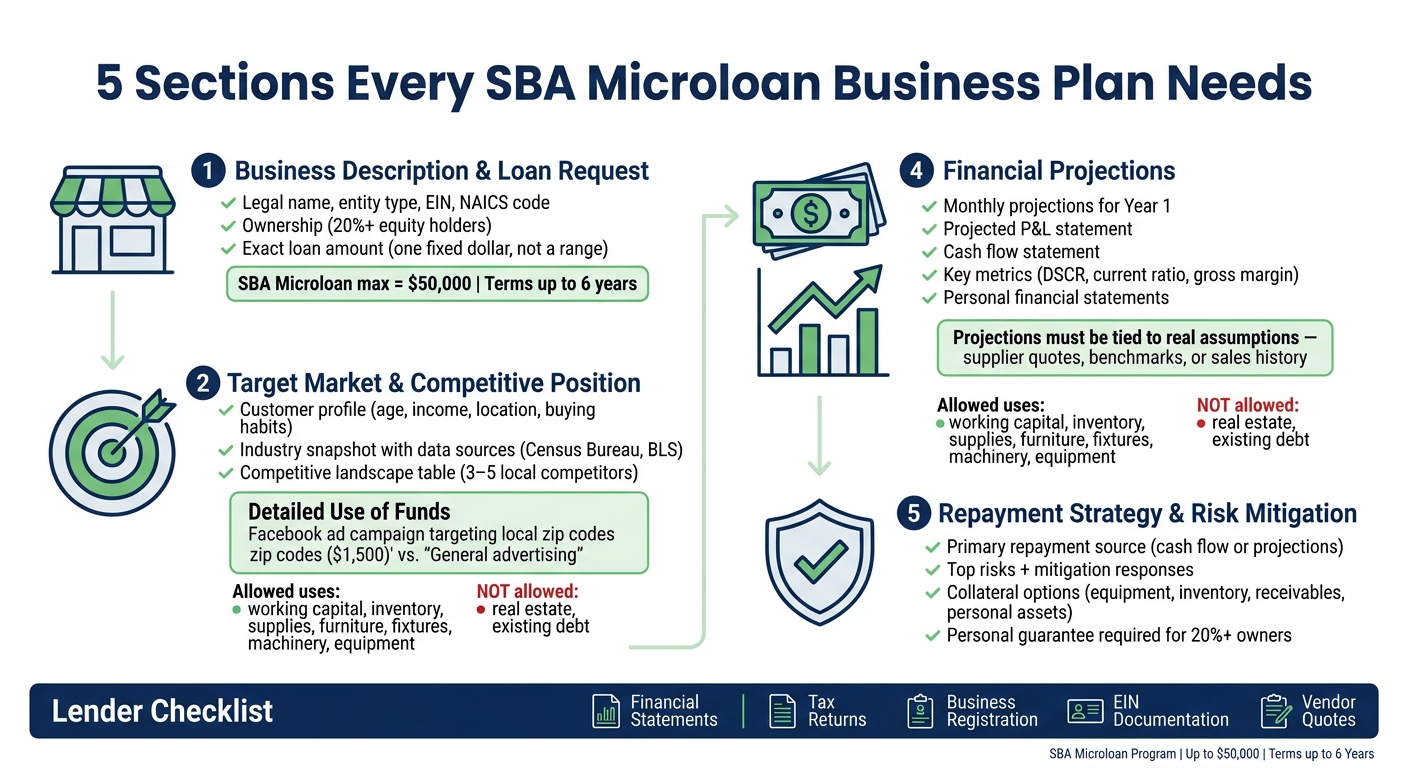
Here’s the full checklist at a glance:
- Business description and loan request: legal setup, owners, what I sell, and one exact funding amount
- Target market and competition: who I serve, local demand, and why customers would choose me
- Use of funds: line-by-line spending for items like equipment, inventory, supplies, or working capital
- Financial projections: monthly sales, expenses, profit and loss, and cash flow
- Repayment and risk plan: how the loan gets paid back, what could go wrong, and what I’d do about it
| Section | What lenders want to see | Why it matters |
|---|---|---|
| Business + loan request | Exact business details and funding ask | Shows what I do and what I need |
| Market + competition | Customer demand and local rivals | Shows sales can happen |
| Use of funds | Itemized spending plan | Shows where each dollar goes |
| Financial projections | Monthly numbers for Year 1 | Shows if cash flow can cover payments |
| Repayment + risk | Payback source, backup plan, collateral | Shows how the lender gets repaid |
Bottom line: if my plan is clear, supported by data, and easy to check, I give the lender fewer reasons to hesitate.
5 Sections Every SBA Microloan Business Plan Needs
How to Write an SBA-Ready Business Plan in 1 Day (Guide included)
sbb-itb-1eb586e
What SBA Microloan Lenders Look For Before Approving a Loan
Each intermediary lender has its own underwriting process, but most review the same core areas before they move an application ahead.
At the top of the list is your ability to repay. Lenders want to see that your business can bring in enough cash flow to cover the monthly loan payment. If you’re a startup, that usually means detailed projections built on realistic assumptions. If your business is already up and running, it means showing actual results and recent cash flow. Clear math and specific assumptions go a long way here.
Lenders also look at business clarity, market demand, eligible use of proceeds, and risk controls. In plain English, your plan should explain what the business does, how it makes money, who the customers are, and how the loan will be used for allowed costs like inventory, equipment, fixtures, supplies, or working capital. Those priorities line up with the five sections below.
They also pay close attention to the owner’s experience, training, and readiness to run the business, especially for startups or borrowers with a limited credit history. Before any of that can land well, though, lenders first need a clear business description and loan request.
1. Clear Business Description and Loan Request
Use this section to explain who your business is, where it operates, and how it brings in money. If this part feels vague, the rest of the plan gets shaky fast.
Start with the basics. Include your legal name, DBA, business address, entity type, state of formation, EIN, and NAICS code. Also note whether the business is home-based, mobile, online-only, or a storefront. Lenders use these details to confirm the business and see how it’s set up.
Then cover ownership and management. List every owner with 20% or more equity, along with their ownership percentage, role, and related experience. If one owner runs day-to-day operations, say that plainly. For startups, lenders also want to see proof that the market is there, any licenses or permits already in hand, and experience that fits the business.
Next, explain what you sell and how you get paid. Keep it simple and specific. Spell out your main products or services, your usual customer, your pricing, and your sales channel. For example:
We provide on-site wash and detailing services to individual vehicle owners and small business fleets in Hillsborough County, FL. Average residential ticket: $95. Monthly fleet contracts average $450 per client.
Be clear about the stage of the business. Say whether it’s a startup, early-stage, or established company, and make sure the rest of the section lines up with that. A startup should point to the planned opening date and show it’s ready to launch. An existing business should mention how long it has been operating and any growth milestones.
Finish with your exact loan request. Use one fixed dollar amount, not a range, and show how the money will be used. Here’s a clean example:
| Use of Funds | Amount |
|---|---|
| Commercial espresso machine and refrigeration | $15,000 |
| Initial coffee, milk, and food inventory | $8,500 |
| Working capital (payroll and utilities, first 3 months) | $5,000 |
| Total SBA Microloan Request | $28,500 |
Keep the request within program limits and tie it to a clear business need. When the number is exact and the uses are spelled out, lenders can see where the money is going without having to guess.
Once the business and funding request are clear, the next step is showing who will buy and why your business can win them.
2. Target Market and Competitive Position
You need to show three things here: demand is there, you know who you’re selling to, and customers have a clear reason to pick you.
Keep this section focused on three parts: customer profile, industry snapshot, and competitive landscape.
Customer profile. Describe your main buyer in plain, specific terms. That means age range, income level, location, and buying habits. Skip vague lines like “everyone in the area.” They don’t help, and lenders know it.
A residential cleaning service, for example, might focus on dual-income households in certain suburbs with median home values above $300,000 and a willingness to spend $120–$180 per month for recurring service. Back that up with local Census or city data. Then connect the dots and show that this group is large enough to support the business.
Industry snapshot. Start with a short market overview, then narrow in on local demand drivers, nearby growth, and one or two trends shaping your sector. Use data from the U.S. Census Bureau, Bureau of Labor Statistics, or SBA Office of Advocacy. Every fact should help prove one point: your revenue projections make sense, and repayment is realistic.
After that, explain where your business fits. Not in theory. In the actual market you’re entering. Show why your offer makes more sense than what people can get now.
Competitive landscape. List three to five local direct competitors, plus any key indirect competitors if they matter. State their strengths plainly. Then explain why customers will choose you instead. Maybe it’s your location. Maybe it’s longer hours, a specialized service, or a gap no one else is filling.
This matters because lenders want proof that you can win share and keep it – not just show up.
A Competitive Landscape Table is a simple way to lay this out fast:
| Factor | Your Business | Competitor A | Competitor B |
|---|---|---|---|
| Target Customer | Specific local niche | General local market | Broad regional market |
| Price Range | Mid-range, value-focused | Premium | Discount |
| Key Strength | Specialized service + strong online presence | Established brand | Low pricing |
| Weakness | New, building reputation | Limited hours | No local presence |
| Location/Reach | High-traffic storefront | Secondary street | Online only |
Use these numbers and comparisons to support your projected revenue and expected market share.
3. Detailed Use of SBA Microloan Funds
After you show who you serve and why your business can win, spell out exactly how the loan will be used. Break down each expense, its cost, when you’ll spend the money, and what the business gets from it. Lenders want an itemized budget that works like an underwriting check. In plain English: they want to see where every dollar goes and what that spend is supposed to do.
Think of this as a budget tied straight to revenue. So instead of writing “marketing,” write “Facebook ad campaign targeting local zip codes ($1,500).” Instead of “new machinery,” write “Industrial dough mixer, Model X, per Vendor Quote #123 ($4,200).” That kind of detail tells the lender you’ve done your homework and already know the plan.
Back up your numbers when you can. Vendor quotes, supplier invoices, and even online cart screenshots can help show that your figures are based on actual pricing. If your request is built on round numbers that don’t line up with an itemized table, underwriters are more likely to slow things down.
Stick to allowed uses only, such as working capital, inventory, supplies, furniture, fixtures, machinery, and equipment. Leave out real estate and existing debt.
Use the table below to turn broad categories into lender-ready line items:
| Use of Funds Category | Vague (Likely Rejected) | Specific (Lender-Ready) |
|---|---|---|
| Marketing | "General advertising" | "Facebook ad campaign targeting local zip codes ($1,500)" |
| Equipment | "New machinery" | "Industrial dough mixer, Model X, per Vendor Quote #123 ($4,200)" |
| Working Capital | "Miscellaneous expenses" | "First 3 months of rent and utilities" |
| Inventory | "Stocking up" | "Initial 500 units of raw textile materials for Fall line ($5,000)" |
One more thing: end each line item with the business result. Every purchase should do one of three things:
- increase sales
- lower costs
- protect cash flow
Those expenses should also line up with the assumptions in your financial projections.
4. Financial Projections Built for Lender Review
Once you’ve shown where the loan money goes, the next step is showing how that spending leads to sales and repayment. That’s what lenders are looking for. They use these figures to judge whether the business can pay the loan back, so each projection should match the costs already listed in your use-of-funds plan.
For the first year, include monthly projections. That level of detail matters because lenders look at when cash comes in and goes out, not just whether the business shows a profit by year-end.
Your financial section should include:
- A projected profit and loss statement
- A cash flow statement
If you’re a startup and haven’t made a profit yet, these projections do a lot of the heavy lifting. In many cases, they’re the main proof that the business can repay the loan.
Some lenders also look at metrics like DSCR, current ratio, and gross margin. These give them another way to size up the business’s ability to handle debt.
Don’t just plug in hopeful numbers. Base your projections on supplier quotes, industry benchmarks, or your own sales history. Those same assumptions should line up with the repayment plan in the next section.
Include personal financial statements along with your business projections.
5. Repayment Strategy and Risk Mitigation
Once you’ve shown where the money will go and what it should do for sales, the next step is simple: show how the loan gets paid back. This is where you lay out your repayment plan, explain what happens if revenue comes in below target, and note any security you can offer.
Start with the repayment source. If the business is already operating, point to current cash flow. If it’s a startup, use projections that clearly cover the monthly debt payment. Either way, base your numbers on the lender’s term and rate so the monthly payment lines up with your cash flow.
Then deal with the downside head-on. Name the main risks and explain your response. If your projections miss the mark, what will you do? Keep this part brief but specific. You can also mention any lender training or mentoring that will help you run the business well and lower risk.
After that, explain what security you can offer. Most intermediaries require a personal guarantee from any owner with a 20% or greater stake in the business. List any collateral you can pledge, such as:
- Equipment
- Inventory
- Receivables
- Personal assets
If your collateral is limited, say that plainly. Then show you’re willing to work with the lender on other collateral options.
Common Mistakes That Weaken an SBA Microloan Business Plan
After looking at what lenders want, it helps to flip the page and look at what trips people up.
Even a good business idea can fall flat if the five plan sections are vague, unsupported, or don’t line up with each other. These mistakes can hurt your approval odds, and the good news is that most of them are avoidable.
A generic business description can lose a lender almost right away. Your description needs to be specific enough to show that you understand your business model, your customer, and the market you’re stepping into.
That also means backing up demand claims with facts. Use local data, competitor counts, customer demographics, foot traffic, or survey results. If the plan says people want what you’re selling, the lender should be able to see why.
The table below shows the most common plan weaknesses and why they matter:
| Mistake | Why It Hurts Your Application |
|---|---|
| Generic business description | Fails to show how the product or service solves a real problem |
| Unsupported market claims | Shows weak research on demand and competition |
| Vague use-of-funds categories | Makes it hard to connect spending to repayment |
| Unrealistic financial projections | Suggests the borrower does not understand costs |
| Missing repayment explanation | Leaves the lender unsure the business can make monthly payments |
Vague use-of-funds categories also make the logic of repayment harder to follow. If your line items are too broad, lenders can’t track where the money is going or how that spending will help the business generate enough cash to pay the loan back.
Financial projections need the same level of care. Keep them tied to clear assumptions about customers, pricing, and costs. If the numbers look disconnected from how the business will actually run, that’s a red flag.
Once you fix these weak spots, the next step is to back up the plan with documents that support the numbers. The documents below make it easier for a lender to verify your claims.
Tables and Supporting Documents That Help Your Plan
Use tables to back up your funding request, key assumptions, and risk plan. They give lenders a quick way to check the claims you made in Sections 1 through 5, which makes the review process faster and cleaner.
| Table | What to Include |
|---|---|
| Use of Funds | Itemized expenses, vendor quotes, and exact amounts |
| Competitive Landscape | Competitor names, pricing gaps, and your advantage |
| Metrics Summary | Monthly revenue, margin, and profit for the first 12 months |
| Risk & Mitigation | Top risks and backup responses |
You should also attach the core documents lenders usually want to see: financial statements, tax returns, business registration records, EIN documentation, and equipment vendor quotes.
If you’re offering collateral, include records that support it. That can mean titles, equipment lists, or receivables schedules. If any owner holds 20% or more of the business, include signed guarantee forms as well.
One smart move before you send anything in: ask for the lender’s checklist first. Microloan intermediaries often have their own submission rules, so getting that list up front can save time and cut down on back-and-forth.
Conclusion
An SBA microloan business plan should answer the lender’s main approval questions before they have to ask them.
Each section serves a clear purpose. It helps the lender decide if your business is easy to understand, has a market, can use the funds well, and is likely to repay the loan.
When those pieces line up, the review process gets simpler. The lender can look at the request with more clarity and move through it with less hesitation.
A strong plan makes the loan request easier to follow and easier to say yes to. Keep it concise, backed by data, and honest about risk. That’s what makes a microloan plan lender-ready.
FAQs
How long should an SBA microloan business plan be?
For most SBA microloan applications, a business plan should be 10 to 20 pages long.
That’s usually enough space to show lenders that you understand how your business works, how it will make money, and how you plan to run it day to day. In most cases, a clear, well-organized plan does more for you than a long document packed with extra detail.
A plan in this range gives lenders what they need to review your readiness. It can also double as a practical roadmap for your business as you get started and grow.
What documents should I attach to support my plan?
Attach a professional business plan, personal and business financial statements, and any other documents your lender asks for.
Each SBA microloan intermediary uses its own rules. So the smartest move is to ask the lender in your area for its full checklist upfront.
Common supporting documents include:
- Business registration records
- A valid EIN
- Proof of a business bank account
- Collateral documents
- A personal guarantee
Can I get approved if my business is a startup?
Yes. SBA microloans can be approved for startups because the program is built to help new businesses and early-stage founders get off the ground.
These loans come through nonprofit, community-based intermediaries, not direct SBA lending. That matters. In many cases, lenders look less at how long you’ve been in business and more at whether your idea makes sense, your numbers add up, and your business plan is well prepared.
So even if you don’t have years of operating history or flawless credit, you may still have a shot if you can show that your business is viable and that you’ve thought through how the loan will be used.
Leave a Reply