
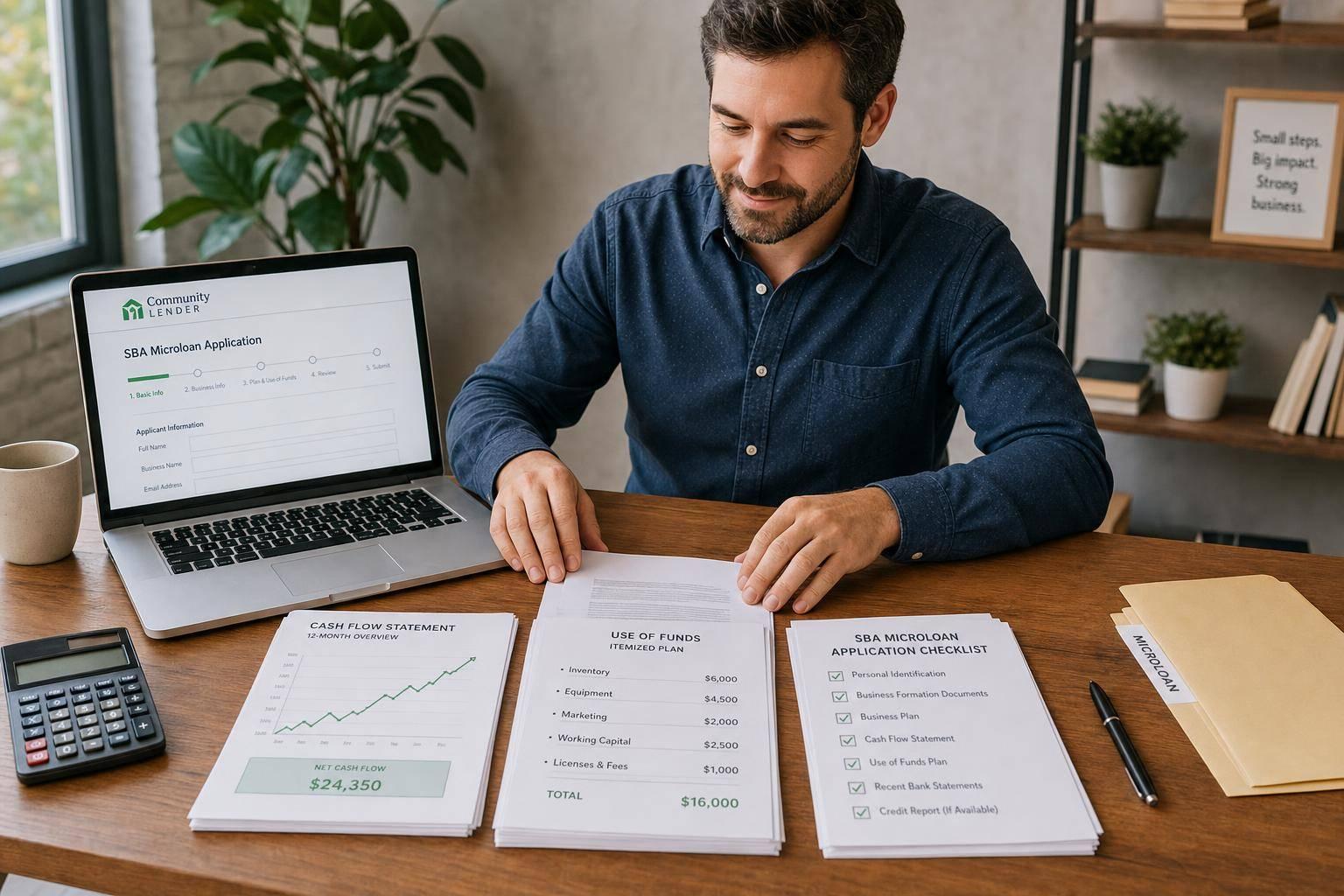
Yes, you can still get an SBA microloan with bad credit. If I were applying today, I’d focus on cash flow, paperwork, and a clear use-of-funds plan first, because those are often what microlenders weigh along with credit.
Here’s the short version:
- SBA microloans go up to $50,000
- Repayment terms can run up to 6 years
- You can use the money for working capital, inventory, supplies, equipment, furniture, and fixtures
- You cannot use it for real estate or debt refinance
- Approval usually depends on the microlender, not the SBA directly
- A weak score can still work if I show:
- steady revenue
- enough cash flow for payments
- a clear business plan
- an itemized loan purpose
- collateral, owner cash in the business, or a co-signer if needed
Before I apply, I’d make sure I can answer these questions in plain English:
- Is my business eligible under SBA rules?
- Are my credit reports correct?
- Can I show that monthly income covers the new loan payment?
- Do my bank statements, tax returns, and projections match?
- Can I explain past credit problems in 1–2 pages with proof?
- Am I applying to an SBA-approved microlender that works with lower scores?
A lot of bad-credit applications get turned down for the same reasons: weak cash flow, missing documents, unpaid collections, mixed-up numbers, vague use of funds, or low owner investment. So if I wanted to improve my odds, I’d fix those first.
One number matters a lot: aim for a DSCR of at least 1.15. In simple terms, that means the business should bring in more than enough cash to cover debt payments.
SBA Business Plan Q&A: Bad Credit, Realistic Projections & Competitor Mistakes
sbb-itb-1eb586e
Quick comparison
| What helps | What hurts |
|---|---|
| Clear monthly cash flow | No cash-flow statement |
| Itemized use of funds | Vague request for “working capital” |
| Current bank statements and tax returns | Missing or conflicting records |
| Short written credit explanation | Ignoring past credit problems |
| Collateral, co-signer, or owner cash in | No backup strength beyond credit score |
If I had to sum up the whole process in one line, it would be this: bad credit does not end the process, but weak numbers and weak paperwork often do.
Check Eligibility and Know What Microlenders Review
Basic SBA Microloan Eligibility for Startups and Small Businesses
Bad credit isn’t the first hurdle. If the business doesn’t meet basic SBA rules, the application usually stops there.
The SBA Microloan Program is generally open to for-profit small businesses in the United States that meet SBA size standards. A small group of nonprofit childcare centers can also qualify.
Your business also needs to be active and operating. In plain English, that means a working business, not a passive investment. SBA rules do not allow certain business types, including speculative real estate ventures, passive investment activities, and illegal activities.
You also need to show two things:
- The business can repay the loan
- Similar financing isn’t available elsewhere on reasonable terms
Before you apply, clear up any delinquent federal debt, unresolved federal tax liens or judgments, and any prior government loss. If you have a defaulted SBA loan or a federal student loan that is 90+ days past due, you’ll usually need to fix that first. It’s smart to pull your credit reports and federal loan history early. That gives you a chance to catch problems before a microlender finds them.
Startups are not shut out. Even with little or no operating history, you may still be considered if you bring a solid business plan, show owner commitment, and explain a realistic path to repayment.
Once you’ve cleared basic eligibility, the next job is proving the business can handle the debt.
What Lenders Look at Beyond Your Credit Score
Intermediary microlenders, often CDFIs, make their own approval decisions based on their own standards.
Here are the main things they review:
| Underwriting Factor | What Lenders Want to See |
|---|---|
| Cash flow | Monthly revenue that covers loan payments |
| Business plan quality | Clear market, pricing, costs, and projections |
| Collateral | Business assets such as equipment, inventory, or receivables |
| Personal guarantee | Owner’s personal guarantee |
| Owner investment | Personal money already invested |
| Industry experience | Relevant work history that supports the business’s chance of success |
Many microlenders will still look at borrowers with fair or damaged credit if the rest of the file is strong. That’s where the bigger picture matters. Steady bank deposits, revenue that is moving in the right direction, and a co-signer or collateral can help lower the lender’s sense of risk.
This is why paperwork matters so much. A messy file makes a hard case harder. A clean file gives the lender something concrete to work with.
How SBA50K Fits Into the Application Process

SBA50K helps borrowers get their documents, business plan, and projections into the shape microlenders expect.
It gives you document checklists, so you know what to gather before you contact a microlender. It also helps turn rough ideas into a clear business plan with realistic cash-flow projections that match what intermediary lenders want to review.
For borrowers with bad credit, organized documents and realistic projections can make the application much stronger.
Build a Strong Application Package Before You Apply
Once you know what microlenders look at, the next step is simple: pull together the proof that your business can pay the loan back.
A complete application file helps a microlender judge repayment risk based on the full picture, not only your credit score. If you have bad credit, being organized can make a big difference. Your package should show what balances out that credit history, like cash flow, collateral, experience, or a co-signer.
Documents to Collect Before Talking to a Microlender
Gather the records that show your business is real, organized, and able to repay:
- Personal ID (driver’s license or passport)
- Business formation documents (articles of incorporation/organization, DBA filing, or partnership agreement)
- Ownership records for anyone with 20% or more ownership
- Business licenses and permits
- Recent business bank statements (typically the last 3–6 months; some lenders ask for 12 months)
- Personal tax returns (usually the last 2 years)
- Business tax returns, if the business is already operating (usually the last 2 years)
- Profit and loss statement
- Balance sheet
- Debt schedule listing every business and personal debt, balance, monthly payment, and interest rate
- Asset list with estimated values in U.S. dollars
- Business plan and use-of-funds explanation, with first-year projections broken down monthly or quarterly and tied to the funding request
- Resume, collateral documentation, or written explanations of past judgments or bankruptcies when relevant
Once the file is complete, check the numbers behind it. This is where many applications either hold together or fall apart.
Credit Reports, Cash-Flow Statements, and Projections to Prepare First
Start with your personal credit reports from Equifax, Experian, and TransUnion. Look for paid collections that still show as unpaid, late payments that are wrong, and accounts that don’t belong to you. If your business has trade lines or vendor accounts, pull a business credit report from Dun & Bradstreet or Experian Business too. If you spot errors, dispute them with backup like payoff letters, bank statements, or written confirmations, and keep following up until the fixes are confirmed.
After that, build a simple monthly cash-flow statement in a spreadsheet or table. It doesn’t need to be fancy. It just needs to be clear. For example, if your business brings in $6,500 per month and spends $4,200, that leaves $2,300 before any new loan payment. That’s the number a lender cares about, because it shows how much room you have for repayment.
Then build a 12- to 24-month projection. If you’re a startup, the first 12 months should be the most detailed. Spell out your assumptions in plain English. For example:
Marketing is expected to add $500 in revenue starting in Month 4.
One check people often miss: make sure the numbers match across your projections, bank statements, tax returns, and business plan. If one document says one thing and another says something else, the lender may stop the process or deny the file. Mismatches are a common reason applications stall.
Weak Application vs. Strong Application: Side-by-Side Comparison
The gap between approval and denial often comes down to how strong the package is.
| Area | Weak Application | Strong Application |
|---|---|---|
| Documentation completeness | Missing tax returns, incomplete bank statements, no asset list | All required documents included, labeled, and current |
| Cash-flow clarity | No cash-flow statement; personal and business expenses mixed together | Monthly statement showing $6,500 revenue, $4,200 expenses, $2,300 available; 12–24 month projections with first-year monthly or quarterly detail and written assumptions |
| Credit explanation | Credit issues ignored or left unexplained | Explain the cause, the fix, and why it won’t repeat |
| Use of funds | Vague request for "working capital" | Itemized breakdown of equipment, inventory, or marketing costs with price quotes where possible |
| Compensating strengths | No collateral listed; no mention of experience or revenue trends | Asset list with values, industry experience summary, revenue trend showing growth from $4,000/month to $7,000/month |
| Repayment case | Unclear | Documented |
A strong file moves the focus away from past credit problems and toward your current ability to repay. That matters most when your credit history is weak.
Step-by-Step: How to Apply and Address Bad Credit Directly
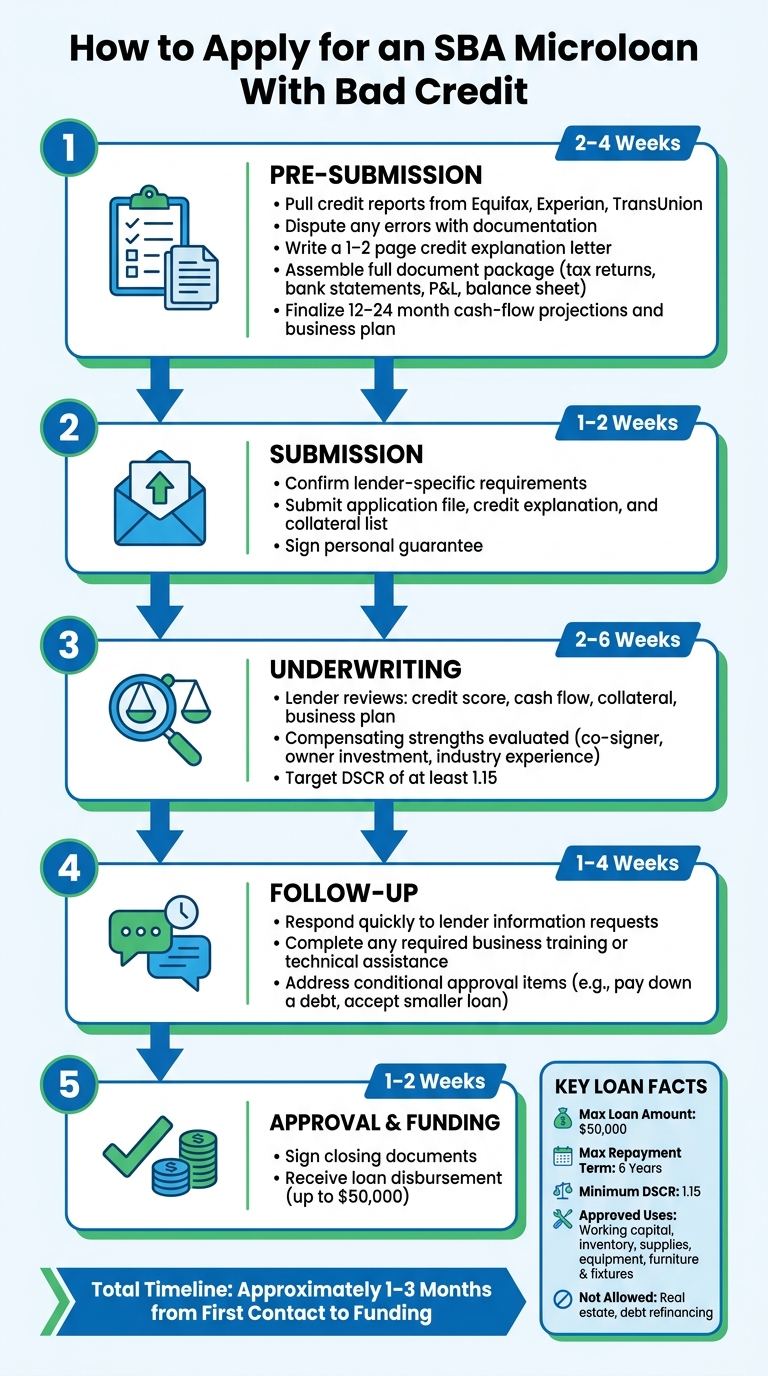
How to Apply for an SBA Microloan With Bad Credit: Step-by-Step
Once your paperwork is in order and you’ve checked your numbers, it’s time to move through the application. The goal is simple: take that package and aim it at lenders that match your credit profile.
Find an SBA-Approved Microlender and Confirm Their Requirements
Apply only through an SBA-approved intermediary lender. Each one sets its own rules for credit, collateral, and documents.
To find lenders near you, start with the SBA’s Microloans program page, your local SBA district office, or the SBA’s Lender Match tool. After that, narrow your list to two or three options and contact each one directly.
Ask a direct question: What exceptions do you make for lower scores? Some lenders will look past a lower score if cash flow, collateral, or industry experience helps balance the risk. That’s why it makes sense to apply only where you fit.
Write a Short Credit Explanation and Show Your Strengths
Your credit explanation doesn’t need to drag on. One to two pages is enough.
For each major negative item on your report, explain what happened, why it was temporary, and what changed after that. Stay factual. Stay forward-looking.
For example: "Several payments were 60 days late in 2022 due to a temporary job loss; all accounts have been current for 12 months, and the collection dropped from $5,000 to $500." That kind of clear, documented statement gives a lender something they can actually use. A vague apology doesn’t.
Then shift to what works in your favor. Point to your month-by-month revenue trend, cash reserves, collateral, and industry experience. If your credit score is very low, a co-signer with stronger credit and stable income may improve the risk picture if the lender allows it.
Application Process Table: Pre-Submission, Submission, and Follow-Up
The table below lays out the full process, who handles each step, and the rough timing. Approval timelines usually run one to three months from first contact to funding.
| Stage | Main Tasks | Typical Timing | Who’s Responsible |
|---|---|---|---|
| Pre-Submission | Pull credit reports; correct errors; write credit explanation; assemble full document package; finalize cash-flow projections and business plan | 2–4 weeks | Borrower / SBA50K Support |
| Submission | Confirm lender requirements; submit application file, credit explanation, and collateral list; sign personal guarantee | 1–2 weeks | Borrower / Intermediary |
| Underwriting | Lender reviews credit, cash flow, collateral, and business plan; underwriting weighs compensating strengths for bad-credit files | 2–6 weeks | Intermediary Lender |
| Follow-Up | Respond quickly to requests and complete required training or conditions | 1–4 weeks | Borrower |
| Approval & Funding | Sign closing documents; receive disbursement | 1–2 weeks | Intermediary Lender |
One detail matters here: SBA microloan intermediaries are often required to provide business training and technical assistance along with the loan. Taking part in that support shows the lender you’re serious, and it can help tighten up your business before the first payment comes due.
If the lender gives you a conditional approval – maybe they want you to pay down a certain debt or accept a smaller first loan – take that as a good sign, not bad news. It means the door is still open. And if the lender still hesitates, the next move is to find the exact weak spot and fix it.
Common Denial Reasons and How to Improve Your Approval Odds
Why SBA Microloan Applications Get Denied
When an application gets denied, it usually comes down to a small set of repeat issues. The most common ones are weak cash flow, missing or conflicting documents, unrealistic projections, an unclear or ineligible use of funds, unresolved credit problems, low owner investment, and limited experience.
Paperwork problems can stop underwriting fast. Missing tax returns, bank statements, licenses, or a business plan can stall the file. So can mismatches between records. If your numbers don’t line up across documents, lenders tend to hit the brakes.
Credit issues can also hurt your odds. Recent charge-offs, unpaid collections, or a pattern of late payments suggest a higher risk of missed repayment. Lenders look at those items alongside cash flow, collateral, and experience when they size up your application.
Credit Problems and How to Address Them: A Quick-Reference Table
Start with the issue a lender will notice first. Then fix it and bring proof.
| Credit Problem | Practical Steps | Evidence to Provide |
|---|---|---|
| Low credit score | Dispute errors, set up automatic payments, and show recent on-time payments | Updated credit report; payment confirmation statements |
| Old collections | Settle the account or set up a payment plan, then document progress | Settlement letters; payment receipts |
| Recent late payments | Write a brief explanation, show what changed, and prove the accounts are current | Explanation letter; current account statements |
| Thin credit history | Open a secured credit card, use reporting vendor accounts, and use strong cash flow to offset thin credit | Business bank statements; vendor account records |
| No collateral | List equipment, inventory, or receivables; add a co-signer if needed | Asset list; co-signer financial documents; signed customer contracts |
| Unclear use of funds | Create a one-page itemized budget tied to specific business results | Use-of-funds summary integrated into your business plan |
Conclusion: How to Put Together a Lender-Ready Microloan Application
Use the table above to fix the weakest part of your file before you submit. That one move can make your application look a lot stronger.
Aim for a DSCR of at least 1.15. Keep any credit explanation short, factual, and backed by documents. It also helps to show offsetting strengths, like collateral, owner investment, or industry experience, so microlenders see a balanced file.
SBA50K helps organize your documents, projections, and credit explanation into a lender-ready microloan package.
FAQs
What credit score do most SBA microlenders want?
SBA microlenders don’t use one fixed minimum credit score. Each nonprofit intermediary lender makes its own rules.
That means approval can vary quite a bit from one lender to the next. Many borrowers get approved with credit scores from 550 to 675, and some qualify with scores as low as 525.
Your score matters, but it’s usually not the only thing a lender looks at. Most SBA microlenders review your full financial picture, including things like:
- Your business experience
- Revenue trends
- Your overall finances
So if your credit score isn’t perfect, that doesn’t automatically put you out of the running.
Can I get approved as a startup with no revenue yet?
Yes. A startup with no revenue can still get approved for an SBA microloan.
What matters most is your ability to show that the business has a solid path forward. Lenders usually look at your potential, not just your current income. That means they’ll want to see an SBA-compliant business plan, realistic financial projections, and a clear explanation of how the business will bring in cash later on.
They may also weigh other strengths, such as:
- A clear use of funds
- Personal investment in the business
- A co-signer
How long does SBA microloan funding usually take?
SBA microloan funding usually takes one to three months.
In some cases, funding can happen in 30 days or less. But the full approval and disbursement process often takes longer. That’s because intermediary lenders tend to do a thorough review, which may also include business counseling and technical assistance.
Leave a Reply