
Before applying for an SBA microloan of up to $50,000, I’d confirm that the lender serves your business address – not just your state. Nonprofit intermediaries issue these loans, and <u>service-area coverage does not guarantee approval</u>.
Here’s the check I’d use before preparing a full application:
- Verify the location: Confirm your physical business address and county using official records. Keep mailing and registered-agent addresses separate.
- Check the lender: Use the SBA microlender directory, then ask the intermediary to confirm coverage for your exact address and business type.
- Clarify startup rules: If your site is planned, home-based, mobile, or not yet leased, ask which address counts and what proof is needed.
- Prepare for contact: Gather available location proof, a brief business description, and a loan summary. Send sensitive records only when requested through a verified, secure method.
- Save the answer: Get coverage confirmation in writing, resolve address conflicts, and recheck if you move. If the lender says no, check another intermediary.
I’d confirm coverage first, then organize the application materials the lender requests. Application help can support that work, but it cannot decide eligibility or promise funding.
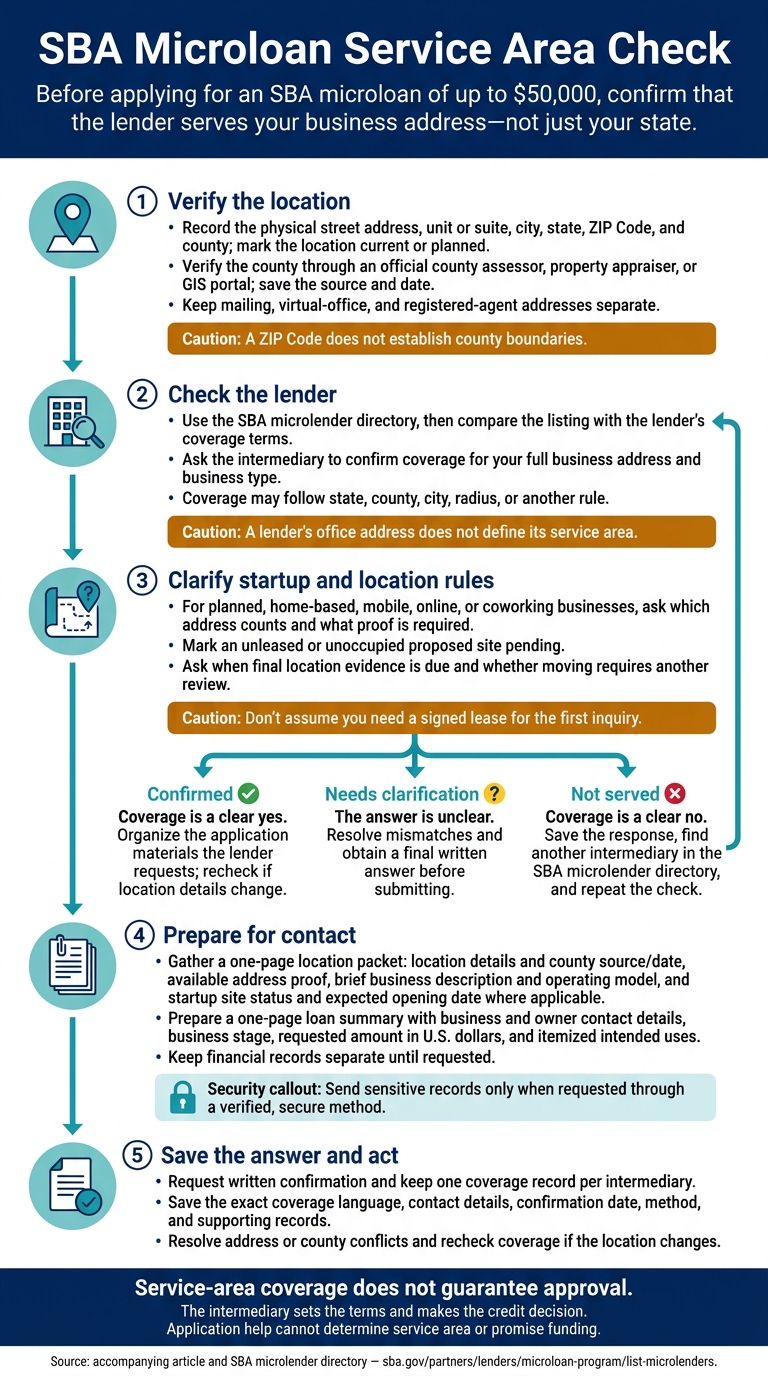
SBA Microloan Service Area Check
Step 1: Verify Your Business Address and County
☐ Fill in your location record with the street number, street name, unit or suite, city, state, ZIP Code, and county. Mark it as current or planned. Keep mailing, virtual-office, and registered-agent addresses separate from your physical business location.
Check Address Records and County Boundaries
☐ Look up the exact street address in an official county assessor, property appraiser, or GIS portal. A ZIP Code does not establish county boundaries. Postal areas can cross county lines. Save a PDF or screenshot of the record, including the source and the date you checked it.
If the city and county records conflict, keep both entries as recorded. Save the parcel ID if one is available, and ask the county office to resolve the mismatch. Don’t change the address to fit a lender’s service area.
☐ Support the physical address and date with a lease, utility bill, certificate of occupancy, zoning approval, or property-tax record. Make sure the document shows the business, unless it requires the owner’s name. A registered-agent record alone does not prove where the business operates.
Determine Which Business Location Counts
☐ Confirm which physical location determines service-area eligibility. If you run a home-based, mobile, online, or delivery business, ask the lender which address and county it will use. Customer addresses do not count.
In the next step, use your verified address and county to check each lender’s service area and startup rules compared to traditional bank options.
sbb-itb-1eb586e
Step 2: Check Lender Coverage and Startup Rules
Use your verified address and county to find lenders that serve your location.
Check the SBA microlender list for your state or territory. Save each lender’s name, service area, website, phone number, and email.
Confirm State and Local Coverage
Compare the directory entry with the lender’s own coverage terms. Check that both your location and business type qualify, and save the exact coverage language. Ask the intermediary to confirm coverage for your full business address. Find out whether it serves the entire state, specific counties or cities, a set radius, or an area defined by another rule.
Coverage warning: A lender’s office address does not define its service area. Even a statewide listing needs verification for your exact location. If the directory and lender website disagree, save both descriptions and the date you checked them. Request written clarification for your exact location and business type, including any planned move.
Check rules for a planned startup location
Mark a proposed site as pending if you haven’t leased or occupied it. If you haven’t chosen a site, ask which location details the lender needs for preliminary screening.
Confirm what proof of location you must provide and when it’s due. Also ask whether a move during underwriting or after approval requires another review. Before applying, make sure your business plan, lease or letter of intent, permits, licenses, and use-of-funds description match the intermediary’s location requirements.
Record Your Coverage Check
Start one record per intermediary before your first lender contact, then update it as you get answers. Save supporting emails, screenshots, and call notes. Mark the status confirmed for a clear yes, needs clarification for an unclear answer, or not served for a clear no. After a phone call, request email confirmation to keep a written record.
| Field | Recorded information |
|---|---|
| Street address | |
| City | |
| State | |
| ZIP Code | |
| County | |
| County-verification source | |
| Lender | |
| Exact coverage language | |
| Contact | |
| Confirmation date | |
| Method | |
| Status: confirmed, needs clarification, or not served |
Step 3: Prepare for Your First Lender Inquiry
Once you confirm coverage, gather only what you need for the first lender contact.
☐ Put together a one-page location packet. Keep financial records separate until the lender requests them.
Separate Location Proof From Application Records
Use the checklist below to sort first-contact documents from records needed later. Don’t assume you need a signed lease for the first inquiry. Ask which location documents the lender accepts and when final site evidence is due.
| Document or information | Purpose | Timing | Readiness |
|---|---|---|---|
| Street address or planned opening address, city, state, ZIP Code, county, and county source/date | Identify the location to check | Before first contact | ☐ Ready |
| Available utility bill, business license, registration showing the physical business address, landlord letter, or draft lease | Support the address | Initial inquiry, if available | ☐ Available / ☐ Not yet available |
| Brief business description and operating model | Explain what the business does and where work happens | Before first contact | ☐ Ready |
| Startup location, expected opening date (MM/DD/YYYY), and site status: owned, leased, home-based, mobile, or under consideration | Explain startup plans | Before first contact | ☐ Ready / ☐ Pending |
Set aside formation records, business-plan drafts, tax returns, financial statements, and projections for application preparation or later lender requests.
Prepare Your Loan Summary and Coverage Questions
☐ Write a one-page loan summary. Include the legal business name, trade name, entity type if formed, owner contact information, business address, and startup or operating stage. Add the expected opening date for startups, current or planned employee count, requested amount in U.S. dollars, and itemized intended uses. List working capital, inventory, supplies, and equipment separately.
☐ Ask which address determines eligibility and whether the lender serves your state, county, ZIP Code, or municipality. Check whether home-based, mobile, online, and coworking businesses qualify. For a startup, ask whether you can apply before signing a lease, which location documents the lender accepts, and when final address evidence is due. Planning to move? Ask whether that requires a new eligibility review. Request written confirmation.
☐ Have ID details ready, but don’t send SSNs, tax returns, bank statements, passwords, or other sensitive records unless the lender requests them. Before sending anything, verify that the contact is an authorized intermediary. Use the lender’s approved secure portal, encrypted upload process, or another documented submission method.
Consider SBA50K for Application Help
After confirming coverage, use application help only to organize the materials the lender requests next.
SBA50K offers step-by-step microloan application guidance and lender connections. It does not determine service area or guarantee approval.
Conclusion: Confirm Coverage Before Submitting
Before you submit, review the coverage record from the checklist above. Get the lender’s coverage answer in writing and verify the operating address. Coverage does not mean approval; the intermediary still sets the terms and makes the credit decision, even for those seeking a start-up business loan with poor credit.
Save the Answer and Recheck After Changes
Save the final written answer in your existing coverage record, along with the contact’s name, contact details, contact date, and exact determination.
If your location details have changed, recheck the lender’s answer before submitting. The intermediary decides whether the updated business location falls within its service area.
Resolve Location Issues Before Applying
Correct any address or county mismatch before submitting. If coverage is still unclear, pause until you receive a final written answer.
If the lender doesn’t serve your location, save its response and use the SBA microlender directory to find another authorized intermediary. Repeat the same location check with the new lender.
FAQs
Which address counts if I operate in multiple counties?
Each SBA microloan intermediary sets its own service area requirements. That means there’s no single rule for businesses operating in multiple counties. Ask the lender which address it uses to determine eligibility, and keep your addresses consistent across business formation records and financial documents to avoid verification delays.
SBA50K can help you connect with suitable intermediary lenders and clarify their location requirements.
Can I confirm coverage before forming my business?
Yes, you can – and should – confirm lender coverage before forming your business. SBA microloan intermediaries serve specific geographic areas and set their own eligibility rules. Contact potential lenders directly to check whether they serve your planned business location and accept applications from businesses at your current stage.
SBA50K helps startups and small business owners pursue SBA microloans of up to $50,000. Its services include funding guidance, lender connections, application preparation, and business plan support.
How long is written service-area confirmation valid?
Written service-area confirmation has no universal expiration period. Individual nonprofit intermediary lenders administer SBA microloans – not the SBA directly. Each lender sets its own rules for document validity and application requirements.
Ask your chosen intermediary how long your confirmation stays valid. You may need to provide updated information when you submit your formal application.
Leave a Reply