

If I had a $50,000 SBA microloan, I’d use it to fix one business problem first – not six at once. That’s the core idea.
An SBA microloan can fund up to $50,000 for small businesses and startups. I can use it for things like cash flow, equipment, inventory, buildout costs, marketing, and payroll. I can’t use it for real estate, personal costs, or debt payoff.
Here’s the short version:
- Working capital: cover rent, insurance, utilities, and cash gaps
- Equipment: buy tools, machinery, furniture, or make repairs
- Inventory and supplies: stock products or raw materials
- Leasehold improvements: set up a rented space for opening day
- Marketing: pay for ads, signs, or outside help
- Hiring and payroll: cover short-term wages, training, or contractor costs
Best move? I’d pick one main use and maybe one support use, then map every dollar to a clear business result. That’s what lenders want to see.
SBA Microloans: A Complete Guide for Startups and Small Businesses
sbb-itb-1eb586e
Quick Comparison
| Use | Best for | Cost pattern | Main limit |
|---|---|---|---|
| Working capital | Cash gaps | Monthly spend | No debt payoff |
| Equipment | Tools and production | One-time buy | No real estate |
| Inventory | Stock and materials | Repeat purchases | Must be for the business |
| Leasehold improvements | Opening a rented location | Mostly one-time | No real estate purchase |
| Marketing | Getting customers | Can repeat | Must be for the business |
| Hiring and payroll | Adding staff | Short-term or repeat | Must be for the business |
In plain English: this loan works best when I know exactly where the money goes, why it matters, and how it helps me repay the loan.
What a $50,000 SBA Microloan Can and Cannot Be Used For
Microloan funds need to stay connected to business costs. In plain English: the money has to go toward expenses that help your business run or grow. These approved uses line up with the six spending priorities below.
Eligible uses include furniture, fixtures, equipment repairs, startup costs, franchise fees, marketing, and hiring employees or consultants. If the expense directly supports day-to-day operations or growth, it will usually qualify.
Prohibited uses are simple. You can’t use microloan funds for personal expenses or debt payoff. So, for example, you can’t use the money to pay off a personal credit card balance.
Each lender has its own rules, so check your planned expenses before you apply. A clear use-of-funds breakdown can help the lender confirm eligibility fast. With those ground rules in place, the first practical use is working capital and cash flow support.
1. Working Capital and Cash Flow Support
Start with the basics: use the loan to keep day-to-day operations running.
Working capital pays for the bills that don’t wait. If sales are slow or customer payments haven’t come in yet, a $50,000 microloan can help cover rent, utilities, insurance, and other operating costs.
Typical expenses include rent, utilities, insurance premiums, and other general operating costs. The funds can bridge short-term cash flow gaps during startup launch, seasonal slowdowns, or the lag between invoicing customers and getting paid.
This is often a smart fit for startups and early-stage businesses that don’t have steady revenue yet. The big advantage comes down to timing. The loan helps cover expenses before revenue catches up, so the business can launch or steady itself instead of losing momentum.
Before you apply, write down the exact costs the loan will pay for. After cash flow is handled, equipment is often the next place where loan dollars can make a big difference.
2. Equipment and Machinery Purchases
Once cash flow is covered, a smart next move is buying the tools the business needs to produce, serve, or deliver. You can use the loan to pay for equipment or machinery that helps the business run better or grow. Eligible purchases include machinery, equipment, furniture, fixtures, and repairs. In plain English, equipment purchases can turn loan money into more capacity, faster work, or higher output.
This option makes sense for startups and small businesses that are getting off the ground or adding room to grow. Lenders usually want a clear purchase plan. That plan should spell out the equipment you want to buy, the total cost, and how it will support revenue or improve efficiency. The more specific and realistic your numbers are, the stronger the application tends to be.
If equipment isn’t the main need, the next common use is stocking the business with inventory and supplies.
3. Inventory and Supplies Funding
Use the loan to buy the inventory and supplies you need to get started, fill orders, or keep the business steady. That can include opening stock, raw materials, and everyday consumable supplies.
Be specific here. Break down each inventory cost by category, then connect it to expected sales or your plan to pay back the loan.
Once inventory is lined up, the next step is often getting the space to store, make, or sell it.
4. Leasehold Improvements and Business Setup
If you lease a space, leasehold improvements are a common way to use microloan funds. You can use the money for tenant improvements, furniture, fixtures, and equipment needed to open the space and get it ready to operate. But there’s an important limit: microloan funds cannot be used to purchase real estate or refinance existing debt. After that, the focus usually shifts to getting customers through the door.
This use makes the most sense when you’re opening your first physical location.
For a buildout, stick to items that help the space function from day one. A salon owner, for example, might use the funds for styling chairs, mirrors, and a point-of-sale system to turn an empty suite into a working business.
Before you apply, break the buildout into clear line items. List each cost with a quote or estimate, and show how each one helps the business open and run.
5. Marketing and Customer Acquisition
Once the space is ready, the next step is getting people through the door. After the buildout, marketing is what turns that space into sales. SBA microloan funds can be used for marketing and advertising, including direct ads, consultant fees, and storefront signage.
You can put that money to work at launch to build awareness, or use it later to keep customer flow steady when sales dip. If low visibility is the main thing holding the business back, putting money into marketing instead of equipment or inventory can make a lot of sense.
When you apply, your business plan should spell out how the marketing budget will be used and how that spend ties to revenue growth and repayment. Lenders also want a clear picture of your target customers, along with your customers and competitors. It also helps to use lender-provided guidance to tighten the marketing budget before you spend.
If new demand starts to put pressure on your team, the next use is hiring and payroll support.
6. Hiring, Training, and Payroll Support
If rising demand is putting pressure on your team, staffing can be a smart use for an SBA microloan. These funds can help you hire employees or consultants and cover short-term payroll costs. In plain English: the loan can give you breathing room while you grow your team before revenue starts to match that growth.
This option makes the most sense when you’re starting a new project or adding capacity. It can also be a good fit for businesses with limited credit history but a clear plan to grow.
Typical costs that may qualify include:
- New wages
- Consultant fees
- Staff training
- Short-term payroll
This matters most when the extra labor helps you bring in more revenue or catch up with demand.
When you apply, lenders will want to see a business plan that clearly explains how the new staff will increase capacity and bring in enough cash flow to handle repayment.
Next, compare the six uses side by side to see which one fits your business best.
Side-by-Side Comparison of the 6 Uses
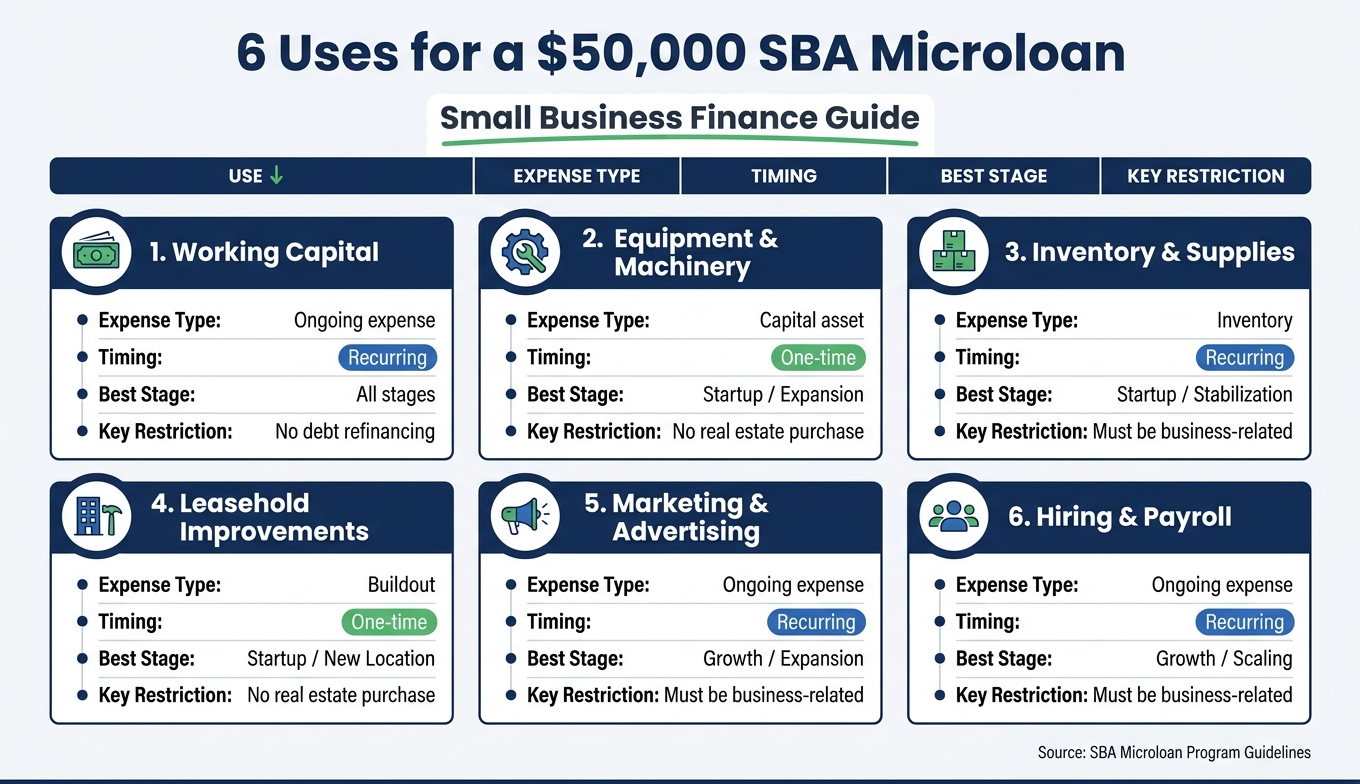
6 Uses for a $50,000 SBA Microloan: Side-by-Side Comparison
A $50,000 SBA microloan can do a few different jobs, but those jobs don’t all play out the same way. Some uses are one-time buys, like equipment or a buildout. Others are costs that keep coming back, like payroll, inventory, or marketing.
That difference matters. If you use the loan for recurring expenses, the money can disappear fast. If you use it for a one-time purchase, you may get a longer payoff from the same dollars. Looking at cost type, timing, business stage, and SBA limits makes it easier to match the loan to what you need right now and what you can repay without getting squeezed.
| Use | Expense Type | Timing | Best Business Stage | Key SBA Restriction |
|---|---|---|---|---|
| Working Capital | Ongoing expense | Recurring | All stages | No debt refinancing |
| Equipment & Machinery | Capital asset | One-time | Startup / Expansion | No real estate purchase |
| Inventory & Supplies | Inventory | Recurring | Startup / Stabilization | Must be business-related |
| Leasehold Improvements | Buildout | One-time | Startup / New Location | No real estate purchase |
| Marketing & Advertising | Ongoing expense | Recurring | Growth / Expansion | Must be business-related |
| Hiring & Payroll | Ongoing expense | Recurring | Growth / Scaling | Must be business-related |
Use this comparison to pick the option that lines up best with your near-term need and repayment plan.
How to Choose the Right Use for Your Loan
After you compare the six options, narrow your loan down to the use that clears your biggest bottleneck.
Don’t scatter $50,000 across every category. If you split $50,000 too many ways, the money loses force.
Pick one primary use and, if needed, one secondary use that directly supports it. Your business plan should back up that decision.
When you apply, list the exact dollar amounts and show how each expense helps you repay the loan. Keep your projections conservative and tied to steady growth.
You should be able to explain your choice in one sentence before you get to the loan request.
Conclusion
After looking at these six options, the next move is simple: pick the one that fixes your biggest bottleneck.
A $50,000 SBA microloan has to be tied to one approved business use that can support repayment. That means lenders aren’t looking for a vague idea or a loose plan. They want a clear, dollar-by-dollar breakdown that shows where the money will go and how that spending helps the business make more money or cut costs.
The best application isn’t the one with the biggest pitch. It’s the one with the clearest use of funds.
FAQs
How do I choose the best use for a $50,000 microloan?
Choose the use that best fits your business needs right now and where you want to go next. The right choice should directly support launching, steadying, or growing your operations.
A solid business plan helps you make that call – and back it up. It should lay out your financial projections, cash flow needs, and market demand in plain terms. Lenders want to see how the money will help your business grow, run better, and stay in a position to repay the loan.
What expenses usually need lender approval first?
There’s no one-size-fits-all list here.
SBA Microloans are handled by local nonprofit intermediary lenders, and each lender has its own rules and paperwork needs.
Because of that, your business plan should include a detailed breakdown of how you plan to use the funds. Lenders look at your exact business model and costs, not just a generic use-of-funds list.
The safest move is simple: check your planned expenses with your assigned lender directly.
How detailed should my use-of-funds plan be?
Your use-of-funds plan should clearly show where the loan money will go and how it will help your business grow. Lenders look at this section to understand your costs and see whether that growth can support repayment.
You don’t need to map out every dollar down to the last cent. But your expense breakdown should be clear, realistic, and closely tied to your business plan, launch, cash flow, or growth goals.
Leave a Reply