

My first check for an SBA microloan plan: Can the business repay what it borrows? For loans up to $50,000, I’d start with the intermediary lender’s checklist, document each planned purchase, and build a 12-month cash-flow forecast that tests a 20% sales drop.
Here are the seven mistakes I’d check before applying:
- Unsupported forecasts: Show the math behind sales, costs, and growth.
- Vague loan uses: List what you’ll buy, its cost, and why it qualifies.
- Missing market research: Use customer and competitor data to support sales targets.
- An unclear repayment plan: Show cash available when payments come due – not just profit.
- Missing or mismatched records: Match your plan to financial statements, tax returns, and bank records.
- Unclear business model and team roles: Explain how you earn money and who handles each task.
- Overlooked lender rules: Confirm required forms, loan terms, collateral, and guarantees.
My rule: <u>Make every number traceable and every loan-funded expense clear.</u> A complete plan helps the lender review your request; it does not guarantee approval.
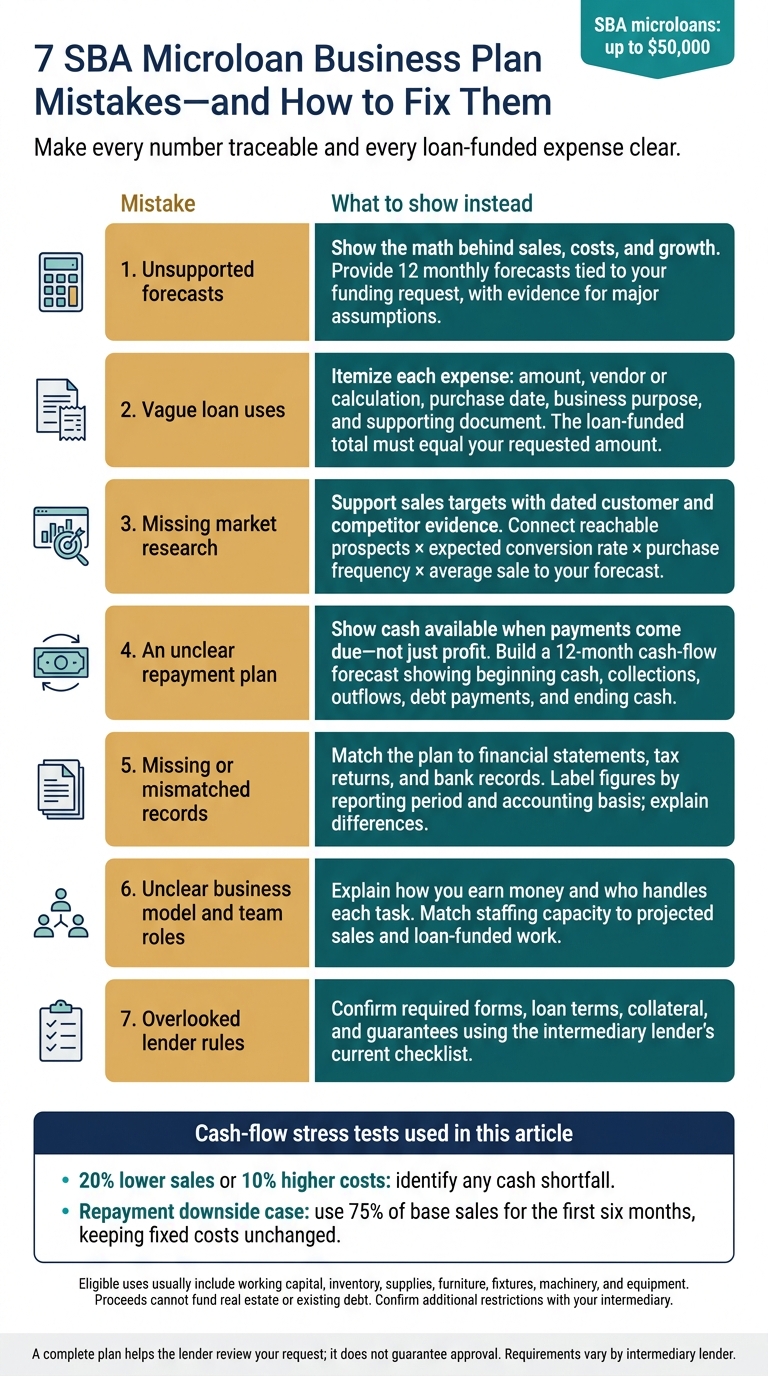
7 SBA Microloan Business Plan Mistakes – and How to Fix Them
What an SBA Microloan Business Plan Should Show
Start with your intermediary lender’s current checklist. Documentation, collateral, credit standards, and technical-assistance requirements vary. Use that checklist to shape your business plan before writing the financial sections.
Explain what you sell, who buys it, and how you earn revenue. Include whether you’re a startup or an existing business, along with your legal structure, location, management experience, and launch date. Back up demand with preorders, contracts, customer interviews, or repeat sales – not broad claims about the market.
Provide an itemized use-of-funds budget showing quantities, prices, vendors, and purchase dates. Attach quotes, invoices, or purchase orders. Eligible uses usually include working capital, inventory, supplies, furniture, fixtures, machinery, and equipment. You cannot use the proceeds for real estate or existing debt. Lenders will then check whether the numbers behind your budget hold up.
For startups, include clearly labeled monthly projections covering at least 12 months. Show your pricing, sales volume, costs, and launch timing. For existing businesses, tie forecasts to actual sales, expenses, tax returns, and bank statements. Explain why you expect future results to differ.
Show how cash flow will cover repayment. Specify when customers will pay and how much cash will remain after payroll, rent, taxes, inventory purchases, owner compensation, and other obligations. Include the proposed loan payment, using terms confirmed with your intermediary. Test slower sales and higher costs so the lender can see whether you could still make payments.
sbb-itb-1eb586e
1. Weak Numbers and Unsupported Forecasts
Why It Hurts
Revenue growth without a clear driver leaves lenders unsure you can repay the loan. Missing recurring expenses makes cash flow look better than it is. Totals that don’t match cast doubt on the forecast.
Tie growth to specific drivers, such as signed contracts, repeat demand, added capacity, a marketing budget, or a new sales channel.
What Lenders Need
Lenders need to follow your forecasts line by line. Provide 12 monthly forecasts tied to your funding request, with notes explaining the major calculations. Show when financed purchases will start producing sales or savings. Don’t assume they’ll run at full capacity right away.
Show the math behind every major line item.
These figures are hypothetical. Replace them with your own records.
Weak numbers Lender-ready numbers Revenue projected at $15,000 a month without support. 75 jobs × $200 = $15,000. Support job volume with bookings and capacity, and pricing with invoices or competitor research. Gross margin stated as 70% without evidence. Use a 42% gross margin and test a range of 38%–45%. Verify materials, shipping, and processing fees with quotes and calculations. Payroll assumed to be minimal. 80 hours × $18 = $1,440 for one employee, before payroll taxes and workers’ compensation. Attach a staffing schedule and cost estimates. Operating costs total $2,000 without a breakdown. Itemize rent, utilities, insurance, software, advertising, repairs, and licenses. Verify costs with leases, bills, and quotes, and separate fixed costs from sales-driven costs.
Correction Checklist
Check revenue formulas and calculate gross margin from direct costs. Include payroll taxes, maintenance, fees, and owner compensation or draws, using the correct accounting treatment.
Make sure the loan request, sources-and-uses schedule, projected statements, and narrative agree. Keep loan proceeds out of revenue and principal payments out of operating expenses, but include both in cash flow.
Attach evidence for major assumptions so lenders can trace each major forecast figure to its basis. Test 20% lower sales or 10% higher costs, and identify any cash shortfall.
2. Unclear Use of Loan Funds
Why It Hurts
Once the numbers work, lenders look at how you plan to spend the money. “Working capital” alone is too vague. They need itemized costs showing what the loan will buy, whether those purchases qualify, and how they support repayment.
What Lenders Need
For each expense, include the amount, vendor or calculation, purchase date, business purpose, and supporting document. Connect each cost to your launch, added capacity, or a signed order. This level of detail is essential when funding your startup business through this program.
Support inventory with quantities, unit costs, and quotes; equipment with specifications and installation estimates; rent with a lease; and payroll with staffing, rates, hours, and dates covered.
Check with your intermediary lender for any additional restrictions.
Correction Checklist
Every dollar should match a documented business need.
- Replace broad labels with specific expenses and attach supporting records.
- Separate loan-funded purchases from owner-funded costs. The loan-funded total must equal your requested amount.
- Connect purchase dates to a launch date, capacity increase, or signed order.
- Remove prohibited items rather than renaming them.
- Check that every requested dollar covers an eligible, documented expense tied to a concrete business goal.
3. Missing Market and Competitor Research
Why It Hurts
Lenders may doubt your sales forecast if they can’t tell whether you can reach enough customers in your service area. Claiming a tiny share of a large market isn’t enough. Show who will buy and why they’ll choose your business.
What Lenders Need
Once your SBA microloan business plan numbers and funding request are clear, lenders need evidence that your sales targets are realistic. Define your customers, service area, and buying habits. Include dated evidence of local demand, and explain how seasonality, pricing, licensing, and labor limits affect sales.
Compare direct and indirect competitors by name. Back up your comparisons with websites, posted prices, reviews, and local directories. Show the gap your business can fill without overstating competitors’ weaknesses.
Correction Checklist
Match each market claim with evidence using the table below.
| Market element | Evidence | Where it belongs |
|---|---|---|
| Target customers and service area | Customer income or business size, buying needs, Census data, ZIP codes or service radius | Market analysis |
| Demand | Dated preorders, sales records, surveys, or letters of intent | Market analysis and appendix |
| Industry context | Local trends, seasonality, pricing, licensing, labor availability, supplier risks, entry barriers | Industry overview |
| Direct and indirect competitors | Offerings, customer segments, prices, strengths, weaknesses, market position | Competitive analysis |
| Forecast connection | Reachable prospects, conversion rate, purchase frequency, average sale, capacity, and ramp-up time that support monthly sales assumptions | Financial projections and assumptions |
Connect your research to the math: reachable prospects × expected conversion rate × purchase frequency × average sale. Clearly label estimates, and use observed results to support conversion assumptions when available. Account for launch timing, seasonality, and staffing limits. These assumptions should support the monthly cash flow you use to show repayment capacity.
A realistic market forecast gives lenders a basis for their next test: whether your repayment plan holds up.
4. An Unclear Repayment Plan
Once you’ve shown demand, the lender’s next question is whether cash will arrive in time to cover each loan payment.
Why It Hurts
Saying sales will cover the loan isn’t enough. Profit does not equal repayment cash. Unpaid invoices, inventory purchases, taxes, and owner draws can leave even a profitable business short when a payment comes due.
What Lenders Need
Lenders need to see that cash will be available on payment dates. Show what’s left after operating costs, taxes, owner draws, inventory purchases, capital spending, and working-capital changes. Compare that amount with the monthly loan payment, without counting any expense twice.
Confirm the loan amount, interest rate, term, fees, payment frequency, and first payment date with the intermediary lender, or compare SBA microloans and bank loans if you are still deciding on a lender. Label any unconfirmed terms as estimates. Don’t assume payments will be deferred.
Correction Checklist
- Build a 12-month cash-flow forecast showing beginning cash, collections, outflows, debt payments, and ending cash.
- Record loan proceeds as financing, not sales.
- Account for seasonality and identify the month with the lowest cash balance.
- Set a specific cash reserve target.
For example, target two or three months of debt payments plus essential fixed expenses.
Downside Test
Run a downside case using 75% of base sales for the first six months. Recalculate gross profit, available cash, and ending cash balances while keeping fixed costs unchanged.
If cash falls short, reduce the loan request, delay optional spending, limit owner draws, or build a larger reserve. If the plan fails this test, fix it before submitting the application.
5. Missing or Mismatched Financial Records
Why It Hurts
A strong cash-flow forecast can fall apart when the records behind it don’t match. Lenders compare your plan with tax returns, bank statements, and financial statements to check your ability to repay. Missing records make your numbers harder to trust, while unexplained differences can weaken your application.
What Lenders Need
Established businesses should provide historical income statements, balance sheets, cash-flow records, year-to-date statements, and business and personal tax returns. Follow your intermediary’s document list so your records cover the required reporting periods.
Use records to back up your projections. Startups shouldn’t claim an operating history they don’t have. Clearly label projections and support them with contracts, vendor quotes, leases, purchase orders, and any operating records already available.
Include an updated debt schedule showing creditors, balances, payments, maturity dates, and collateral. Supply owner financial details as required, including assets, liabilities, income, and expenses, and ask whether you need SBA Form 413. Collateral records should show ownership, approximate value, existing liens, and supporting documents.
These records help lenders check whether your forecast and repayment plan rest on actual numbers.
Correction Checklist
Match each plan item to the records lenders will use to check it.
| Plan item | Check against | Verify or explain |
|---|---|---|
| Revenue history | Tax returns, bank statements, invoices | Reconcile historical sales; separate transfers and owner contributions from revenue. |
| Recurring costs | Bank statements, vendor invoices, payroll records, leases | Check payment frequency, missing costs, and one-time versus recurring expenses. |
| Existing debt | Debt schedule, loan statements, credit-line statements, leases | Match balances, monthly payments, maturity dates, and collateral. |
Label every figure by reporting period and accounting basis. If numbers differ, add a short reconciliation note explaining cash-versus-accrual timing, uncollected invoices, or year-end adjustments. Include supporting records, then update every affected total throughout the application before submitting.
Reconciliation Check
Check that the plan matches its supporting records, and explain any differences.
6. An Unclear Business Model and Team Roles
After reviewing your numbers, market, and repayment plan, lenders check whether your team can put the plan into action.
Why It Hurts
Lenders need to know how your business earns money and who does the work. Unclear pricing, day-to-day processes, or responsibilities make it hard to judge whether your team can carry out the funded plan. A small team is fine. Undefined roles are not.
Without that clarity, lenders have less reason to trust your forecast.
What Lenders Need
Explain how demand becomes revenue. Include your sales channels, pricing, direct costs, and gross margin. Separate recurring revenue from one-time sales, and state when customers pay. Walk through the process from purchasing to delivery, billing, and collection.
Name each owner and their ownership percentage. Assign responsibility for sales, operations, purchasing, hiring, bookkeeping, and loan payment tracking. Show your current staff, planned hires, wage assumptions, hiring milestones, and who covers each role when the owner is away.
Match staffing capacity to projected sales and loan-funded work. Connect each owner’s experience to specific launch or expansion risks, such as inventory control, licensing, or staff supervision. Skip career history that doesn’t help explain how they’ll handle those risks.
Correction Checklist
- Add a one-page business model, a role chart, and a staffing schedule.
- Give every task an owner. For each hire, specify a cost, start date, or sales trigger. Name who will fill each skill gap and include the cost.
- Check that staffing can support the sales volume in your repayment forecast. Confirm that loan-funded equipment or working capital fits your day-to-day process.
7. Overlooking Loan Rules and Lender Requirements
Why It Hurts
Even when your numbers, market, and repayment plan check out, you still need to meet the lender’s rules. SBA eligibility does not guarantee approval. Nonprofit intermediary lenders run the SBA Microloan Program, and each sets its own underwriting, documentation, and service-area requirements.
What Lenders Need
Check your request against the intermediary’s current checklist. Confirm the loan amount, eligible use, term, rate, fees, funding window, and required forms. Use terms the lender has confirmed, and clearly label anything else as an estimate.
Correction Checklist
- Match your repayment source to the financial documents the lender requires.
- Explain how you’ll cover a funding delay.
- Disclose available collateral, estimated values, and existing liens. Confirm personal guarantee requirements.
- Submit every required form and supporting record. Don’t assume collateral or guarantees are waived.
Before submitting, use the intermediary’s current checklist to check every page against its requirements.
Conclusion: Review Your Plan Before Submitting
Before you submit, check your written business plan and the entire package one last time: forecast numbers, loan uses, market evidence, repayment cash flow, records, team roles, and lender rules.
Support every forecast, budget item, and demand claim with records, quotes, or dated evidence. Test whether your cash flow can handle a 20% sales drop, and assign each key role. If you’re launching a startup, clearly separate estimates from actual results.
Track discrepancies as you compare the plan, application, budget, and supporting records. Resolve each mismatch and update all related documents. Explain any differences that remain in a note, then check the intermediary’s current checklist before sending the package.
If your package still feels incomplete, get help organizing it before you file. SBA50K offers business-plan and application support for SBA microloans up to $50,000. Preparation makes your package clearer; it doesn’t improve approval odds. The intermediary makes the lending decision under its own requirements.
FAQs
How can I support sales forecasts without past revenue?
Build a conservative, bottom-up forecast based on research you can verify – not guesswork. Start with your service area and customer segments. Then back your projections with local demand data, industry benchmarks, and your marketing plan. Support the numbers with signed contracts, vendor quotes, and conversion rates.
Make sure customer counts and prices match what your business can deliver. Link sales projections to monthly cash flow and expected profit to show how you’ll repay the loan.
Can I qualify for an SBA microloan with poor credit?
Yes, you can still qualify with poor or limited credit. Local nonprofit intermediaries issue SBA microloans. They focus more on whether your business can succeed and repay the loan than on a perfect credit history.
To improve your chances, submit a clear business plan with market details, realistic financial projections, and a solid repayment strategy. SBA50K helps applicants pursue microloans up to $50,000 through custom-written business plans, application support, and connections to intermediary lenders.
What if my cash-flow forecast shows a shortfall?
Address the shortfall before you submit your application. Lenders want to know how you’ll cover debt payments during slow periods. Build a cash cushion into your budget and explain where that money will come from – for example, cash set aside during peak months.
Include a downside scenario, too. Show how you’ll keep the business running and make debt payments if sales fall below your projections.
Leave a Reply