
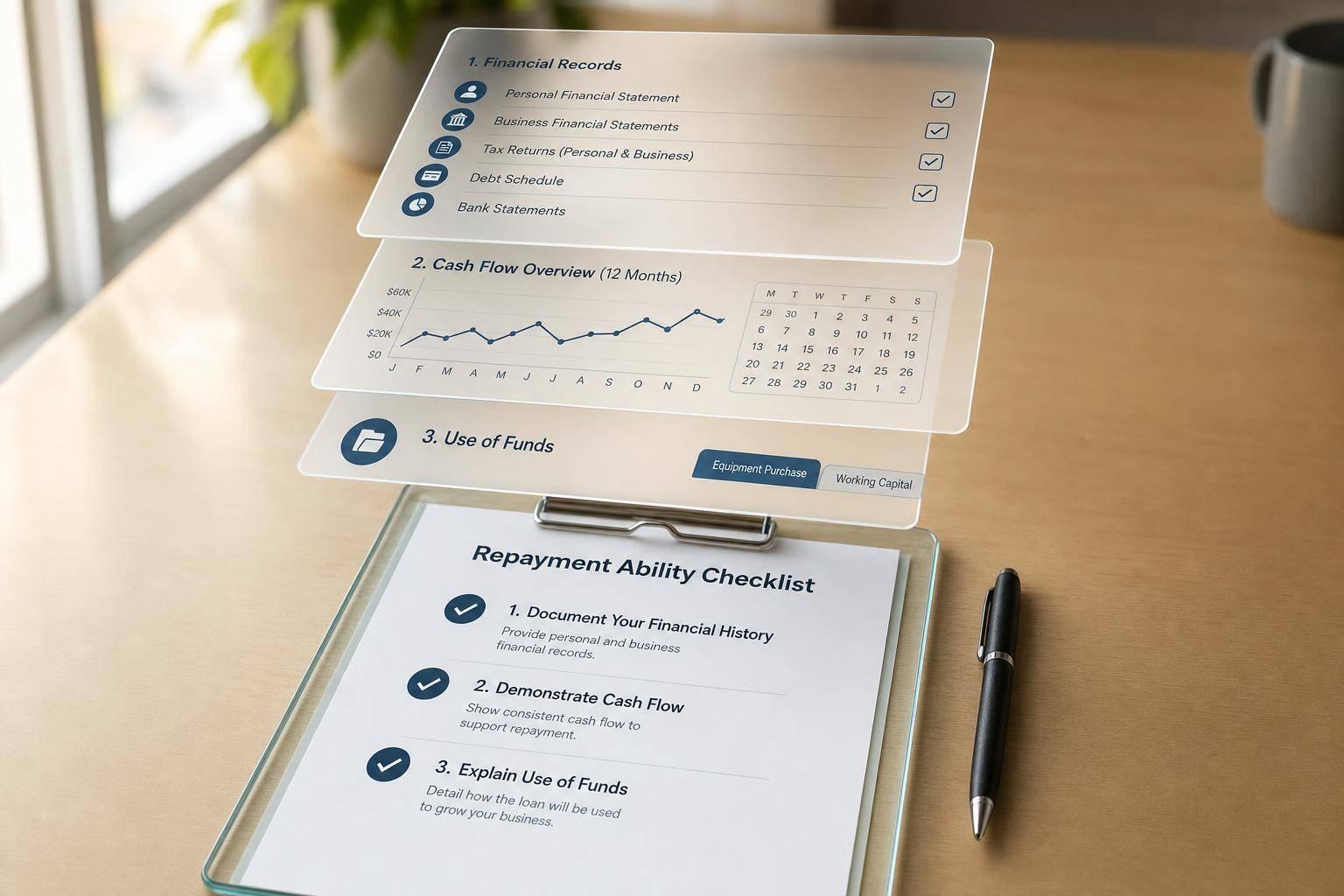
If I want an SBA microloan, the first thing I need to prove is simple: I can make the payment every month. For loans up to $50,000, lenders usually look at four things: my personal finances, my business cash flow, my 12-month forecast, and proof that the loan money will help me pay the loan back.
Here’s the short version:
- I need 2–3 years of tax returns, recent income records, and a current personal financial statement.
- I need a full list of monthly personal and business debt.
- I should review credit reports from Experian, Equifax, and TransUnion before I apply.
- I need business records like P&Ls, bank statements, expense lists, and debt schedules.
- I should build a 12-month cash flow forecast that includes the new loan payment.
- I need to test whether cash flow still works if sales drop by 10% to 20%.
- A monthly DSCR of at least 1.15x is the floor. 1.25x gives more room.
- I must show that each use of funds has backup, like quotes, contracts, or purchase orders.
- I also need to make sure loan proceeds are for allowed uses, not real estate or paying off old debt.
In other words: this checklist is about matching every number to a record. If my tax returns, bank statements, forecast, debt schedule, and use-of-funds sheet all say the same thing, my file is much easier for a lender to review.
Quick comparison
| Area | What I need to check | What lenders want to see |
|---|---|---|
| Personal finances | Income, debts, credit | I can handle current bills plus a new payment |
| Business finances | Revenue, expenses, existing debt | The business has enough monthly cash flow |
| Forecast | 12-month monthly plan | The loan payment fits, even with slower sales |
| Use of funds | Itemized loan purpose with proof | The loan should support repayment within 12 months |
So before I apply, I’d use this checklist to spot weak points, fix missing documents, and make sure the payment fits my numbers on paper.
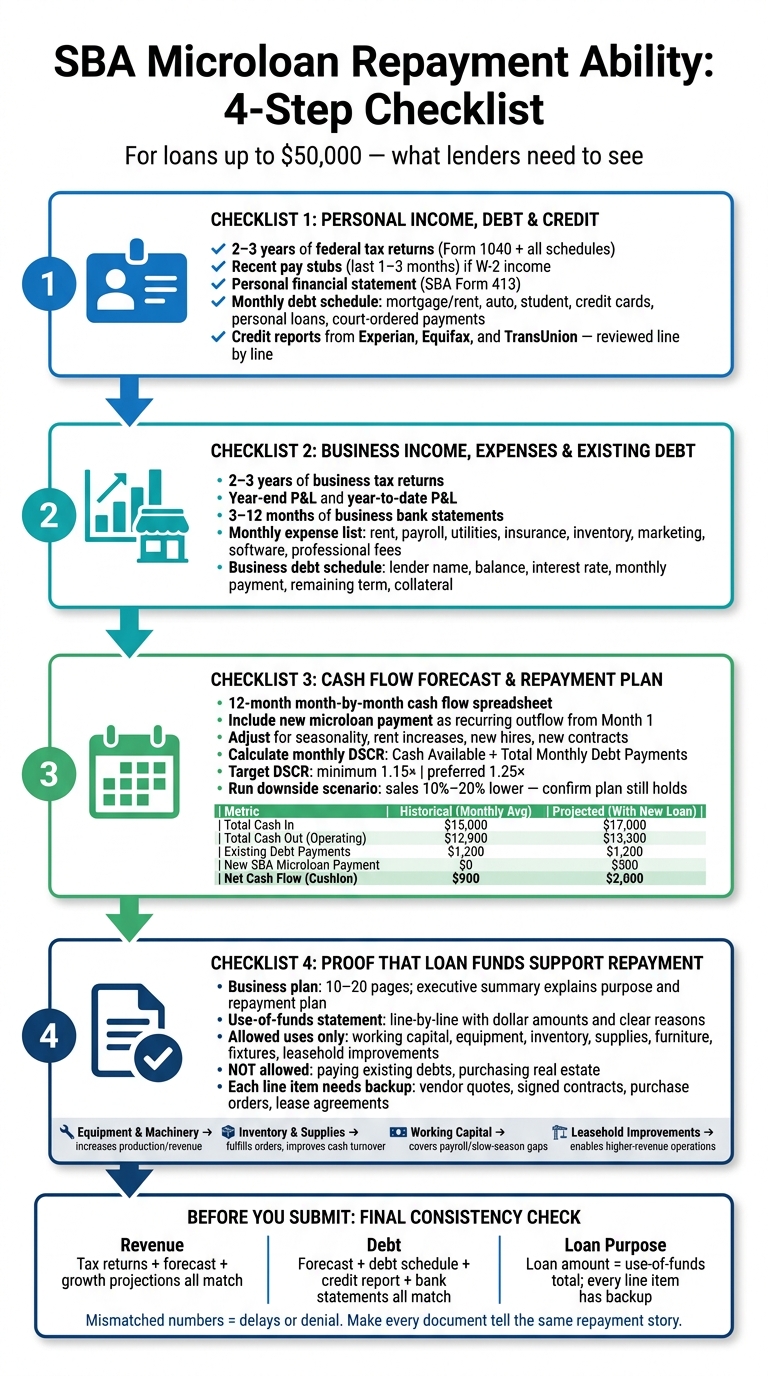
SBA Microloan Repayment Readiness: 4-Checklist Framework
Checklist 1: Personal Income, Debt, and Credit Records
Use this first checklist to gather the personal documents lenders use to judge whether you can repay the loan. Start with your personal records, because lenders look at them alongside your business file.
Income Records and Personal Financial Statement
Collect your last 2–3 years of federal tax returns – Form 1040 with all schedules. If you or a co-borrower earn W-2 income, add recent pay stubs from the last 1–3 months.
If you pay yourself through owner draws or distributions, gather the records that show that money moving. That can include accounting records, bank statements showing the transfers, or Schedule K-1s. Microlenders, including those offering SBA microloans for women entrepreneurs, often look at your last 2–3 years of reported income to help estimate repayment capacity.
You’ll also need a personal financial statement. Many lenders use or refer to SBA Form 413. Date the form and use current statements so every number lines up with your records. In plain English: if your bank balance, debts, and other figures don’t match your backup documents, that can slow things down fast.
Monthly Debt Payments and Credit Report
Create a one-page monthly debt schedule that lists every recurring obligation. Include:
- Mortgage or rent
- Auto loan
- Student loan
- Minimum credit card payment
- Personal loan
- Court-ordered payment
The goal is simple: list every recurring payment so nothing gets left out of your application.
Pull a current credit report from all three major bureaus – Experian, Equifax, and TransUnion – and review each one line by line before you apply. Check for late payments, collections, charge-offs, liens, and judgments. If you spot an error, dispute it before you apply and keep the correction on file.
If your credit is thin or weak, add a short explanation for any past setback and show recent on-time payments.
Next, compare these personal numbers with your business income, expenses, and debt.
sbb-itb-1eb586e
Checklist 2: Business Income, Expenses, and Existing Debt
Once your personal records are set, turn to your business paperwork. This process is especially critical when funding your startup business with an SBA microloan, as new ventures face stricter scrutiny. This is where lenders check whether the business can handle another monthly payment.
Business Income Records and Bank Statements
Pull together:
- 2–3 years of business tax returns
- A year-end P&L
- A year-to-date P&L
- 3–12 months of business bank statements
Lenders want clean proof that your revenue and costs can support repayment. That means they’ll look at your deposits closely, including how steady they are, when they come in, and how much they are.
It also helps to review your statements before you apply. Watch for overdrafts, NSF fees, and months where balances got too low. Those details can stand out fast.
Once your income and deposits are documented, the next job is to map out your fixed costs and current business debt.
Monthly Expense List and Debt Schedule
Create a one-page monthly expense list that shows every recurring operating cost. Include rent, payroll, payroll taxes, utilities, insurance, inventory, marketing, software subscriptions, and professional fees. It also helps to split fixed costs from variable costs so a lender can see where spending has room to move.
Then build a business debt schedule. Keep it simple: a table with every current loan, line of credit, equipment lease, and business credit card. For each debt, include:
- Lender name
- Original balance or credit limit
- Current balance
- Interest rate
- Monthly payment
- Remaining term or maturity date
- Collateral, if the loan is secured
Leaving out any current obligation is a common mistake. And it can derail an application if the lender finds it during the credit review.
These expenses and debts go straight into your 12-month repayment forecast. You’ll use them in the next step when you build a 12-month cash flow forecast that includes the new loan payment.
Checklist 3: Cash Flow Forecast and Repayment Plan
Use your income, expense, and debt records to show that the loan payment fits within your monthly cash flow.
12-Month Cash Flow Forecast Including the New Loan Payment
Build a month-by-month spreadsheet with 12 columns for each month and rows for cash in and cash out. Add the proposed microloan payment as a recurring outflow starting in the first month after funding.
Start with your last 12 months of bank statements. Then adjust the forecast for seasonality and known changes, like rent increases, new hires, or new contracts.
Be conservative with sales growth. Tie any increase to a clear reason, such as a signed contract or a confirmed marketing push. Also model known changes in rent, payroll, insurance, and hiring costs.
After the forecast is done, check whether it still supports repayment. That’s the whole point: The numbers need to work on paper as part of your business plan before the loan starts hitting your account.
Check Debt Coverage and Test the Numbers
Calculate monthly DSCR using this formula: projected cash available for debt service ÷ total monthly debt payments, including the new loan. Aim for at least 1.15×. 1.25× is better.
Use one sample month to test the math. Then run a downside case with sales 10%–20% lower. If the plan still holds up, that’s a good sign.
| Metric | Historical (Monthly Avg) | Projected (With New Loan) |
|---|---|---|
| Total Cash In | $15,000 | $17,000 |
| Total Cash Out (Operating) | $12,900 | $13,300 |
| Existing Monthly Debt Payments | $1,200 | $1,200 |
| New SBA Microloan Payment | $0 | $500 |
| Total Monthly Debt Obligations | $1,200 | $1,700 |
| Net Cash Flow (Cushion) | $900 | $2,000 |
In this example, the projected version still leaves a $2,000 monthly cushion after operating costs and debt payments. That gives you room to handle normal swings in the business without putting the loan payment at risk.
Checklist 4: Proof That Loan Funds Support Repayment
Once the forecast works, the next step is simple: show that the loan will lead to those results. In plain English, each forecasted gain should tie back to a document that proves it.
Business Plan and Use-of-Funds Statement
Your business plan doesn’t need to be long. For a microloan, 10–20 pages is enough. The executive summary should explain what your business does, why you need the loan, and how you plan to pay it back.
The use-of-funds statement should be specific, line by line. Cut vague wording like "to grow the business." Instead, spell out each item with a dollar amount and a clear reason. For example: "$8,000 for a used commercial mixer to increase weekly bakery production by 30%" or "$5,000 for inventory to fulfill signed orders over the next 60 days." Each line should answer one question: Will this item increase revenue, lower costs, or protect cash flow within 12 months?
Also, SBA microloan proceeds cannot be used to pay existing debts or purchase real estate. Only list items that fit allowed uses such as working capital, equipment, inventory, supplies, furniture, fixtures, or leasehold improvements.
| Use of Funds Category | How It Connects to Repayment |
|---|---|
| Equipment & Machinery | Increases production or service capacity, leading to higher monthly revenue |
| Inventory & Supplies | Fulfills existing orders faster, improving cash turnover |
| Working Capital | Covers payroll or slow-season gaps without missing a loan payment |
| Leasehold Improvements | Makes the space operational for a higher-revenue service or product line |
Quotes, Contracts, and Other Supporting Documents
Every major line item needs backup. Vendor quotes, signed customer contracts, purchase orders, and lease agreements help confirm both the cost and the business impact.
A good rule: for each major line item, attach one document that shows the cost and one that shows the business effect. If you’re buying a packaging machine and saying it will cut labor time by 25%, include the vendor quote plus a written estimate that shows the before-and-after labor hours. If you’re buying inventory to fill new orders, attach the signed contract that shows those orders are real.
Before you submit, check that every line item has matching support.
Conclusion: Final Pre-Application Review
Use the records from the last four checklists to make sure every number lines up. This last step is all about consistency. Each document should tell the same repayment story.
Run One Final Document Check Before You Submit
Lenders read these documents side by side. If something is missing or the numbers clash, your SBA microloan application can get delayed or denied.
Before you submit, check these three areas:
- Revenue: Do your tax returns, revenue forecast, and growth projections point in the same direction?
- Debt: Do your forecast, debt schedule, credit report, and bank statements show the same monthly debt payments?
- Loan purpose: Does the loan amount match your use-of-funds total, and does each line item have backup?
Read those documents together, not one at a time. That’s often where small gaps show up. Maybe the debt payment in your forecast doesn’t match your bank statements. Maybe your loan request is $35,000, but your use-of-funds sheet only supports $32,000. Little mismatches like that can create doubt.
If your credit history includes credit issues, a polished package with matching numbers matters even more. SBA50K helps startups and small businesses prepare SBA microloan applications, with step-by-step guidance, business plan writing support, and lender connections for loans up to $50,000. That kind of help can make it easier to submit a cleaner package the first time.
FAQs
What if my DSCR is below 1.15x?
If your DSCR is below 1.15x, SBA microloan intermediaries don’t look at that number in isolation. They review your full financial picture.
That means you can still strengthen your application with a solid business plan, realistic cash flow projections, and a clear explanation of how the loan will help your business grow and improve future earnings.
How detailed should my 12-month forecast be?
Your 12-month forecast needs enough detail to show you can repay the loan.
Lenders look at this part to judge risk. So your forecast should clearly lay out your expected cash flow, profit, and sales projections. Those numbers should be grounded in your target market and actual demand, not guesswork.
If you’re a startup, this matters even more. Since you don’t have much past data to point to, your projections help show how the business will bring in enough revenue to cover loan payments.
What documents best prove my loan use?
Your business plan is the most important document in the package. It needs to show, in plain terms, how you’ll use the loan funds with a clear breakdown of each expense.
Lenders want documented detail that shows where the money is going and how it helps the business grow. That can include inventory, equipment, supplies, furniture, or working capital. Just as important, they want to see how that use of funds ties back to repayment.
SBA50K can help prepare this breakdown and present it clearly in an SBA-approved business plan.
Leave a Reply