

An SBA microloan can provide up to $50,000 – but that’s a limit, not a promise. Apply through an SBA-approved nonprofit intermediary, and request only what your business needs and its cash flow can repay.
Before applying, review these 10 points:
- Eligibility: Check the lender’s rules for your location, industry, and business stage.
- Use of funds: Build a budget for allowed expenses – not real estate or existing debt.
- Lender selection: Compare SBA-approved intermediaries that serve your area.
- Credit: Review personal and business credit reports and dispute errors.
- Collateral and guarantees: Understand which business or personal assets could be at risk.
- Records: Gather financial statements, tax returns, ownership documents, and purchase quotes.
- Business plan: Explain the loan request and support sales forecasts with records or research.
- Loan costs: Compare SBA microloan vs bank loan costs, including interest, fees, and total repayment.
- Cash flow: Test whether payments still fit when sales fall or customers pay late.
- Final review: Check for missing documents, errors, and unexplained differences.
Confirm the lender’s requirements before paying anyone for help. Rates generally range from 8% to 13%, with terms up to seven years; get the actual offer in writing before deciding.
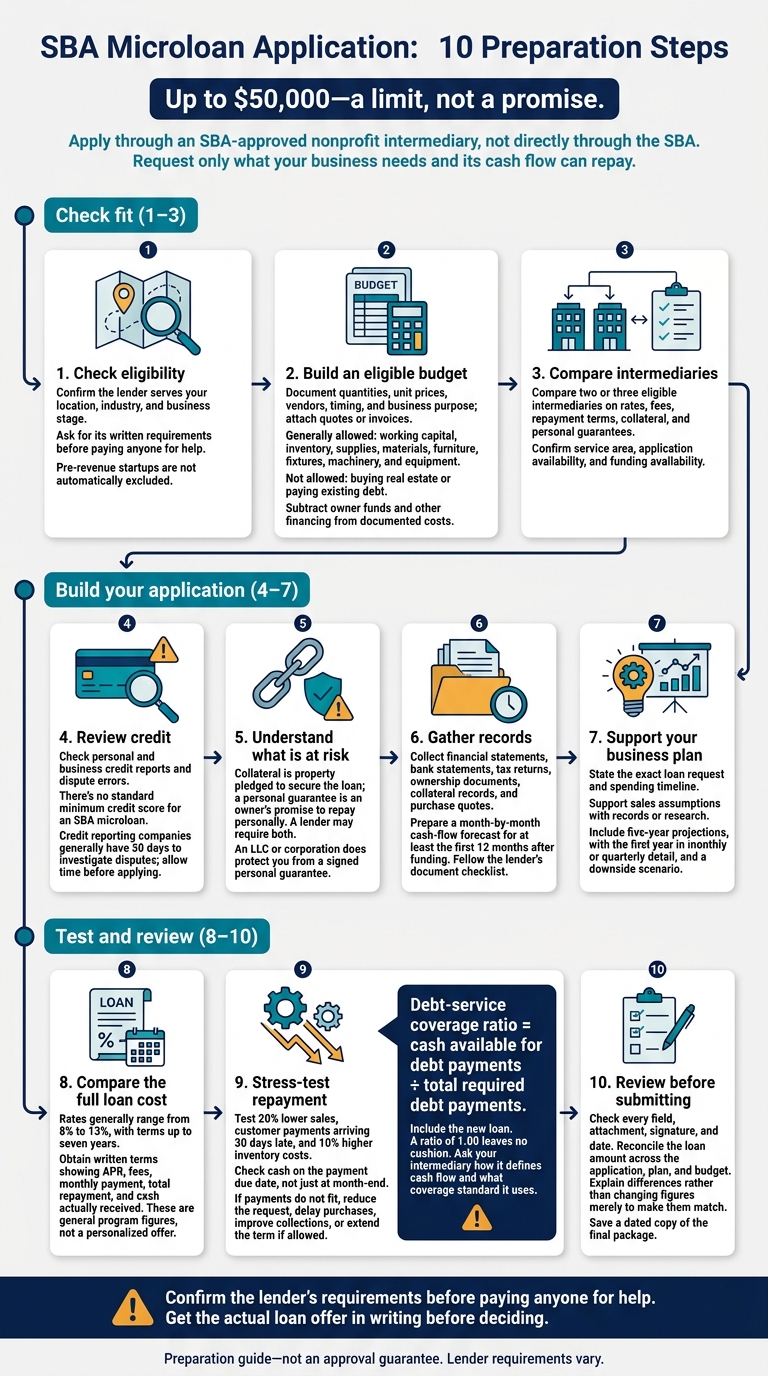
SBA Microloan Application: 10 Preparation Steps
SBA Microloan Approval: What I’d do in 3 Situations #sbaloans #businessfunding #smallbusiness
sbb-itb-1eb586e
1. Check Your Eligibility Before Paying for Help
Check the basics before you spend money on help. Your business generally must be U.S.-based, for-profit, small under SBA size standards, and outside SBA-ineligible categories. Certain nonprofit childcare centers may also qualify. You’ll also need a legitimate business purpose and a reasonable ability to repay.
No revenue yet? That doesn’t automatically rule out your startup. Ask whether the intermediary accepts pre-revenue businesses and what it needs to see about your management experience, startup budget, and projected cash flow.
Ask for the intermediary’s written eligibility checklist. Make sure it serves your location and industry. Before paying anyone, check for extra eligibility rules, collateral or personal guarantee requirements, and fees.
You don’t need to pay a third party to apply. Small Business Development Centers offer free or low-cost guidance. Watch for red flags: guaranteed approval, claims of special SBA access, and upfront processing-fee demands from unverified parties. Once you’ve checked your eligibility, match your funding request to allowed uses for the loan.
2. Prepare an Eligible Use-of-Funds Budget
SBA microloan proceeds can generally pay for working capital, inventory, supplies, materials, furniture, fixtures, machinery, and equipment. You can’t use them to buy real estate or pay existing debt.
Give every dollar a specific business purpose. Create a line-item budget that shows quantity, unit price, vendor, timing, and purpose for each expense. Attach quotes or invoices. List taxes, shipping, and installation as separate costs, and ask the intermediary whether the loan can cover them.
Keep one-time purchases separate from recurring expenses. For working capital, spell out costs such as payroll, rent, utilities, and supplies. Show how many months the request covers, match the amounts to your cash-flow projections, and confirm that every expense is allowed.
Treat $50,000 as a ceiling, not a target. Base your request on documented costs and your ability to repay. Subtract owner funds and other financing from those costs. If you need the full $50,000, explain which necessary purchases a smaller loan would leave unfunded and how the spending will support repayment.
Ask whether the loan can cover expenses incurred before approval, and keep the final budget consistent with your business plan. With the budget set, the next step is finding an SBA-approved intermediary that serves your business.
3. Find an SBA-Approved Intermediary Serving Your Business
With your budget set, look for lenders that serve your area. You apply through an SBA-approved intermediary – not the SBA.
Start with the SBA’s official list of microlenders. Select your state, then check each organization’s service area and contact details. A statewide listing doesn’t mean the lender serves every city or county, so confirm coverage before moving ahead.
Before applying, ask whether the intermediary is accepting applications, can fund your requested amount, and lends to businesses in your industry and at your stage. Request its application checklist, current funding availability, training requirements, and typical timeline from a complete application to funding.
Compare two or three eligible intermediaries on rates, fees, repayment terms, collateral, and personal-guarantee requirements. Also ask whether preliminary screening involves a credit inquiry.
Some lenders offer counseling to help you refine your financial projections or business plan, but that help doesn’t guarantee approval. Once you have a shortlist, review each lender’s credit standards.
4. Check Your Personal and Business Credit
Credit can affect approval, loan size, and terms. There’s no standard minimum credit score for an SBA microloan. Ask the intermediary which credit reports it uses and whether it requires a minimum score. Your personal credit may carry more weight if your business has little credit history.
Review your reports from Equifax, Experian, and TransUnion, along with any business credit reports. Check names and addresses, account ownership, payment history, balances, credit limits, collections, bankruptcies, tax-related records, recent inquiries, and accounts you don’t recognize. Address any problems before applying.
Dispute errors with both the credit bureau and the furnisher – the company that supplied the information. Keep copies of all dispute records. Credit reporting companies generally have 30 days to investigate, so leave time to resolve errors before you apply.
For accurate negative items, briefly explain what happened, why it happened, whether it was resolved, and what has changed since then. Back up your explanation with payment records, settlement letters, or other documents. Pay bills on time and reduce revolving balances without draining the cash you need to run your business.
If your business credit file is thin, prepare business bank statements, tax returns, paid invoices, and a current accounts-receivable/accounts-payable (AR/AP) schedule. Ask the lender which records best support your credit profile and show your ability to repay. Don’t take on debt just to improve a score.
5. Understand Collateral and Personal Guarantees
For a $50,000 microloan, collateral and guarantees can matter as much as credit when a lender reviews your application. Collateral and a personal guarantee are separate obligations. Collateral is business property the lender can claim after default. A personal guarantee is an owner’s promise to repay the debt personally. A lender may require both.
The SBA says intermediaries generally require some form of collateral and a personal guarantee. Requirements vary by lender, so don’t assume your loan will be unsecured. Ask which assets you must pledge, whether there’s a minimum collateral value or a blanket lien on business assets, and which owners must sign a guarantee.
Prepare an asset schedule that lists each item’s owner, estimated liquidation value, existing liens, and supporting documents. Purchase price isn’t proof of current value. The intermediary may value an asset based on what it could sell for in liquidation. Use this list to document what you can pledge in your application.
If your startup has few assets, be upfront about it. Ask what collateral or guarantee the lender will accept.
Before signing, confirm whether the lender requires a lien on specific property or a blanket lien covering business assets. Ask about lien priority, insurance, filing costs, and when the lien will be released. Check whether the personal guarantee is capped or unlimited, covers just this loan or other debt, and stays in effect after restructuring or refinancing.
An LLC or corporation does not protect you from a signed personal guarantee. If you default, your personal assets may be at risk under the guarantee and state law. Have an attorney review any unfamiliar guarantee language before putting personal property at risk. Before submitting your application, check exactly what you’re pledging against the asset and ownership records you’ll gather next.
6. Gather Your Financial and Business Records
Start with the intermediary’s document checklist. Requirements vary by lender. Gather records that prove ownership, document collateral, and show you can repay the loan. Some lenders require interim financial statements dated within 60 days of submission.
- Financial records: Back up your requested loan amount with a current year-to-date profit-and-loss statement, balance sheet, business bank statements, and an existing-debt schedule. Include at least two years of personal tax returns, plus business tax returns and three years of year-end financial statements when available. Submit complete returns with every schedule attached.
- Legal, ownership, and supporting documents: Collect ID, formation documents, licenses, ownership records, leases, insurance, and contracts. Include each owner’s personal financial statement, along with quotes or invoices that match your budget. If you’re launching a startup, replace missing business history with bank records, startup-cost estimates, proof of owner investment, and realistic projections.
Prepare a month-by-month cash-flow forecast for at least the first 12 months after funding. Show expected collections, operating costs, planned purchases, loan payments, and ending cash.
Your application, bank records, and tax returns should tell the same story. Before uploading, reconcile your books with bank activity and explain any known differences in writing. Save labeled PDFs by category and keep the originals. Have a bookkeeper or accountant check the calculations and look for missing forms or schedules. Use these records to support the business plan and cash-flow forecast in the next section.
7. Write a Business Plan That Explains Your Loan Request
Turn the records and forecasts you’ve gathered into a business plan that follows your intermediary’s expected format. The SBA does not use one standard business-plan format.
Start with an executive summary: what your business does, where it operates, who leads it, and how much funding you need. Then explain what you sell, who buys it, how you reach customers, and how the business runs. Show how your management experience prepares you for the work the loan will fund.
Specify the exact loan amount, term, and spending timeline. Tie every line item to a documented business need. Build your request around those needs – not simply the program’s $50,000 maximum.
Explain the assumptions behind your revenue forecast, including sales volume, prices, margins, seasonality, and when customers will pay. Back them up with sales history, contracts, customer research, or other evidence. If you’re launching a startup, outline your launch schedule and how you’ll attract customers. Avoid growth projections you can’t support.
Include five-year projections for your income statement, balance sheet, cash flow, and equipment and major-purchase budgets. Break the first year into monthly or quarterly detail. Add a downside scenario that shows how you’d handle slower sales or rising costs, including which expenses you could delay. Keep these projections aligned with the loan cost and repayment review in the next section.
8. Calculate Interest, Fees, and Total Loan Cost
The interest rate doesn’t tell the whole story. SBA microloan rates generally range from 8% to 13%, with repayment terms of up to seven years. Ask your intermediary whether the quoted rate is fixed or variable. If it’s variable, ask which benchmark determines future rate changes.
Request a written term sheet, fee schedule, and amortization schedule. Make sure they spell out the APR, monthly payment, total repayment, and every required fee.
Cost illustration: A $50,000 loan at 10% for 84 months costs about $830 a month and about $69,700 total before fees; a 3% packaging fee and $300 in closing costs raise total cost to about $71,500.
Judge affordability by the monthly payment and total cost, not just the amount you borrow. Test whether your cash flow can cover that payment.
Also, confirm how much cash you’ll actually receive. Subtract any fees withheld at closing from the loan amount before fees. If you roll fees into the loan, they count toward the $50,000 cap – you can’t finance fees on top of that limit.
Packaging fees are capped at 3% for terms of at least one year and 2% for shorter terms. Get late-payment and prepayment terms in writing, too.
9. Check Whether Your Cash Flow Can Cover Payments
Once you’ve calculated loan costs, check whether the payment fits your monthly cash flow. Cash flow – not revenue – pays the loan. Use your existing 12-month forecast to test your ability to repay. Even a profitable business can run short of cash when customers pay late.
For the payment month, start with cash on hand and add expected customer collections. Then subtract operating expenses, taxes, owner draws, existing debt payments, planned purchases, and the new loan payment. Show loan proceeds separately from sales receipts, including when you’ll spend those funds. Check your cash balance on the payment due date, not just at month-end.
Calculate your debt-service coverage ratio: cash available for debt payments ÷ total required debt payments. Include the new loan in those payments. A ratio of 1.00 leaves no cushion. Ask your intermediary how it defines cash flow and what coverage standard it uses.
Stress-test your forecast with 20% lower sales, customer payments arriving 30 days late, and 10% higher inventory costs. Back up your assumptions with the bank statements, sales records, quotes, or contracts you’ve already gathered. Keep a cash reserve instead of spending every dollar of projected surplus.
If the loan fails the stress test, you may be asking for too much. If your forecast falls short, reduce the request, put off purchases you can wait on, improve collections, or extend the loan term if allowed. Next, check that every number and document in your application matches.
10. Check Your Application for Missing or Conflicting Details
After reviewing repayment fit, give your application one last check for accuracy and missing information. Follow the lender’s checklist – requirements vary by lender. Make sure every field, attachment, signature, and date is complete.
Confirm that the loan amount is the same in your application, plan, and budget. Your budget must total the requested amount. Check your legal business name, EIN, address, ownership percentages, and owner details against your formation records, tax filings, and ID.
Reconcile differences – don’t change numbers just to make them match. Check figures across all supporting documents. Label reporting periods clearly and separate actual results from projections. If figures differ, attach a written explanation and records that support it.
Ask your accountant or bookkeeper to review the package. Correct inaccurate statements and explain any gaps before signing. Submit only when every number, name, and attachment matches or any difference is documented. Open every attachment to check that it’s readable, then save a dated copy of the final package.
Conclusion: Know What You Need, How You’ll Spend It, and How You’ll Repay
Once you’ve reviewed eligibility, costs, and repayment, request only what your budget supports and your cash flow can repay through a business loan for $50,000 or less. Your use-of-funds budget should list each eligible business expense, when you’ll pay it, and a supporting quote or invoice.
Base repayment on cash flow you can document – not projected sales alone. If the payments don’t fit comfortably, reduce your request, adjust your spending plan, or improve collections before applying.
Contact an SBA-approved intermediary serving your area. Confirm its eligibility rules and required documents, and ask for written terms covering the rate, fees, payments, maturity, collateral, and guarantees. Before signing, use its amortization schedule to check the payments against your cash flow forecast.
Confirm the lender’s requirements before paying anyone for help. If you hire someone, get the scope of work, price, and refund policy in writing.
FAQs
Can I qualify if I’ve been denied a business loan?
Yes. A previous denial doesn’t automatically disqualify you. Individual intermediary lenders – not the SBA – decide whether to approve your loan, and their requirements vary.
Before applying again, find out why you were denied and address the issue. You can often strengthen your application by explaining past credit problems, improving your business plan, offering collateral, or adding a co-signer to help show you can repay the loan.
What if I’m approved for less than I requested?
Intermediary lenders make their own credit decisions based on your business’s finances, cash flow, and ability to repay. You can request up to $50,000, but the lender decides how much to approve based on what your business can afford to pay back.
To improve your chances of getting the full amount, provide clear documentation, realistic cash-flow projections, and a detailed plan explaining how each dollar you request will help generate revenue.
What should I do if I can’t make a payment?
Contact your intermediary lender as soon as you expect trouble making a payment – or if you’re already having trouble. Each lender sets its own terms and requirements, so work directly with yours to address any potential shortfall.
Check regularly that you can cover payments during slower sales months. If you expect a gap, consider reducing optional spending, cutting owner draws, or tapping established operating reserves. Have a repayment plan before payments are due.
Leave a Reply