

Yes – women with limited credit can qualify for SBA microloans for women entrepreneurs of up to $50,000. The SBA sets no universal minimum personal credit score; each approved intermediary sets its own rules. Before applying, ask whether the lender accepts thin credit files and which records it needs.
Limited credit means little borrowing history – not necessarily missed payments. Approval depends on the lender’s review of repayment ability and other requirements.
- Prepare proof of repayment: Bank statements, business records, and monthly cash-flow projections can help support an application.
- Check the terms: Repayment can run up to seven years. Collateral and a personal guarantee may be required.
- Plan the spending: Funds can cover working capital, inventory, and equipment – not real estate or existing debt.
- Get application help: Women’s Business Centers and other support services can help with planning, but the intermediary alone decides approval.
SBA Microloans 101
sbb-itb-1eb586e
Limited Credit vs. Poor Credit
The difference comes down to how lenders read your track record. Thin credit means little borrowing history; poor credit means a record of repayment problems. Intermediaries make their own credit decisions and set lender-specific requirements.
How Lenders Evaluate Credit History
Lenders often assess these profiles differently, especially when you compare SBA microloans vs bank loans.
| Factor | Limited or thin credit | Poor credit |
|---|---|---|
| Credit history | Few or no established accounts | Late payments, defaults, collections, or high utilization |
| What it indicates | Little evidence of repayment behavior | Repayment problems or higher credit risk |
| Typical lender response | Ask for more financial records or consider a smaller loan | Ask for explanations and stronger evidence that you can repay now |
These are general categories, not classifications every lender uses. Your profile helps determine which documents to provide.
With thin credit, ask whether the lender accepts paid rent and utility records, customer contracts, or proof of income to fill gaps in your borrowing history.
With poor credit, lenders consider how recent, severe, and frequent the negative items are. Check your personal and business credit reports for errors. Prepare a brief, honest explanation of any problems, and document steps you’ve taken to address them, such as bringing accounts current or setting up payment plans.
Collateral, a personal guarantee, or both may be required. A personal guarantee makes you liable if the business defaults; it doesn’t prove you can repay the loan.
SBA Microloan Rules and Lender Requirements
Apply through an SBA-approved intermediary. That lender decides whether to approve your loan and sets pricing and repayment terms within SBA rules. For women with thin credit files, the focus is less on a long borrowing history and more on showing that the business can repay. You still need to meet the lender’s standards.
Business Eligibility, Loan Uses, and Terms
Borrowers generally must be for-profit small businesses located in the United States that meet SBA size rules. Certain nonprofit child care centers also qualify. Microloans offer up to $50,000, with repayment terms of up to seven years.
You can use the funds for working capital, inventory, supplies, furniture, fixtures, machinery, and equipment – but not to buy real estate or pay existing debt. Connect every dollar you request to a business need, and back it up with estimates, invoices, or purchase quotes. Once you’ve explained the loan’s purpose, the lender will look at your credit history and ability to repay.
Credit Requirements, Collateral, and Guarantees
Each intermediary sets its own credit score requirements and may consider payment records beyond loans and credit cards. Ask whether you can apply without a credit score and which payment records the lender accepts.
Intermediaries often require collateral and a personal guarantee. Ask how the lender values collateral, whether business assets alone will be enough, and which personal guarantee rules apply.
How Lenders Assess Repayment Ability
Lenders look beyond credit scores. They may review your personal credit, business credit if you have it, debts, cash flow, owner investment, experience, business plan, and planned use of the funds.
If your credit file is thin, support your application with records that show how repayment will work. For an established business, that means bank statements, tax returns, and bookkeeping reports. For a startup, prepare realistic monthly projections backed by customer contracts, pricing, and supplier quotes.
Show that enough cash will remain to make the loan payment after operating costs, existing obligations, and owner compensation.
Counseling for Women Business Owners
Many intermediaries are community organizations that serve underserved entrepreneurs and offer technical assistance. For women with limited credit, Women’s Business Centers can help organize financial records, prepare a business plan, and test cash-flow assumptions. They aren’t automatically lenders, and they can’t decide eligibility or guarantee approval.
Use that guidance to prepare the documents in the application checklist below, including the records, projections, and business plan your lender will review.
How to Prepare an Application With Limited Credit
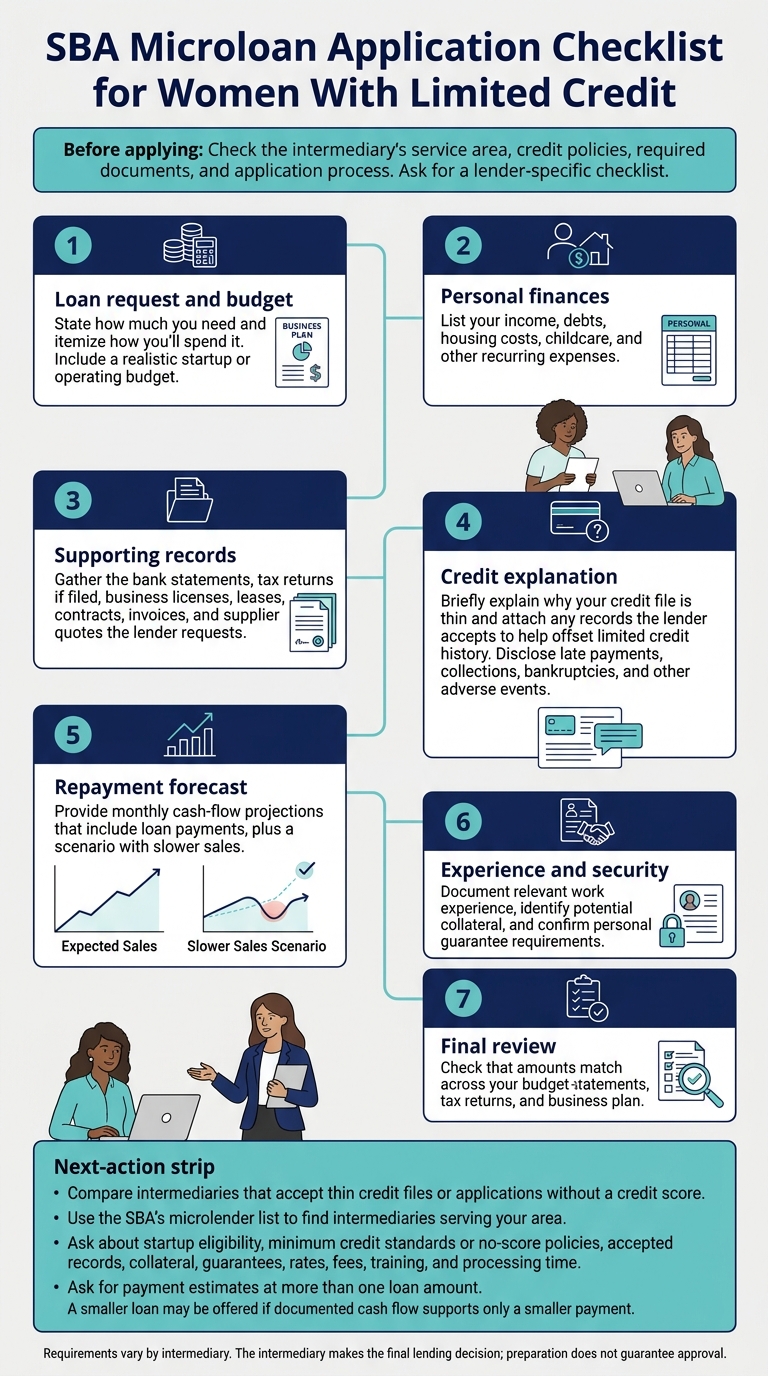
SBA Microloan Application Checklist for Women With Limited Credit
Build your application around documented repayment ability. With a thin credit file, focus on proof that you can repay rather than a long borrowing history. Before applying, check the intermediary’s service area, credit policies, required documents, and application process.
Application Checklist
Ask for a lender-specific checklist, then gather the documents in one application file. Requirements vary by intermediary. Next, compare intermediaries that work with your credit profile.
- Loan request and budget: State how much you need and itemize how you’ll spend it. Include a realistic startup or operating budget.
- Personal finances: List your income, debts, housing costs, childcare, and other recurring expenses.
- Supporting records: Gather the bank statements, tax returns if filed, business licenses, leases, contracts, invoices, and supplier quotes the lender requests.
- Credit explanation: Briefly explain why your credit file is thin and attach any records the lender accepts to help offset limited credit history. Disclose late payments, collections, bankruptcies, and other adverse events.
- Repayment forecast: Provide monthly cash-flow projections that include loan payments, plus a scenario with slower sales.
- Experience and security: Document relevant work experience, identify potential collateral, and confirm personal guarantee requirements.
- Final review: Check that amounts match across your application, budget, bank statements, tax returns, and business plan.
How to Find an SBA Microloan Intermediary
Once your documents are ready, check them against each lender’s credit rules before applying. Focus on lenders that accept thin credit files or applications without a credit score.
Use the SBA’s microlender list to find intermediaries serving your area. Ask about startup eligibility, minimum credit standards or no-score policies, accepted records, collateral, guarantees, rates, fees, training, and processing time.
Ask for payment estimates at more than one loan amount. An intermediary may approve less than you request if your documented cash flow supports only a smaller payment. Decide which purchases you could postpone so a smaller loan would still leave you with a workable business plan.
SBA50K Application and Business Plan Support
SBA50K offers a step-by-step microloan guide, lender connections, application help, and business-plan writing support for applicants with limited or poor credit. Before paying, confirm current pricing, deliverables, eligibility, and the scope of service – including what revisions cover.
SBA50K does not make lending decisions or guarantee approval. A prepared business plan is not SBA approval or endorsement; the intermediary makes the final lending decision.
Conclusion: Next Steps for Applicants With Limited Credit
Women with limited credit history can still qualify for an SBA microloan of up to $50,000 if an SBA-designated intermediary approves the business, documents, use of funds, and repayment plan. The focus is less on a long credit history and more on showing you can repay the loan.
That $50,000 cap isn’t a promise of approval. An intermediary may offer a smaller loan and require collateral or a personal guarantee.
Contact an eligible intermediary in your area and ask about its credit rules. Then submit a budget and monthly cash-flow forecast showing that your business can afford the payments. Once those numbers work, you’re ready to apply.
FAQs
Can I qualify without business revenue or credit history?
Yes – you can qualify without business revenue or credit history. SBA microloan lenders focus mainly on your ability to repay through cash flow and the strength of your overall application.
If your business is new or has little operating history, lenders put more weight on your personal credit and finances. They also look for a strong SBA-compliant business plan and realistic 3–5-year projections that show how you’ll repay the loan.
Will applying for a microloan hurt my credit?
Applying for a microloan typically triggers a hard credit inquiry. A single inquiry usually has a small effect on your credit score. But several applications for new credit close together may lower it.
To help protect your score, avoid applying for other new credit in the months before you apply for an SBA microloan. Give your business plan a careful review and check your documents for errors to improve your chances of approval.
Can I reapply if my microloan application is denied?
Yes. Before you reapply, address the reason for the denial. This could be weak cash flow, missing or inconsistent documents, an unclear use of funds, or unresolved credit issues. Gather all required paperwork and make sure your business plan clearly explains how you’ll repay the loan.
SBA50K can help you refine your business plan and prepare an application that better meets lender requirements.
Leave a Reply