
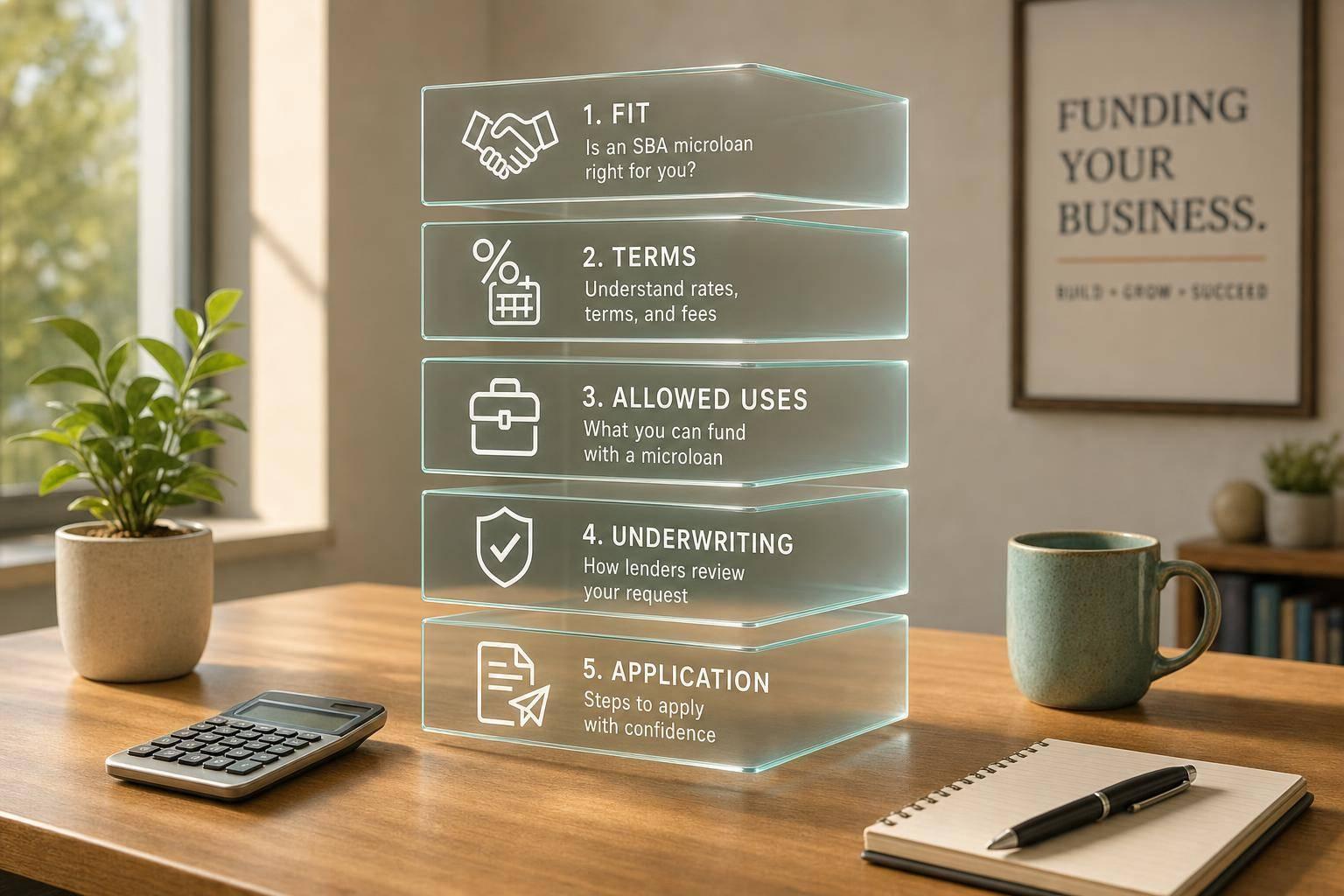
If you need $50,000 or less, an SBA microloan may fit best when your use of funds is clear, your repayment plan is solid, and the local lender matches your profile. Most loans are much smaller – about $13,000 to $16,000 – with rates often around 8% to 13% APR and funding often taking 30 to 60 days after a complete application.
Here’s the short version:
- I’d look at this loan if I need money for working capital, inventory, equipment, supplies, or startup costs
- I would not use it for real estate, land, refinancing debt, or personal expenses
- I’d expect the lender to check cash flow, credit, business experience, debt load, collateral, and a personal guarantee
- I’d prepare an itemized use-of-funds budget, a business plan, and 12 to 24 months of monthly cash flow projections
- I’d apply through an SBA intermediary lender, not the SBA
A few points matter most before applying: loan fit, allowed use, repayment ability, and document readiness. This guide gives the key terms, who this loan tends to fit, how lenders review files, and what I’d gather before sending an application.
Who SBA Microloans Fit Best
Basic Eligibility and Borrower Profile
The SBA microloan program is a solid option for for-profit small businesses, startups, and early-stage companies that meet SBA size standards, along with eligible nonprofit childcare centers.
One thing that trips people up: the SBA does not set one minimum credit score for microloans. Instead, each intermediary lender sets its own rules. That means a borrower with weaker credit may still get approved if the business plan is strong, the owner has useful experience, and the repayment plan makes sense. In plain English, the paper score matters, but the business case matters a lot too.
Most borrowers also need to sign a personal guarantee. Collateral is often part of the review as well, though the exact requirement depends on the lender.
When a Microloan Makes Sense
The clearest use case is a business that needs $50,000 or less for one clear purpose. Microloans are often used for:
- Working capital
- Inventory
- Equipment
- Startup costs
For example, a catering startup might buy refrigeration equipment. A retail shop might purchase its first round of inventory. A contractor might use the funds to buy tools and get to work.
Many intermediary lenders also pair the loan with technical assistance, and some make training part of the process. That can make a big difference for first-time owners. If someone needs help with bookkeeping, pricing, or loan paperwork, that extra support can take a lot of pressure off.
A microloan tends to fit best when the amount needed is $50,000 or less, the use of funds is clear, and the borrower can show a realistic path to repayment.
Once fit is clear, review loan terms, costs, and allowed uses.
sbb-itb-1eb586e
Loan Terms, Costs, and Allowed Uses
Amounts, Rates, Terms, Fees, and Funding Timeline
Once you’ve confirmed that a microloan fits, the next thing to check is the math. The loan might sound good on paper, but the amount, rate, fees, and timing will tell you if it works for your business.
SBA microloans top out at $50,000, but most are far smaller. Average loan sizes usually land around $13,000 to $16,000. So if you’re asking for the full $50,000, expect more scrutiny. Lenders usually want stronger financials and a clear case for why that amount makes sense for your business.
Repayment terms can run up to six to seven years, though most loans fall in the three-to-six-year range. Payments are monthly and fully amortized, which means you pay down the balance over time and don’t face a balloon payment at the end.
Interest rates are set by the intermediary lender, not by the SBA itself. In most cases, rates fall between 8% and 13% APR. That’s often higher than what you’d see with a standard bank term loan. The reason is pretty simple: small loans tend to cost more to make and service.
Fees depend on the lender and may include origination fees and closing fees. On a smaller loan, even a few hundred dollars can change the total cost more than you might think. Ask for a full breakdown of fees before you sign.
| Term | Details |
|---|---|
| Maximum loan amount | $50,000 |
| Average loan size | ~$13,000–$16,000 |
| Repayment term | Up to 6–7 years (most loans: 3–6 years) |
| Interest rate range | 8%–13% APR (set by intermediary) |
| Common fees | Origination and closing fees |
| Estimated funding timeline | 30–60 days from a complete application |
Funding usually takes 30 to 60 days once the application is complete. If things drag, it’s often because paperwork is missing or the lender wants counseling completed first.
The next piece is just as important: making sure your planned use of the money fits SBA rules.
Allowed Uses and Restricted Uses
SBA microloan rules are pretty specific about what the money can cover. Allowed uses include working capital, inventory, supplies, furniture, fixtures, machinery, and equipment. Working capital can include day-to-day operating costs.
For example, a restaurant could use a microloan to buy kitchen equipment, stock its first round of food inventory, and help cover early payroll.
There are also clear limits. Microloan funds cannot be used to buy real estate or land, pay off existing debt, or cover personal expenses. So a retailer couldn’t use the funds to wipe out an older high-interest business loan or purchase a building.
When you apply, spell out each planned expense. Something like $10,000 for equipment, $6,000 for inventory, and $4,000 for working capital makes your plan easy to follow. A simple use-of-funds budget helps the lender see right away that your request lines up with SBA rules. During review, they’ll compare that budget with your business plan.
SBA Microloans: A Complete Guide for Startups and Small Businesses
How Lenders Review Applications and Why the Business Plan Matters
Once your use of funds is clear, lenders review the application checklist to see if repayment makes sense. That puts the business plan and financials front and center.
Main Underwriting Factors
Lenders look at credit, cash flow, experience, and debt together. Credit matters, but it doesn’t carry the whole decision. The main question is simple: Can the business bring in enough cash each month to cover the payment? Cash flow – not collateral – is the main repayment test.
They also look at your industry experience, management background, and whether you seem ready to run the business day to day. On top of that, lenders review your current debt to make sure a microloan won’t stretch repayment too thin. Collateral comes after that. What matters most is cash flow, experience, and debt load.
If your credit report has problems like late payments, collections, or a past bankruptcy, address them directly. Keep the explanation short, connect it to documented events, and show that the issue has been resolved.
What a Strong Business Plan Should Include
A good plan answers the same questions an underwriter is asking: What is the business? Why do you need this loan? How will you pay it back? And why are you the right person to make it work?
A lender-ready plan should spell out:
- The business model
- The target customer
- Market demand
- The owner’s background
- Use of funds
- Cash flow projections
The use-of-funds section needs to be itemized. Don’t stop at "equipment and working capital." Show the line items and dollar amounts, and make sure they match the loan request you submitted.
SBA guidance says financial projections should go out five years, though lenders usually focus most on the first 12 to 24 months of monthly cash flow when they judge whether payments look realistic. For startups, the business plan is the main proof that the idea can work, so the numbers need to stay grounded and clearly tied to repayment.
Step-by-Step Application Process and Final Takeaways
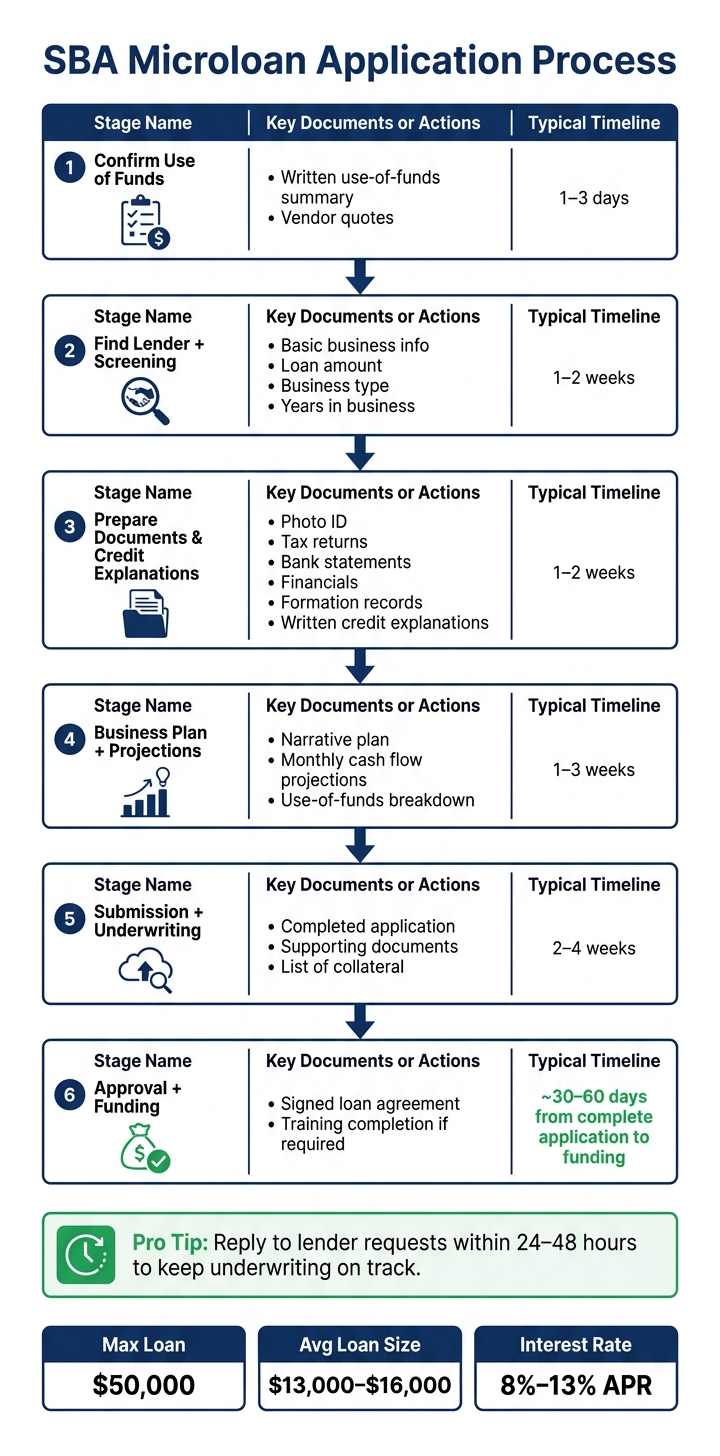
SBA Microloan Application Process: Steps, Documents & Timeline
From Lender Search to Loan Submission
Once your business plan is set and you know exactly why you need the money, it’s time to apply.
First, make sure your request lines up with SBA microloan rules and how they differ from traditional bank financing. Then look for a local SBA microloan intermediary. That’s a big detail: you apply through the intermediary, not through the SBA itself.
Next comes the lender’s early screening. Some lenders also want applicants to complete training before they move ahead, so check that up front. Then review your personal credit report, fix any clear errors or problem spots, and pull together the documents you’ll need:
- Photo ID
- Business formation records
- Personal and business tax returns
- 3–6 months of bank statements
- List of collateral
- Financial statements
- Existing debt schedule
Here’s the path from prep work to submission:
| Stage | Key Documents / Actions | Typical Timeline |
|---|---|---|
| Confirm use of funds | Written use-of-funds summary, vendor quotes | 1–3 days |
| Find lender + screening | Basic business info, loan amount, business type, years in business | 1–2 weeks |
| Prepare documents and credit explanations | Photo ID, tax returns, bank statements, financials, formation records, written credit explanations | 1–2 weeks |
| Business plan + projections | Narrative plan, monthly cash flow projections, use-of-funds breakdown | 1–3 weeks |
| Submission + underwriting | Completed application, supporting documents, list of collateral | 2–4 weeks |
| Approval + funding | Signed loan agreement, training completion if required | About 30–60 days from a complete application to funding |
One small habit can make a big difference: reply to lender requests within 24–48 hours. That helps keep underwriting from slowing down.
SBA50K offers step-by-step SBA microloan guidance, lender matching, and business plan support for borrowers with limited or imperfect credit.
Conclusion: What to Check Before You Apply
Before you file, focus on the three things that shape most approval decisions: eligible use, lender fit, and repayment capacity.
In plain English, that means checking a few basics before your application goes out:
- Your planned use of funds is allowed
- The local intermediary fits your profile and you meet its criteria
- You’ve reviewed your credit report
- Your business plan is ready
- Your collateral documents are ready
Terms vary by intermediary, and each lender sets its own credit and collateral rules. The strongest applications usually have three things in place: complete documents, realistic projections, and a clear use-of-funds budget.
FAQs
Can I get an SBA microloan with bad credit?
Yes. You may still qualify for an SBA microloan with poor or limited credit.
The SBA doesn’t set a program-wide minimum credit score. Instead, intermediary lenders make the final call based on the strength of your business and your ability to repay.
Some lenders look for scores in the 550 to 675 range. But many have room to work with borrowers who can show a solid business model. SBA50K can help you present that clearly.
What can disqualify me from an SBA microloan?
You may be disqualified if you don’t meet basic intermediary requirements, including:
- the ability to repay based on cash flow or realistic projections
- U.S. residency or work authorization
- an eligible business use of funds
Your application may also be delayed or declined if required collateral or personal guarantees are missing, or if your file is incomplete.
How detailed should my business plan be?
Focus on clarity and professionalism, not length. For most microloan applications, 10 to 20 pages is enough.
Your plan should be well organized, error-free, and easy to follow. It also needs to include realistic financial projections, a clear business model, and a specific breakdown of how the funds will be used.
If you need help pulling it all together, SBA50K can support you with business plan writing and application guidance.
Leave a Reply