
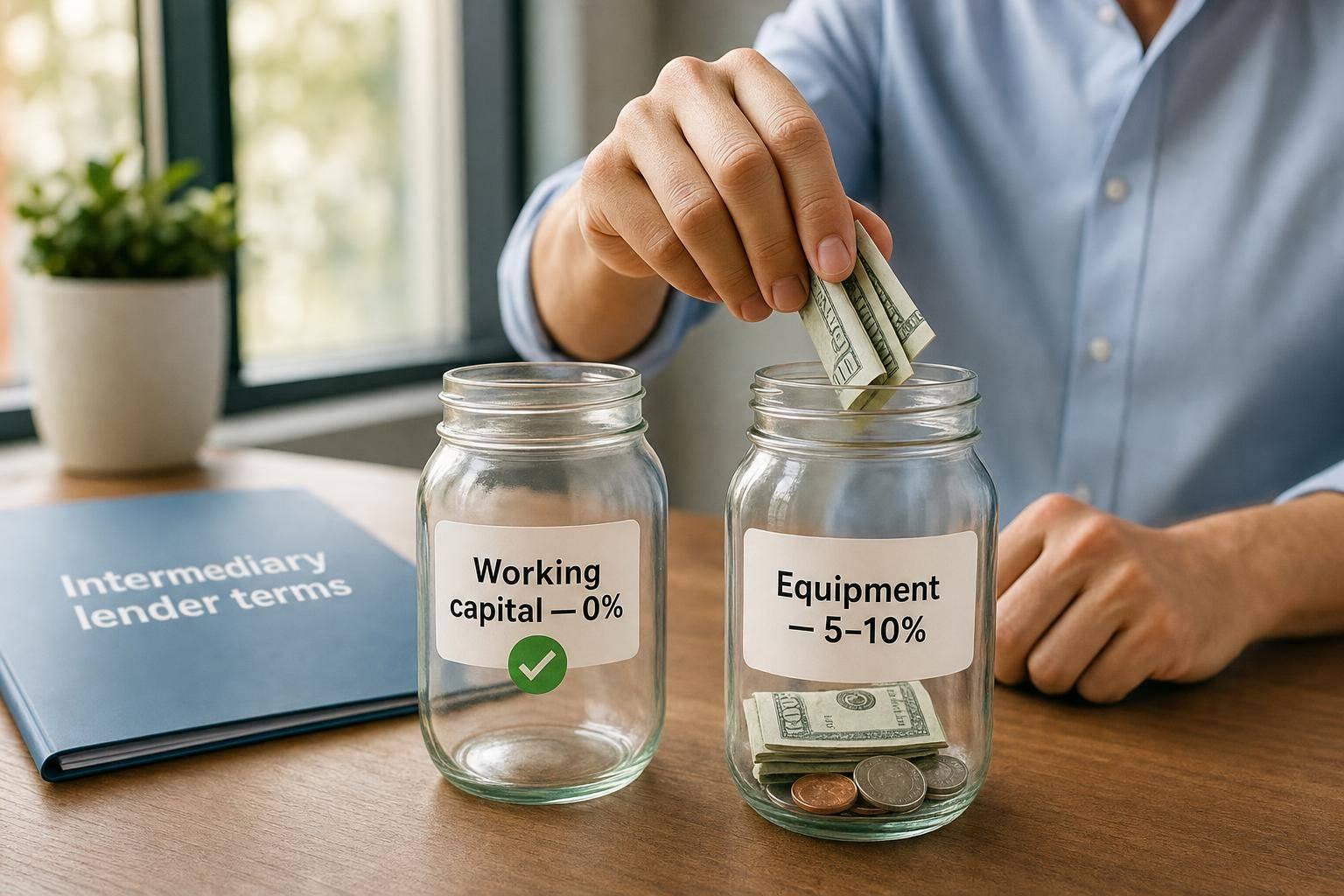
Most SBA microloans do not come with a fixed SBA down payment rule. But a lender can still ask you to put in your own money, often 0%, 5%–10%, or sometimes 10%+ if the deal looks riskier.
Here’s the plain-English answer: if you want an SBA microloan of up to $50,000, the SBA usually does not set one flat cash requirement for everyone. Instead, the nonprofit intermediary lender decides whether you need a down payment or cash injection. In many working capital deals, you may need $0 up front. For equipment or startup costs, a lender may ask for part of the project cost, such as 5%–10%.
Before I apply, I’d keep these points in mind:
- SBA rule: no universal microloan down payment
- Lender rule: may still require borrower funds
- Working capital loans: often no upfront cash
- Equipment loans: more likely to need a borrower contribution
- Risk matters: startups, weak credit, thin cash flow, or missing records can lead to a higher cash ask
- Average microloan size: about $13,000, so 10% would be about $1,300
A lot of the confusion comes from one thing: people mix up down payment, cash injection, collateral, and personal guarantee. They are not the same. That distinction can change how much cash you need to show.
| Term | What it means |
|---|---|
| Down payment | Your share of a specific purchase |
| Cash injection | Your money put into the business or project |
| Collateral | Property pledged to secure the loan |
| Personal guarantee | Your promise to repay if the business cannot |
If I were getting ready to apply, I’d ask the lender three direct questions right away: Do I need to bring cash? How much? What proof do you want? That gets to the heart of the issue fast and helps you avoid surprises.
How Much Downpayment is Required for an SBA Loan
sbb-itb-1eb586e
Down Payment vs. Cash Injection: What Is the Difference?
Lenders don’t always use these terms the same way, and that can change how much money you may need to put in.
A down payment is linked to a specific purchase price. Say you’re buying $20,000 in equipment and the lender finances $15,000. Your $5,000 share is the down payment for that asset.
A cash injection is different. It’s your equity put into the business or project, and it isn’t tied to one item. That can include money you’ve already deposited from savings, startup costs you paid out of pocket, or working capital you commit alongside the loan.
That difference matters because a lender may ask for one or the other based on how the loan is set up.
Collateral is something else entirely. It’s an asset pledged to secure the loan, not cash from you. A personal guarantee is also separate. It’s a legal promise that you’ll repay the debt yourself if the business can’t. In plain English: it’s about repayment, not money you bring in at closing.
| Concept | What It Is | Involves Upfront Cash? |
|---|---|---|
| Down payment | Borrower’s share of a specific purchase price | Yes |
| Cash injection | Owner’s equity contribution to the business or project | Yes |
| Collateral | Asset pledged to secure the loan | No |
| Personal guarantee | Legal promise to repay if the business can’t | No |
Why SBA rules and lender rules are not the same
Once you sort out the terms, the next step is figuring out who actually sets the rule.
For microloans, the intermediary lender – the group that underwrites and services the loan – decides whether borrower funds are required, not the SBA. So when people say, “the SBA requires X% down,” that isn’t accurate in this case. Some lenders ask startups to put in 10% to 20% of total project cost. Another lender may take less if the borrower has strong industry experience or a co-signer.
When a Lender May Still Ask for Borrower Funds
The way you plan to use the loan often shapes the type of contribution a lender wants to see.
If the loan is paying for a defined asset purchase – for example, a $30,000 piece of equipment – the lender may ask you to cover 10% to 20% of that cost. That keeps the loan amount lower and shows you’re sharing some of the risk.
Lenders tend to ask for borrower funds more often with startup loans or loans they view as higher risk. Loan purpose, risk level, and lender policy all play a part in that amount, which the next section breaks down.
How Much Borrowers Are Often Asked to Put In
When lenders ask borrowers to put in their own money, the amount is usually small. It also depends a lot on what the loan is for and how risky the deal looks.
Typical Lender-Driven Contribution Ranges
For most working-capital microloans, there’s often no upfront cash contribution at all. In those cases, lenders tend to look more at your SBA microloan requirements like your business plan, cash flow, and character.
When microloan intermediaries do ask for a contribution, it often falls in the 5%–10% range of the total project cost. And because the average SBA microloan is about $13,000, even a 10% contribution comes out to only about $1,300. That’s a useful planning benchmark, not a fixed program rule.
How Loan Purpose Affects the Contribution Requirement
What you plan to do with the funds can change the answer fast. In many cases, that matters more than almost anything else.
Working capital loans – for payroll, inventory, marketing, or day-to-day costs – are the most likely to come with no down payment requirement, especially if the business already has some operating history and a plan the lender believes in.
Equipment and asset purchases usually work a bit differently. If there’s a clear price tag attached to the project – for example, a $40,000 machinery package for a new landscaping business – many lenders will want the borrower to cover part of that cost. A common range is 5%–10%, which would be about $2,000–$4,000 in that example. It makes the cost share easy to see, and it shows the borrower has some skin in the game.
| Loan Use Case | Typical Lender Practice (Not an SBA Rule) |
|---|---|
| Working capital only | Often no required contribution; many lenders can finance the full working-capital need when cash flow and the plan are solid |
| Equipment/asset purchase | More likely to involve a small borrower contribution |
The amount lenders ask for tends to go up when the risk goes up, which leads to the next factor to look at.
Why the Required Amount Varies by Risk Level and Lender
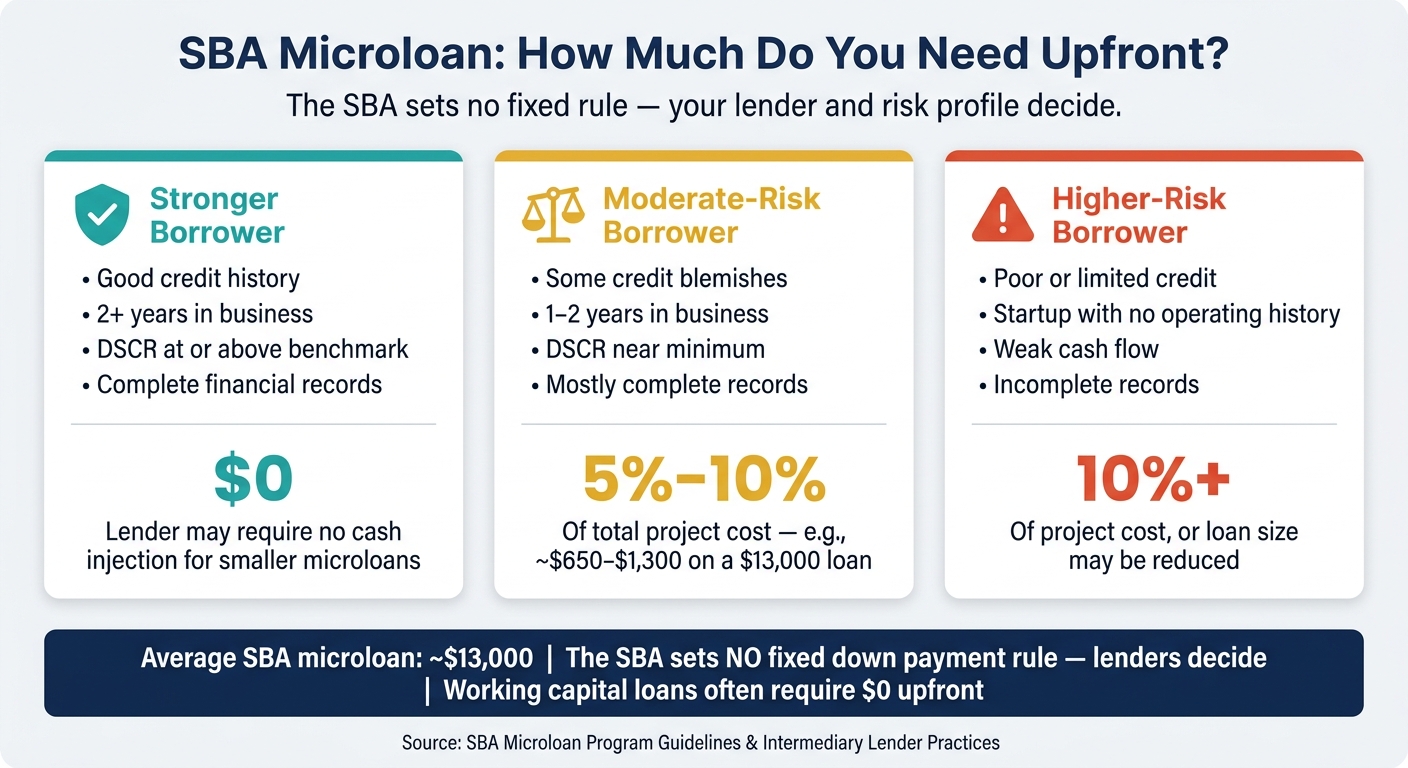
SBA Microloan Down Payment by Borrower Risk Level
What a lender asks for upfront usually comes down to one thing: risk. If the file looks strong, the lender may ask for little or nothing. If the file has gaps, the lender may want the borrower to put in more cash.
The main drivers are credit, cash flow, business age, and record quality.
Borrower Factors That Can Increase the Upfront Contribution
Credit history is one of the first things a lender reviews. A thin credit file, past delinquencies, or accounts in collections can signal more repayment risk. When that happens, lenders often want to see more money from the owner up front.
Startup status tends to work the same way. A new business with no track record is harder to underwrite. Instead of denying the application right away, a lender may ask for a cash contribution to offset that risk.
Weak cash flow is another common trigger. Lenders often want cash flow to cover debt payments by 15%–25%. If the numbers are tight, they may ask the borrower to lower the loan amount or put in cash so the ratio lands in a safer spot.
Less owner commitment can also hurt the file. If the owner has put in very little equipment, no inventory, or almost no savings, a lender may ask for cash to strengthen the deal.
Incomplete records add more doubt. When the paperwork is unclear or missing key details, lenders often respond by asking for more cash or approving a smaller loan.
That helps explain why one borrower may pay $0 up front while another has to contribute much more.
How Borrower Strength Affects the Contribution Requirement
| Borrower Profile | Key Characteristics | Likely Contribution Requirement |
|---|---|---|
| Stronger borrower | Good credit, 2+ years in business, DSCR at or above benchmark, complete financials | Often $0; lender may not require any cash injection for smaller microloans |
| Moderate-risk borrower | Some credit blemishes, 1–2 years in business, DSCR near minimum, mostly complete records | Small contribution likely – often 5%–10% of project cost |
| Higher-risk borrower | Poor or limited credit, startup with no operating history, weak cash flow, incomplete records | 10% or more of project cost, or loan size may be reduced |
Once you know which parts of the file look risky, you can start tightening them up.
Steps to Lower the Chance of a Higher Upfront Contribution
The goal is simple: make the lender more comfortable with the deal.
Start with your records. Put together current profit and loss statements, a balance sheet, and at least two to three years of tax returns. If the business is new, use detailed startup projections instead. Clean, organized financials make the file easier to trust and can reduce the need for extra cash up front.
Show what you’ve already invested. Bank statements and a personal financial statement can help prove owner commitment. The same goes for past spending on equipment or inventory. If a lender can see you’ve already put skin in the game, there may be less pressure to add more cash at closing.
Build projections that hold up. Lenders don’t want wishful thinking. They want numbers tied to actual performance or solid industry data, with DSCR at or above their benchmark. If the projections make sense, it’s easier to show that a big equity injection isn’t needed.
Be specific about how you’ll use the funds. An itemized breakdown of microloan uses for equipment, inventory, marketing, and working capital helps the lender see where the money is going and how it supports revenue and repayment. That can lower the push for more cash up front.
Borrowers with limited credit can still improve their odds with organized records, realistic projections, and a clear use-of-funds plan.
Conclusion: What to Expect and How to Prepare
After looking at lender ranges and risk factors, the main point is pretty simple: the SBA does not set a fixed down payment or cash injection rule for microloans. That decision is left to intermediary lenders.
What they ask from you usually depends on the loan purpose, the risk level, and the lender’s own policy. For example, equipment purchases may require a more visible borrower contribution. Working capital can be handled with more flexibility. And if your credit is weaker or your business has a short operating history, you may be asked to put in more of your own money. On the flip side, strong cash flow, collateral, or direct experience can sometimes lower that amount.
Because each intermediary lender makes its own rules, it’s smart to ask a few direct questions early:
- Is a borrower contribution required for my loan type?
- Can existing assets or past business spending count toward that amount?
- When do I need to document it?
Getting clear answers up front makes it much easier to compare lenders based on what you can actually afford and document.
Getting Your Application Ready
To avoid surprises at closing, document your cash contribution, build a clear project budget, and show how the loan will support repayment. Gather recent bank statements and proof of owner funds already committed, such as receipts, deposits, or inventory purchases. Then match those documents with a SBA microloan business plan and realistic cash flow projections.
If you want help with that process, SBA50K offers a step-by-step funding guide and custom-written SBA-approved business plans to support your microloan application. Bring proof of funds, a clear budget, and realistic projections.
FAQs
Can past business spending count as my cash injection?
It depends on your intermediary lender’s rules. In most cases, lenders look at your full financial picture, not just what you’ve already spent. That usually includes your business plan, cash-flow projections, tax returns, and bank statements.
So if you’ve put money into the business before applying, that past spending often isn’t treated as a formal cash injection on its own.
That said, every lender has its own policy. Check with your intermediary to find out whether your previous investments can count toward any required borrower contribution.
When do I need to prove my down payment or cash contribution?
Usually, this comes up during the loan application and underwriting process.
Lenders often ask for a personal financial statement, along with your business plan and use-of-funds statement. The goal is simple: they want to check your assets and see whether you can put some of your own capital into the deal.
The exact requirements depend on the intermediary lender. SBA50K can help you pull together a complete application file that lines up with what that lender asks for.
Can I still qualify if I have poor credit or a startup business?
Yes. You may still qualify for an SBA microloan as a startup, even with poor or limited credit.
Most lenders look at your full application, not only your credit score. A strong SBA-compliant business plan, realistic cash-flow projections, and organized financial documents can help show that you can repay the loan. SBA50K can help you prepare these materials.
Leave a Reply