

A first SBA microloan can provide up to $50,000 – but the application goes to an SBA-approved nonprofit lender, not the SBA. Start with that lender’s checklist and a budget showing how the business will use the funds and repay the loan.
The process has three main steps:
- Prepare: Check eligibility, confirm allowed expenses, and gather business records, financial statements, and cash-flow projections.
- Complete lender review: Answer questions about credit, repayment, collateral, and personal guarantees. Funding timelines vary, and approval is not the same as receiving funds.
- Review and close: Check rates, fees, and loan conditions before signing. Repayment terms can run up to seven years.
After closing, confirm when funds are available, keep records of loan-funded purchases, and prepare for the first payment. Microloan funds cannot pay existing debt or buy real estate.
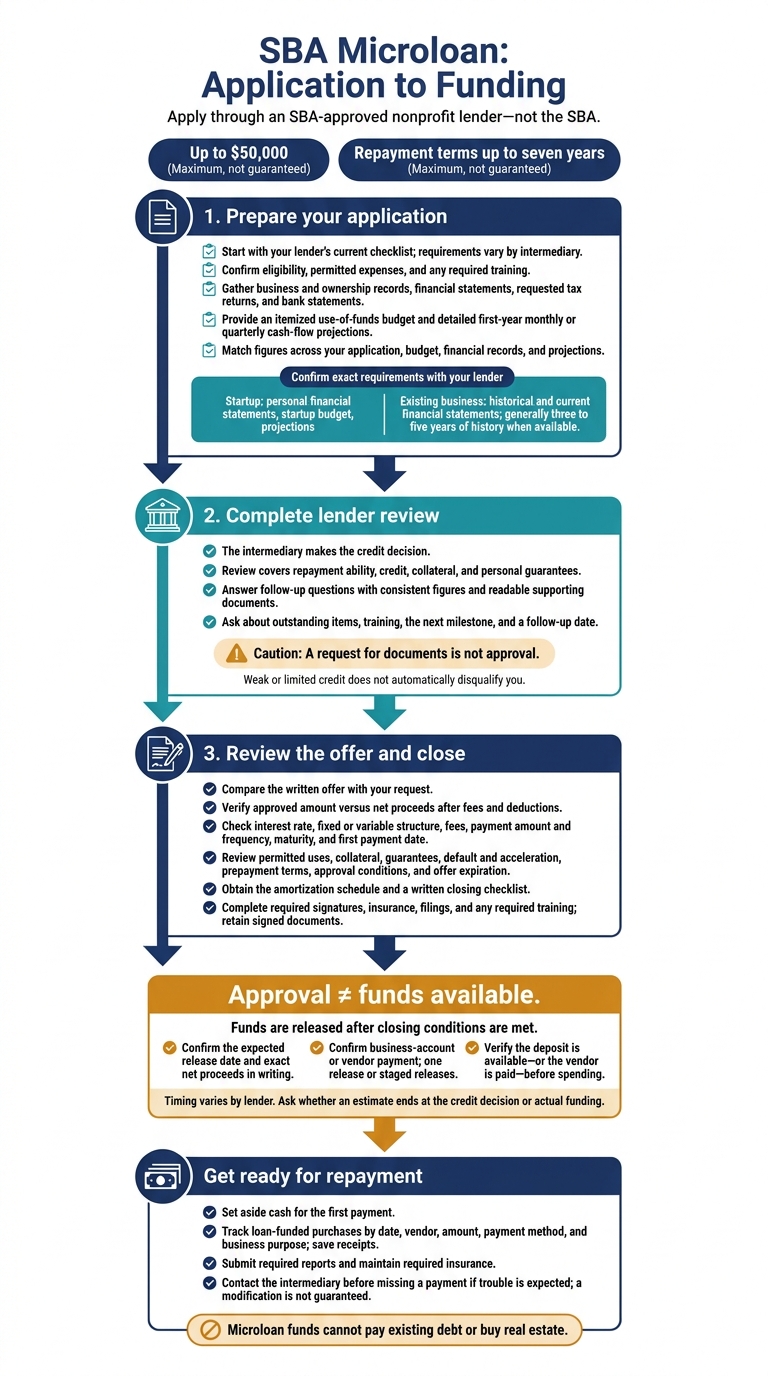
SBA Microloan: Application to Funding
SBA Microloans: A Complete Guide for Startups and Small Businesses
sbb-itb-1eb586e
Step 1: Prepare Your Application
Start with the intermediary’s current application checklist. Confirm which forms you need, accepted projection formats, how recent your records must be, and whether pre-approval training is required.
Once you’ve confirmed the loan fits your business, gather the exact documents on that checklist. These records help the intermediary assess your ability to repay.
Explain Your Funding Request in Your Business Plan
Describe your company, customers, products or services, and management experience. State how much you want to borrow, then include an itemized budget with each planned purchase, its cost, and its business purpose. Separate loan-funded expenses from owner-funded costs so the lender can see how you’ll pay for the full project.
Show how those expenses connect to your repayment plan. Include monthly or quarterly cash-flow projections for the first year, detailing when money comes in, when bills are due, and how loan payments fit. Ask whether the lender also needs longer-term projections, such as income statements, balance sheets, cash flow, and capital spending plans.
Gather Your Financial and Business Records
| Document category | Startup borrower | Existing business |
|---|---|---|
| Financial statements | Owner personal financial statements, startup budget, and detailed first-year monthly or quarterly projections | Historical income statements, balance sheets, and cash-flow information – generally three to five years when available – plus current statements |
| Tax returns and bank statements | Requested personal tax returns and available bank statements | Requested personal and business tax returns, including schedules, plus bank statements |
| Business and ownership records | Business registrations, formation and ownership documents, licenses, permits, leases, and owner resumes | Current versions of these records |
Requirements vary by intermediary. Confirm which records and time periods yours requires rather than treating this table as a checklist for every lender.
Check for Gaps and Conflicting Figures
Compare your application, itemized budget, financial statements, tax returns, bank statements, and projections line by line. Check that expenses, cash balances, debt payments, and revenue assumptions match across documents.
Unexplained differences can prompt questions and delay approval. Explain any legitimate timing differences, label files clearly, and submit readable PDFs. A clear, consistent file means fewer follow-up requests and a faster lender review.
Step 2: Work Through Lender Review
After you submit your file, the intermediary checks whether it’s complete, whether you can repay the loan, and whether you meet its rules. It may also verify ownership, business structure, and required licenses or registrations. The intermediary makes the credit decision.
To assess repayment ability, it reviews past and projected revenue, expenses, debt obligations, bank activity, owner contributions, cash on hand, and projected cash flow.
Understand Credit, Collateral, and Personal Guarantees
Weak or limited credit history doesn’t automatically disqualify you. The lender considers payment history, debts, business viability, and your ability to repay. It usually asks you to explain past credit problems and provide proof that they’ve been resolved. For startups, realistic sales assumptions and owner experience carry more weight because there’s less financial history to review. Weak spots in credit, revenue, or projections can lead to follow-up questions.
Intermediaries generally require collateral and a personal guarantee. Ask which assets will secure the loan, how liens will be recorded, and whether existing liens could cause problems. Also, check whether co-owners or a spouse must sign. Before agreeing, understand what default could mean for both your business and personal assets.
Answer Requests for More Information
Follow-up requests are a normal part of review. The lender may ask about unexplained deposits, unusual expenses, undisclosed debts, ownership changes, collateral titles, or sales projections that lack support. A request for documents is not approval.
Answer each question directly, keep amounts and dates consistent, and send readable supporting documents promptly. Explain corrections in writing, separate past results from forecasts, and report any changes in revenue, debt, ownership, or planned loan use.
Ask About the Lender’s Timeline
A credit decision isn’t the last step. Before funding, the lender still needs to clear closing conditions. Timing varies by lender, and paperwork, follow-up questions, collateral checks, training, and closing conditions can cause delays.
Ask for the current time estimate, outstanding items, required training, next milestone, and a specific follow-up date. Confirm whether that estimate runs through the credit decision or actual funding. Don’t place nonrefundable orders, sign leases, or hire based on expected approval.
Step 3: Review the Offer and Complete Funding
Once the lender issues terms, review the offer and complete any remaining closing requirements.
Compare the written offer with your original request before accepting. Check the loan amount, use of proceeds, net proceeds, payment amount, rate, term, and funding conditions. If the lender approves less than you requested, make sure the amount still covers your planned expense.
Check Loan Costs and Legal Obligations
Ask for the complete offer and amortization schedule before signing. The schedule should break down each payment into principal and interest. Check whether you can afford the payments using conservative cash flow estimates that account for existing debt and seasonal slowdowns.
Review the terms that affect your costs, repayment, and collateral.
| Term to verify | Why it matters | Where to find it |
|---|---|---|
| Approved amount | Confirms how much you are borrowing. | Offer; promissory note |
| Net proceeds | Shows what remains after fees and other deductions. | Closing or disbursement statement |
| Annual interest rate and fixed or variable structure | Determines interest costs and whether payments can change. | Offer; promissory note |
| Payment amount and frequency | Sets how much you must pay and how often. | Amortization schedule; promissory note |
| Maturity | Sets the final repayment date. | Promissory note |
| First payment date | Establishes when repayment begins. | Payment schedule; promissory note |
| Fees and late charges | Identifies upfront costs and charges for missed payments. | Disclosures; loan agreement |
| Default and acceleration | Explains when the lender can demand the unpaid balance. | Loan agreement; promissory note |
| Prepayment | States whether you can repay early and whether a charge applies. | Promissory note; loan agreement |
| Permitted uses | Limits how you may use the proceeds. | Loan agreement; use-of-proceeds schedule |
| Collateral | Defines pledged assets and lien rights. | Security agreement; UCC filing; mortgage |
| Guarantees | Identifies who is personally responsible and for what. | Personal guarantee |
| Approval conditions | Lists requirements that still block funding. | Commitment; closing checklist |
| Offer expiration | Sets the deadline to accept the terms. | Written offer |
Complete the Closing Requirements
Expect a promissory note, loan agreement, security agreement, personal guarantee, and lender-specific disclosures. Depending on the transaction, collateral paperwork may include UCC filings, a mortgage, or other security instruments. Confirm the required insurance, licenses, filing fees, and every required signature.
Ask for a written closing checklist that lists each outstanding item and who must provide it. Check whether you must complete training before the lender releases funds. Clear up any confusing terms or differences from the offer before signing. Keep copies of all signed documents and collateral filings.
Confirm When and How You Will Receive Funds
The lender releases funds after you meet the closing conditions. Get written confirmation of the expected release date and exact net proceeds. Confirm whether the money goes to your business account or directly to vendors, and whether the lender releases it all at once or in stages.
For each release, ask which invoices, receipts, canceled checks, or progress reports you must provide. Before spending the funds, verify that the deposit is available – or that the vendor has been paid.
Conclusion: Get Ready for Funding and Repayment
Before accepting the offer, check that the final terms still fit your cash flow and repayment plan. Review the loan documents for the rate, payment terms, collateral, guarantees, and funding conditions.
Prepare for Payments and Recordkeeping
Once the loan closes, your focus shifts from getting approved to making payments and keeping accurate records.
Set aside cash for the first payment before spending the loan proceeds. Track each loan-funded expense by date, vendor, amount, payment method, and business purpose. Save receipts, submit required reports, and keep required insurance in place.
Know what happens if you miss a payment. Beyond late fees, you could face acceleration, which can make the full balance due immediately. If you expect trouble paying, contact the intermediary before you miss a payment. Bring an updated cash-flow forecast and a proposed payment plan. A loan modification isn’t guaranteed.
Take Your Next Application Step
If your application file is incomplete, use the lender’s checklist to find and fill any gaps before submitting it. Submit only when every figure matches across your plan, projections, and financial records.
FAQs
Can I qualify for an SBA microloan without collateral?
Yes, you may qualify with limited or no collateral. Many intermediary lenders require collateral and a personal guarantee, but requirements depend on the lender, your credit profile, and the loan amount. Some smaller loans may be unsecured.
A strong business plan, detailed cash-flow projections that show you can repay the loan, or a cosigner may help strengthen your application. Check with your intermediary lender about collateral requirements early in the process.
How can I estimate payments before applying?
Ask the intermediary lender for its interest rate, repayment term, fees, and payment schedule. Use those details to estimate your monthly payment, and label any unconfirmed terms as estimates. Rates and terms vary by lender.
Add the payment to your 12-month cash-flow forecast. Check that you can cover it along with operating expenses, taxes, and existing debts – not just in normal months, but when sales are weak, too.
What can I do if my application is denied?
Ask your lender why your application was denied. Based on their feedback, you may need to submit missing documents or more financial records, strengthen your business plan, improve your cash-flow projections, or address credit concerns.
The provided materials don’t confirm whether you can reapply. Addressing the lender’s concerns is the first step toward having your eligibility reconsidered.
Leave a Reply