
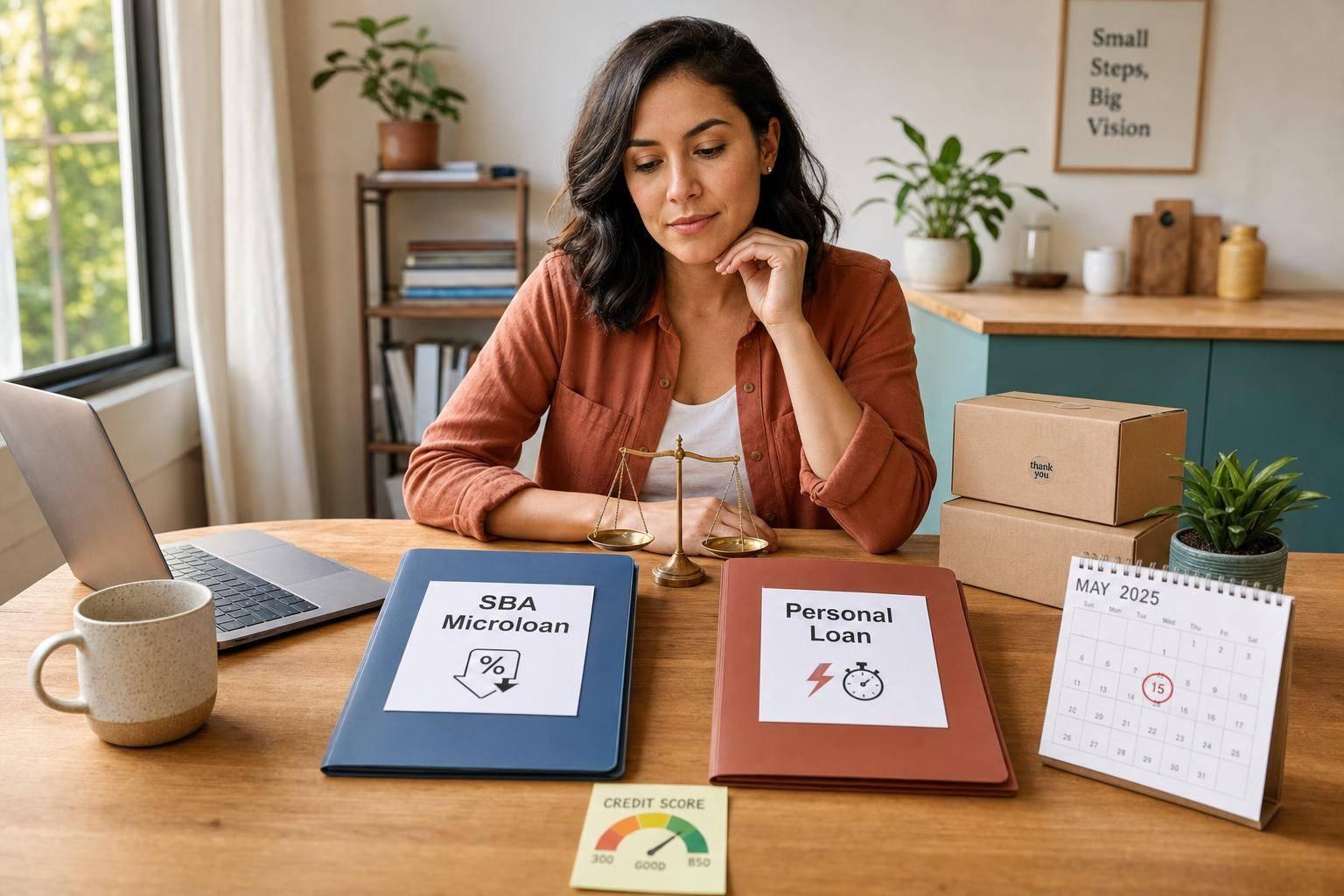
If I need lower rates and smaller monthly payments, I’d lean toward an SBA microloan. If I need cash in days and have strong personal credit, I’d look at a personal loan first.
Here’s the short version:
- SBA microloans offer up to $50,000
- Rates are often around 8% to 13% APR
- Terms can go up to 7 years
- Funding often takes 30 to 90 days
- Funds must be used for business costs only
On the other side:
- Personal loans can fund in 1 to 7 business days
- Rates can range from 6% to 36% APR
- Many borrowers with lower credit land closer to 20% to 35% APR
- Terms are often 2 to 7 years, with many loans in the 3 to 5 year range
- Use rules are often looser, but some lenders do not allow business use
So the choice is pretty simple:
I’d pick an SBA microloan vs bank loan for lower cost and business-focused funding.
I’d pick a personal loan for speed, simple paperwork, and small urgent purchases.
What matters most is:
- How much I need
- How fast I need it
- My credit score and debt-to-income ratio
- Whether I can handle personal risk if the business fails
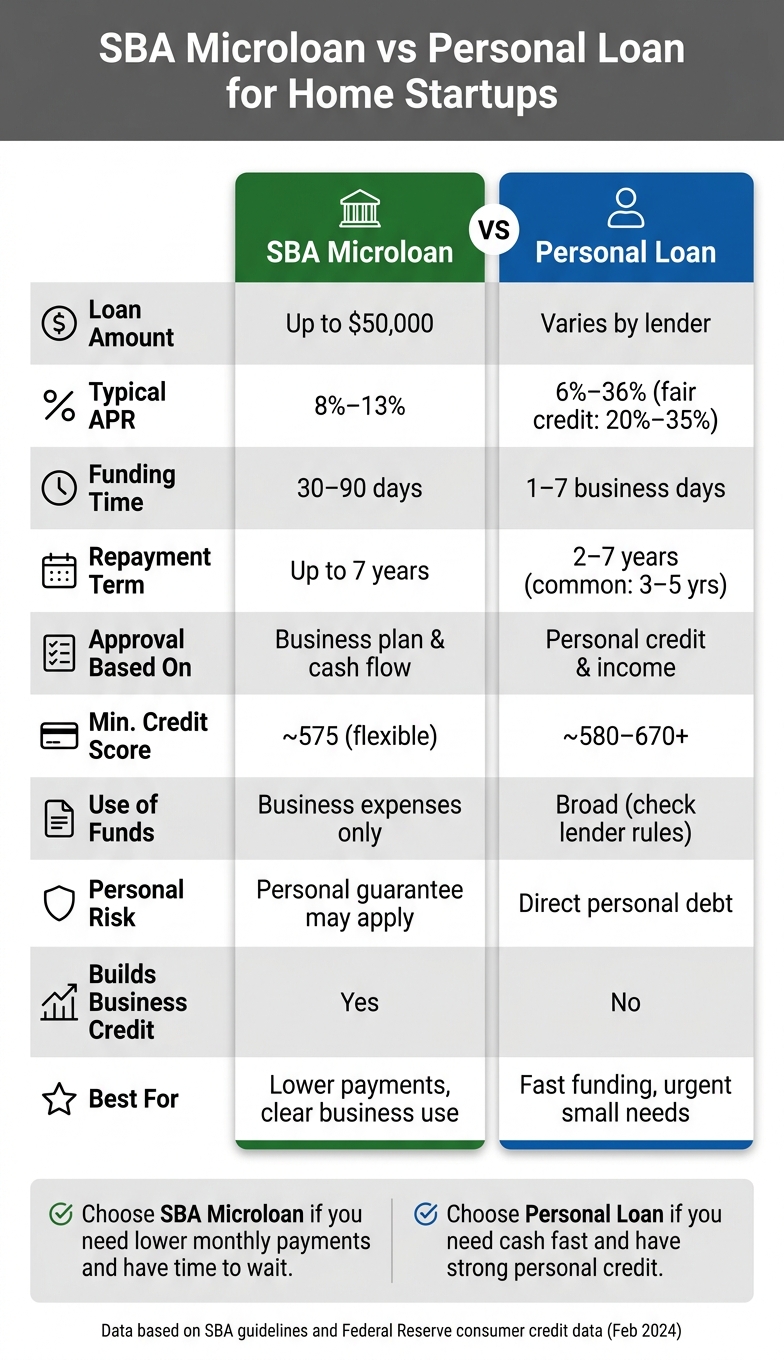
SBA Microloan vs Personal Loan: Side-by-Side Comparison for Home Startups
Business Loan vs. Personal Loan: Which Works for You?
sbb-itb-1eb586e
Quick Comparison
| Factor | SBA Microloan | Personal Loan |
|---|---|---|
| Loan amount | Up to $50,000 | Varies by lender |
| Typical APR | 8%–13% | 6%–36% |
| Funding time | 30–90 days | 1–7 business days |
| Repayment term | Up to 7 years | Often 2–7 years |
| Main approval focus | Business plan, cash flow, credit | Personal credit, income, DTI |
| Use of funds | Business only | Often broad, but check lender rules |
| Personal risk | Often includes a personal guarantee | Direct personal debt |
| Best fit | Lower payment pressure and clear business use | Fast funding and smaller urgent needs |
If I’m starting from home, the main trade-off is simple: lower cost and more paperwork vs. faster funding and more personal exposure. Understanding how to fund your startup with an SBA microloan can help you navigate these requirements.
SBA Microloans for Home-Based Startups
SBA microloans give home-based startups a smaller funding option when a big loan would feel like too much, too soon. These loans come from nonprofit intermediary lenders, not directly from the SBA. Many of those lenders also offer help like counseling or training, which can matter a lot when you’re still getting the business off the ground. In many cases, these intermediaries are community-based groups or CDFIs (Community Development Financial Institutions).
Rates, loan sizes, and repayment terms
Microloans top out at $50,000, but most borrowers use far less, usually about $13,000 to $16,000. For a home-based startup, that smaller loan size can be a good fit. You get enough money to buy what you need without taking on a payment that squeezes your cash flow right away.
Interest rates usually range from 8% to 13% APR, with the intermediary setting the rate within SBA rules. Repayment terms can go up to seven years, and payments are fixed. That longer runway can make monthly payments easier to handle while sales are still ramping up.
Allowed uses and restrictions
There’s a catch: microloans come with tighter spending rules than a general-purpose loan. For a home-based startup, the funds can be used for things like:
- Inventory
- Packaging supplies
- Equipment
- Computers
- Business software
- Furniture for a dedicated workspace
- Working capital for daily operating costs
These loans can’t be used for personal expenses, debt refinancing, or real estate. So if you apply, your planned spending needs to be clear, specific, and easy for the lender to follow.
Approval factors for startups with fair or limited credit
If your home business is new, lenders often look beyond the credit score alone. With nonprofit intermediaries, the review process is usually more flexible than what you’d get at a bank. They look at your business plan, cash-flow projections, how you plan to use the money, and your personal credit history.
For a home-based startup, lenders want to see a simple point: can this business repay the loan from future revenue? Many lenders look for a personal credit score of about 575, though rules vary by lender. Some may also ask for a personal guarantee or collateral, especially if the business is brand new.
SBA50K helps applicants put together lender-ready business plans and loan applications for SBA microloans, which can be especially helpful if credit is limited.
Personal Loans for Home-Based Startups
If an SBA microloan feels too slow or too rigid, especially compared to the SBA microloan program, a personal loan can be a much faster option. It also gives you more freedom in how you use the money. The catch is simple: you pay for that speed and freedom. Approval and pricing depend on your own finances, and the loan is in your name, not your business’s.
For a home-based startup, that puts the trade-off front and center. You may get cash fast, but you also take on the debt yourself.
Rates, terms, and funding speed
The biggest draw here is speed. The biggest downside is cost.
Many online lenders can fund a personal loan within one to seven business days, and some offer same-day or next-day disbursement after approval. That can matter a lot when you need to buy equipment, lock in inventory, or get your site live without waiting weeks.
Rates vary a lot by credit profile. The Federal Reserve tracked the average 24-month personal loan rate at 12.49% APR in February 2024. But that average doesn’t tell the whole story. Borrowers with fair or subprime credit can face rates that often land in the 20% to 35% APR range.
Repayment terms usually run from 24 to 84 months, with many lenders clustering around three to five years. A shorter term can help you clear the debt sooner, but it also means bigger monthly payments. For a new business operating from home, that can put pressure on early cash flow fast.
Spending flexibility and common limits
Compared with microloans, personal loans are usually easier to use. In many cases, lenders don’t closely track how the money is spent.
Home-based founders often use personal loan funds for things like:
- a laptop or desktop
- website hosting
- software subscriptions
- initial inventory
- packaging
- basic marketing and ad spend
- shelving and storage for a home workspace
Still, don’t assume every lender is okay with business use. Some personal loan agreements explicitly prohibit using the funds for business purposes. If you use the money for a business when the agreement says you can’t, you may be violating the loan terms.
If business use is allowed, keep clean records anyway. Even though the loan is personal, a simple paper trail can save you headaches later.
Approval based on personal finances
Because this is personal debt, lenders look at you, not your startup.
That means approval is based on your credit, income, job stability, and debt-to-income ratio, not your business plan. For a brand-new home startup, your personal financial profile is basically the whole case.
A credit score of 670 or higher can improve your odds of approval and help you get better pricing. A score around 580 may still qualify, but usually at a higher cost. Lenders also tend to like a DTI of 36% or less. Approval often gets tougher once DTI moves above 43% to 50%.
That makes personal loans pretty straightforward in one sense: if your finances are in decent shape, the process can move fast. If they aren’t, the loan may still be available, but the price can climb in a hurry.
SBA Microloan vs Personal Loan: Side-by-Side Comparison
Here’s the practical comparison for a home startup. If you’re running a business from home, the main issue usually comes down to this: do you need lower monthly payments, faster funding, or more freedom in how you spend the money?
Cost, Repayment, and Total Cost
SBA microloans usually come with 8%–13% APR and terms of up to 7 years. Personal loans can range from 6%–36% APR, with terms often in the 1–5 year range. And if your credit is fair or limited, those personal loan rates often land on the high end.
That gap changes your monthly payment in a big way. SBA microloans often ease monthly strain because the repayment period is longer. Personal loans usually cost more each month because you pay them back faster. For a home-based business with uneven early income, that can make a big difference.
| Factor | SBA Microloan | Personal Loan |
|---|---|---|
| Typical APR | 8%–13% | 6%–36% |
| Repayment Term | Up to 7 years | 1–5 years (common) |
| Origination/Packaging Fees | Packaging/closing fees may apply, often capped around 2%–3% | Origination fees can run about 1%–10% |
| Monthly Payment Pressure | Lower because the term is longer | Higher because the term is shorter |
Cost matters. But in plenty of cases, approval rules are what decide which option is even on the table.
Approval, Documentation, and Time to Funding
SBA microloans are judged more on business viability. Lenders look at your SBA microloan business plan, your projected cash flow, and how you’ll use the funds. Personal loans are mostly about your credit score, income, and debt-to-income ratio.
That split matters for new founders. If you have a solid business idea but only a thin credit file, an SBA microloan intermediary may be more open to your application than a consumer lender.
The catch is speed. SBA microloans often take 30 to 90 days from application to funding. Many personal loans can fund in 1 to 7 business days. So if timing is tight, that slower pace can be hard to work around.
| Factor | SBA Microloan | Personal Loan |
|---|---|---|
| Main approval factor | Business plan and cash flow | Your credit and income |
| Documents Required | Business plan, projections, tax returns, and lender forms | ID, income proof, and credit check |
| Collateral or Guarantee | Often requires a personal guarantee and may require collateral | Usually unsecured |
| Time to Funding | 30–90 days | 1–7 business days |
Once you get approved, the next thing to look at is how much control you have over the money.
Use-of-Funds Rules and Personal Liability
SBA microloans are for business use only. You can’t use them for real estate or to refinance existing debt. Some intermediaries may also ask for invoices or receipts to make sure the money is used within the rules.
Personal loans usually give you more spending freedom, although some lenders do ban business use. Another key point: personal loans show up on your personal credit, not your business credit.
| Factor | SBA Microloan | Personal Loan |
|---|---|---|
| Allowed Uses | Business only (working capital, inventory, supplies, equipment, furniture, fixtures) | Broad spending flexibility |
| Prohibited Uses | Real estate and debt refinancing | Not generally restricted for legal uses |
| Business Credit Impact | Can help build business credit history | Does not help build business credit |
| Personal Credit Exposure | Indirect, but personal guarantee can create personal liability | Direct – tied to your personal credit |
| Default Consequence | A personal guarantee can create personal liability | Collections and charge-offs can damage your personal credit |
Which Loan Fits Your Home Startup Better
Use the comparison above to narrow your choice based on purpose, timing, and risk.
When an SBA microloan may be the better choice
An SBA microloan can make more sense if you need $5,000 to $50,000 for clear business costs and you have time to wait for approval. It also fits well when the money is going toward launch expenses and you need payments to stay easier to handle while sales are still getting off the ground.
Because SBA microloan intermediaries look at your business plan and ability to repay, along with your credit history, a first-time founder with limited credit may have a better chance here than with a consumer lender.
If you want help with the process, SBA50K offers step-by-step guidance, custom business plan writing, and intermediary lender connections to help improve approval chances.
If the need is clearly tied to the business and your timeline has some room, this is often the cleaner option.
When a personal loan may make more sense
A personal loan can be a better fit when the amount is small, the need is urgent, and the purchase is pretty straightforward. If you need money fast, many personal loans can fund in 1 to 7 business days. That is much faster than the SBA microloan process.
For a small purchase that can’t wait, a personal loan may simply be the easier route.
If speed matters more than business loan structure, this is the faster path.
Use this quick test before you apply
Pick based on four things: amount, timing, documentation, and how much personal risk you can carry.
| Decision Factor | Lean Toward SBA Microloan | Lean Toward Personal Loan |
|---|---|---|
| Funding amount | Moderate startup funding | Very small amount |
| Timing | Can wait longer for approval and funding | Need funds within days |
| Credit profile | Fair, limited, or imperfect | Strong personal credit |
| Documentation | Can provide a business plan | Minimal paperwork preferred |
| Monthly cash flow | Want lower payments over a longer term | Can handle higher short-term payments |
Both options can put your personal finances on the line. SBA microloans often require a personal guarantee, and personal loans are tied directly to your personal credit. Put simply, a microloan is built for a business plan, while a personal loan is built for personal borrowing.
FAQs
Can I use a personal loan for startup costs?
Yes, you may use a personal loan for startup costs.
By contrast, SBA microloan funds are for approved business uses like working capital, inventory, equipment, supplies, furniture, and fixtures. They can’t be used for personal expenses or personal debt.
If you’re going after an SBA microloan, SBA50K can help with a step-by-step funding guide, SBA-approved business plans, and loan application support.
Which option is easier to qualify for?
SBA microloans are often easier to qualify for than bank financing or standard equipment loans because they’re built for startups and business owners with limited or poor credit.
Instead of putting most of the weight on a long track record or major collateral, intermediary lenders often look at things like your business potential, your ability to repay, and how strong your business plan is. SBA50K can help by walking you through the process and backing your application.
What happens if I can’t repay the loan?
If you can’t repay an SBA microloan, what happens next comes down to your loan agreement and your intermediary lender’s rules. Because the SBA doesn’t lend money directly, your first move should be to contact your intermediary lender as soon as possible and explain what’s going on.
If you miss payments, the loan can go into default. That can damage your personal credit and make it harder to get financing later. And if you pledged collateral for the loan, the lender may take those assets and sell them to cover what you still owe.
Leave a Reply