
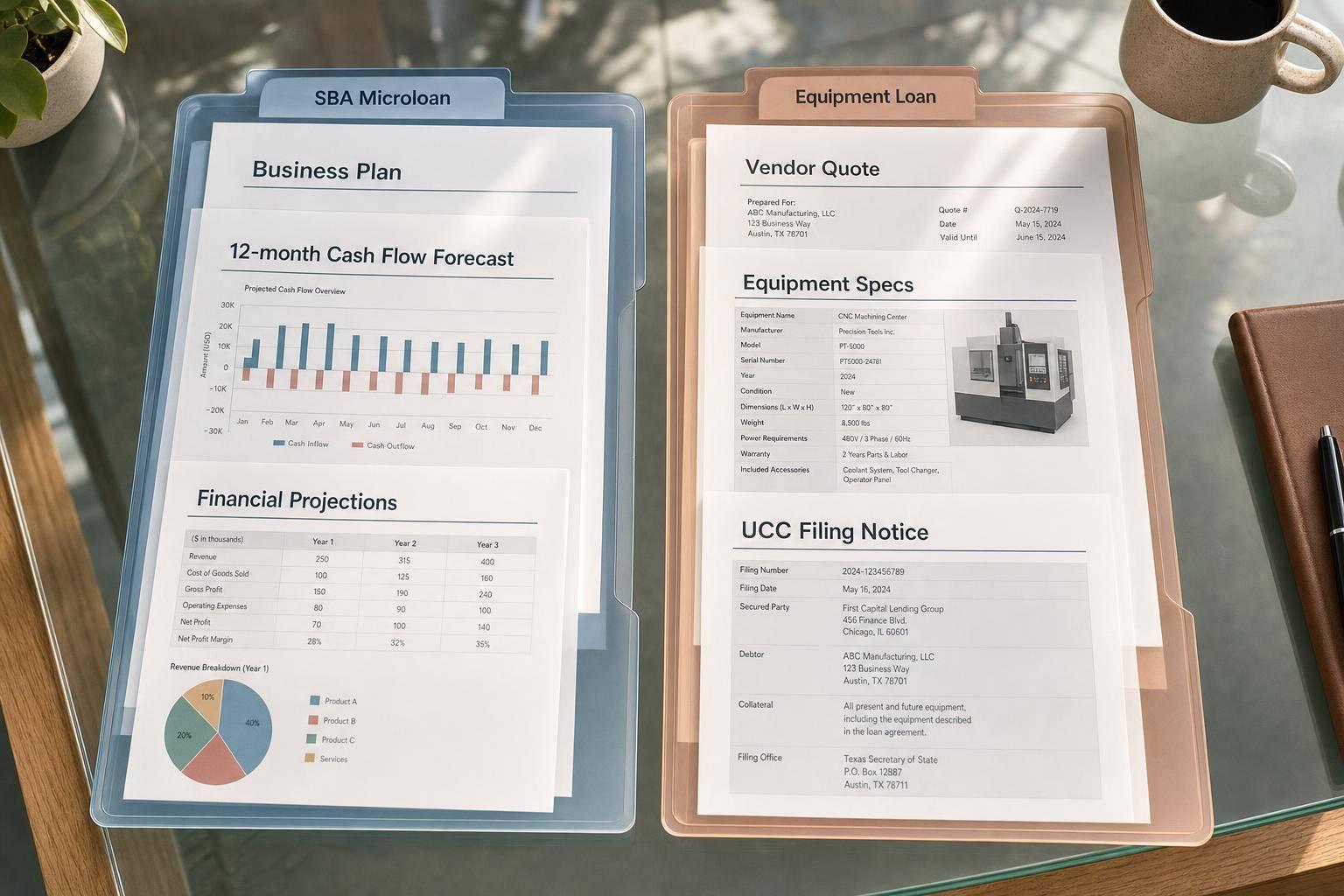
If I need an SBA microloan, I should expect more business paperwork. If I need an equipment loan, I should expect more asset paperwork. That’s the core difference.
Here’s the short version:
- SBA microloans go up to $50,000
- They often ask for:
- a business plan
- a use-of-funds breakdown
- cash flow forecasts
- personal and business tax returns
- a personal financial statement
- Equipment loans are tied to a specific purchase
- They often ask for:
- a vendor quote or invoice
- equipment details like make, model, year, serial number, or VIN
- recent bank statements
- business tax returns
- security documents like a UCC-1
Put another way:
- With a microloan, I’m proving why the business needs the money
- With an equipment loan, I’m proving what asset I’m buying and what it’s worth
A few points stand out:
- Microloan lenders often want 12 to 24 months of forecasts
- Many review repayment using a debt service coverage ratio of about 1.15 to 1.25
- Both loan types often ask for 3 to 6 months of business bank statements
- Owners with 20% or more of the business often need to give personal financial details and a guarantee
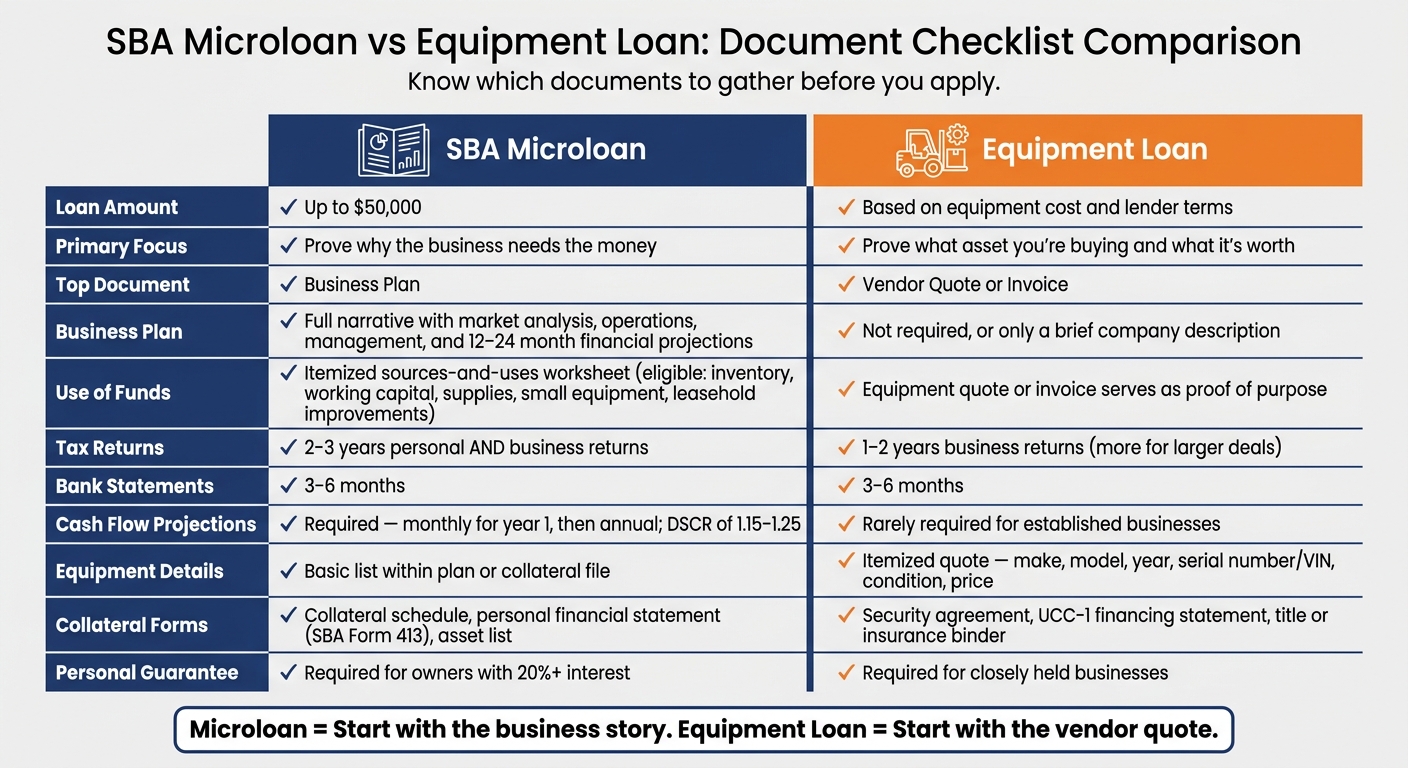
SBA Microloan vs Equipment Loan: Document Checklist Comparison
Equipment Financing or SBA Loan Which is Better?
sbb-itb-1eb586e
Quick Comparison
| Area | SBA Microloan requirements | Equipment Loan |
|---|---|---|
| Main focus | Business plan and repayment story | Asset details and current cash flow |
| Top document | Business plan | Vendor quote or invoice |
| Loan amount | Up to $50,000 | Based on equipment cost and lender terms |
| Forecasts | Usually required | Often not needed for established firms |
| Collateral file | Asset list, personal financial statement, lender forms | Security agreement, UCC-1, title or insurance if needed |
My takeaway: if I’m building a microloan file, I should start with the story and the numbers. If I’m building an equipment loan file, I should start with the quote and the asset records.
SBA Microloan Documents: What Lenders Typically Request
SBA microloan files usually revolve around three things: the business plan, proof of the numbers, and how the loan gets paid back. In most cases, lenders want documents in three buckets: the business plan, financial records, and collateral paperwork.
Business Plan and Use-of-Funds Breakdown
A written business plan is a core part of most SBA microloan applications. Lenders use it to size up the business model, target market, competitive position, and the owner’s ability to carry the plan out.
The plan should cover the market, explain the product or service, and include realistic revenue projections for the next 12 to 24 months. The first year should be shown month by month, and those projections should tie straight to the loan request. You’ll also want a use-of-funds schedule that shows where each dollar is going.
That breakdown should point to eligible costs such as:
- inventory
- working capital
- supplies
- small equipment
- leasehold improvements
Leave out real estate and debt refinancing.
After that, lenders look at the numbers to see whether repayment makes sense.
Financial Records, Tax Returns, and Cash Flow Projections
Most intermediaries ask for a pretty standard set of financial documents:
- 2 to 3 years of personal tax returns
- 1 to 2 years of business tax returns for existing businesses
- Year-to-date profit and loss statement
- Balance sheet dated within 60 to 90 days
- 3 to 6 months of business bank statements
- Forward-looking cash flow projections
The big idea here is simple: lenders want to know if monthly cash flow can cover the loan payment and still leave some breathing room. Many look for a debt service coverage ratio of at least 1.15 to 1.25. Equipment lenders, by contrast, tend to lean more on current cash flow and the value of the asset itself.
Collateral Lists, Personal Financial Statements, and Lender Forms
Even small microloans often come with collateral paperwork. Lenders may ask for a list of business assets, rough values, and any liens already tied to them.
Owners with 20% or more ownership usually need to submit a personal financial statement, often with SBA Form 413 used as the template, and sign a personal guarantee. Many lenders also ask for their own borrower forms and checklists. In some cases, that includes SBA Form 1919, depending on the lender.
Next, compare that package with the asset-first documents required for equipment loans.
Equipment Loan Documents: What Lenders Focus On
Microloans tend to lean on your business story. Equipment loans are different. Here, lenders care most about proof of the asset and how the business looks right now.
Application, ID, and Business Formation Records
Most equipment lenders begin with a completed business equipment loan application, a government-issued photo ID for each owner with at least 20% ownership, and basic business formation and registration records. The application usually asks for the business’s legal name, EIN, ownership details, time in business, loan amount, and the equipment’s description and purpose.
They also tend to ask for Articles of Organization or Incorporation, an operating agreement or bylaws, a recent Certificate of Good Standing, and any required business licenses. For LLCs, the operating agreement shows the ownership split and identifies who has authority to sign. Sole proprietors are often asked for a business license and, if they use a trade name, a DBA certificate.
This paperwork helps lenders verify that the business is set up properly, confirm who can sign the loan documents, and see who may need to provide a personal guarantee.
After that, attention shifts to the paperwork tied to the purchase itself.
Equipment Quotes, Invoices, and Asset Details
The quote or invoice is what defines the asset being financed. A solid quote should include the vendor’s name and contact information, along with the equipment’s make, model, year, serial number or VIN, condition (new or used), and itemized purchase price. If there are extra charges like installation, freight, or training, those should appear as separate line items.
For used equipment, lenders often want more backup. That can include photos, an hour-meter reading or mileage, and sometimes an independent inspection report or appraisal. Many lenders also require an insurance binder or policy that names the lender as loss payee, plus proof of clear title for any titled asset such as a vehicle or trailer.
Why the extra detail? Simple. Lenders want to know the equipment is worth what the invoice says it is, and they want their lien tied to the right asset.
Bank Statements, Tax Returns, and Security Documents
Once the equipment is documented, lenders look at cash flow and the legal papers that secure the deal.
On the financial side, equipment lenders usually ask for 3–6 months of business bank statements and 1–2 years of business tax returns. Bigger loan amounts may call for up to 3 years of returns. Underwriters look through bank statements for steady deposits, average balances, overdrafts, and returned items. Tax returns help show revenue direction and profit history.
If the deal includes a personal guarantee, or if owners hold 20%+ equity, personal tax returns and a personal financial statement are often added to the file. Lenders may also ask for a current year-to-date profit and loss statement, a balance sheet, and a business debt schedule listing each existing loan, monthly payment, remaining balance, and maturity date.
The collateral file usually matches the equipment shown on the invoice and includes:
- a security agreement
- a UCC-1 financing statement
- a matching collateral description
SBA Microloan vs Equipment Loan Documents: Side-by-Side Comparison
The difference is pretty simple: microloans ask you to prove the business case, while equipment loans ask you to prove the asset. In practice, that comes down to three things: what shows the loan makes sense, what shows what you’re buying, and what backs repayment.
Here’s the side-by-side view across the main document categories:
| Documentation Area | SBA Microloan | Equipment Loan |
|---|---|---|
| Business plan | Full narrative plan with market analysis, operations, management, and financial projections | Often not required; a brief company description may be enough |
| Use of funds | Itemized sources-and-uses worksheet with dollar amounts by category | Equipment quote or invoice serves as proof of purpose |
| Equipment details | Basic equipment list or description within the plan or collateral file | Itemized quote with make, model, condition, price, and other asset details |
| Tax returns | Usually 2–3 years of personal and business returns | Often 1–2 years of business returns; more for larger deals |
| Bank statements | Recent 3–6 months | Recent 3–6 months |
| Cash flow projections | Required; generally monthly in the early period, with longer-range projections after that | Rarely required for established businesses |
| Collateral forms | Collateral schedule, personal financial statement, and asset list | Security agreement, UCC-1 filing, and title or insurance binder when applicable |
| Personal guarantee | Typically required for owners with 20%+ interest | Typically required for closely held businesses |
Business Plan, Use of Funds, and Equipment Quote Requirements
The biggest gap shows up right at the start of the file. SBA microloan intermediaries usually want a full business plan, not a one-page overview. That plan often covers the market, daily operations, ownership, and financial projections.
SBA microloans usually require a full narrative plan and sources-and-uses schedule; equipment loans usually lean on the vendor quote or invoice.
| Requirement | SBA Microloan | Equipment Loan |
|---|---|---|
| Business plan depth | Full narrative plan with market analysis and financial projections | None required, or only a brief company description |
| Use-of-funds format | Written narrative plus itemized sources-and-uses worksheet | Equipment quote or invoice |
| Equipment documentation | Basic list as part of the plan or collateral file | Itemized quote with make, model, condition, price, and delivery details |
Once the lender sees what the money is for, the file usually shifts to cash flow and collateral.
Cash Flow Records and Collateral Paperwork
SBA microloan lenders look at both past results and future projections, since many borrowers are startups or businesses with thin credit files. Those projections are often monthly for the first 12 months, then annual after that, with assumptions that explain how the numbers were built.
Equipment lenders usually care more about the current picture. Recent bank statements from the last three to six months, with steady deposits and manageable balances, can matter more than a long-range forecast. For an established business, current cash flow often tells the story.
The collateral paperwork follows that same split. A microloan file often includes a collateral schedule, a personal financial statement showing real estate, vehicles, and savings, plus a list of business assets. An equipment loan file is usually centered on a security agreement and a UCC-1 financing statement that connects the lender’s lien to the financed asset.
| Requirement | SBA Microloan | Equipment Loan |
|---|---|---|
| Tax return history | Usually 2–3 years of personal and business returns | Often 1–2 years of business returns; more for larger deals |
| Bank statement history | Recent 3–6 months | Recent 3–6 months |
| Cash flow projections | Required; monthly early on, then annual projections | Rarely required for established businesses |
| Collateral forms | Collateral schedule, personal financial statement, asset list | Security agreement, UCC-1 filing, title or insurance binder when applicable |
| Personal guarantee | Typically required for owners with 20%+ interest | Typically required for closely held businesses |
Lender Review Steps and Approval Workflow
The review process follows the same divide. Microloan lenders review the full business file. Equipment lenders tend to focus on the asset and the source of repayment.
SBA microloan intermediaries, which are usually nonprofit or community-based groups, tend to run a more guided process. They screen for eligibility, walk borrowers through a document checklist, review the business plan, look at cash flow, check collateral, and prepare SBA-required forms before approval. Many of these intermediaries also provide coaching or technical assistance along the way.
Equipment finance is more asset-driven and lighter on paperwork. The lender takes the application, pulls credit, reviews the quote, checks recent bank statements, looks at the asset’s resale value, and moves toward closing. The closing package is usually slimmer too: a security agreement, a UCC-1 filing, and a loan or lease agreement.
| Review Area | SBA Microloan | Equipment Loan |
|---|---|---|
| Review focus | Business viability, character, community impact, and cash flow | Asset value, current repayment capacity, and credit |
| Documentation checkpoints | Business plan, projections, tax returns, collateral schedule, SBA forms | Application, quote or invoice, bank statements, tax returns |
| Collateral review | Business and personal assets may both be considered | Asset-specific lien with UCC-1 perfection |
| Typical closing paperwork | Intermediary loan agreement and SBA-required forms | Security agreement, UCC-1 filing, loan or lease agreement |
How to Prepare the Right File for Each Loan Type
You can turn the differences above into a SBA microloan application checklist. For an SBA microloan, start with the business plan and the use-of-funds schedule. The plan should explain your market, day-to-day operations, and management team. Then map every dollar in the use-of-funds schedule to an eligible expense category.
Next, pull together the tax returns, current financials, and projections listed above, and add a short assumptions sheet. That gives the lender a clear view of how the business makes money and whether the loan can be paid back from operations. After that, complete the lender’s personal financial statement and build a collateral list that covers business assets, vehicles, inventory, and any real estate.
With a microloan, the file is built around the business. With an equipment loan, the focus shifts to the asset itself.
That means the equipment-loan file should start with proof of the purchase, not a long business story. The anchor document is a full vendor quote or invoice. It should show the vendor name, equipment details, total price, taxes, delivery charges, and the expiration date. Add 3 to 6 months of recent business bank statements and your latest business tax returns alongside it.
For borrowers putting together an SBA microloan file, SBA50K offers custom-written SBA-approved business plans and lender connections for borrowers pursuing SBA microloans.
FAQs
Which loan is easier to document?
SBA microloans are usually easier to document than standard equipment loans. You’ll still need the basics, like financial statements, tax returns, and a clear explanation of how you plan to use the money. But microloans are built to be more accessible for startups and for borrowers with limited credit history.
Standard equipment loans often ask for more physical collateral and a longer track record in business. SBA50K can make the microloan process feel less like a maze by guiding you through each step and helping with a custom business plan.
Can I use an SBA microloan to buy equipment?
Yes. SBA microloans can be used to buy equipment for your business, including machinery, furniture, fixtures, and other startup or day-to-day business needs.
When you apply, you’ll usually need to provide supporting documents, such as vendor quotes or purchase contracts, that show how you plan to use the funds.
What if I have weak credit or limited financial history?
You may still qualify for an SBA microloan. Many microlenders care more about whether you can repay the loan than whether your credit is spotless.
That means preparation matters. A strong, SBA-ready business plan, solid financial projections, and clear cash-flow estimates can go a long way. You may also need to explain any gaps or negative marks on your personal credit report.
It also helps to show up with your paperwork in order. That can include organized financial records and supporting documents like vendor quotes.

Leave a Reply