

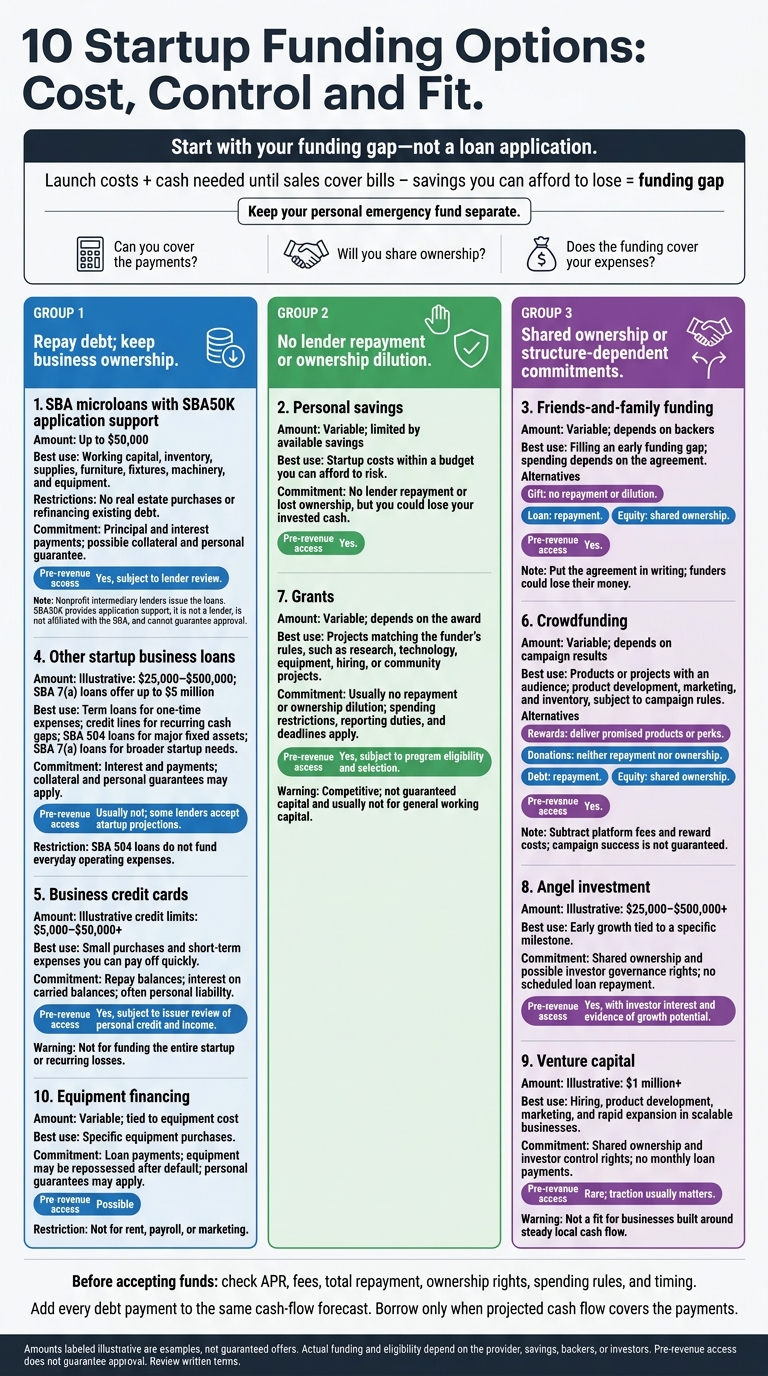
I’d start with your funding gap – not a loan application. Add your launch costs and cash needed until sales cover bills, then subtract savings you can afford to lose. Keep your personal emergency fund separate.
Your choice comes down to three questions: Can you cover the payments? Will you share ownership? Does the funding cover your expenses? SBA microloans, for example, offer up to $50,000, but cannot fund real estate or refinance debt.
Here’s how I’d compare the 10 options.
Quick Comparison
| Funding option | Best use | What you owe or risk |
|---|---|---|
| SBA microloans with SBA50K application support | Smaller startup costs, inventory, and equipment | Loan payments; possible collateral and personal guarantee. SBA50K helps with applications but isn’t a lender. |
| Personal savings | Costs you can afford to fund yourself | Your invested cash; no loan payments or lost ownership |
| Friends-and-family funding | Filling an early funding gap | Repayment, shared ownership, or neither – depending on the agreement |
| Other startup business loans | Larger purchases and cash needs | Interest and payments; approval can be harder before revenue |
| Business credit cards | Small purchases you can pay off soon | Interest on carried balances; often personal liability |
| Crowdfunding | Products or projects with an audience | Rewards, ownership, or repayment, depending on the campaign |
| Grants | Projects that meet a funder’s rules | Spending limits and reporting duties; usually no repayment |
| Angel investment | Early growth tied to a clear goal | Shared ownership and possible investor control |
| Venture capital | Businesses built to scale | Shared ownership and investor control |
| Equipment financing | Specific equipment purchases | Loan payments and possible repossession |
<u>Before accepting funds, check the written terms.</u> I’d compare fees, total repayment, ownership rights, spending rules, and timing – and add every debt payment to the same cash-flow forecast.
10 Startup Funding Options: Cost, Control and Fit
Best & Worst Business Funding Options For A Startup Company
sbb-itb-1eb586e
Estimate Your Startup Funding Needs
Separate opening costs from monthly bills. Record every expense in U.S. dollars. Set aside a one-time budget for equipment, furniture, business licenses, renovations, and initial inventory. Track rent, payroll, supplies, inventory replenishment, and marketing as monthly operating costs. This split shows how much you need to open and keep the business running.
Include monthly cash-flow projections in your business plan. Then use projected shortfalls to set a buffer for delayed sales and surprise costs.
Calculate your funding gap by subtracting the savings you’re willing to put at risk from your total startup and operating costs. Leave your personal emergency fund out of the calculation.
Next, check which lenders can cover that gap. Strong personal credit can help you qualify for loans. If you have limited credit or no revenue history, SBA microloans may be a better fit. Each lender has its own requirements, so ask about credit standards and collateral before applying. Show how you’ll use the funding and how the business will cover repayment. Compare your funding gap with the available loan amount to see whether an SBA microloan can cover it.
Test the payment, not just the loan amount. Add proposed principal and interest payments to your monthly projections, along with existing debt payments. If projected cash can’t cover them, reduce launch costs or avoid debt. Use your funding gap and payment limit to compare which funding sources fit your budget.
1. SBA Microloans With SBA50K Application Support
How Funding Works and Allowed Uses
An SBA microloan can help cover early launch costs if your funding gap is under $50,000 – without giving up ownership. Nonprofit intermediary lenders issue loans of up to $50,000; the SBA does not lend directly. You can use the money for working capital, inventory, supplies, furniture, fixtures, machinery, and equipment, but not real estate or refinancing existing debt. This option fits smaller startup gaps when your planned expenses qualify.
Eligibility and Credit Requirements
U.S.-based, for-profit small businesses must meet SBA size standards for their industry. Lenders review your credit history, business plan, and cash flow to assess your ability to repay. Limited or weak credit doesn’t automatically rule you out. Each lender sets its own requirements.
Repayment, Ownership, and Risk
You keep ownership and repay principal and interest over a term set by the lender, up to seven years. Interest rates range from 8% to 13%. Lenders may require collateral and a personal guarantee, which makes you personally responsible for repayment. If you default, your collateral could be at risk.
Funding Needs and Startup Fit
The average loan is about $13,000, so microloans tend to suit smaller startup needs. Before buying anything, confirm that the expense qualifies.
SBA50K Application Support
SBA50K offers a step-by-step guide, checklist, lender connections, and application help. It isn’t a lender, isn’t affiliated with the SBA, and can’t guarantee approval. Before paying, check the fee and what services it covers. Its support doesn’t replace the lender’s eligibility review. Use SBA50K for help organizing your application – not for guaranteed approval.
If a microloan won’t cover your full funding need – or you’d rather avoid debt – the next option is personal savings.
2. Personal Savings
How Funding Works and Allowed Uses
Use personal savings to cover the part of your startup funding gap you can afford to risk. Savings or side-job income can pay for licenses, inventory, supplies, marketing, deposits, and cash to run the business at launch. You don’t need lender approval, you keep full ownership, and you avoid loan payments and interest.
Repayment, Ownership, and Risk
If the business fails, you could lose the money you invest. Stick to funds you’ve set aside for startup costs.
Funding Needs and Startup Fit
Savings work best when launch costs fit a budget you can afford. Account for both one-time expenses and regular costs until the business can support itself.
If your savings don’t cover the full amount, friends-and-family funding can help fill the gap.
3. Friends-and-Family Funding
How Funding Works and Allowed Uses
Friends and family can help fund a startup through a loan, equity investment, or gift. Agree on the type before money changes hands, and connect it to specific costs: inventory, equipment deposits, professional fees, or working capital. This funding often bridges the gap between personal savings and formal financing.
Eligibility and Credit Requirements
Friends-and-family funding relies more on trust than credit. That can make it an option for founders with limited credit history or no established business records. Even so, share a business plan, financial projections, and a clear explanation of where the money will go.
Repayment, Ownership, and Risk
Loans require repayment with interest but give the lender no ownership. Equity gives the funder a stake in the business. Gifts require neither repayment nor ownership, but they may create gift tax issues. Have a tax professional review large gifts and below-market loans.
Put the agreement in writing. For loans, spell out payment dates and interest. For equity, define ownership percentages and voting rights. Explain what happens if the business closes, including who gets repaid first and how remaining assets are divided. Make it clear that funders could lose their money, and keep records of all business transactions, profits, and losses.
Funding Needs and Startup Fit
This option fits early-stage startups when formal financing is out of reach and backers can afford the risk. If friends-and-family funding still leaves a gap, the next option is a startup business loan.
4. Other Startup Business Loans
How Funding Works and Allowed Uses
When a microloan won’t cover the gap, startup business loans can provide more funding. Conventional term loans give you a lump sum that you repay on a fixed schedule. A revolving line of credit lets you borrow, repay, and borrow again within your limit.
Term loans can pay for equipment, inventory, marketing, or working capital. Credit lines work best for recurring inventory purchases and cash-flow gaps.
SBA 7(a) loans offer up to $5 million for startup needs, including working capital, equipment, and real estate. SBA 504 loans fund major fixed assets, such as machinery and business property – not everyday operating expenses. Match the loan to the expense before you apply.
Eligibility and Credit Requirements
Getting approved is harder before your business earns revenue. Banks often require at least two years of business records. Some lenders that work with startups accept projections instead, but they also review your personal credit, industry experience, and ability to repay. A credit score around 690 is a common 7(a) benchmark, not a guarantee of approval.
Have your business plan, owner resumes, tax returns, bank statements, and projections ready. Before applying, ask whether the lender accepts pre-revenue businesses. Also check industry eligibility, collateral, down payment requirements, and personal guarantees.
If your credit and projections meet the lender’s requirements, compare term loans, credit lines, and SBA-backed options.
Repayment, Ownership, and Risk
Compare APR, fees, payment schedules, and total repayment – not just the interest rate. Shorter terms can leave you with larger payments.
Collateral requirements depend on the loan amount and program. If you default, the lender can seize pledged assets. Read any personal guarantee carefully, too: it can put your personal assets at risk.
Funding Needs and Startup Fit
Use a term loan for a one-time expense, a credit line for recurring cash gaps, a 504 loan for major fixed assets, or a 7(a) loan for broader startup needs. If your business hasn’t earned revenue yet, you’ll need to show that projected cash flow can cover the payments.
For smaller or shorter-term funding needs, the next option is a business credit card.
5. Business Credit Cards
Business credit cards can cover smaller funding gaps when you need flexible, revolving credit.
How Funding Works and Allowed Uses
A business credit card lets you charge business expenses up to your limit, repay the balance, and use the available credit again. You can use it for short-term working capital, supplies, materials, and marketing. Use cards to bridge short-term gaps – not to fund your entire startup.
Eligibility and Credit Requirements
Startups can qualify without business credit. Issuers commonly check the owner’s personal credit and income. They also often require a personal guarantee, which means you may be personally responsible for the debt.
Repayment, Ownership, and Risk
You keep ownership of your business, but you must make the required payments. Any balance you carry accrues interest, adding to your costs.
Funding Needs and Startup Fit
Cards work best for small expenses you can pay off quickly. Avoid using them to cover recurring losses, major equipment purchases, or real estate. If you can’t repay the balance quickly, switch to a non-revolving funding source.
If cards won’t cover the gap – or you need funding you don’t have to repay – crowdfunding can help you bring in money without monthly payments.
6. Crowdfunding
When savings, loans, or cards don’t cover your startup costs, crowdfunding can help close part of the gap before launch.
How Funding Works and Allowed Uses
Crowdfunding pools money from many backers to fund a product idea and test market interest. Reward-based, donation-based, and equity-based campaigns work differently. Check what backers receive in return and whether campaign rules permit your planned spending, such as inventory or initial working capital.
Eligibility and Credit Requirements
Crowdfunding usually depends more on your pitch and audience appeal than on loan-style credit requirements. A clear pitch and realistic funding goal help show demand and explain how you’ll spend the money.
Repayment, Ownership, and Risk
Crowdfunding comes with obligations. Reward-based campaigns require you to deliver promised rewards, while equity campaigns reduce your ownership share. Subtract platform fees and reward costs from your funding target to see how much you’ll have left to spend.
Funding Needs and Startup Fit
Crowdfunding works best for products or projects with a clear audience and a strong visual pitch.
Prototypes, independent music releases, and film or series development are potential fits.
Preorders and backer feedback help test demand before launch. Have a backup plan in case your campaign misses its goal.
If crowdfunding doesn’t cover the gap, grants can provide funding without repayment.
7. Grants
How Funding Works and Allowed Uses
Government and private grants fund specific projects, not routine startup costs. They commonly support research, technology, equipment, hiring, or community projects. Most don’t cover general working capital. Your startup’s fit with the program matters just as much as how you’ll use the money.
Eligibility and Credit Requirements
Eligibility may depend on your location, industry, project, ownership demographics, or the community you serve. Program fit matters more than credit. Awards are competitive, so track application deadlines and submit a business plan and budget.
Repayment, Ownership, and Risk
Grants usually don’t require repayment or an ownership stake. But you must follow the award terms, submit required reports, and meet deadlines.
Funding Needs and Startup Fit
Grants suit startups whose planned work matches the funder’s mission and whose schedules leave time for the selection process. Treat grants as possible funding – not guaranteed capital. If they don’t fit your project or timeline, the next option is angel investment.
8. Angel Investment
How Funding Works and Allowed Uses
When grants or loans don’t fit your growth plan, angel investors can help close the gap. These individuals invest their own money in startups in exchange for equity. You can use this growth-stage funding for marketing, working capital, or expansion tied to a specific growth milestone.
Eligibility and Credit Requirements
Investors look at your background, traction, and potential to expand. Your business plan should explain who your customers are, how you plan to grow, and what returns investors can expect. You don’t need a strong revenue history, but early-stage startups must show clear demand and a delivery plan backed by evidence.
Repayment, Ownership, and Risk
Angel funding comes with no monthly repayments, but you give up a share of ownership. Investors may also receive governance rights that affect your control and future financing. Before signing, review how the terms will affect your ownership and later funding rounds.
Funding Needs and Startup Fit
Choose angel funding based on your growth stage, how much capital you need, and whether you’re willing to share ownership. It works best when the money helps you reach a specific milestone. It’s a poor fit if you want to keep full ownership or don’t plan to scale. If your business needs more growth capital, venture capital is the next option.
9. Venture Capital
How Funding Works and Allowed Uses
For startups that have outgrown angel checks and can scale quickly, venture capital can be the next step. VC funds hiring, product development, marketing, and fast expansion. It’s not a fit for businesses built around steady local cash flow.
Eligibility and Credit Requirements
Investors usually want to see traction, a large market, a strong founding team, and a clear path to scale. Expect a thorough due diligence process. Prepare a business plan, financial projections, and cash-flow information. You’ll also need founder bios, resumes, tax records, and legal documents.
Repayment, Ownership, and Risk
VC provides funding in exchange for equity, so there are no monthly loan payments – but you give up some ownership. You may also agree to investor control rights that limit your say in business decisions.
Read the terms carefully and weigh the funding for growth against ownership dilution. If keeping full ownership is your priority, VC isn’t the right fit.
If you need funds for equipment rather than growth equity, equipment financing is the next option.
10. Equipment Financing
How Funding Works and Allowed Uses
Equipment financing funds a specific asset, usually using that equipment as collateral. Provide quotes or invoices so the lender can review the purchase and its value.
Eligible purchases may include vehicles, machinery, computers, medical or kitchen equipment, tools, and production systems. Some programs also allow you to refinance eligible equipment debt.
Eligibility and Credit Requirements
Startups may qualify without a long business history, but approval isn’t automatic. Expect a personal credit review and requests for a business plan, financial projections, and equipment invoices.
Before applying, ask about the down payment, additional collateral, and personal guarantee. The equipment alone may not meet the lender’s collateral requirements.
Repayment, Ownership, and Risk
Once you pay off the loan, you own the equipment outright. If you default, the lender may repossess it. A personal guarantee can also put your personal assets at risk.
Funding Needs and Startup Fit
This loan pays for equipment – not rent, payroll, or marketing. It suits startups that have limited cash, need a specific asset to launch, and can handle asset-backed debt. Check whether your projected cash flow covers the equipment payments and still leaves enough for daily operations.
Next, compare cost, control, and speed across all 10 funding options.
Compare the 10 Funding Options
Compare repayment terms, ownership obligations, spending limits, and pre-revenue access below. Choose a funding structure that fits your startup before focusing on the amount. These amounts are examples; actual funding depends on the provider, your savings, or your backers and investors.
| Funding method | Financing type | Repayment or ownership obligation | Credit or eligibility requirements | Startup uses and restrictions | Approximate capital needs | Pre-revenue access |
|---|---|---|---|---|---|---|
| 1. SBA microloans with SBA50K application support | Debt | Repayment with interest; no ownership dilution | Limited credit history may be considered; business plan and revenue potential matter | Working capital, inventory, supplies, equipment; no real estate purchases or debt refinancing | Up to $50,000 | Yes, subject to lender review |
| 2. Personal savings | Self-funding | No lender repayment or ownership dilution | Available personal cash | Flexible startup spending | Variable; limited by available savings | Yes |
| 3. Friends-and-family funding | Gift, loan, or equity | Gift: no repayment or dilution; loan: repayment; equity: shared ownership | Backers willing to fund on agreed terms | Flexible, based on the agreement | Variable; depends on backers | Yes |
| 4. Other startup business loans | Debt | Repayment with interest; no ownership dilution | Requirements vary; many options require revenue or operating history | Working capital; some SBA loans also cover real estate or debt refinancing | Illustrative: $25,000–$500,000; some SBA loans go up to $5 million | Usually not |
| 5. Business credit cards | Revolving credit | Repay balances; no ownership dilution | Personal credit review | Small purchases and daily operating expenses | Illustrative credit limits: $5,000–$50,000+ | Yes |
| 6. Crowdfunding | Rewards-based, donation-based, debt-based, or equity-based | Deliver rewards, repay debt, or share ownership, depending on the structure; donations require neither repayment nor ownership | Persuasive campaign and ability to attract backers | Product development, marketing, inventory | Variable; depends on campaign results | Yes |
| 7. Grants | Grant | No repayment or ownership dilution | Program-specific industry, location, demographic, or project criteria | Limited to approved projects or expenses | Variable; depends on the award | Yes |
| 8. Angel investment | Equity | Ownership dilution rather than scheduled loan repayment | Strong growth potential and investor interest | Product development, research, scaling | Illustrative: $25,000–$500,000+ | Yes |
| 9. Venture capital | Equity | Ownership dilution, not loan repayment | Scalable business and strong traction or growth potential | Fast expansion and market growth | Illustrative: $1 million+ | Rare; traction usually matters |
| 10. Equipment financing | Asset-backed debt | Repayment; no ownership dilution | Credit review and acceptable asset value | Equipment purchases, not general working capital | Variable; tied to equipment cost | Possible |
The commitment matters as much as the money. Friends-and-family funding may be a gift, loan, or equity investment – each comes with different terms. Rewards-based crowdfunding avoids debt and ownership dilution, but you still owe backers the promised products or perks. Equity crowdfunding gives backers ownership.
If you have no revenue, start with the last column. Then remove options that won’t cover your actual expenses before weighing repayment terms or shared ownership.
Choose Your Funding Mix
Once you know your funding gap, match each dollar to the safest source. Start with cash you can safely invest and debt you can repay from projected cash flow. If monthly payments would put pressure on the business, use nondebt funding first.
Give each funding source a specific job. Use business credit cards only for small purchases you can pay off quickly. Consider equipment financing for assets to keep cash available for inventory, supplies, and operating costs.
Borrow only when projected cash flow covers the payments. Otherwise, turn to savings, grants, crowdfunding, or equity funding – if you’re willing to share ownership.
If you have no revenue, explain how you’ll repay the debt. Support your request with a business plan, projections, founder experience, and any required personal funds.
Map each expense to a funding source and add up all scheduled payments. Do not use an SBA microloan to refinance existing debt. Then compare cost, control, and timing before you commit.
Check Costs and Terms Before Accepting Funding
Once you choose a funding mix, check the final terms before you sign. Match the offer to each startup expense, separating one-time costs, such as equipment and furniture, from recurring costs, such as inventory, supplies, and operating expenses. Make sure each expense meets the program’s rules. SBA microloans cannot pay for real estate purchases or refinance existing debt.
Compare SBA microloans and bank loans by APR, fees, and total repayment, and ask for a written breakdown of interest, fees, and the total amount you’ll repay. For crowdfunding, factor in fulfillment costs, too. These costs help you decide whether the funding fits your budget. With equity funding, check how much ownership you’ll give up and what control investors will receive.
Review the exact offer – not just the advertised program terms – with the lender or program. SBA microloan intermediaries set their own rates and repayment schedules, so the lender’s written offer determines your final rate and terms.
Check which assets secure the loan and whether you’ll be personally liable. Before accepting funds, review grant reporting rules and crowdfunding fulfillment obligations. Have an attorney review any ownership or obligation terms you don’t understand.
FAQs
Will applying for startup funding hurt my credit?
Applying for startup funding usually involves a credit check. This may lead to a hard inquiry and a small, temporary drop in your credit score.
To limit the impact, avoid opening new credit accounts or triggering multiple credit checks in the months before you apply. Once you’re approved, on-time loan payments can help build or improve your business credit over time.
How long does it take to get startup funding?
Funding timelines depend on the method you choose. SBA microloans typically take 1 to 2 weeks after you submit a complete application. Online startup business loans can take as little as 5 to 14 days, and equipment financing generally follows the same timeline.
Grants can take weeks or months. Crowdfunding campaigns typically run for 30 to 60 days before funds are disbursed. Personal savings are available immediately, with no approval needed.
Can I combine an SBA microloan with a grant?
Yes, combining funding sources is common. You can pair an SBA microloan with a grant to cover startup costs.
Grants are competitive and often restricted to certain industries or project types. But a grant can cover part of your costs, while a microloan fills the remaining funding gaps. Using both can reduce how much you need to borrow and put your business on stronger financial footing at launch.
Leave a Reply