

If I’m young and need money to start a business, my best move is to match the funding type to my stage, credit, cash flow, and exact costs. For many founders, that means starting with a clear budget, then looking at options like SBA microloans up to $50,000, credit cards for small repeat costs, equipment financing for one asset, online loans for fast access, or non-debt options like grants, crowdfunding, and family support.
Here’s the short version:
- I first total one-time startup costs and add 3 to 6 months of monthly expenses.
- If I need general startup money, an SBA microloan may fit.
- If I need one machine or vehicle, equipment financing may fit better.
- If I already have sales and need cash fast, an online startup loan may work, but it often costs more.
- If I’m not ready for a loan, I can look at grants, crowdfunding, or family-and-friends funding.
- Before I apply, I need a business plan, projections, bank records, and a use-of-funds statement.
One number stands out: the average SBA microloan is about $13,000, while the max is $50,000. That gives me a simple benchmark when I check whether my budget makes sense.
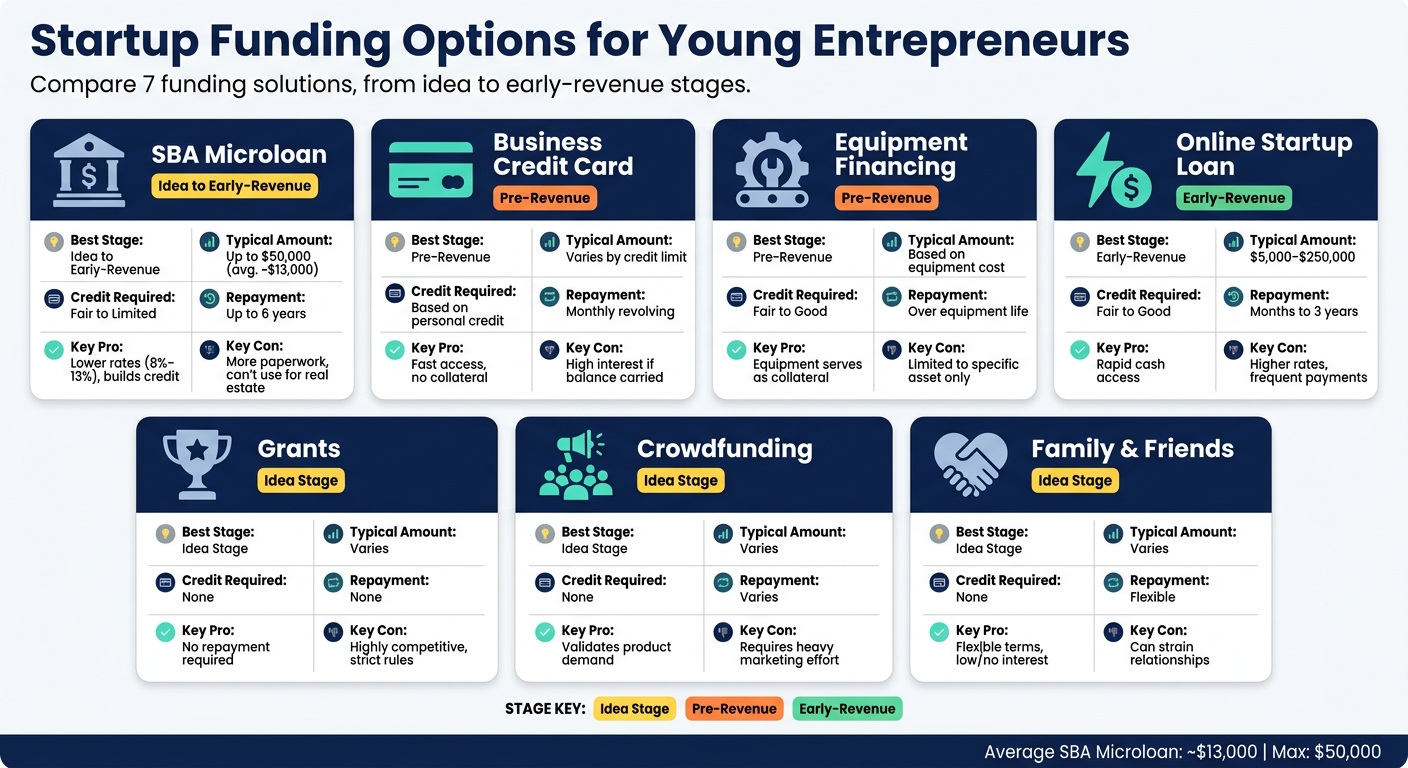
Startup Funding Options for Young Entrepreneurs: Side-by-Side Comparison
SBA Microloans: A Complete Guide for Startups and Small Businesses
sbb-itb-1eb586e
Quick Comparison
| Option | Best for | Typical amount | Main drawback |
|---|---|---|---|
| SBA Microloan | Startup costs, inventory, working capital, equipment | Up to $50,000 | More paperwork |
| Business Credit Card | Small repeat purchases | Based on credit limit | High interest if I carry a balance |
| Equipment Financing | One asset, like a vehicle or machine | Based on equipment cost | Can only be used for that asset |
| Online Startup Loan | Early-revenue businesses needing cash fast | $5,000 to $250,000 | Higher cost, short repayment |
| Grants | Mission-based or niche businesses | Varies | Hard to win |
| Crowdfunding | Consumer products with pre-sale appeal | Varies | Takes a lot of promotion |
| Family & Friends | Early gap funding | Varies | Can strain relationships |
Bottom line: I’d keep it simple – figure out how much I need, pick the funding type that matches that need, and apply only when I can show how I’ll repay it.
1. Assess Your Funding Needs and Eligibility Before You Apply
Before you apply, get clear on two numbers: your startup cost and your monthly runway.
Calculate How Much Money You Actually Need
Start by separating your costs into two buckets. One-time startup costs include equipment, initial inventory, business licenses, and website setup. Ongoing monthly operating costs include supplies, marketing, software subscriptions, and other bills you’ll keep paying month after month.
After you total your startup costs, add 3 to 6 months of monthly operating costs. That cushion gives your business time to get to steady revenue.
If you borrow too little, you can run into cash gaps. If you borrow too much, you take on debt you didn’t need.
The average SBA microloan is about $13,000, which gives you a useful point of reference. If your budget lands far above or below that number, it’s smart to check your math before you apply.
That final number also helps you figure out what kind of funding to pursue, whether that’s a flexible loan, asset-based financing, or a smaller short-term option.
Four Factors That Shape Your Funding Options
Four things will narrow your choices:
| Factor | Definition | How It Affects Your Options |
|---|---|---|
| Business Stage | Idea-stage, pre-revenue, or early-revenue | Determines whether you need projections or actual cash flow records |
| Credit History | Personal credit score or thin credit file | Low or no credit may require collateral or a co-signer |
| Cash Flow | Current income or projected revenue | Helps prove your ability to repay the loan |
| Cost Type | General startup needs vs. specific assets | Guides whether a microloan or equipment financing fits better |
Your business stage matters right away. Idea-stage and pre-revenue businesses usually need 3- to 5-year projections and a strong business plan. Early-revenue businesses can lean on cash flow statements and profit and loss records.
Credit history is another major piece. SBA microloan lenders often accept scores in the 550 to 675 range. If your credit file is thin, collateral can make your application stronger.
Cash flow also plays a big role. Lenders want to see how you’ll make payments, whether that’s through current income or projected revenue.
Then there’s cost type. If you need money for broad startup expenses, a microloan may fit. If you’re buying a specific asset, equipment financing may make more sense.
Once those filters are clear, you’re in a much better spot to match your business stage and cost setup with the right funding path.
2. Funding Options Young Entrepreneurs Can Actually Use
Once you know how much money you need, the next step is simple: pick the funding source that fits your situation. Not every option works for every business. Some are better for the idea stage. Some work only if you already have sales. Others look cheap at first, then get expensive fast.
The smart move is to narrow your choices based on your stage, credit, cash flow, and what you need to pay for.
SBA Microloans for Startups and Small Business Costs
SBA microloans offer up to $50,000 through nonprofit intermediary lenders. You can use them for working capital, inventory, equipment, and fixtures. You can’t use them for real estate purchases or to refinance existing debt.
These loans make sense for founders who need startup capital with a bit more room to work. Interest rates usually fall between 8% and 13%, and repayment terms can run up to six years. Many programs also come with training or mentoring, which can help if you’re still finding your footing.
Business Credit Cards, Equipment Financing, and Online Startup Loans
Business credit cards work best for smaller, repeat expenses. Think software subscriptions, supplies, or travel. But there’s a catch: approval often leans hard on your personal credit score. And if you carry a balance for long, the interest can sting. Cards are best used as a short-term tool, not a long-term plan.
Equipment financing is a better match when you need one specific asset, like a machine, vehicle, or tool. The equipment serves as collateral, so the loan is tied closely to that item. That can make approval easier, but it also means the money is limited to that purchase.
Online startup loans can work for early-revenue businesses that need money fast. Still, speed usually comes at a price. Approval often depends on your cash flow history or a stronger credit profile, and these loans tend to cost more with faster repayment schedules. Read the terms closely before you sign.
Crowdfunding, Grants, and Family-and-Friends Funding
If a loan isn’t a fit yet, look at funding sources that don’t depend as much on strong credit or collateral.
Crowdfunding can work well for consumer-facing products that have strong pre-sale appeal. If people can see it, want it, and buy into the story, crowdfunding has a shot. The tradeoff is the amount of marketing work involved. A campaign doesn’t usually sell itself.
Grants are worth a look if your business fits a specific profile, such as research-focused work, social impact, or a certain demographic category. The upside is obvious: you’re not taking on debt. The downside is heavy competition and ongoing reporting.
Family-and-friends funding can help fill a small gap before you qualify for formal financing. It may feel casual, but don’t treat it that way. Put the terms in writing so everyone knows the deal and you avoid personal and business tension later.
| Funding Option | Best Stage | Best Use | Main Tradeoff |
|---|---|---|---|
| SBA Microloan | Idea to Early-Revenue | Working capital, inventory, equipment | Requires a solid business plan and documentation |
| Business Credit Cards | Pre-Revenue | Small recurring expenses | High interest if balances aren’t managed |
| Equipment Financing | Pre-Revenue | Specific machines or vehicles | Limited to the asset being financed |
| Online Startup Loans | Early-Revenue | Fast-access capital | Higher pricing and stricter cash flow requirements |
| Crowdfunding | Idea Stage | Consumer product launches | Requires significant marketing effort |
| Grants | Idea Stage | Specific projects or mission-aligned growth | Highly competitive and ongoing reporting |
| Family & Friends | Idea Stage | Filling early funding gaps | Requires written terms to avoid conflict |
3. Compare Funding Options by Stage, Credit, Cost, and Risk
Your stage, credit profile, cash flow, and startup costs all shape which funding option makes sense right now. The table below gives you a side-by-side view of each option based on stage, credit, cost, and risk.
| Funding Option | Best For | Typical Funding Range | Credit Requirements | Repayment | Speed | Key Pros | Key Cons |
|---|---|---|---|---|---|---|---|
| SBA Microloan | Startups and small businesses with limited credit | Up to $50,000; average about $13,000 | Fair to limited credit | Up to 6 years | Several weeks | Lower rates than many short-term loans (typically 8%–13%); builds business credit; can include training or mentoring | May require collateral or a co-signer for weaker credit; cannot be used for real estate or refinancing existing debt |
| Business Credit Cards | Short-term recurring expenses | Varies by credit limit | Based mostly on your personal credit score | Monthly, revolving | Near-instant | Fast access; usually no collateral | High interest if you carry a balance; easy to overspend |
| Equipment Financing | Buying machinery or vehicles | Based on the equipment cost | Fair to good | Over the life of the equipment | 1–2 weeks | The equipment itself serves as collateral | Limited to specific asset purchases |
| Online Startup Loan | Fast working-capital needs | $5,000–$250,000 | Often fair to good | Months to 3 years | 24–72 hours | Rapid access to cash | Higher interest rates; frequent repayment schedules |
| Grants | Specific missions or demographic groups | Varies | No credit requirement | None | Slow | No repayment required | Highly competitive; strict usage rules |
| Family & Friends | Idea-stage gap funding | Varies | No credit requirement | Flexible | Fast | Flexible terms; often low or no interest; high trust | Can strain personal relationships |
Use the table to trim your options, then line each one up with your current business stage.
Best Funding Fits for Idea-Stage, Pre-Revenue, and Early-Revenue Businesses
At the idea stage, grants or family and friends funding usually make the most sense for early costs. A microloan tends to fit better once your plan, numbers, and projections are ready to show a lender.
For pre-revenue founders, a microloan can work if you have a clear startup budget and a believable repayment plan. Lenders look at repayment capacity, character, and the strength of your business plan, not just your credit score.
Early-revenue businesses often have the strongest position. Once you can show cash flow, profit-and-loss statements, and steady income, lenders get a much clearer view of how the loan will be repaid. On top of that, making microloan payments on time can help build business credit for larger loans later. That gives you more room to combine funding sources without piling on too much monthly debt.
How to Combine Funding Sources Without Taking on Too Much Debt
A simple path is to use family and friends funding to cover early gaps, then move to an SBA microloan once you can show exactly how the money will be used. That sequence can help you avoid borrowing too much too soon.
The main rule is simple: keep monthly debt payments within your projected cash flow. SBA microloans can help here because repayment terms may extend up to six years, which is often easier to handle than a short-term online loan. If you add a business credit card to the mix, use it for short-term expenses only. Carrying a revolving balance for day-to-day spending can get expensive fast.
Once you’ve picked the best fit, the next step is pulling together the documents lenders will want to see.
4. Prepare Your Documents and Improve Your Approval Chances
Once you’ve picked the funding type that fits, get your documents together first. That simple step can save time and lower the odds of getting turned down for something you could have fixed.
Documents Most Young Founders Need Before Applying
Getting your paperwork lined up before you apply helps the process move with less friction.
| Document Category | What to Prepare |
|---|---|
| Personal | Government-issued ID, resume, short bio, and any required background disclosure |
| Business Legal | Formation documents, business licenses, leases, contracts |
| Financials | Recent bank statements, profit and loss statements, debt schedule, tax returns |
| Planning | Business plan, 12–36 month financial projections, startup budget |
| Loan Specific | Written use-of-funds statement, collateral details, credit reports |
If you’re pre-revenue, your business plan and projections carry a lot of weight. Lenders want to see your offer, target market, pricing, operations, and 12–36 month projections laid out clearly.
One item people often miss is the use-of-funds statement. It’s a short, direct explanation of where the money will go and how you’ll spend it.
Common Approval Problems and How to Fix Them
A few issues show up again and again in denials: thin credit, weak cash flow, no collateral, and an unclear plan for repayment.
If your credit file is thin, you may have a better shot starting a business with poor credit if you offer collateral with solid value or apply with a co-signer. It also helps to pull your credit reports before applying so you can spot mistakes and explain any problems up front.
Your projections need to be tied to market data, sensible sales assumptions, and a clear monthly cash flow picture. If you already have early sales or signed contracts, include them. That kind of proof tells a lender there is demand beyond your own confidence in the idea.
SBA microloan intermediaries look at your full profile, including your resume, credit, and business plan.
Use these documents to put forward a cleaner, stronger application.
Conclusion: Pick the Funding Option That Fits Your Business Today
There’s no one-size-fits-all funding source for every young entrepreneur. The best pick comes down to where your business stands right now, along with your credit, cash flow, and how you plan to use the money. Once you’ve compared the main options, go with the one that lines up with your current stage and cash needs.
Pick the option that works for your budget, timeline, and ability to repay. Before you apply, get your business plan, projections, and use-of-funds statement in order.
If you need up to $50,000 for working capital, inventory, equipment, or supplies, an SBA microloan may be a strong match.
Use SBA50K‘s guidance to organize your application and move ahead with the funding option that fits your business today. Gather your documents, match the funding type to the expense, and apply with a clear, focused request.
FAQs
How much should I borrow to start?
Borrow only what lines up with your startup costs and what your business can pay back.
Start by adding your one-time expenses, like equipment, licenses, and opening inventory. Then include enough working capital to cover your first 3 to 6 months.
After that, subtract your personal equity and any other funding that’s already committed.
To back up your loan request, include:
- a detailed business plan
- a line-item budget
- 12-month cash flow projections
Can I get funding with little credit history?
Yes. You can still get funding with limited credit history, and SBA microloans may be easier to get than a bank loan.
To improve your odds, show lenders a strong business plan, realistic financial projections, and clear records of your startup costs. It also helps to show steady income, put some of your own cash into the business, or offer collateral.
Which funding option fits my business stage?
The right funding option comes down to three things: your business stage, your credit history, and how much money you need.
If you’re in the early stages and don’t have much credit history yet, SBA microloans can be a solid fit. They can cover working capital, inventory, or equipment, with loan amounts up to $50,000.
Need more than $50,000? In that case, startup loans may make more sense, especially if you have stronger credit or collateral to back the loan.
For smaller costs under $5,000, personal savings are often the fastest route. And if you’re buying machinery, tools, or other business assets, equipment financing can work well since the equipment itself acts as collateral.
Leave a Reply