
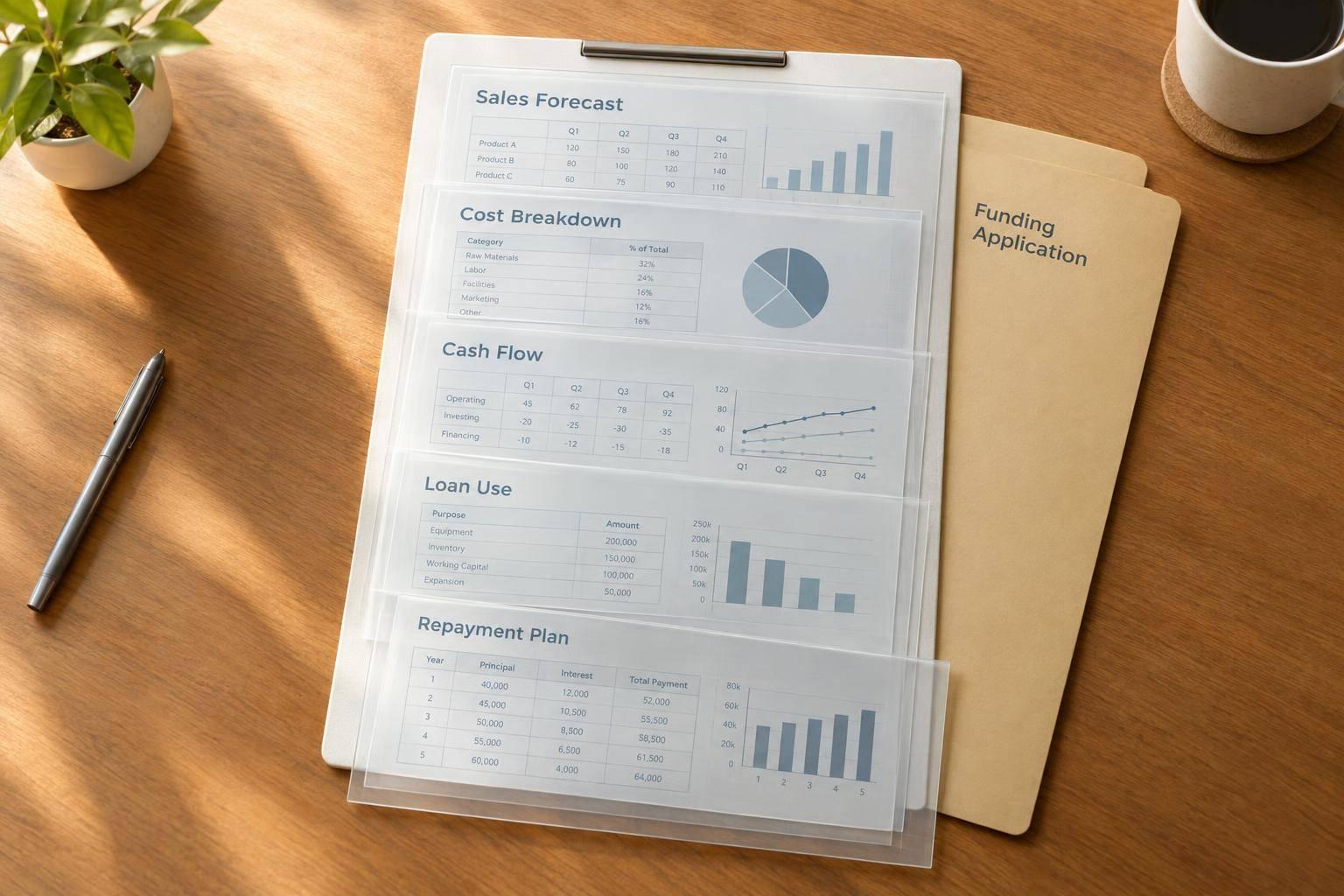
My first check before applying for funding: Does the plan show how the business will repay the loan? (See how this differs for an SBA microloan vs bank loan). I’d tie sales estimates to records, account for every cost, and check that monthly cash covers payments – even if sales fall short.
Here are the 10 mistakes I’d check for in your plan:
- Unclear business model: Explain what you sell, who buys it, and when you get paid.
- Unsupported sales forecasts: Base estimates on customer counts, prices, and sales records.
- Missing expenses: Include startup costs, recurring bills, taxes, and loan costs.
- Unrealistic cash flow: Match customer payment dates with bills and debt payments.
- Weak market research: Use local data to support demand estimates.
- Incomplete competitor analysis: Compare customer options and account for the cost of competing.
- Unclear funding request: Calculate the dollar amount needed after other committed funding.
- Unclear use of funds: Assign each dollar to a cost, purpose, and spending date.
- Missing repayment plan: Show cash available for existing debt and the proposed loan.
- Mismatched financial figures: Use the same numbers across your plan and supporting documents.
For an SBA microloan of up to $50,000, I’d also check the SBA microloan requirements and eligible uses. Funds cannot buy real estate or refinance existing debt.
Profit alone doesn’t show that you can pay on time. My final check is <u>cash available when each payment is due</u>.
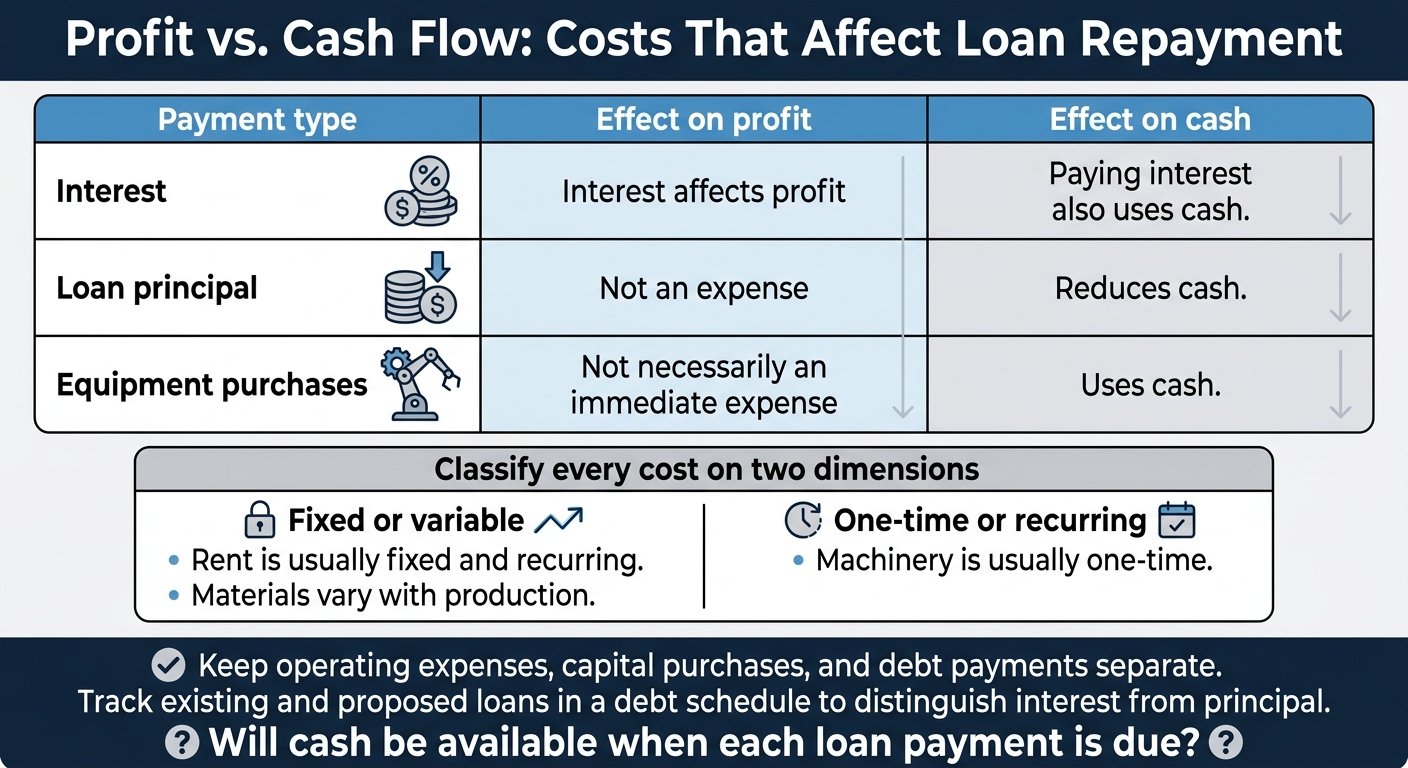
Profit vs. Cash Flow: Costs That Affect Loan Repayment
Top 5 Business Loan Mistakes to Avoid
sbb-itb-1eb586e
What Your Business Plan Should Show
Use this checklist to find the weak spots lenders tend to notice first.
A clear business model: Explain what you sell, who buys it, and what customer need it meets. Show how your operations, suppliers, and staff help you deliver.
Evidence-backed assumptions: Back up your sales and expense estimates with market research and financial records.
A calculated funding request: Give every dollar you request a specific purpose, such as inventory, equipment, supplies, or working capital. SBA microloan funds cannot purchase real estate or refinance existing debt. Explain how each expense supports growth.
Cash flow that covers payments: Prepare monthly projections for 12 months and annual forecasts for up to six years. Include cash coming in, expenses, and expected profit. Show whether your monthly cash will cover loan payments.
The next step is to fix the most common business plan errors.
1. An Unclear Business Model
Mistake in the Plan
If your plan leaves out pricing, payment timing, or how customers receive your product or service, lenders can’t trace sales to cash flow.
Lender Concern
Lenders assess repayment capacity by checking how sales turn into cash, what fulfillment costs, and whether enough cash remains to make loan payments.
Practical Correction
For each offering, specify the customer, price, payment timing, key suppliers, staffing needs, and delivery method. Explain the problem you solve and how the activity funded by the loan will generate revenue and support repayment.
Verification Checklist
Check that your executive summary, company description, marketing plan, and projections all use the same pricing, payment timing, and operating model.
Next, check whether evidence supports your sales forecast.
2. Sales Forecasts Without Supporting Evidence
Mistake in the Plan
A sales growth forecast is speculation if it doesn’t show where customers will come from. Build it from measurable inputs instead.
Lender Concern
Lenders need evidence that you can meet your sales projections. That helps them judge whether you’ll be able to repay the loan.
Practical Correction
Build a monthly, bottom-up forecast using customer counts, sales volume, and average price. Back up customer counts with market research and conversion rates.
Keep projected sales within what your staff and equipment can handle. Account for seasonality and the time it takes to close a sale. Retain historical sales records, tie customer commitments to contracts, and document every estimate.
Verification Checklist
Make sure each assumption links to a record. Check customer counts, pricing, capacity, and timing. Show how the loan funds will increase your sales capacity.
With sales estimates backed by evidence, the next test is whether your expense estimates are complete.
3. Missing Expense Estimates
Mistake in the Plan
Leaving out costs makes profit look higher than it is and hides how much working capital you need. Include materials, payroll and payroll taxes, occupancy costs, insurance, licenses, marketing, technology, professional services, and interest and fees.
Lender Concern
An incomplete cost breakdown makes it harder for lenders to assess repayment. They need to see whether your funding request covers both startup purchases and day-to-day operations.
Practical Correction
Label each cost as fixed or variable, then as one-time or recurring.
Rent is usually fixed and recurring; materials vary with production; machinery is usually one-time.
Back up your estimates with vendor quotes, leases or contracts, utility bills, and payroll records.
Keep operating expenses, capital purchases, and debt payments separate so they appear in the right projections. Interest affects profit; principal payments reduce cash but aren’t expenses. Equipment purchases also use cash but don’t necessarily count as an immediate expense. Add existing and proposed loans to a debt schedule to track interest and principal correctly when assessing your ability to repay.
Verification Checklist
Check past records for annual fees, subscriptions, and other costs that are easy to miss. If your business already operates, review the past two years of financial records. Look for hidden costs and payments recorded in the wrong categories that could make funding needs look too low or cash available for repayment look too high.
Once you’ve included all costs, test whether monthly cash flow still covers them.
4. Unrealistic Cash-Flow Projections
Mistake in the Plan
A complete expense list won’t help if cash arrives after bills are due. Profit is not cash. Revenue can remain unpaid while inventory, payroll, and taxes still require payment. Your plan must show not just a profit, but enough cash at the right time.
Lender Concern
Lenders want to know whether you can cover obligations when they’re due – not just end the year with a profit. If projections leave out seasonal slowdowns or late customer payments, lenders can’t clearly assess your ability to repay.
Practical Correction
Line up expected collection dates with payroll, taxes, inventory purchases, and every loan payment. Account for seasonal changes, too.
Include a lower-sales scenario with reduced receipts and delayed collections. Show when cash would run short and how you would fund the gap.
Verification Checklist
Check collection assumptions against historical records and seasonal patterns against past results. Make sure each projected cash shortfall has a clear funding plan.
5. Weak Market Research
After reviewing your sales estimates, lenders want proof that local demand supports those numbers.
Mistake in the Plan
Industry growth alone doesn’t prove local demand. It also doesn’t identify your customers, explain their needs, or show whether demand supports your forecast.
Lender Concern
Without local data, lenders can’t tell whether your forecast rests on actual demand or broad assumptions. Weak market research makes your revenue forecast harder to trust – and leaves lenders less confident that you can repay the loan.
Practical Correction
Define your service area and customer segments. Back them up with local population, income, and buying-pattern data, then connect that data directly to the customer counts and conversion assumptions in your forecast.
Verification Checklist
Check your sources’ reliability and geographic coverage. Confirm that the data describes customers in your service area, and ask a SCORE counselor to review any gaps between your research and forecast.
Next, show how your business compares with others already serving that market.
6. Incomplete Competitor Analysis
Once you’ve shown demand, explain why customers will choose you.
Mistake in the Plan
Listing a few rivals doesn’t tell the whole story. An incomplete analysis misses other options customers might choose and doesn’t compare pricing, location, service, quality, and convenience.
Lender Concern
If you don’t show clear differences, lenders may question your ability to win and keep customers. They may also doubt whether your advantages can support loan repayment.
Practical Correction
Create a side-by-side comparison backed by documented competitor research. Tie each difference to your customer strategy and calculate what each advantage will cost – including the cost of competing on service or quality. Add those costs to your expense estimates and cash-flow projections.
Verification Checklist
Check that every claimed advantage has evidence. Your marketing budget should reflect the competition you face, and your retention forecasts should explain how you’ll keep customers loyal. Identify where competitors are stronger, then test whether your projections still hold if those competitors respond.
7. An Unclear Funding Request
Even a solid competitive plan can fall short if lenders can’t connect your funding request to project costs.
Mistake in the Plan
An expansion request without a specific dollar amount gives lenders nothing to measure.
Lender Concern
A vague request suggests you haven’t fully calculated the financing gap or tied the amount to the project’s cost.
Practical Correction
State the exact amount, business purpose, and time period the funds will cover. Calculate your request by subtracting owner contributions and other committed funding sources from the total project cost.
List every planned expense and funding source. Back up costs with supplier quotes, leases, or contracts.
Verification Checklist
Check that your request equals the remaining financing gap and that committed funding sources, including the requested loan, cover the budget. The requested loan amount should match the Loan Proceeds line in your cash-flow projections. Also, confirm that every proposed expense qualifies under the funding program.
Once you’ve stated the amount, show exactly how you’ll use each dollar.
8. Unclear Use of Loan Funds
Once you’ve set the total loan request, show exactly where the money will go.
Mistake in the Plan
A label like “working capital” leaves too much unexplained. Lenders need a breakdown that accounts for each dollar.
Lender Concern
Without clear allocations, lenders can’t easily assess whether each expense supports growth and follows program rules.
Practical Correction
Use a table to show each expense, its amount, timing, and purpose. Then add one sentence explaining how it supports day-to-day work or revenue.
Example: Line-item allocation of a $40,000 loan request
Use of loan funds Amount Planned purchase date Business purpose Supporting documentation Inventory $15,000 Nov 2026 Stock for holiday sales Supplier price quotes Equipment $10,000 Dec 2026 Increase production speed Equipment lease/contract Furniture $5,000 Oct 2026 Outfit new office space Vendor invoices Marketing $10,000 Jan 2027 Launch new product line Marketing agency contract Total request $40,000 – – –
Verification Checklist
Check that the allocations add up to the total request, every line has an explanation, and supporting documents are current. Purchase dates should match your growth timeline. Confirm that each expense is an eligible use of funds, and exclude real estate or debt refinancing.
With the spending plan laid out, the next question is whether the business can repay the loan.
9. A Missing Repayment Plan
Mistake in the Plan
Saying future sales will cover the loan isn’t enough. You need to show available cash. Lenders want operating cash flow from daily operations to cover repayment.
Lender Concern
Lenders need to see that your business can pay on time while meeting current obligations and paying existing debt.
Practical Correction
Include estimated loan payments in your monthly cash-flow projections. Label the interest rate, loan term, and payment frequency as assumptions until the lender confirms them.
Add a debt schedule showing existing balances and payments, backed by financial records. Tie the payment schedule to the exact loan amount and use of funds already listed in your plan.
For a startup, explain the assumptions behind projected cash flow. List collateral or a personal guarantee only as backup support – not as repayment sources.
Keep these repayment figures consistent with the rest of your plan.
Verification Checklist
- Check that projected cash covers existing debt and the new loan payment.
- Match balances to your debt schedule and bank statements.
- Test what happens if sales fall short.
- Keep unconfirmed loan terms labeled as assumptions.
Compare the repayment schedule with the rest of your financial statements to check for mismatches.
10. Financial Figures That Do Not Match
After showing how you’ll repay the loan, check that the numbers match across every document.
Mistake in the Plan
When the narrative, forecasts, and funding request show different numbers, lenders can’t tell which figures to rely on.
Lender Concern
Unexplained gaps can point to poor recordkeeping or inaccurate projections. If internal reports don’t match tax records, lenders may also question the accuracy of your application. Consistent figures help them check your ability to repay without sorting through conflicting numbers.
Practical Correction
Use one verified set of figures across the narrative, financial statements, forecasts, funding request, and allocation table. Compare projections with prior tax returns and bank statements, and explain any differences.
Verification Checklist
Check that the legal name, address, ownership percentages, and dates match across all documents. Clearly label reporting periods and use the same dollar format throughout. Matching numbers also help lenders review your plan faster.
Conclusion: Check Your Plan Before Applying
Review your plan through a lender’s eyes. Is the forecast backed by evidence? Will cash cover repayment?
For each use of funds, state the amount and its business purpose.
Test repayment under conservative conditions using the lender’s actual terms. If cash looks tight, cut spending or reduce your request before applying.
Fix any mismatched figures before submission. Keep bank statements, tax filings, and supporting records organized so the lender can verify every number. Submit only when the numbers hold up.
FAQs
How can I forecast sales without a sales history?
Build your assumptions on research, not guesswork. Use market data, industry trends, and competitor analysis to back them up. Define your target customer, then explain how your marketing and operations will turn demand into revenue. Support your growth projections with evidence, such as signed contracts or a confirmed marketing plan.
Keep your 3- to 5-year projections conservative. Include a monthly cash flow statement that shows you can cover operating costs and loan payments during both busy and slow periods.
How much cash cushion should I plan for?
Include at least 12 months of working capital in your loan request to cover short-term cash-flow gaps. Lenders look for this cash cushion to help pay operating costs and loan payments during slower months.
Keep your estimates conservative and realistic – not based on the best-case scenario. Back them up with documented costs, vendor quotes, and month-by-month cash-flow projections that account for both busy and quiet periods.
What if my projections show a cash shortfall?
Address the shortfall before you submit your application. Lenders want to see how you’ll cover debt payments during slower periods. Build an operating reserve or cash cushion into your budget for short-term gaps, and explain how you’ll fund it – for example, by setting aside money during peak months.
Keep your projections conservative and realistic. Include all debt payments so lenders can judge whether you’ll have enough cash to cover them.

Leave a Reply