

Before applying for an SBA microloan of up to $50,000, I’d pin down two things: what the money will pay for and how you’ll repay it. You apply through an SBA-approved nonprofit lender – not the SBA – and that lender sets its own requirements.
Here’s the seven-step checklist I’d use:
- Check eligibility: Confirm your business type, size, location, and activities qualify.
- Find an approved lender: Ask about credit rules, collateral, guarantees, fees, and training.
- List eligible expenses: Document each purchase. Real estate and debt repayment aren’t allowed.
- Calculate your funding gap: Subtract available funds from eligible costs, then test the loan payments against your cash flow.
- Review credit: Check personal and business reports, dispute errors, and explain past payment problems.
- Prepare your plan and projections: Show how the loan supports your business and test cash flow with sales 20% below forecast.
- Gather your documents: Follow the lender’s checklist and check that your figures match across files.
My final check: <u>every dollar has a documented use</u>, and payments fit the budget – even in a slow month. Meeting eligibility rules doesn’t guarantee approval.
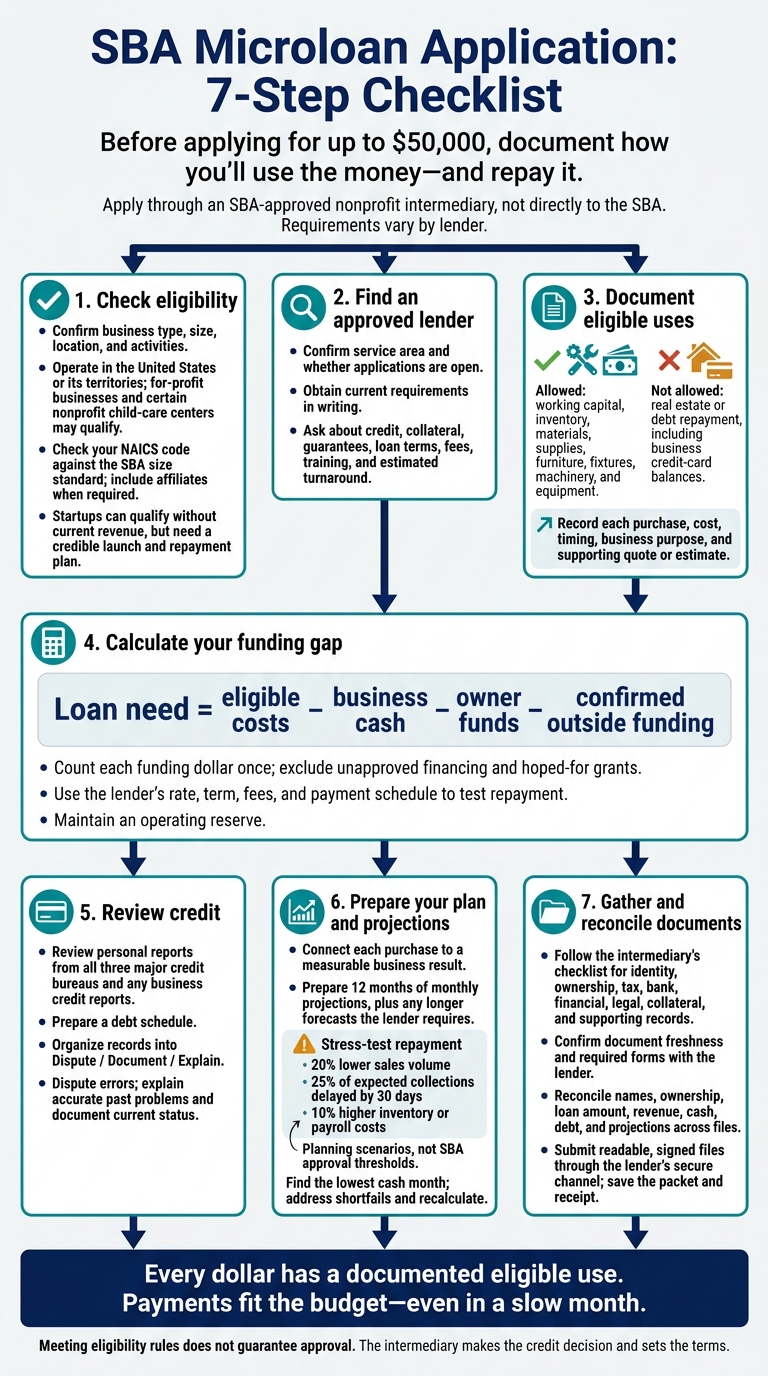
SBA Microloan Application: 7-Step Checklist
1. Check Your SBA Microloan Eligibility
Check Your Business Status and Activities
Confirm that your business operates in the United States or its territories and is organized for profit. Certain nonprofit child-care centers may also qualify. Describe what your business does, and check that its activities don’t fall into an ineligible category.
Compare your NAICS code with the SBA size standard. Use receipts or employee count, as required, and include affiliates when the rules call for it. Record the calculation period and the figures you used. Once you meet these requirements, check the intermediary’s own lending criteria.
Startups can qualify without current revenue. You’ll still need a clear launch plan, owner investment, projected sales and expenses, and a realistic repayment timeline.
Record Your Eligibility Details
Create a one-page eligibility sheet with your business name, entity type, NAICS code, ownership, affiliates, start date, size calculation, requested loan amount, and primary repayment source. Clearly separate projected revenue from existing income. Keep the sheet beside your application so you can answer lender questions quickly.
☐ Confirm your business profile, eligible activities, and expected repayment source. Flag any questions about size calculations, ownership, or startup status for the lender. Check that your location falls within its service area and that your requested amount fits its typical loan size. Record the response date, the staff member’s name, and any follow-up documents needed.
sbb-itb-1eb586e
SBA Microloans: A Complete Guide for Startups and Small Businesses
2. Find an SBA-Approved Intermediary
After confirming your eligibility, use the SBA’s intermediary directory to find a lender that serves your area. Request its current application packet and check that it’s accepting applications.
Ask About Borrower Requirements
Ask about credit standards, cash-flow requirements, time in business, and whether startups without revenue can apply. Also confirm which ownership documents, residency rules, collateral, and personal guarantees the lender requires.
Check whether you must complete training or technical assistance before approval or after funding. Knowing the timing can help prevent closing delays. Record the details in the checklist below.
Track the Lender’s Application Requirements
Use this checklist to record the intermediary’s written requirements and compare them with your application packet. If the website and packet differ, ask for clarification in writing. Save the date each requirement was confirmed.
| Information to record | Details to obtain |
|---|---|
| Contact and coverage | Legal name, website, office address, phone, email, application contact, and service area |
| Required forms | Current application, document checklist, submission instructions, and any interview requirement |
| Credit and ownership | Credit expectations, ownership rules, startup eligibility, and minimum operating history |
| Collateral and guarantees | Accepted assets, valuation method, lien requirements, and required guarantors |
| loan terms and fees | Available amount, interest rate, repayment term, and application or closing fees |
| Estimated turnaround | Time from a complete application to a decision, and from approval to funding |
| Training | Required classes or counseling, schedule, format, cost, deadline, and whether completion affects closing |
☐ Record the intermediary’s contact details and get its current requirements in writing. Treat processing times as estimates: missing documents, collateral review, and underwriting workload can delay processing. Save these requirements before planning how you’ll use the funds.
3. Define How You Will Use the Funds
Check Allowed and Prohibited Uses
Once you understand the lender’s rules, match the loan funds to specific eligible expenses. SBA microloans can pay for working capital, inventory, materials, supplies, furniture, fixtures, machinery, and equipment. Connect each planned purchase to a clear business need.
You can’t use the funds for real estate or debt repayment, including business credit-card balances. Unsure whether an expense qualifies? Check with the intermediary before adding it to your plan.
Document Your Planned Expenses
Group expenses into categories: equipment, inventory, supplies, and working capital. For each item, record what you’ll buy, the cost, when you need it, and how it supports your business. Include a quote, estimate, invoice, purchase order, or price list with the vendor, date, price, and terms.
If you can’t get an exact quote, explain how you calculated the cost and where you found the price. Remove duplicate and personal expenses. Break bundled purchases into separate items so you don’t double-count costs or include ineligible expenses. Keep copies of every supporting record.
Use this breakdown to back up your requested loan amount.
☐ Assign every dollar to an eligible, documented use, then transfer those line items to your sources-and-uses budget. List owner funds and other financing separately.
4. Calculate How Much You Need to Borrow
Build a Sources-and-Uses Budget
Calculate your funding gap – not a round number. Use this formula: Loan need = eligible costs − business cash − owner funds − confirmed outside funding. An exact request helps you test whether you can afford repayment.
Separate one-time expenses from recurring costs, and show how much working capital you need each month. Include lender fees in your total request.
| Expense | One-time or recurring | Cost | Timing | Available funds applied | Remaining loan requirement | Supporting evidence |
|---|---|---|---|---|---|---|
| Equipment | One-time | $___ | Purchase date or installment dates | $___ | $___ | Vendor quote |
| Initial inventory | One-time | $___ | Initial order date | $___ | $___ | Supplier estimate |
| Payroll | Recurring | $___ | Monthly payroll dates | $___ | $___ | Payroll records and budget |
| Rent and utilities | Recurring | $___ | Monthly due dates | $___ | $___ | Lease and utility estimates |
| Total | $___ | $___ | $___ |
Record each funding source, its amount, and when it becomes available. Count each dollar only once, and include only cash you can safely use. Leave out hoped-for grants and financing that hasn’t been approved.
With that amount set, check how the loan payments fit your monthly cash flow.
Check Whether Cash Flow Covers Payments
Test repayment in both normal months and months with weak sales.
Before estimating payments, get the intermediary’s interest rate, repayment term, fees, and payment schedule. If those terms aren’t set, label them as estimates. Use the offered repayment schedule – don’t assume you qualify for the longest term.
Check each month’s cash balance after operating expenses, taxes, owner draws, existing debt payments, and the new loan payment. Leave room for a minimum operating reserve.
Then run the numbers with sales 10% to 20% below forecast and slower customer payments. If cash falls short, cut or phase purchases, add owner funds, or postpone applying.
Next, check your credit and address any issues before submitting.
5. Review Personal and Business Credit
Check Credit Reports and Debts
Before you submit your application, review the credit file the intermediary is most likely to check.
Download your personal reports from all three major credit bureaus through AnnualCreditReport.com, and save dated copies. Review any business credit reports you have, too.
Compare those reports with your bank, credit-card, loan, and court records. Check account ownership, balances, utilization, payment history, collections, and hard inquiries, along with relevant liens and judgments.
Create a debt schedule covering every personal and business obligation. Include each debt’s balance, interest rate, monthly payment, maturity date, collateral, and status. Use it to separate errors from accurate negative items before contacting the bureaus.
Organize Disputes and Credit Explanations
Sort your records into three folders: Dispute, Document, and Explain. Use Explain for accurate negative items or limited credit history.
For each error, record the bureau, the account number’s last four digits, the disputed detail, the submission date, and the outcome. Contact both the bureau reporting the error and the company supplying the information. Keep copies of your evidence and confirmation receipts. A bureau generally has 30 days to investigate, so tell the intermediary about open disputes. Don’t assume they’ll be resolved before your deadline.
For accurate credit problems, write a short explanation covering what happened and when, the account’s current status, and what has changed. Attach payment records or other supporting documents. Don’t dispute accurate information just because it hurts your application. Keep each explanation brief and focused on repayment risk.
Ask the intermediary for its written requirements for credit scores, personal guarantees, and collateral, including which owners must guarantee the loan. List pledged assets and existing liens so you don’t offer collateral that’s already committed.
Use your organized credit file to support your business plan and build repayment projections that reflect your debt load.
6. Prepare Your Business Plan and Cash-Flow Projections
Explain How the Loan Supports Your Business
After reviewing credit, explain how the loan fits your business. Cover your business model, ownership, market, operations, and sales. Connect the exact loan request to your funding gap and show how cash flow will cover repayment.
Tie each purchase to a measurable result, such as higher output or more inventory to sell. Back up those expectations with vendor quotes, production records, customer commitments, or past sales. Label future sales, savings, and hiring dates as assumptions. Include the proposed loan term and estimated payment, then test those assumptions in your monthly forecast.
Project Monthly Cash Flow and Test Setbacks
Follow the intermediary’s required format, statements, and forecast period. Prepare 12 months of monthly projections, plus any required longer-term forecasts. Include projected income statements, balance sheets, cash-flow statements, and a capital spending budget. Established businesses should attach three to five years of historical statements. Newer businesses should support their projections with startup costs, current bank records, and owner-investment details.
For each month, show beginning cash, customer payments, operating expenses, loan proceeds, equipment purchases, debt payments, owner contributions or withdrawals, and ending cash. Explain your assumptions for pricing, sales volume, seasonality, collection timing, launch dates, and hiring.
Record customer payments as cash receipts in the month you expect to receive them. Treat loan proceeds as financing, not revenue, and carry each month’s ending cash into the next month. Your forecast should show whether you can cover loan payments in both normal months and months with setbacks.
Stress-test the forecast using these planning scenarios:
- 20% lower sales volume
- 25% of expected collections delayed by 30 days
- 10% higher inventory or payroll costs
Identify the month with the lowest cash balance and state whether you can still cover scheduled payments. If you find a shortfall, document a specific response – such as delaying optional spending, reducing owner withdrawals, or using documented reserves – then recalculate. Use these projections to assemble the supporting documents in the next step.
7. Gather Your Financial and Legal Documents
Prepare the intermediary’s document packet. Ask for its checklist, confirm which documents are required and which substitutes it accepts, and check whether financial records must be dated within 30, 60, or 90 days of submission.
Use the figures from your budget, credit review, and cash-flow forecast to support your requested loan amount, repayment plan, and assumptions.
Create a Document Checklist
Set up a spreadsheet or checklist with columns for document name, period, status, date obtained, file name, and notes. Organize the documents below as the intermediary requests.
| Group | Documents to track |
|---|---|
| Required/core | Government-issued ID; formation and ownership records; operating agreements; applicable licenses, permits, and registrations; requested tax returns; current bank statements; recent financial statements, projections, and debt schedule |
| Intermediary-specific | Application forms; personal financial statement if requested; background, personal-history, and guarantor forms; collateral records |
| Supporting | Leases; material contracts; management biographies; vendor quotes; equipment specifications; explanations of unusual financial activity |
Check that legal names, addresses, ownership percentages, and EINs match across records. Flag expired licenses and unsigned agreements. Vendor quotes should include quantities, prices, shipping, taxes, and expiration dates. If your startup has no tax returns, ask which substitute records the intermediary accepts.
Check Forms, File Names, and Financial Figures
Check each form and file against the numbers you’ve already documented. Download current forms from the intermediary’s portal, and confirm which SBA forms apply, including whether it requires Form 1919 or Form 413. Sign and date all applicable forms.
Use file names that show the applicant, document type, period, and version. Keep personal and business records separate.
Reconcile your figures before uploading. Compare the loan amount, revenue, cash, debt, owner contributions, payroll, and projected expenses across the application, business plan, tax returns, bank statements, and financial statements. Explain timing or accounting differences rather than changing numbers to force a match.
Open every file to check that it’s readable and has no missing pages. Submit only when the numbers, forms, and files match – or any differences are explained. Use the intermediary’s secure channel, and save the complete packet and submission receipt.
Conclusion: Check Your Application Before Submitting
Give your application one last check: confirm your eligibility, the lender’s requirements, eligible uses, and a request below $50,000. Include credit explanations, repayment projections, and all required documents. This includes a detailed business plan that outlines your strategy. Your budget should account for every dollar requested, and your cash-flow forecast should cover payments even after a modest setback.
If anything remains unclear, pause and work it out with the intermediary before submitting. Meeting eligibility rules doesn’t guarantee approval. The intermediary makes the credit decision and sets the terms.
FAQs
Can I qualify for an SBA microloan with limited collateral?
Yes, you may still qualify with limited collateral. Many intermediary lenders require collateral, but the rules depend on the lender, your credit profile, and the loan amount. Some smaller loans may be unsecured, meaning you don’t need to pledge assets.
A strong business plan, cash-flow projections that show you can repay the loan, or a cosigner can help strengthen your application. Check each intermediary’s requirements early as you plan.
Will applying for an SBA microloan affect my credit score?
Applying for an SBA microloan means authorizing a credit check. But a low credit score doesn’t automatically rule you out. Intermediary lenders also review your business plan, cash flow projections, and ability to repay.
If you’re worried about your credit, explaining past issues, offering collateral, or using a cosigner may strengthen your application.
Can I reapply if my SBA microloan application is denied?
The provided materials don’t say whether you can reapply after a denial. But common reasons for denial – such as missing documents, weak cash flow, or credit issues – can be addressed.
Start with the reason your lender gave. Before moving forward, you may need to strengthen your business plan, submit missing records, improve cash flow, or work through credit concerns.
Leave a Reply