

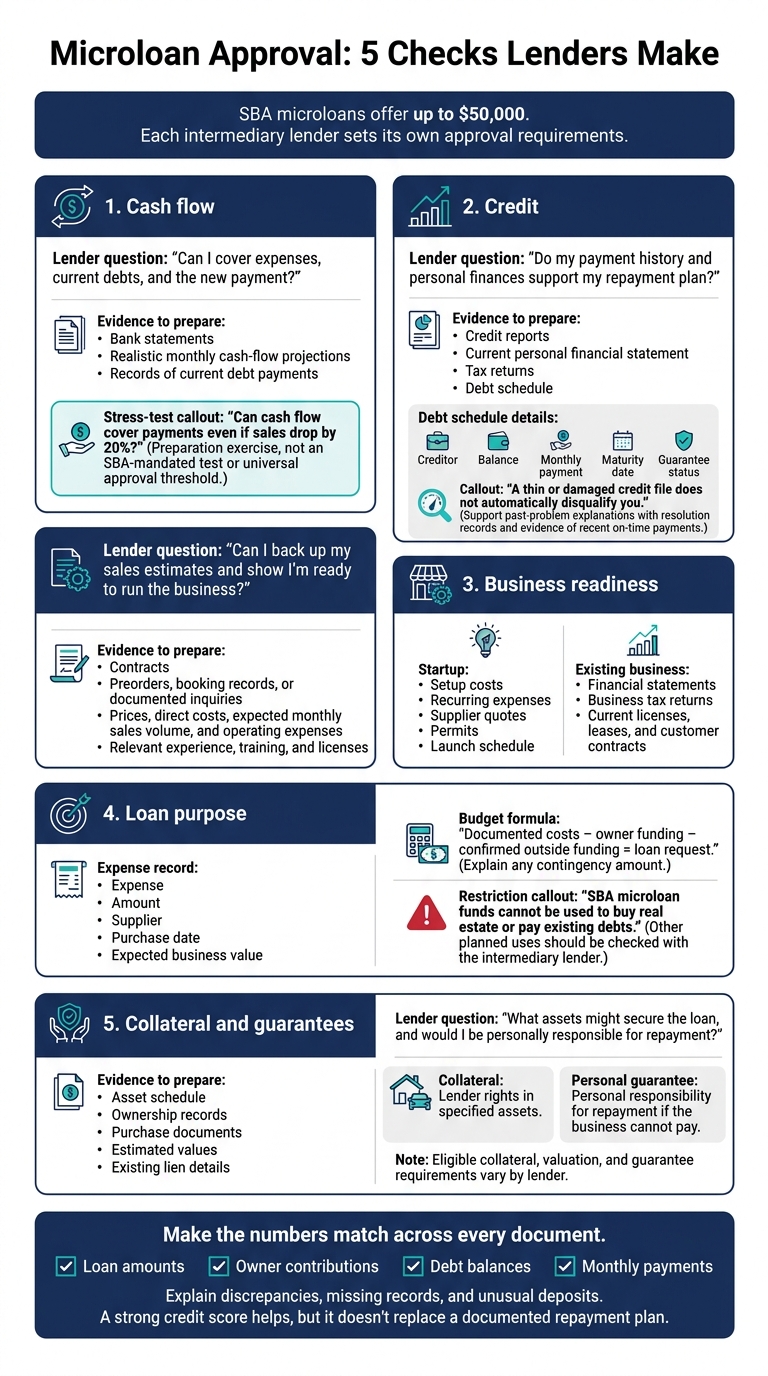
Before I apply for a microloan, I need to show how I’ll repay it – not just explain what I’ll buy. That means matching my loan request to documented costs and checking whether my cash flow can cover payments even if sales drop by 20%.
SBA microloans offer up to $50,000, but each intermediary lender sets its own approval requirements. I’d prepare my application around five questions:
- Cash flow: Can I cover expenses, current debts, and the new payment?
- Credit: Do my payment history and personal finances support my repayment plan?
- Business readiness: Can I back up my sales estimates and show I’m ready to run the business?
- Loan purpose: Are my planned expenses allowed and supported by quotes or other records?
- Collateral and guarantees: What assets might secure the loan, and would I be personally responsible for repayment?
My final check: <u>make the numbers match across every document</u>. A strong credit score helps, but it doesn’t replace a documented repayment plan.
Microloan Approval: 5 Checks Lenders Make
SBA Microloan Approval: What I’d do in 3 Situations #sbaloans #businessfunding #smallbusiness
sbb-itb-1eb586e
Credit History and Personal Finances
After reviewing cash flow, lenders check whether your debt history supports your repayment plan. They review your personal credit and, if you have it, your business credit to assess payment habits and total debt.
That review may cover on-time and late payments, collections, credit utilization, recent applications, installment and revolving debt, and account age. If your business is new or has little credit history, your personal credit and finances may carry more weight. A thin or damaged credit file does not automatically disqualify you, but it puts more weight on your documents.
Credit reports, financial statements, and debt schedules help lenders check whether your current obligations leave room for another loan payment.
Choose Documents That Explain Your Credit
Check your credit reports for incorrect balances, account status errors, and accounts you don’t recognize. Prepare a current personal financial statement that lists your assets, liabilities, monthly obligations, and personally guaranteed debts. Your debt schedule should include each creditor, balance, monthly payment, maturity date, and guarantee status.
If your business has a limited history, tax returns help verify earnings, while bank statements show whether cash is consistently available for payments. Ask whether the lender will count outside income toward repayment. If it will, include proof of that income.
| Credit profile | Lender concern | Documentation to emphasize |
|---|---|---|
| Limited credit | Too little repayment history | Personal financial statement, tax returns, income proof, bank statements, and rent or utility payment records if accepted |
| Damaged credit | Delinquencies, high utilization, or unresolved debts | Written explanations, resolution or payment-arrangement records, recent on-time payments, and realistic cash-flow projections |
| Strong credit | Repayment capacity and total obligations still need verification | Credit report, personal financial statement, tax returns, business bank statements, debt schedule, and cash-flow projections |
Explain Past Credit Problems and Recent Progress
For each major credit setback, explain what happened, when it happened, where it stands now, and what shows improvement. Back up your explanation with creditor confirmations, resolved-account records, or several months of on-time payments – not promises alone. Even strong credit doesn’t replace evidence that your business can succeed.
Disclose bankruptcies, taxes owed, liens, and judgments as requested. Depending on your situation, provide filing or discharge papers, IRS or state payment agreements, lien releases, judgment satisfaction records, or proof of current payments.
Lenders look at when the event occurred, how it was resolved, any remaining balance, and its effect on your ability to repay. An active payment arrangement still adds a monthly obligation, so include it in your financial records.
Disclose all debts and liabilities. Unresolved delinquencies, unpaid taxes, and active judgments can hurt your approval odds. So can mismatches among your listed liabilities, tax returns, credit reports, bank statements, and personal financial statement.
Business Viability and Owner Readiness
After reviewing your numbers and credit, lenders assess whether your business can generate enough money to repay the loan.
For an SBA microloan, your business must meet SBA microloan requirements for size, location, and business type. Most borrowers must be for-profit U.S. businesses; nonprofit child care centers are a narrow exception. List your legal entity, owners, location, industry, and affiliates. Meeting these rules doesn’t guarantee approval. The lender still weighs repayment risk and checks whether your business model can support the loan.
Link Your Business Plan to Repayment
Explain what you sell, who buys it, how you reach those buyers, and why they’ll choose you over other options in your market. Back up demand with signed contracts, preorders, booking records, or documented inquiries. Show your prices, direct costs, expected monthly sales volume, and operating expenses. Connect those assumptions to the repayment plan you’ve already provided.
Identify who runs the business day to day. Include relevant experience, training, and licenses, and explain who handles sales, customer service, scheduling, purchasing, staffing, compliance, and bookkeeping.
Plan for seasonal shifts and disruptions, too. Explain how you’ll use backup suppliers, maintain equipment, or cover employee absences. Test whether you can still make loan payments if sales start slowly or your opening is delayed.
Show Startup Readiness or Business Results
Once you’ve explained the business model, show lenders that you’re ready to open – or that the business is already delivering results.
For a startup, separate one-time setup costs from recurring expenses. Provide supplier quotes, permit and location documents, insurance estimates, and a launch schedule with dates. Show when permits, equipment, and staffing will be in place, when you’ll open, and when revenue can begin.
For an existing business, document your operating history with financial statements, business tax returns, current licenses, leases, and customer contracts. These records help lenders judge whether your projections are realistic.
Loan Purpose and Cost Documentation
Once the lender confirms that the business can repay, it reviews how you’ll use the funds. List each expense, amount, supplier, purchase date, and expected business value. These details help the lender check whether the use is eligible, the loan amount fits, and the spending supports repayment.
SBA microloan funds cannot be used to buy real estate or pay existing debts. Check other planned uses with your intermediary lender, which may set additional restrictions. You may also want to compare SBA microloans and bank loans to see which fits your specific needs.
Document Each Planned Expense
Support every budget line with evidence. Vendor quotes should include quantities, unit prices, taxes, delivery, installation, and expiration dates. Align purchase dates with when you need the funds and when each purchase will start helping the business.
| Expense | Supporting evidence | Lender’s evaluation question |
|---|---|---|
| Equipment | Dated vendor quote, specifications, warranty, and delivery and installation costs | Is it needed, fairly priced, and likely to increase capacity or revenue? |
| Inventory | Itemized inventory budget, supplier quotes, reorder assumptions, and sales forecast | Can the business sell the inventory within a reasonable period without tying up too much cash? |
| Working capital | Monthly payroll calculation, rent and utilities schedule, insurance bill, and 12-month cash-flow forecast | Does it cover a defined operating need while leaving enough cash flow for repayment? |
| Supplies and materials | Vendor invoices or quotes, unit-cost calculations, and expected production volume | Does the quantity match projected sales or production without creating unnecessary stock? |
| Business improvements | Contractor estimate, permits if applicable, materials list, and before-and-after operating assumptions | Is the improvement eligible, needed, and tied to revenue, capacity, or efficiency? |
The lender then compares the total loan request with the documented cost of your plan.
Justify the Loan Amount
Start with documented costs, then subtract owner funding and confirmed outside funding. Show how each expense supports repayment, capacity, efficiency, or cash flow. Explain any contingency amount rather than adding an unexplained cash cushion.
Even with complete cost records, your request must still pass collateral and personal guarantee review.
Collateral, Guarantees, and Application Review
After reviewing repayment, credit, and loan use, lenders check what secures the loan – and who must repay it if the business cannot.
Each intermediary lender sets its own collateral, guarantee, and paperwork requirements. These rules cover which assets qualify, how they’re valued, which owners must sign, and whether existing liens are acceptable.
List Your Assets and Understand Personal Repayment Responsibility
Equipment, vehicles, inventory, and other business assets may secure the loan. Equipment purchased with loan proceeds may qualify, too. Prepare an asset schedule with ownership records, purchase documents, estimated values, and details of existing liens. These records help support ownership and value. Ask how and when the lender will record its lien.
Collateral and a personal guarantee are different. Collateral gives the lender rights in specified assets. A guarantee makes you personally responsible for repayment if the business cannot pay.
If you have limited collateral, ask about the lender’s policy. Support your ability to repay with bank statements, signed contracts, and realistic monthly projections. Accurate asset disclosures, supported values, and complete records help your application. Undisclosed liens, unclear ownership, inflated values, and missing or conflicting information can cause concerns.
Once the collateral details are clear, check that every document agrees with the rest of your file.
Check Your Application Before Submitting
Make sure your file includes the loan request, repayment evidence, credit and debt records, and collateral documents. Check that all documents are current, explanations of personal debt and credit are consistent, and security documents meet the lender’s requirements.
Compare the numbers across your application. Loan amounts, owner contributions, debt balances, and monthly payments should match. If they don’t, provide a clear written explanation. Explain missing records and unusual deposits rather than leaving the lender to guess.
Conclusion: Close Gaps Before Applying
Check for gaps between your repayment capacity, business viability, loan purpose, and collateral so your application presents one complete, consistent account.
FAQs
How do I calculate what microloan payment I can afford?
Build a 12-month cash flow forecast from your bank statements and profit-and-loss reports. Account for slower months, then calculate your debt service coverage ratio (DSCR): cash left after operating expenses divided by total monthly debt payments, including the microloan.
Lenders typically look for a DSCR of 1.15x–1.25x. Test your forecast with sales 10%–20% lower. If your DSCR stays at or above 1.15x, your repayment plan is likely to hold up under those conditions.
How can I validate sales projections before opening?
Build your projections on documented evidence: signed contracts, confirmed marketing initiatives, and historical bank statements. If you’re running a startup, base your estimates on target market analysis and actual demand. Back them up with vendor quotes, cost estimates, or customer commitments.
Then stress-test your numbers with sales 10% to 20% below forecast. Showing lenders you can still cover debt payments and operating costs gives them more reason to trust your projections.
Should I resolve credit issues before applying?
Yes. Review your credit reports and dispute any errors. Prepare a short, honest explanation of negative marks: what happened, when the issue was resolved, and what changed afterward.
If your credit is still weak, collateral, a co-signer, or a guarantor may help strengthen your application. Lenders look beyond your score, so include a strong business plan, cash flow projections, and complete documentation showing your ability to repay. Check your intermediary lender’s credit requirements before applying.
Leave a Reply