
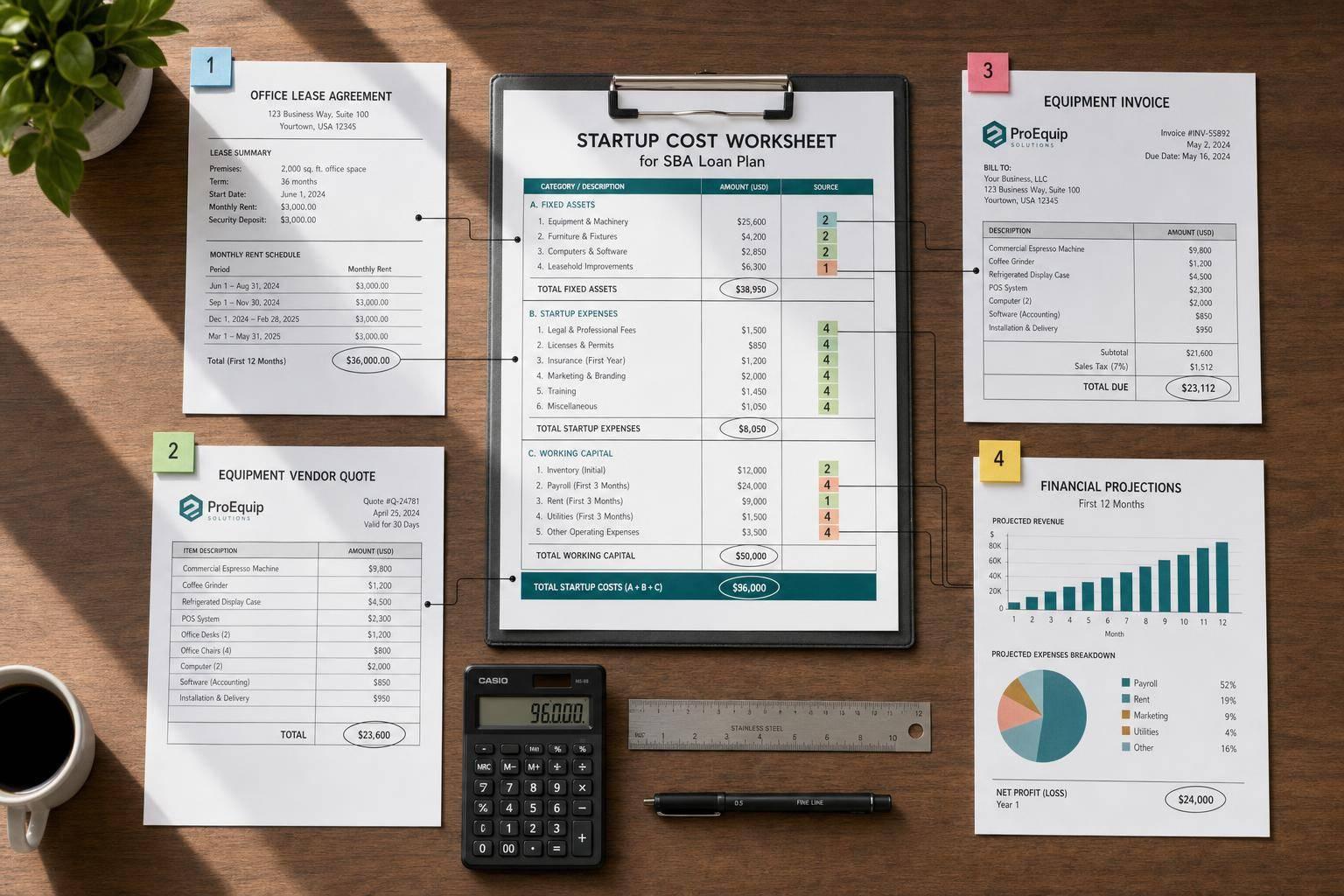
If you want an SBA loan, I’d treat the startup cost worksheet like a proof file, not just a budget. Every dollar should match a quote, lease, invoice, contract, bank record, or tax document.
Here’s the short version:
- I list one-time startup costs such as equipment, buildout, licenses, opening inventory, website work, and prepaid insurance.
- I list monthly first-year costs such as payroll, rent, inventory restocking, supplies, marketing, permit renewals, and the loan payment.
- I plan for 3 to 6 months of recurring costs as working capital.
- I make sure the worksheet matches the business plan, 12-month cash flow, debt schedule, and loan-use statement.
- I separate owner cash and any other committed funds from the amount I want to borrow.
A few numbers help set the range. SBA microloans vs bank loans average about SBA microloans average about $13,0003,000, with rates around 8% to 13% and terms of up to 6 years. That does not mean your request should match that figure. It means your ask should match your startup costs and cash flow.
At a basic level, the math looks like this:
- Total startup costs
- + monthly costs covered by the loan
- − owner equity
- − other committed funding
- = SBA loan request
What matters most is consistency. If my worksheet says one number and my projections say another, that can slow the file down. So I’d use this process to build one clean list, attach required documents for each line, and turn it into a loan request that is easy to review.
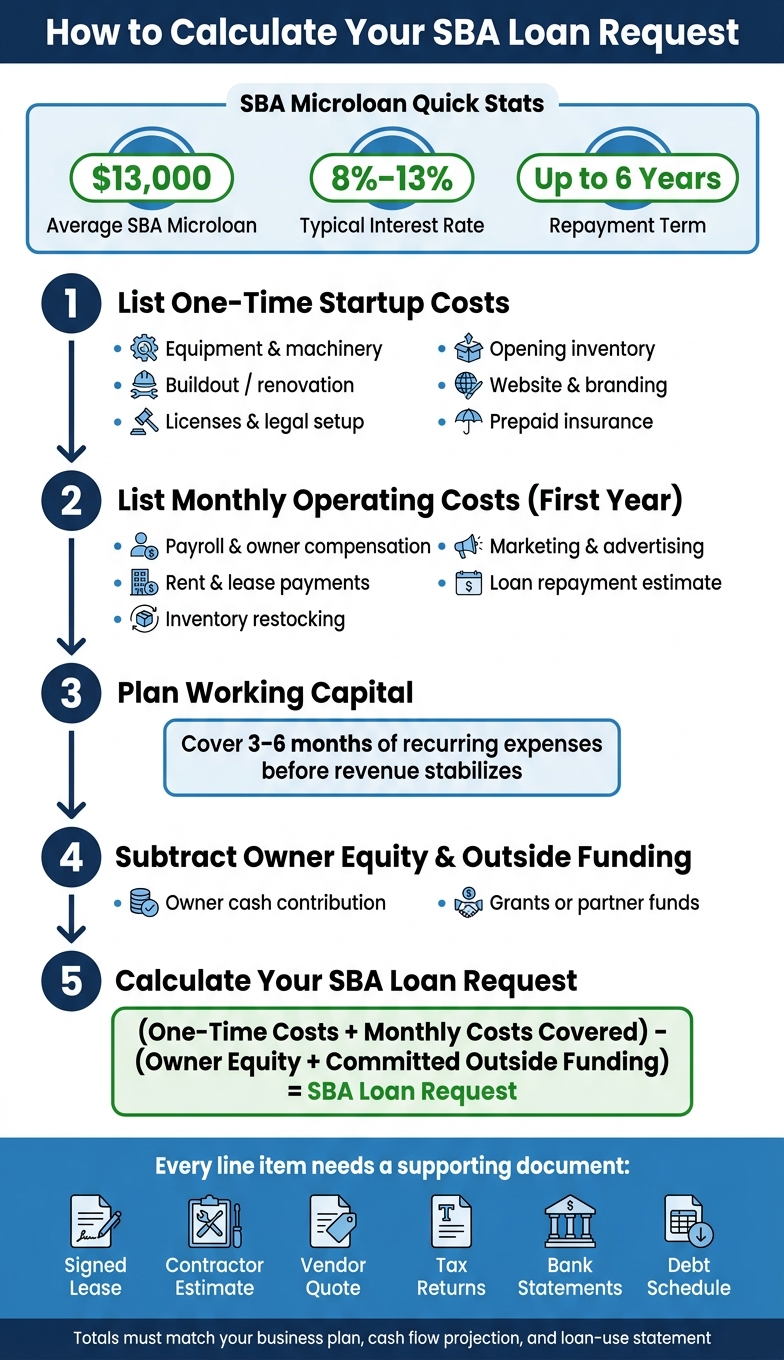
How to Calculate Your SBA Loan Request: Step-by-Step Formula
SBA Microloans: A Complete Guide for Startups and Small Businesses
sbb-itb-1eb586e
One-Time Startup Cost Checklist
One-time startup costs are launch-only expenses like equipment, inventory, licenses, and branding. Payroll, rent, and utilities belong in the monthly checklist instead.
Lenders usually want a clear paper trail for every one-time cost. That means signed leases, contracts, invoices, price lists, or written estimates that match the numbers in your business plan.
Location, Equipment, and Setup Costs
Use these numbers as placeholders, then swap them out with your own quotes or signed contracts.
List each cost as its own line item.
| Line Item | Estimated Cost ($) | Notes | Supporting Document |
|---|---|---|---|
| Lease deposit | $2,500–$5,000 | Initial deposit for commercial space | Signed lease agreement |
| Buildout / Renovation | $12,000 | Interior partitions and painting | Contractor estimate or contract |
| Signage | $1,500 | Exterior business sign | Vendor quote |
| Machinery / Tools | $46,000 | Heavy equipment needed to begin operations | Purchase agreement or invoice |
| Point-of-sale (POS) system | $1,200 | Hardware and initial software setup | Vendor quote or screenshot |
| Computers / IT | $3,000 | Laptops and networking gear | Price list or invoice |
Licenses, Inventory, Marketing, and Insurance Costs
These are one-time admin and launch costs. Each one should have matching paperwork.
List each cost as its own line item.
| Line Item | Estimated Cost ($) | Notes | Supporting Document |
|---|---|---|---|
| Business Licenses | $500 | Local and state operating permits | License application copy |
| Legal / Accounting Setup | $2,000 | Entity formation and initial tax setup | Professional service quote |
| Opening Inventory | $15,000 | Initial stock for retail or product businesses | Wholesale order or invoice |
| Website and branding | $2,500 | Site design and logo creation | Marketing agency contract |
| Prepaid Insurance | $1,800 | First year of general liability coverage | Insurance quote |
Leave out real estate and debt refinancing from this list. Every figure should tie back to an invoice, lease, quote, or application copy. Your totals should also match the numbers in your business plan and financial projections.
Next, add first-year monthly operating costs.
Monthly Expense Checklist for the First Year
Monthly operating costs are part of your working capital. Plan for 3 to 6 months of recurring expenses so the business has some room to settle in before revenue becomes steady.
Payroll, Rent, and Loan-Related Expenses
These are the fixed costs that tend to hit every month, along with your projected SBA loan payment. SBA Microloans usually come with interest rates between 8% and 13% and repayment terms of up to six years. So, estimate the monthly payment based on your loan amount, rate, and term, then add it as a fixed line item.
| Expense Category | Monthly Estimate ($) | Fixed/Variable | Notes | Documents |
|---|---|---|---|---|
| Payroll / owner compensation | Your estimate | Fixed/Variable | Include wages, owner draws, and payroll taxes if they apply. | Personal tax filings, proof of income, financial projections |
| Rent / office lease | Your estimate | Fixed | Monthly lease payment for your business location. | Signed lease agreement |
| Equipment lease payments | Your estimate | Fixed | Monthly lease costs for business equipment. | Lease or contract details |
| Loan repayment | Your estimate | Fixed | Base this on the loan amount, interest rate, and repayment term. | Debt schedule statement |
| License and permit renewals | Your estimate | Fixed | Monthly share of renewals and permit fees. | Renewal notices or license details |
Inventory, Marketing, Supplies, and Working Capital Costs
Variable costs move up and down from month to month based on sales and daily operations. That’s why lenders want a 12-month cash flow projection that shows these changes.
| Expense Category | Monthly Estimate ($) | Fixed/Variable | Notes | Documents |
|---|---|---|---|---|
| Inventory restocking | Your estimate | Variable | Monthly replacement of products or raw materials. | Supplier invoices or quotes |
| Supplies / materials | Your estimate | Variable | Items used up during daily operations. | Purchase records or price lists |
| Marketing / advertising | Your estimate | Variable | Monthly ad spend and promotion costs. | Marketing plan or vendor quotes |
| Operating reserve (cash cushion) | Your estimate | Variable | Money set aside for short-term gaps in cash flow. | Bank statements, financial projections |
If your business also pays regular professional, admin, or legal fees, add those too so they show up in the same 12-month cash flow projection.
Use these monthly totals in your 12-month cash flow projection, and make sure each line matches a support document.
Document Support Checklist for an SBA Loan Package
After you list each startup cost, attach the document that backs it up. The goal is simple: every line item on the worksheet should connect to a source document.
What Documents to Attach to Each Line Item and Loan File
| Cost Category | Supporting Documents |
|---|---|
| Equipment being financed | Lease or contract for the equipment being financed |
| Commercial space lease | Lease or contract for the company’s physical office space |
| Licenses and franchise agreements | Specific business license details; franchise agreements, if applicable |
| Financial records | Bank statements, tax returns, proof of income, and profit-and-loss records |
| Loan use statement | A detailed statement explaining how the funds will be used and how cash will circulate within the business |
| Debt and collateral support | Debt schedule statement; collateral documents |
| Owner/management profile | Resume; short biography; educational qualifications; character certificates |
For financial records, attach two years of bank statements, personal and business tax returns, proof of income, and profit-and-loss records. Also include the debt schedule and collateral documents.
This part matters more than people think. If your worksheet shows one set of numbers, but your Purpose of Loan statement or business plan shows another, that gap can slow things down. Keep the worksheet totals lined up with the Purpose of Loan statement, the business plan, and your cash flow projections.
Once every line item has backup, total the worksheet and separate owner cash from loan funds.
If you need help putting the worksheet package together, SBA50K offers SBA-approved business plans and loan application support.
Calculate Total Funding Needed and Final Review
Total Funding Needed and Owner Contribution
Once you’ve listed each cost category, turn those figures into your total funding request.
Start by adding your one-time startup costs and the working capital you want the loan to cover. Then subtract owner cash and any other committed funds. What’s left is your SBA loan request.
Use the totals from the startup and monthly checklists to complete the calculation below.
| Funding Category | How to Calculate It |
|---|---|
| Total One-Time Costs | Sum of equipment, licenses, initial inventory, supplies, materials, and setup fees |
| Monthly Costs Covered by the Loan | Monthly operating expenses × the number of months you want covered |
| Owner Equity | Cash or assets you’re personally contributing |
| Committed Outside Funding | Grants, partner contributions, or other committed non-SBA funds |
| SBA Loan Request | (One-Time Costs + Monthly Costs) − (Owner Equity + Committed Outside Funding) |
Keep the request tied to documented costs and cash-flow projections that line up with those numbers.
Final Checklist Before Using the Worksheet in Your SBA Loan Plan
Go through this checklist before attaching the worksheet to your loan plan.
- Every startup and monthly cost has its own line item with a dollar estimate
- Each line item has a quote, lease, license, or contract
- Totals match the business plan and cash flow projection
- Owner equity and other funding are listed separately from the loan request
- The request excludes real estate purchases and existing debt refinancing
FAQs
How do I estimate costs if I do not have final quotes yet?
Use estimates grounded in market research, actual demand, and industry norms – not gut feel.
Back up each estimate with two documents:
- one that confirms the projected cost, such as a vendor catalog or price quote
- one that shows the expected business impact, such as an analysis of how the purchase could improve revenue or efficiency
SBA50K can help tighten these projections and make the cost breakdown in your business plan more convincing.
How many months of working capital should I include in my loan request?
Include at least 12 months of working capital in your loan request. Then back it up with month-by-month cash-flow projections for Year 1. In some cases, lenders may also ask for 12–24 months in total, with Year 2 broken out in detail if needed.
Why does this matter? Lenders use these forecasts to check two things at the same time:
- Can you repay the loan?
- Can the business still cover day-to-day costs and loan payments during slower months?
That second point matters more than many people think. A business can look fine on paper and still run into trouble if cash gets tight for a month or two. Your forecast helps show that you’ve planned for those dips, not just the good months.
What if my worksheet totals do not match my cash flow projection?
If your startup cost worksheet doesn’t match your cash flow projection, it can create inconsistencies that delay your SBA microloan application or even lead to a denial. Lenders review these documents side by side to make sure your loan request is fully supported.
Review both documents carefully. Make sure your line items, debt obligations, revenue assumptions, use-of-funds statement, and month-by-month forecasts all match up.

Leave a Reply