
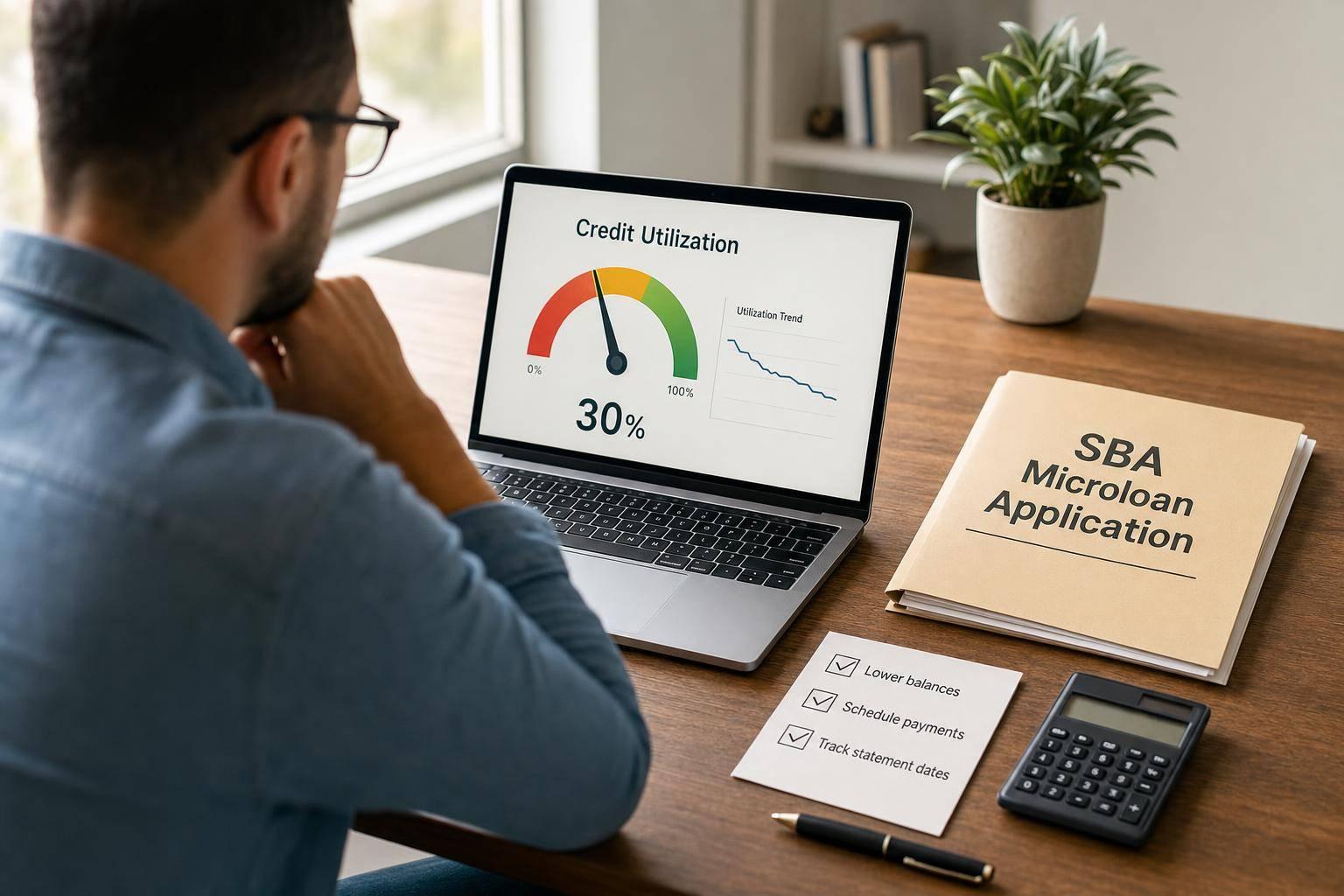
Your credit score is not the whole story. If too much of your card limit is already used, an SBA microloan lender may see more risk – even if your score looks okay.
Here’s the short version:
- If you owe $4,500 on cards with $15,000 in total limits, your utilization is 30%
- Under 30% usually looks better
- 30% to 50% may lead to more lender questions
- Above 50% can hurt both your score and your loan file
- 75% to 100% often looks high-risk, especially for startups
- Lenders may check both personal and business revolving debt
- They also look at payment habits, cash flow, and whether you use cards for payroll, rent, or vendor bills
For many startup owners, this matters more than they expect. If the business has limited revenue or little business credit history, I’d expect the lender to look more closely at personal card balances.
A few steps can help before you apply:
- Pay balances down before the statement closing date
- Avoid adding new revolving debt
- Check personal and business credit reports for errors
- Make sure your loan file shows a clear use of funds and a solid repayment plan
In plain terms: lower utilization gives lenders more comfort that you can handle one more monthly payment. That’s the main point of this article.
SBA Microloans: A Complete Guide for Startups and Small Businesses
sbb-itb-1eb586e
How lenders read personal and business credit utilization
Lenders look at personal and business utilization as two separate signals. That matters because the same borrower can look steady on one side and stretched on the other.
What personal credit card utilization tells lenders
Personal utilization below 30% – and even better, close to 10% – often helps support a stronger credit profile because it shows there’s still room for another payment. For startups, this matters even more. Many entrepreneurs choose funding your startup with an SBA microloan because of the flexible credit considerations. When the business doesn’t have much history yet, lenders often lean on the owner’s personal credit to fill in the gaps.
The number itself is only part of the story. Lenders also look at the pattern behind it. If balances keep rising month after month, if there’s a big jump right before an application, or if several cards are sitting at mid-to-high balances at the same time, that can signal budget pressure instead of a one-off expense.
Business credit can paint a different picture, especially when the company has its own revolving accounts.
What business credit utilization tells lenders
Business credit utilization shows up on reports from Dun & Bradstreet, Experian Business, and Equifax Business. PAYDEX focuses on payment timeliness, while other business scores factor in balances, utilization, and payment behavior.
When microlenders read these reports, they usually focus on a few things:
- Whether balances carry from month to month
- Whether usage stays high across several accounts
- Whether payments are made on time or early
If business utilization stays high for a while – especially when paired with slower payments – it can suggest the company is leaning on short-term debt to cover regular gaps instead of keeping cash flow in line.
Debt patterns that can weaken a microloan application
Some habits stand out as warning signs no matter what the credit score says. Minimum-only payments, repeated cash advances, and using revolving credit to cover payroll, rent, or vendor bills can all point to cash-flow strain.
That tells lenders they’re looking at a cash-flow issue, not just a timing mismatch. And they weigh those patterns alongside other SBA microloan requirements when they review the loan file.
Utilization levels that help or hurt approval chances
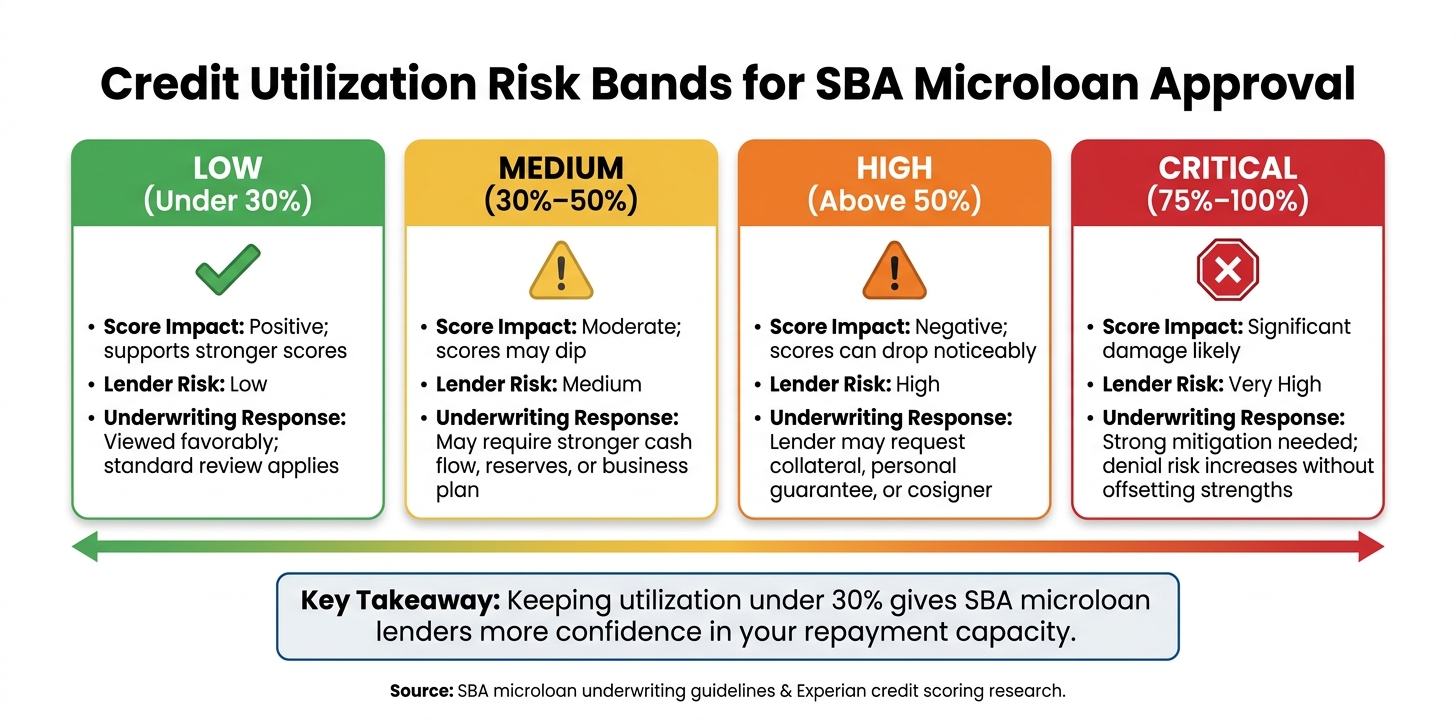
Credit Utilization Risk Bands for SBA Microloan Approval
After lenders look at personal and business balances, they usually sort utilization into risk bands. It’s not a simple yes-or-no test.
SBA lenders don’t use one fixed utilization cutoff. Intermediary lenders look at utilization along with income, time in business, repayment history, cash flow, reserves, collateral or guarantees, and the size and purpose of the loan. Still, some ranges tend to make underwriting a lot easier than others.
Utilization ranges that tend to look better to lenders
Personal utilization under 30% tends to support stronger approval odds because it shows room for another payment. Lower is usually better. Once business revolving balances move above that range, lenders may start to wonder whether the company is using short-term debt to patch regular cash gaps instead of staying on top of cash flow.
Utilization ranges that often trigger more lender review
Utilization between 30% and 50% doesn’t automatically shut the door. But it can lead to more questions.
Experian notes that 30% is roughly the point at which utilization begins to have a more pronounced negative impact on scores. In that band, lenders may want stronger support in other parts of the file, such as:
- steady cash flow
- operating reserves
- a clearly documented business plan
That extra context can help offset the debt signal.
High utilization and near-limit balances as red flags
Persistent utilization above 50% can suggest that a borrower is leaning hard on revolving credit. And accounts sitting between 75% and 100% fall into a high-risk range.
That hurts in two ways. Scores can drop, and lender perception can get worse at the same time, since utilization is part of the Amounts Owed category.
| Utilization Band | Likely Score Impact | Perceived Lender Risk | Common Underwriting Response |
|---|---|---|---|
| Low (under 30%) | Positive; supports stronger scores | Low | Viewed favorably; standard review applies |
| Medium (30%–50%) | Moderate; scores may dip | Medium | May require stronger cash flow, reserves, or business plan |
| High (above 50%) | Negative; scores can drop noticeably | High | Lender may request collateral, personal guarantee, or cosigner |
| Critical (75%–100%) | Significant damage likely | Very High | Strong mitigation needed; denial risk increases without offsetting strengths |
These bands matter because they point to the clearest next step: if your utilization is above 30%, lower balances before you apply.
How to improve credit utilization before applying for an SBA microloan
Pay down balances and avoid new revolving accounts
If your utilization is above the preferred range, the main job is simple: get lower balances reported before underwriting.
Start with the accounts that are closest to their limits. Those tend to hit your overall ratio the hardest. And timing can make a big difference. Try to make larger payments before the statement closing date, so the lower balance is the one that shows up when your credit gets pulled.
It also helps to stay away from new revolving accounts in the months leading up to your application. Opening a new card or line of credit can push utilization back up and make your file look weaker at the wrong time. Stick with the accounts you already have, and keep new charges light.
Review personal and business credit reports for errors
Before you assume your utilization is correct, check the reports yourself. Sometimes the numbers are just wrong.
For example, a card issuer may have increased your credit limit months ago, but the credit bureau may still show the old limit. When that happens, your utilization can look higher than it is. The same thing can happen if a recent balance payoff hasn’t been updated yet.
Pull your personal credit reports from Equifax, Experian, and TransUnion through annualcreditreport.com. Review each revolving account and check the:
- Reported credit limit
- Current balance
- Account status
If something looks wrong, dispute it directly with the bureau.
For business credit, review your profiles with Experian, Equifax, and Dun & Bradstreet. Watch for accounts reported by mistake, old limits that were never updated, or personal accounts that may have been tied to your business when they shouldn’t have been. Catching those issues before a lender sees them can help your file look more accurate and steadier.
Use application support to build a stronger loan file
If your ratios are still high, shift some attention to the rest of the application.
Lenders reviewing SBA microloan applications also look at cash flow, repayment history, how you plan to use the loan, and whether the business plan makes sense. So if your credit is a bit weak, a stronger overall file can help balance out a borderline utilization ratio.
SBA50K helps startups and small business owners pursue SBA microloans up to $50,000 with step-by-step guidance, lender connections, and custom-written SBA-approved business plan support. If your credit history is thin or has some damage, lower utilization paired with a well-built application file can make the full application look stronger to intermediary lenders.
Conclusion: How credit utilization can shape your SBA microloan outcome
Credit utilization affects how lenders read risk before they approve a loan. It’s one of the main signals they use to gauge debt pressure. When intermediary lenders review an SBA microloan application, they look at utilization to judge repayment capacity across both personal and business revolving accounts.
Lower utilization tends to give lenders more confidence. Higher balances can trigger more concern during underwriting. And once utilization goes above 75%, it can signal that there’s less room for new debt, which may hurt approval odds or shrink the amount approved.
If your ratio is high, the fastest way to improve your file is usually to lower reported balances before underwriting starts. It also helps to fix credit report errors and submit a complete application with a clear business plan and a clear use-of-funds plan. Lower utilization makes your cash flow story easier to explain and your repayment capacity easier to support.
If you want help turning a stronger credit profile into a complete loan package, SBA50K can help with a step-by-step funding guide, intermediary lender connections, application preparation, and custom business plan support.
FAQs
Does paying off cards right before applying help?
Yes. Paying down your cards right before you apply can help.
Lenders look at your personal credit, and high credit utilization can stand out as a warning sign. If your balances are lower, your credit profile usually looks stronger on paper.
SBA microloan intermediaries may have a bit more room to work with than some other lenders. Even so, lower utilization and a cleaner credit profile can ease credit concerns during underwriting. It also helps to submit a complete application that clearly shows your ability to repay.
Do lenders care more about personal or business card balances?
Usually, lenders look at your full financial picture, not just your personal or business card balances on their own. They check both personal and business credit for signs like high credit utilization, which can point to financial strain.
Because SBA microloans often require a personal guarantee from owners with 20% or more equity, your personal credit is directly tied to the application. In the end, lenders want to see whether your debt load and utilization leave room for steady repayment.
Can I still qualify with utilization above 50%?
Yes, you may still qualify for an SBA microloan even if your credit utilization is above 50%. That’s because SBA microloans are issued through local intermediary lenders, and each lender sets its own underwriting rules.
In most cases, lenders look at your full financial picture, not just a single credit metric. A strong business plan, realistic financial projections, and steady cash flow can help balance out concerns about high utilization or past credit problems.

Leave a Reply