
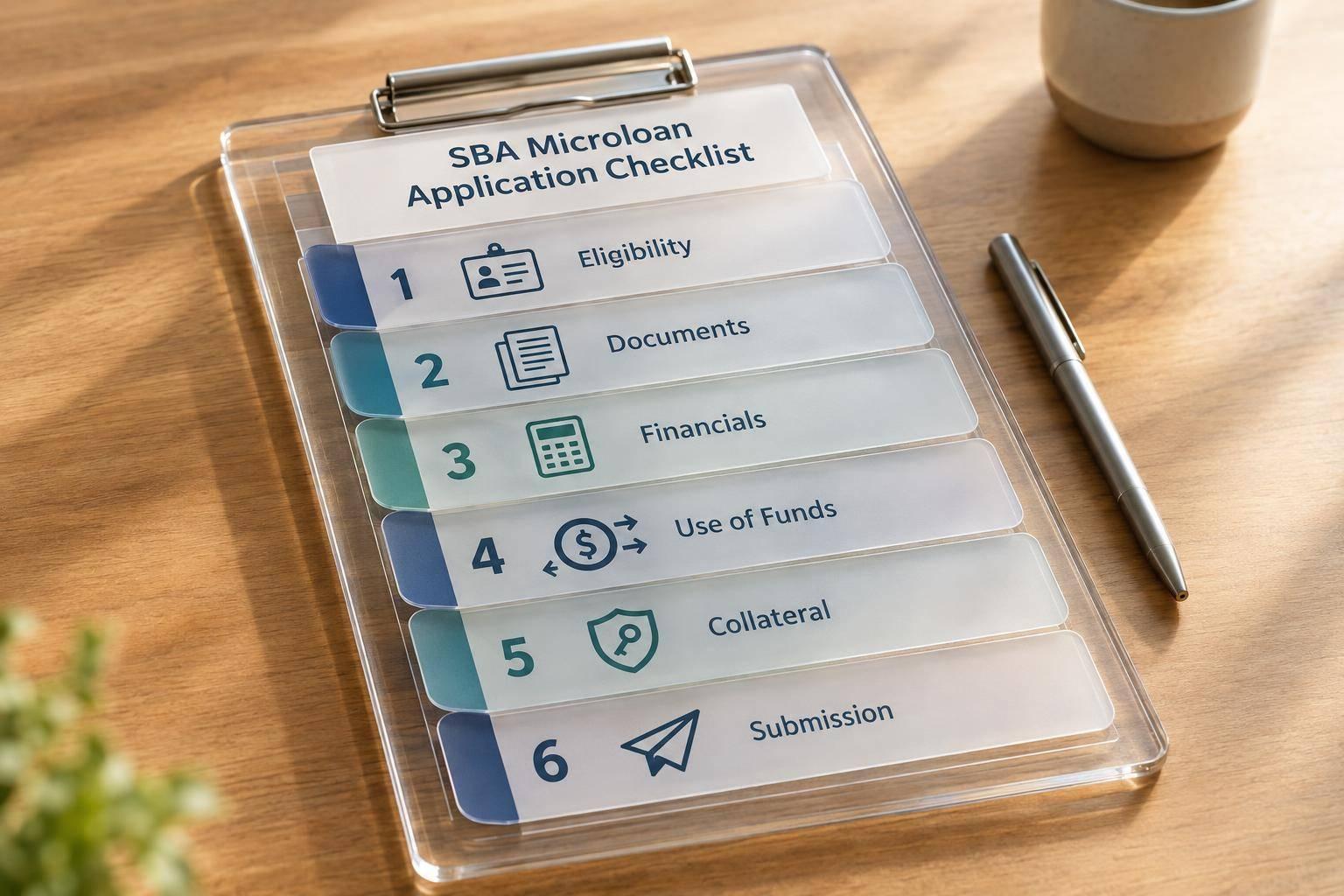
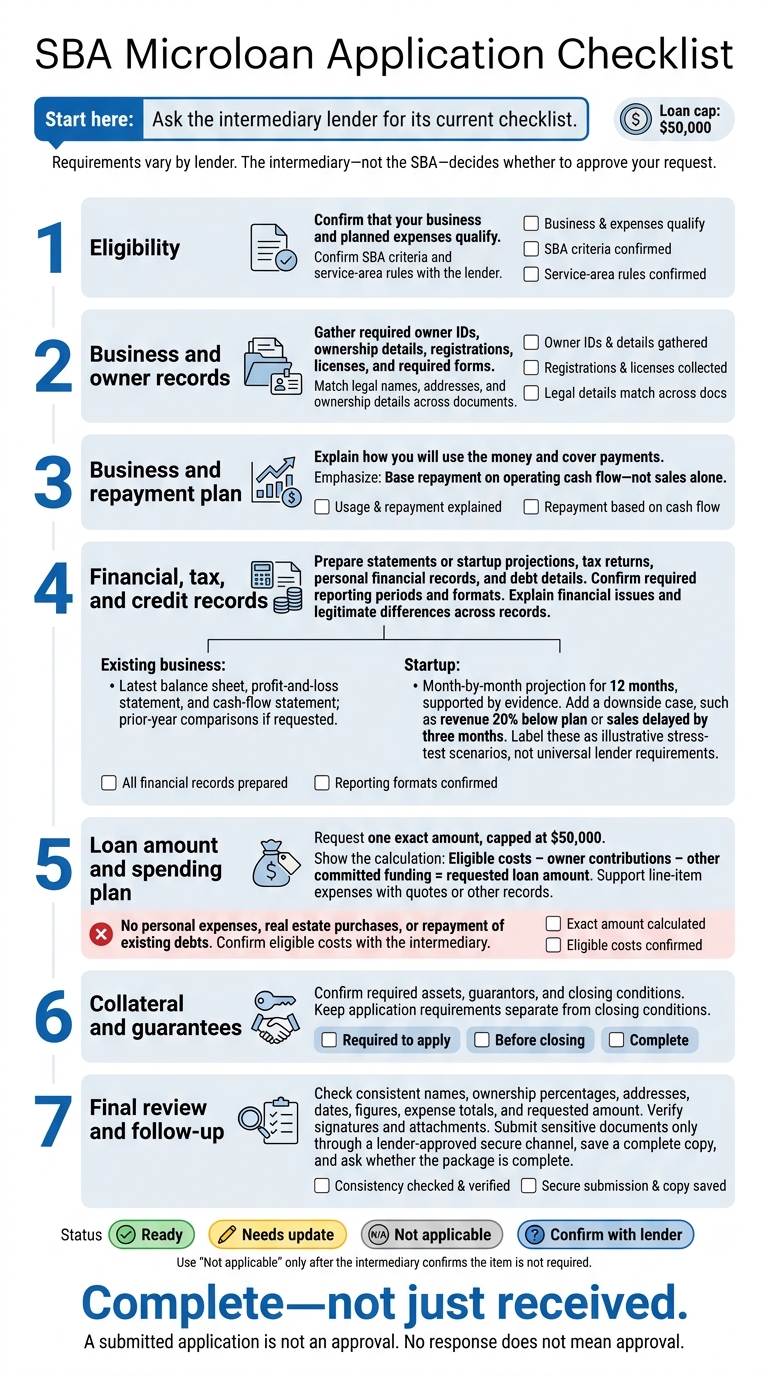
I’d start an SBA microloan application by asking the intermediary lender for its current checklist. Loans are capped at $50,000, and the intermediary – not the SBA – decides whether to approve your request.
Here’s what I’d check before submitting:
- Eligibility: Confirm that your business and planned expenses qualify.
- Business and owner records: Gather IDs, ownership details, registrations, licenses, and required forms.
- Business and repayment plan: Explain how you’ll use the money and cover payments with cash flow.
- Financial, tax, and credit records: Prepare statements or startup projections, tax returns, debt details, and explanations for financial issues.
- Loan amount and spending plan: Request one exact amount and support costs with quotes or other records.
- Collateral and guarantees: Confirm required assets, guarantors, and closing conditions.
- Final review and follow-up: Check that details match, submit through an approved secure channel, and ask whether your package is complete.
My final check: <u>complete – not just received</u>. A submitted application is not an approval.
SBA Microloan Application Checklist
SBA Microloans: A Complete Guide for Startups and Small Businesses
sbb-itb-1eb586e
2. Business and Owner Documents
Use the lender’s checklist to gather records that confirm ownership, identity, and the business’s readiness.
Gather Identification and Business Records
For each required owner, prepare a government-issued photo ID and an owner profile sheet. Include their legal name, date of birth, address, phone number, email, SSN or EIN, ownership percentage, and role.
Create a master information sheet with the business’s legal name, DBA, addresses, and requested loan amount. Check all application materials against this sheet and the owner profiles so the details match. Submit sensitive information only through the lender’s secure portal or approved delivery method.
Gather these business records:
- Tax identification: EIN confirmation letter.
- Formation and registration: Articles of organization or incorporation, partnership agreement, business license, assumed-name or DBA filing, and any applicable state or local registrations.
- Operating records: Applicable licenses, permits, leases, contracts, and insurance records.
If startup documents are pending, note what’s missing and when you expect to get it.
Prepare a one-page ownership and management schedule that lists each owner’s start date and signing authority. Cross-reference it with the owner profiles. Include a brief business history, related business interests, and owner or key-manager résumés focused on industry experience, operations, sales, and financial management.
With the ownership file complete, use the business plan to explain how the loan will support operations and repayment.
Write the Business Plan and Repayment Plan
Explain what the business does, how it will use the funds, and how it will repay the loan. Cover the legal structure, products or services, target customers, local market, competitors, competitive advantage, pricing, and marketing channels. Include the staffing plan, suppliers, facilities, and management responsibilities. State the requested loan amount and connect it to clear business results.
Base repayment on operating cash flow – not sales alone. Show expected monthly revenue alongside cost of goods sold, payroll, rent, utilities, insurance, taxes, existing debt payments, owner draws, and the proposed loan payment. Explain when customers will pay and when expenses come due. Identify a cash reserve or contingency plan, and name the cash source for each payment.
For startups, use supporting evidence in place of historical results. Back up demand, pricing, launch timing, costs, and break-even assumptions with customer interviews, preorders, supplier quotes, lease estimates, launch dates, and a detailed startup-cost schedule. Show the lender why the projected cash needs and ability to repay are realistic. Keep confirmed commitments separate from estimates.
3. Financial, Tax, and Credit Records
Use your business plan’s numbers to show how you’ll repay the loan and back up every financial claim below. Before preparing files, confirm the lender’s required statement dates, tax years, bank-statement months, “as of” date, year-to-date figures, and signature or preparation format. Your records should support the repayment plan and use-of-funds breakdown you’ve already outlined.
Prepare Financial Statements or Startup Projections
Existing business: Gather your latest balance sheet, profit-and-loss statement, and cash-flow statement. Include prior-year comparisons if the lender requests them.
Startup: Prepare a month-by-month projection for 12 months. Include revenue, cost of goods sold, operating expenses, debt payments, net cash flow, and ending cash balance. Back up each assumption with contracts, customer commitments, supplier quotes, pricing research, payroll plans, rent estimates, or comparable sales data.
Add a downside case, such as revenue 20% below plan or sales delayed by three months, and show that loan payments still fit the cash flow.
Check those projections against tax filings, bank activity, and debt payments.
Provide business bank statements for the exact months requested. Make sure account-holder names match the legal business name, deposits line up with reported revenue, transfers are identified, and ending balances agree with the financial statements. Projected purchases and debt payments should also match the business plan, loan request, and debt schedule.
Gather Tax Returns and Personal Financial Records
Ask whether the lender needs federal business returns, owners’ personal returns, or both. Confirm which tax years to include. Depending on your entity and ownership structure, the package may include Forms 1040, 1065, 1120, or 1120-S, along with Schedule C, K-1s, and depreciation schedules.
Check whether the lender accepts signed copies, filed returns, IRS transcripts, extensions, amended returns, or explanations for missing filings. If your startup hasn’t filed a business tax return yet, ask whether one is required and be ready to explain the gap.
Complete the lender’s personal financial statement form for each required owner or guarantor. Include assets, liabilities, income, monthly expenses, real estate, investments, vehicles, guarantees, and other obligations.
Add a debt schedule covering each business and personal creditor. List the account type, current balance, monthly payment, maturity date, and interest rate if requested.
Check Credit Reports and Explain Financial Issues
Review personal credit reports and any business credit file. Check names, addresses, account ownership, balances, payment history, collection accounts, public records, and recent inquiries. Dispute factual errors promptly, and keep copies of your disputes and supporting records.
If the business has little or no credit history, gather other proof of how it handles its bills. This can include vendor references, payment records, bank statements, and a clear explanation of how the business has managed its obligations.
Explain anything that could affect repayment. This includes late payments, collections, bankruptcy, tax liens or payment plans, overdrafts, unexplained deposits, income gaps, declining revenue, and prior business closures. Keep each explanation brief: state what happened, when it occurred, the amount involved, whether it’s resolved, and what controls now prevent it from happening again. Attach relevant records.
Compare tax returns, financial statements, bank records, and projections. Explain legitimate timing or accounting differences rather than forcing the totals to match.
4. Loan Amount, Use of Funds, and Final Review
Once your financials are ready, use them to set the loan amount and show exactly how you’ll spend the money.
List the Loan Amount and Planned Expenses
Use your cash-flow projections to request one exact amount, capped at $50,000. Calculate it by subtracting owner contributions and other committed funding from eligible costs.
Create a line-item use-of-funds schedule with each expense’s category, specific item, vendor, estimated cost, purchase date, and business purpose. For working capital, name the expenses and the months covered. Include only costs the lender approves.
Explain how each major expense supports revenue, capacity, efficiency, or your ability to repay the loan. Attach quotes, invoices, catalog pages, lease estimates, or other lender-required cost records when available. Keep owner contributions, grants, investor funds, vendor financing, and other loans separate from the microloan request.
Do not include personal expenses, real estate purchases, or repayment of existing debts. Check with the intermediary before adding leasehold improvements or other startup costs.
With the request set, review the collateral and closing requirements.
Confirm Collateral, Guarantees, and Closing Requirements
Prepare a collateral schedule listing each asset’s owner, description, identifying details, estimated market value, and existing liens. Ask which assets the lender requires as security and who must sign a personal guarantee.
Keep application requirements separate from closing conditions. Request a written list of deadlines for insurance, appraisals, lien searches, title records, property or lease reviews, and proof of owner contributions.
Confirm who pays the fees, whether original signatures or notarized documents are required, and whether the lender will release funds at closing or in stages. Track each item as required to apply, before closing, or complete.
Check the Application Before Submitting
Compare the application, business plan, financial statements or startup projections, tax records, collateral schedule, and use-of-funds table line by line. Names, ownership percentages, addresses, dates, revenue figures, the requested amount, and expense totals should match throughout the package.
Check that every required field is filled in, all required signatures are present, dates follow the lender’s requested format, and attachments are easy to read. If a document doesn’t apply, ask the lender before marking it “N/A.” An unexplained omission can delay review.
Confirm how the intermediary accepts applications: through a secure portal, encrypted email, in-person delivery, or another approved method. Send sensitive identity or tax documents only through a lender-approved channel.
Save a complete copy of your submission, including the final use-of-funds schedule and signed forms. Ask who will handle follow-up questions, how to send additional documents, and when to expect status updates.
5. Conclusion: Check Your Application Status
Use this checklist to track what’s complete, what needs lender confirmation, and what to send next.
| Checklist item | Status | Needed / next step |
|---|---|---|
| Eligibility | Confirm SBA criteria and service-area rules. | |
| Identity and business records | Address missing IDs, registrations, licenses, or ownership records. | |
| Business plan and repayment plan | Show how projected cash flow will cover loan payments. | |
| Financial statements or startup projections | Confirm the lender’s required reporting periods and format. | |
| Tax returns and personal financial records | Confirm which tax returns and personal financial statement form are required. | |
| Collateral and personal guarantee | Confirm acceptable assets and required signers. | |
| Loan purpose and use of funds | Get current quotes or other supporting records for expenses that lack enough documentation. |
Mark each row Ready, Needs update, Not applicable, or Confirm with lender. Use Not applicable only after the intermediary confirms that the item isn’t required.
Before submitting, check the table for gaps. Your package should show that you qualify, can repay the loan, and will use the funds for eligible expenses.
After submission, ask the lender to confirm that your package is complete – not just received. Follow its status-check process. No response does not mean approval.
Update the table as lender feedback comes in. Then send only the items still marked incomplete through the lender’s approved channel.
Work with the intermediary to resolve open requirements. It – not the SBA – makes the credit decision and sets the loan terms.
FAQs
Can I qualify for an SBA microloan with bad credit?
Yes, you may still qualify with bad or limited credit. Nonprofit intermediary lenders issue these loans – not the SBA directly. They often look beyond your credit score to review your full financial picture, though requirements vary by lender.
To improve your chances, prepare a strong business plan and clear cash-flow projections. Collateral or a cosigner may also help. Be honest about past credit issues and provide a brief written explanation.
What if I don’t have enough collateral?
Limited collateral doesn’t rule out an SBA microloan. Requirements depend on the lender, your credit profile, and the loan amount. Some smaller loans may not require collateral.
A strong business plan, detailed cash-flow projections that show you can repay the loan, or a cosigner may help your application. Check with your chosen intermediary lender early to confirm its collateral requirements and which assets it accepts.
How long does SBA microloan approval take?
SBA microloan approval typically takes two weeks to three months. The time from a complete application to funding is generally 30 to 60 days. These ranges are estimates: each nonprofit intermediary lender sets its own underwriting standards and review process.
Missing documents, collateral reviews, or required training can delay funding. Before you apply, ask your chosen lender how long the process is likely to take.
Leave a Reply