

If your SBA loan is charged off, you still owe the debt. I’d treat the notice as the start of federal collection, not the end of the loan.
Here’s the short version:
- A charge-off is an accounting step, not forgiveness.
- The SBA can refer the debt to the U.S. Treasury for collection.
- Treasury can use tax refund offsets, wage garnishment, and collection agencies.
- Personal guarantees still apply, even if the business closed.
- Credit damage can last up to 7 years on personal reports.
- You may still have options like a payment plan, settlement, Offer in Compromise, or bankruptcy review.
- Good records matter if you want to ask for lower payments or a deal.
- Future SBA funding is still possible, but a past charge-off can make approval harder.
I’d also keep three numbers in mind right away:
- 60 days: the SBA may give about this long to pay or ask for a payment plan
- 15%: Treasury may garnish up to this share of disposable pay without a court judgment
- ~32%: collection fees can add about this much to the principal balance in some cases
Bottom line: if you act early, keep every notice, and line up your financial records, you give yourself a better shot at dealing with the debt and getting back in shape for future borrowing.
What is an SBA Loan "Charge Off"
sbb-itb-1eb586e
What an SBA loan charge-off actually means
A charge-off is an accounting move, not a legal free pass. The lender removes the balance from its books and records it as a loss, but SBA guidance is clear: a charge-off does not release the borrower or any guarantors from liability for the debt.
That matters for one simple reason: the lender can still try to collect after the write-off.
A charge-off does not erase the debt
The unpaid balance can still be legally collectible after charge-off, whether the original loan was whether the original loan was $10,000 or $250,000.0,000 or $250,000. That can include principal, interest, fees, and collection-related costs, depending on the loan documents and how the debt gets settled.
And selling collateral doesn’t automatically end the story. If liquidated assets like equipment, vehicles, or real estate don’t bring in enough to cover the full loan balance, the borrower will usually still owe the deficiency. The lender applies the sale proceeds first, then may continue to pursue what’s left. In many cases, charge-off comes after the lender decides further recovery looks unlikely.
How a loan typically reaches charge-off
Most SBA loans reach charge-off through a fairly standard path: delinquency leads to default, then liquidation, then charge-off. Each step moves the loan farther away from normal servicing and closer to formal collection.
At that point, the loan shifts from servicing to collection. From there, the big issue becomes who is collecting and what options they have next.
What happens after an SBA loan is charged off
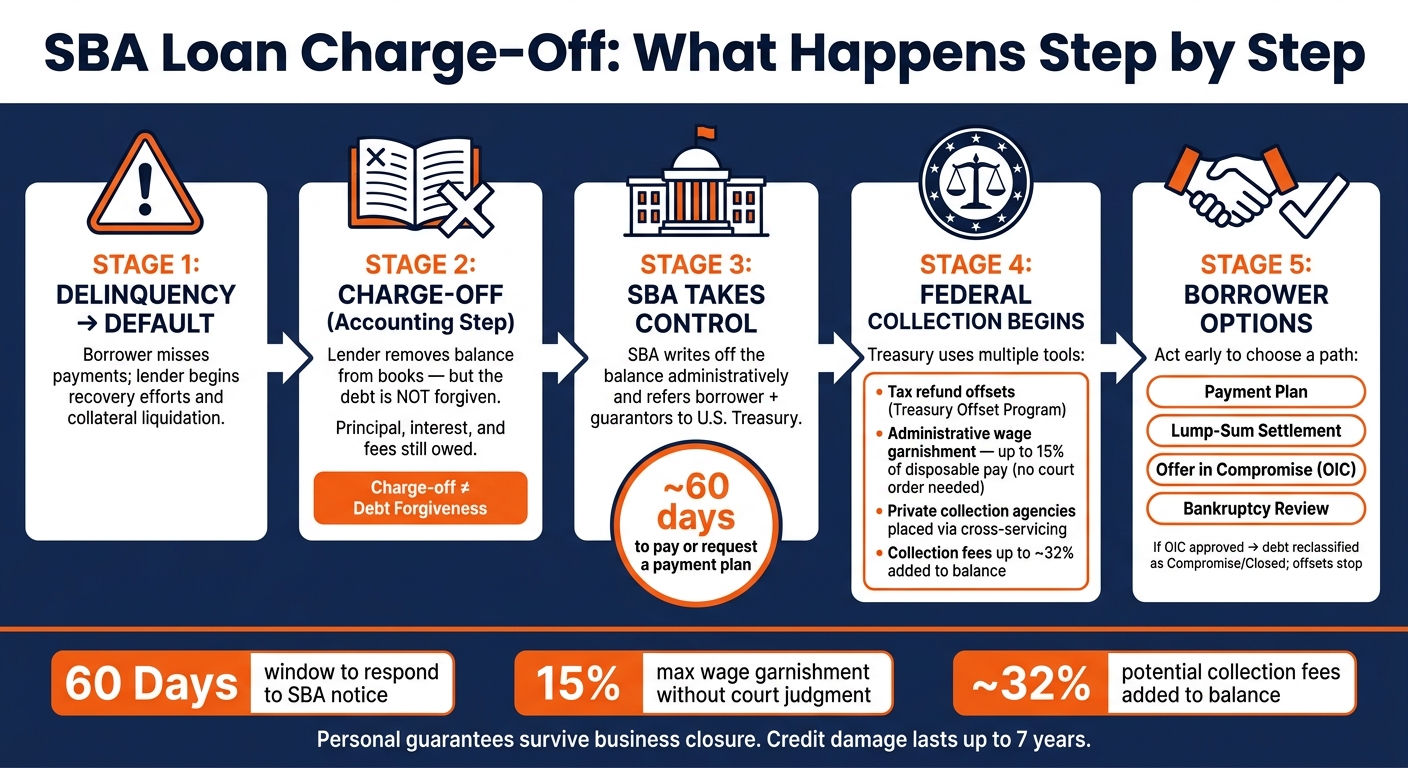
SBA Loan Charge-Off: What Happens Step by Step
After a charge-off, the lender is mostly out of the picture. Collection can still continue, but now it happens through the federal system. In plain English: the file moves from lender servicing to government collection.
How the lender, SBA, and Treasury each play a role after charge-off
After liquidation, SBA reviews the liquidation report, writes off the remaining balance, and refers the borrower and guarantors to Treasury for collection unless bankruptcy or a statute-of-limitations defense applies. SBA takes control of the file and refers the borrower and any guarantors to the U.S. Department of the Treasury for further collection.
Once that referral happens, lenders are generally barred from continuing servicing or collection activity on the loan. At that point, Treasury becomes the main contact through its collection programs. For borrowers, this is a big shift: the matter is no longer sitting with the original lender. It has moved into the federal collection process.
| Stage | Who’s in control | What typically happens |
|---|---|---|
| Pre-charge-off | Lender / SBA servicing | Delinquency management, collateral liquidation, borrower contact |
| Charge-off | SBA | Loan written off administratively after recovery efforts are exhausted |
| Post-referral | U.S. Department of the Treasury | Federal collections begin – offsets, garnishment, collection agencies, and possible lawsuits |
Collection tools the government may use
Treasury can use the Treasury Offset Program to intercept federal tax refunds, certain federal benefits, federal salaries, and vendor payments and apply them to the SBA debt. Treasury can also pursue administrative wage garnishment – without a court judgment – by directing an employer to withhold up to 15% of a guarantor’s disposable pay. That means pay can be reduced before a lawsuit ever enters the picture.
Treasury may also place the debt with private collection agencies through its cross-servicing program, and collection fees can climb to about 32% of the principal balance. So the balance can grow fast, even if the loan was already written off on the agency’s books.
Notices borrowers may receive after charge-off
SBA typically sends a notice giving borrowers about 60 days to pay or request a payment plan. Once the debt is referred, Treasury or a contracted collection agency usually sends a formal demand letter that explains the amount owed, the legal basis for collection, available payment options, and the consequences of non-payment.
Later notices may ask for updated financial information, warn that offsets are coming, or confirm that garnishment has begun. Open every notice right away, keep copies, and track each deadline. The paperwork may feel dry, but missing a date can make a bad situation worse.
From here, the main risks shift to credit damage, guarantor liability, and legal action.
Credit, personal guarantees, and legal consequences
How a charge-off can hurt personal and business credit
Once Treasury begins collection, the fallout goes well beyond letters and offsets. A charge-off can hurt your credit for years.
In most cases, the lender reports late payments, default, and the charge-off to consumer credit bureaus. Under the Fair Credit Reporting Act, that negative item can stay on your personal credit report for up to 7 years from the date of the first missed payment. Business credit bureaus may also report the account as late, in default, or charged off, which can drag down scores like PAYDEX. How hard that hit lands depends on your credit profile and payment history. But the aftereffects tend to look the same: higher interest rates, tighter underwriting, stricter vendor terms, and sometimes more trouble getting approved for commercial leases or insurance underwriting.
If you signed a personal guarantee, the debt may still follow you as an individual.
Why personal guarantees still apply after the business closes
A personal guarantee does not end when the business shuts its doors. Many SBA loans require one from owners with a 20% or greater ownership stake, and that guarantee stands on its own as a contract. So even if an LLC is dissolved or a corporation closes, the promise to repay does not just vanish.
That’s where many owners get tripped up. They assume that once the business is closed, personal liability ends too. It doesn’t if a personal guarantee was part of the loan. The lender or SBA can still go after you for the balance, and that can put your personal finances on the line long after the business is gone.
Legal risks that can follow a default
If collection efforts do not settle the debt, the matter can move into court. After a charge-off, the lender or the government may seek a court judgment against you. A judgment makes the debt official in court and can lead to tools such as bank levies, property liens, and wage garnishment. And if the loan was backed by specific collateral, such as commercial real estate, equipment, or even a personal residence, foreclosure or repossession may follow.
Federal collection can begin even before a lawsuit is filed. On top of that, court judgments may be renewed under state law, which means collection can last far longer than the 7-year credit reporting period. So even after the charge-off no longer appears on your credit report, an unpaid lien or judgment can still get in the way when you try to sell property, refinance, or line up new SBA financing.
Repayment and settlement options after charge-off
Payment plans, settlements, and compromise requests
A charge-off does not mean you’re out of options. If Treasury is handling collection, you may still be able to set up a payment plan, work out a settlement, or submit an Offer in Compromise (OIC).
The best option comes down to one simple question: what can you actually afford right now?
- Payment plans usually make sense for borrowers with steady income.
- Settlements tend to fit people who can come up with a reduced lump-sum payment.
- An OIC asks Treasury or SBA to accept less than the full balance when full repayment is not realistic.
If SBA approves an OIC, the debt is reclassified as "Compromise/Closed," which ends SBA collection on that balance and stops offset activity on that debt.
Records to gather before you respond
Before you contact the SBA, Treasury, or a collection agency, pull your paperwork together. Good records can make a big difference when you’re trying to get a payment plan or settle for less.
Here’s the core file to gather:
- Original SBA loan note and any modifications – confirms the terms, interest rate, and default provisions
- Personal guarantee agreements – shows exactly who is personally liable
- Collateral documents (UCC filings, mortgages, security agreements) – shows what property may be at risk
- Recent federal and state tax returns – verifies income and any claimed losses
- Current bank statements for all personal and business accounts – shows actual cash flow
- Personal financial statement with supporting documents for real estate, vehicles, and retirement accounts – helps SBA or Treasury review your ability to pay
- Business closure records (state dissolution filings, asset sale documents) – helps show the business is no longer bringing in income
- Proof of hardship – medical records, unemployment documentation, caregiving responsibilities, or other evidence of extraordinary circumstances
These records support payment talks, settlement offers, and compromise requests. If your file is incomplete, your request gets harder to approve. Federal collectors usually want full, consistent documentation before they agree to accept less than the full amount.
When bankruptcy and state law questions may come up
If a payment plan, settlement, or OIC won’t work, bankruptcy may be the next issue to look at. Some SBA-related debts may be dischargeable, but fraud or willful misrepresentation can change the outcome.
This is where people can get tripped up. You shouldn’t assume state-law deadlines or discharge rules will control a federal debt. Federal obligations play by their own rules in many cases, so it’s smart to get advice from a bankruptcy attorney who handles federal debts.
How to recover and prepare for future SBA funding
Steps to rebuild credit and strengthen your finances
Once the charge-off shows up on your record, the job changes. At that point, it’s less about damage control and more about repair.
Start by bringing every account current and setting up automatic payments. That matters because even one new late payment can slow your recovery in a hurry.
Next, pull your personal credit reports from all three major bureaus: Experian, TransUnion, and Equifax. Then check any business credit reports you can access through Dun & Bradstreet or Experian Business. A charge-off can leave behind messy reporting, like inaccurate balances or duplicate collection entries, and those issues need to be fixed before you apply for new financing.
Review each report line by line. Look for:
- The charge-off itself
- Duplicate collections
- Wrong balances
If you find an error, dispute it directly with the credit bureau and send proof. That can include your original loan agreement, payment history, settlement letters, or bankruptcy discharge papers if they apply.
It also helps to get your financial records in order. Keep your profit and loss statements, tax returns, bank statements, and accounts receivable/payable aging reports in one place. Then review your monthly free cash flow after core expenses and debt payments. That gives you a plain view of where you can cut spending and where your payment ability can improve.
Once your books and credit files are clean and organized, you can start getting ready for the next loan application.
What a past charge-off means for future SBA microloan applications
A past charge-off makes approval harder, but it does not automatically shut the door on an SBA microloan.
Lenders tend to focus on what your business looks like now. They want to see recent revenue, steady cash flow, and enough income to cover debt payments. Recent behavior matters a lot here. If your revenue is stable or growing and your cash flow supports repayment, that can help offset older credit problems.
Your loan request also needs to match your numbers. A realistic request tied to your current cash flow will usually land better than an overly hopeful figure. If you’re running a startup, detailed financial projections can help show that you have a path to repayment.
A clear business plan can also carry a lot of weight when your credit history is rough. SBA50K offers SBA microloan application support and business-plan writing for borrowers with limited or damaged credit.
Key points to remember after a charge-off
Keep these priorities in order:
- Federal collection continues after charge-off. Tax refund offsets and administrative wage garnishment can continue for years. Stay on top of notices and deadlines.
- Personal exposure remains until resolved. Even if your company has been dissolved, your personal finances can still be on the hook until the debt is settled, compromised, or legally discharged.
- Credit damage is real but manageable. Personal and business credit can both take a hard hit, which can affect leases, vendor terms, and future financing for years if you leave it alone.
- Fast, organized action gives you the best shot. When you gather records, respond to notices, and deal with creditors early, you put yourself in a better position to work out payment plans or compromises.
- Consistent on-time payments and better cash flow improve approval odds for future SBA-backed funding.
FAQs
Can I stop Treasury collection after a charge-off?
It depends on your financial situation and what kind of deal you can work out. Once a debt is charged off and sent to the Treasury, collection usually keeps going until the balance is paid in full, settled, or handled through an official payment plan.
You should contact the agency involved to talk through repayment options or a possible settlement plan.
What documents should I gather before responding?
Gather documents that show you can repay the loan, such as:
- an SBA-compliant business plan
- a use-of-funds statement
- 12- to 24-month financial projections
- personal and business tax returns, year-to-date profit and loss statements, balance sheets, and recent bank statements
You should also include management details, collateral information, and written explanations for any credit issues.
SBA50K can help with SBA-approved business plans and application guidance.
Will a charged-off SBA loan block future SBA funding?
Not necessarily. But it is a major red flag.
SBA loans go through local intermediary lenders, so approval comes down to each lender’s underwriting rules.
Lenders will look closely at your credit history. They’ll check for patterns, ask what led to past defaults, and look at what has changed in your finances since then. If you can show a stronger financial picture now, that can help your case.
A strong, SBA-compliant business plan can also make a difference. SBA50K offers custom-written, SBA-approved business plans, a step-by-step funding guide, and connections to intermediary lenders.

Leave a Reply