

Yes – if you’re 20, you can usually get an SBA loan in the U.S. Your age is not the main issue. I’d focus on four things instead: legal age to sign, credit, cash flow, and how strong the business looks on paper.
Here’s the short version:
- At 20, you can usually sign loan papers
- SBA Microloans are often the easiest place to start for smaller needs
- SBA 7(a) loans can fund much more, but lenders often want a stronger file
- Thin credit and short business history are the main roadblocks for younger borrowers
- You can improve your odds with a well-written business plan, financial projections, collateral, or a guarantor
A few numbers matter right away:
- SBA Microloans: up to $50,000
- Repayment term for Microloans: up to 6 years
- SBA 7(a) loans: up to $5 million
- Community Advantage-style loans: often up to $350,000
If I were 20 and applying, I’d keep it simple: start with the loan type that fits your stage, show exactly how the money will be used, and make it easy for the lender to see how repayment will work.
Quick Comparison
| Loan type | Best for | Max amount | What lenders often look for |
|---|---|---|---|
| SBA Microloan | Startups, inventory, supplies, small equipment, working capital | $50,000 | Business plan, repayment path, basic credit review |
| SBA 7(a) | Larger funding needs, equipment, real estate, acquisitions, working capital | $5,000,000 | Stronger credit, more paperwork, clear cash flow |
| Community Advantage-style | Borrowers with limited history in some local markets | $350,000 | Local lender fit, use of funds, business case |
Bottom line: if you can legally sign and show the business can repay, being 20 does not block you. What matters most is how well you prepare your file.
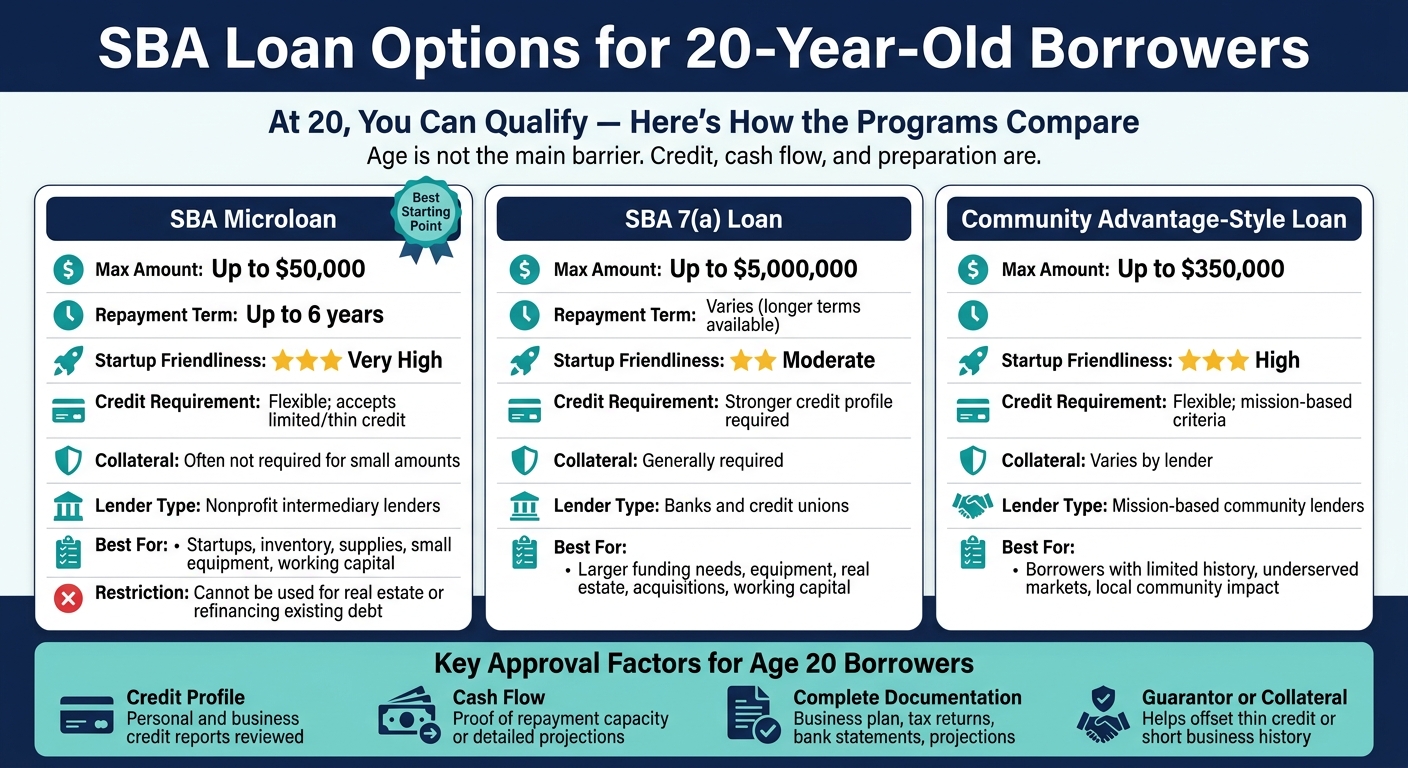
SBA Loan Options for Young Borrowers: Side-by-Side Comparison
How To Find a SMALL SBA loan For Your Startup or Business (Real Example)
sbb-itb-1eb586e
Can a 20-Year-Old Sign for an SBA Loan?
The short answer is yes. In the United States, a 20-year-old is legally an adult and can usually sign a binding contract. That means they can generally sign SBA loan documents and provide a personal guaranty when required. So the legal piece is pretty straightforward. After that, it comes down to whether the business fits the SBA program.
Age Is Usually Not the Barrier
In most cases, age isn’t what stops approval. Rejections tend to happen because of starting a business with poor credit, limited income, or missing paperwork – not because the borrower is 20. That’s why the loan program matters just as much as the person applying.
For a 20-year-old, lenders usually look at a few core things:
- Legal standing
- Credit
- Cash flow
- Collateral
- Business experience
At this age, the bigger issue is often a thin credit file, short operating history, and documents that aren’t fully in order. A clean personal record helps, of course. But lenders care more about credit strength and the ability to repay.
Once the legal signing issue is out of the way, the next step is matching the borrower’s size, credit profile, and funding needs to the right SBA program.
SBA Loan Programs a Young Borrower Can Use
Different SBA programs fit different funding needs. For a young borrower, a few stand out as the most practical places to start.
SBA Microloans for Smaller Startup and Working-Capital Needs
The SBA Microloan program is often the most realistic first step for a young entrepreneur. It offers up to $50,000 with repayment terms of up to six years.
These loans are often used for:
- Inventory
- Supplies
- Small equipment
- Early working capital
Unlike many bank loans, SBA Microloans are issued through nonprofit intermediary lenders. Those lenders often provide business guidance and training along with the money. That can make a big difference when you’re still building your track record.
Another plus: microloan lenders may put more weight on your SBA microloan business plan and your ability to repay than on a long credit history. That doesn’t mean standards disappear. It just means the lender may look at the full picture, not just your age or thin file.
There are limits, though. Microloan funds can’t be used to buy real estate or refinance existing debt.
Microloan lenders often place more weight on your plan, character, and repayment story than many banks do.
SBA 7(a) Loans for Larger Financing Needs
The SBA 7(a) loan is the SBA’s main program for larger financing needs. It can be used for working capital, business acquisition, real estate, and large equipment.
A 20-year-old is not automatically ruled out. But this program usually comes with tougher lender review. In most cases, lenders want to see a stronger credit profile, more paperwork, and a clear plan for repayment before they approve the loan.
So if you need more than a microloan can offer, 7(a) may be the target. You just need to walk in ready with more proof.
Community Advantage-Style Options Where Available
Community Advantage loans are offered through community lenders and are often geared toward borrowers with limited history or those in underserved markets. These loans can go up to $350,000.
This route can make sense if you don’t have much operating history yet but can show a clear local market, a sound use of funds, or a strong community impact. The catch is availability. It depends on local lenders and the current program setup, so you may not find this option in every area.
Program choice matters, but it doesn’t override lender judgment. Approval still comes down to the lender’s review of the full application.
| Feature | SBA Microloan | SBA 7(a) Loan | Community Advantage |
|---|---|---|---|
| Max Loan Amount | Up to $50,000 | Up to $5 million | Typically up to $350,000 |
| Startup Friendliness | Very high | Moderate | High |
| Credit Requirement | Flexible; accepts limited credit | Stronger profile required | Flexible, mission-based criteria |
| Collateral | Often not required for small amounts | Generally required | Varies by lender |
| Lender Type | Nonprofit intermediaries | Banks and credit unions | Mission-based community lenders |
Even if you pick the best-fit program, lenders still look at the same core issues: credit, cash flow, collateral, and whether your application is complete.
What Lenders Review Beyond Age
Even if you pick the right SBA program, approval still comes down to underwriting. For a 20-year-old, the main issue usually isn’t age. It’s whether you can show that you’ll repay the loan and run the business well.
Credit Profile, Cash Flow, and Collateral
Lenders look at personal and business credit reports from the major credit bureaus. A strong score helps. But if your credit history is short or just average, you may still have a shot with an SBA Microloan if the rest of your application is in good shape.
Cash flow often matters more than your score. Lenders want proof that the business can make payments on time. If the business hasn’t started bringing in money yet, detailed projections can help fill that gap. Some smaller microloans may not need collateral, but assets you can pledge may help your case.
Business Viability and Industry Experience
Lenders want proof that a first-time owner can actually run the business. That means your business plan needs to do more than look polished. It should lay out a clear path to profitability, show market demand, include realistic projections, explain management, and spell out how the funds will be used.
Industry experience matters too. So does training. These help show that you can follow through on the plan instead of just talking a good game. Your resume should make that experience and training easy to spot.
Documentation Completeness
A complete file cuts down on back-and-forth with lenders. In plain English: the fewer gaps they find, the smoother the review tends to be.
Lenders usually expect documents in four areas:
| Document Category | What to Include |
|---|---|
| Personal Info | Background bio, address, education history, personal background summary |
| Financials | Credit reports, tax returns, bank statements, debt schedule |
| Business Case | Business plan, financial projections, profit/loss statements, purpose of loan |
| Legal/Operations | Business licenses, leases, contracts, resume |
One item people often miss is a clear purpose-of-loan statement. Be specific about where the money will go. It also helps to check your credit file before you apply.
For a young borrower, a complete file can be one of the best ways to make up for a thin credit record or short operating history.
How to Strengthen Your Application at Age 20
At 20, the best way to improve your approval odds is simple: make the lender feel less risk. The two issues that show up most often are thin credit and a short business track record. So your application needs to deal with both head-on. That matters even more when your credit history and operating history are still limited.
Build a Lender-Ready File Before You Apply
Your business plan should be specific and grounded in numbers, not just big ideas. Tie it directly to repayment. Include 12- to 24-month financial projections, a market analysis, management details, and revenue assumptions that make sense. You should also show when repayment is expected to start and how the business is supposed to support it.
Just as important, make sure your funding request lines up with the loan amount and the reason you need the money. If you’re asking for $25,000, the file should make it clear where that $25,000 is going and why that amount fits the plan.
Before you apply, pull your personal credit reports and check them closely. Look for errors, old accounts that should have been updated, or missing information. Fixing problems early can save you a headache later.
Use Outside Support to Offset Limited History
If your credit file or business record is still thin, add proof that lowers lender risk. A stronger file can include:
- Collateral, which gives the lender added protection
- A guarantor, who backs repayment
- Your own money invested in the business, which shows you have skin in the game
Your resume can help too. Don’t treat it like filler. Use it to show relevant work experience, training, and your day-to-day role in the business. Lenders want to see that you can run the operation and repay the loan – not just that you’re motivated.
If the file still feels light, a smaller SBA-friendly loan may be the smarter next move.
What to Do If a Standard SBA Loan Is Not Yet Within Reach
Not every borrower gets approved for a 7(a) loan on the first attempt, and that’s normal. The better move is to choose a funding option that matches your current credit profile and business track record.
Start with a Smaller SBA-Friendly Path
Microloans are often a smart first step if you have thin credit, limited collateral, or a newer business. A smaller loan request is often easier to get approved, especially when your business plan includes financial projections, management details, and a clear use of funds.
These loans come through intermediary lenders, and those lenders often provide more hands-on support. For many borrowers, that makes a microloan the clearest bridge from startup funding to a larger SBA loan later.
Improve Weak Areas and Reapply with a Stronger Package
If a microloan still isn’t available, use that time to shore up the areas lenders check most closely. Put together a lender-ready file with your credit report, tax filings, bank statements, business plan, and projections. Build cash reserves to show steady money habits. If credit remains a problem, a guarantor or strong collateral may help reduce the lender’s risk.
Paying back a microloan on time can help build the credit history needed to qualify for a larger SBA 7(a) loan down the road.
Conclusion: Age Matters Less Than Preparation
Age usually isn’t the main issue. Proof that you can repay is. If a standard SBA loan isn’t within reach yet, start smaller, strengthen your file, and apply again with a more complete package. Lenders want to see repayment capacity, cash flow, and full documentation – things a younger borrower can build over time.
FAQs
Do I need a co-signer or guarantor at age 20?
Not automatically. At age 20, you’ll usually need to provide a personal guarantee if you own 20% or more of the business.
A lender might also ask for a co-signer or guarantor if your credit score is low or you don’t have enough collateral. A solid business plan and realistic financial projections can make your application stronger.
What credit score helps me qualify for an SBA loan?
SBA microloan intermediaries often look at credit scores in the 550 to 675 range. But there isn’t a hard cutoff that automatically gets you approved or denied.
Instead, lenders look at the full picture. That includes your cash flow, business plan, and experience in your industry. You may also improve your application with collateral, a co-signer, steady income, and money you’ve put into the business yourself.
Can I get an SBA loan for a startup with no revenue?
Yes, you may qualify for an SBA microloan for a startup with no revenue. These loans are often aimed at early-stage businesses, so lenders may look less at past performance and more at your ability to make money going forward.
A strong application should include:
- A solid business plan
- Realistic financial projections
- Your industry experience
- Your personal credit
- A clear plan for how you’ll use the funds

Leave a Reply