
Yes, you can get business funding without established business credit. I’d start by checking SBA microloans of up to $50,000, community lenders, and equipment financing. Lenders may review your personal credit, cash flow, collateral, and repayment plan instead.
Here’s what I’d check before applying:
- Your credit: No business credit is different from poor credit. Review both personal and business reports, and ask about personal credit inquiries.
- Your paperwork: Gather bank statements, available tax returns, a use-of-funds budget, and cash-flow forecasts. Startups may need contracts, quotes, and proof of owner investment.
- Your costs and risks: Compare fees, total repayment, payment schedules, collateral requirements, and personal guarantees – not just monthly payments.
My rule: <u>borrow only if conservative forecasts support repayment</u>. Test a 20% drop in sales, and remember that application help, including SBA50K’s preparation support, does not guarantee approval.
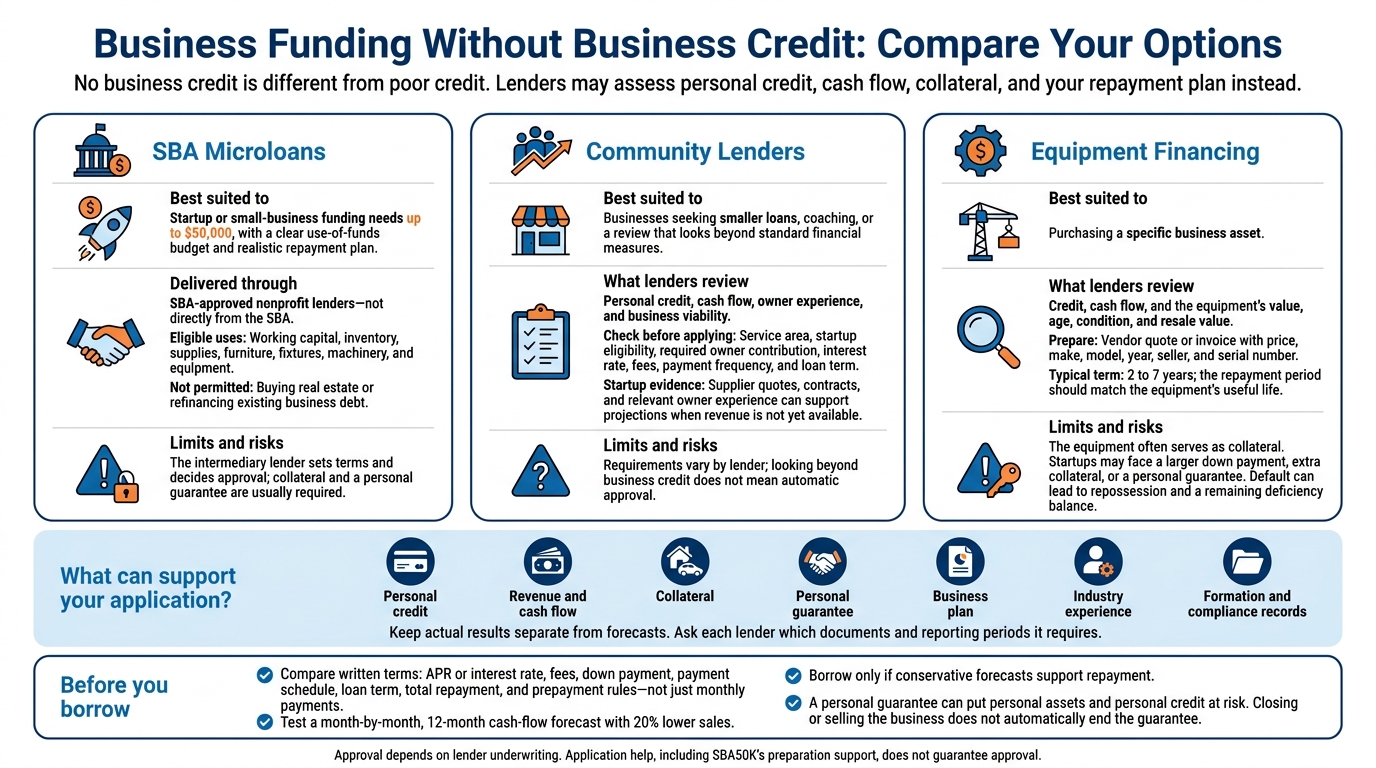
Business Funding Without Business Credit: Compare Your Options
When Can SBA Microloans and Community Lenders Help?
These options work best for startups that know how they’ll use the funds and have a realistic plan to repay the loan.
SBA Microloans Up to $50,000
SBA microloans come through SBA-approved nonprofit lenders – not directly from the SBA. You can use the funds for working capital, inventory, supplies, furniture, fixtures, machinery, and equipment. You can’t use them to buy real estate or refinance existing business debt. Submit an itemized funding request with supplier quotes and supporting documents.
The lender sets repayment terms and usually requires collateral and a personal guarantee. Ask which assets will secure the loan and which owners must guarantee repayment. Some lenders also provide management or technical assistance to help you improve your business plan or financial projections.
Community Lender Requirements
Community lenders may look beyond business credit when reviewing your application. If your business hasn’t built credit yet, they may assess your personal credit, cash flow, experience, and whether the business can succeed.
Check the lender’s service area, whether it funds startups, how much owners must contribute, and any other application requirements. Also confirm the interest rate, fees, payment frequency, and loan term. If your startup has no revenue, support your projections with supplier quotes, contracts, and relevant owner experience.
How SBA50K Helps You Prepare
SBA50K helps applicants organize documents and prepare a lender-ready business plan, which can make preparation easier. Use that support to explain your funding needs and repayment projections, then confirm the lender’s document checklist.
Preparation support does not guarantee approval, determine eligibility, or replace the lender’s underwriting process. Before enrolling, confirm what the assistance includes and how much it costs.
sbb-itb-1eb586e
Can You Finance Equipment Without Business Credit?
Yes – equipment financing may be available without established business credit. The equipment often serves as collateral, helping secure the loan. If you default, the lender can repossess it. Approval still depends on your cash flow and credit.
What Equipment Lenders Review
Lenders review your credit, cash flow, and the equipment’s value. If you don’t have revenue yet, you may need signed contracts, industry experience, and projections showing how the equipment will help you make payments. Startups may also face stricter requirements, such as a larger down payment, extra collateral, or a personal guarantee.
Provide a vendor quote or invoice with the equipment’s price, make, model, year, seller, and serial number. Lenders also consider its age, condition, and resale value. For used equipment, they may request maintenance records, photos, and operating-hour or mileage readings. Equipment that’s hard to resell may require more money upfront.
Equipment Financing Costs and Risks
Compare the total cost – not just the monthly payment. Review the APR, fees, down payment, loan term, and total repayment. Terms commonly range from 2 to 7 years, but the repayment period should match the equipment’s useful life. Check whether paying early saves interest or triggers a charge. Also, find out whether required insurance must name the lender as loss payee.
You’ll still owe payments if the equipment sits idle, breaks down, or falls short of expectations. Before signing, test whether your cash flow can cover payments during lower sales, repairs, and downtime. If you default, the lender can repossess the equipment – and you may still owe a deficiency balance, or the amount left after its sale.
What Do Lenders Check Besides Business Credit?
Lenders still need proof that you can repay. If you don’t have business credit, they assess personal credit, cash flow, collateral, and operating records instead. Together, these help lenders evaluate your business without an established credit file. No single strength guarantees approval.
Here’s what lenders usually review and what to prepare.
| What lenders check | Why it matters | What to prepare |
|---|---|---|
| Personal credit | Helps lenders assess borrowers with thin or missing business credit. | Credit reports, explanations of negative marks, and a personal financial statement. |
| Revenue and cash flow | Shows whether you can make payments. | Recent bank statements, profit-and-loss statements, balance sheets, accounts-receivable aging reports, and monthly cash-flow projections. |
| Collateral | Confirms which assets can secure the loan. | Asset list, ownership records, appraisals, titles, and liens. |
| Personal guarantee | Makes you personally responsible for repayment. | Review who signs, how much is owed, and when collection starts. |
| Business plan | Explains how the business will repay the loan. | Use-of-funds budget, pricing, sales assumptions, break-even point, milestones, and downside scenarios. |
| Industry experience | Shows your relevant experience. | Résumé, licenses, certifications, prior ownership experience, contracts, and evidence of customer demand. |
| Formation and compliance records | Confirms ownership and authority to act for the business. | Formation documents, licenses, permits, tax registrations, ownership records, and details of lawsuits, liens, or bankruptcies. |
Use these items to start building your lender file.
Documents You May Need
Lenders may also ask for government-issued identification, operating agreements or bylaws, an EIN where applicable, available tax returns, accounts-payable aging reports, existing debt schedules, leases, and equipment quotes or invoices. Ask each lender which records it needs and which reporting periods those records must cover.
Missing startup records? Ask about accepted substitutes before applying. Purchase orders and proof of owner investment may help support your file. Keep actual results separate from forecasts. Explain your assumptions about sales, margins, and customer payment timing so the lender can assess repayment capacity without a business credit history.
Approval is only part of the picture. You also need to know what the loan will cost.
Loan Costs and Repayment Terms
Without business credit, don’t focus only on getting approved. Request written terms showing the interest rate or APR, application and origination fees, packaging or closing charges, required down payment, late fees, and total repayment.
Confirm how often payments are due, the first payment date, the maturity date, whether the rate is fixed or variable, and the prepayment rules. Check which events could make the full balance due early.
Test the payments against a month-by-month, 12-month cash-flow forecast. Include a downside case with 20% lower sales to see whether the business could still cover them.
Pay close attention to any personal guarantee.
What a Personal Guarantee Means
If a lender requires a personal guarantee because business credit is missing, you become contractually responsible if the business defaults. That obligation is separate from any pledged collateral and can put your personal assets and personal credit at risk.
Before signing, check whether the guarantee is limited or unlimited, which owners must sign, and whether a spouse or another guarantor is included. Review whether the obligation continues after business closure, sale, or bankruptcy. Closing or selling the business does not automatically end the guarantee.
Which Funding Option Fits Your Business?
Once you know what lenders review, choose a loan type that fits your credit, cash flow, and collateral.
Match Funding to Your Finances and Goals
An SBA microloan may fit funding needs up to $50,000 if you have strong personal credit, steady revenue, clean records, and a clear plan for the money. The intermediary lender decides whether to approve your application. SBA microloans and bank loans from community lenders may suit businesses that need smaller loans, coaching, or a review that looks beyond standard financial measures at both the owner and the business.
Buying a single asset? The loan structure matters as much as the approval requirements. Equipment financing is usually the most targeted choice because the equipment can secure the loan. Your cash flow still needs to cover repayment.
Weak credit and weak cash flow sharply limit affordable options. Before borrowing, improve your payment history, reduce expensive debt, separate business and personal finances, and keep accurate bookkeeping and tax records. A smaller request for a necessary expense, backed by a detailed budget, generally makes a stronger case than a large request without one. Do not borrow until conservative projections show you can repay the loan.
After choosing the funding type that best fits your finances, prepare your application file.
Steps to Take Before Applying
Check the lender’s requirements, gather your records, and compare written offers. Apply only if conservative projections show that repayment fits your budget.
SBA50K’s funding guide can help you organize the process. Preparation does not guarantee approval, better rates, faster funding, or fewer documents.
FAQs
What personal credit score do I need to qualify?
There’s no program-wide minimum personal credit score. Each nonprofit intermediary lender sets its own requirements. Some look for scores between 550 and 675, though approval may be possible with a score as low as 525.
Your score is only part of the picture. Lenders also review your finances, and a strong business plan, solid cash-flow projections, relevant industry experience, collateral, or a qualified co-signer can often help offset a lower score.
Can I qualify without revenue or collateral?
Yes, but you’ll have fewer options. Some smaller SBA microloans are unsecured, meaning you don’t need to pledge an asset. Without revenue or collateral, you’ll need to show lenders how you’ll repay the loan.
Prepare a strong business plan, realistic financial projections, and proof of industry experience. A personal guarantee or co-signer may help, too. Equipment financing may also be an option because the equipment itself serves as collateral.
Will repaying a loan help build my business credit?
Yes, consistently paying your loans on time can help build or improve your business credit over time. Lenders and credit bureaus review your payment history to assess your business’s creditworthiness. Keeping enough cash flowing to cover your monthly bills also helps strengthen your overall credit profile.
Leave a Reply