

If your debt-to-income ratio is too high, an SBA microloan can be hard to get – especially if your credit is weak or your business is new.
I’d sum it up like this: lenders want to see that you have enough monthly income left after rent, loans, and card payments to handle one more bill. In many cases, a DTI under 35% to 40% looks better, while 43%+ gets more review and 50%+ can be a red flag.
Here’s the short version:
- DTI = monthly debt payments ÷ gross monthly income × 100
- Lenders look at recurring payments, not just total balances
- For startups, personal DTI matters more because there may be little business history
- High DTI + low credit can hurt approval odds fast
- You may be able to improve your file in 3 to 6 months by paying down debt, avoiding new borrowing, and showing more verifiable income
- For SBA microloans up to $50,000, lenders also want to see how the loan will help cash flow and repayment
A simple example: if you earn $6,000 a month before taxes and have $2,100 in monthly debt payments, your DTI is about 35%. That tells a lender how much of your income is already tied up before a new loan payment is added.
This article explains what DTI means, how microloan lenders look at it, where common DTI ranges fall, why it matters more when credit is thin, and what I’d do before applying to put the file in better shape.
How SBA microloan lenders review debt-to-income ratio

For startups with a thin credit file, lenders often lean hard on DTI. It gives them a simple way to see how much room you have for another monthly bill. SBA microloan lenders use DTI to judge whether you can handle one more payment without stretching yourself too far.
There isn’t one set DTI cutoff across the board because SBA microloans are issued through intermediary lenders, and each lender sets its own underwriting rules. Still, when your credit history is limited or bruised, DTI tends to matter more.
What lenders include in the DTI calculation
Lenders calculate DTI by adding up your recurring monthly debt payments and dividing that total by your documented monthly income.
On the debt side, they usually count:
- Rent or mortgage payments
- Auto loans
- Student loans
- Credit card minimum payments
- Personal loans
- Business debt you personally guaranteed
On the income side, lenders look for documented recurring income. If you’re self-employed or launching a startup, plan to show tax returns, bank statements, or pay stubs to back up your numbers. Verbal estimates won’t cut it.
DTI ranges lenders may see as stronger or riskier
Many lenders tend to look at DTI ranges like this:
| DTI Range | How Lenders Tend to View It |
|---|---|
| Below 35–40% | Relatively strong; more room for a new payment |
| 40–43% | Acceptable but draws closer scrutiny |
| Above 43% | Higher scrutiny; compensating factors needed |
| 50% or higher | Major risk signal; approval less likely without strong offsets |
DTI is only one part of the picture. Lenders also want to know whether the business itself can support repayment.
How DTI differs from DSCR and global cash flow
DTI looks at the owner’s personal debt load. DSCR looks at business cash flow. Global cash flow pulls personal and business income and debt into one combined view.
That difference matters. A borrower may look fine based on DTI alone but still have heavy business obligations that change the full repayment picture. That’s why lenders compare DTI with business cash flow before making a decision.
sbb-itb-1eb586e
Why high DTI can block approval for owners with poor or limited credit
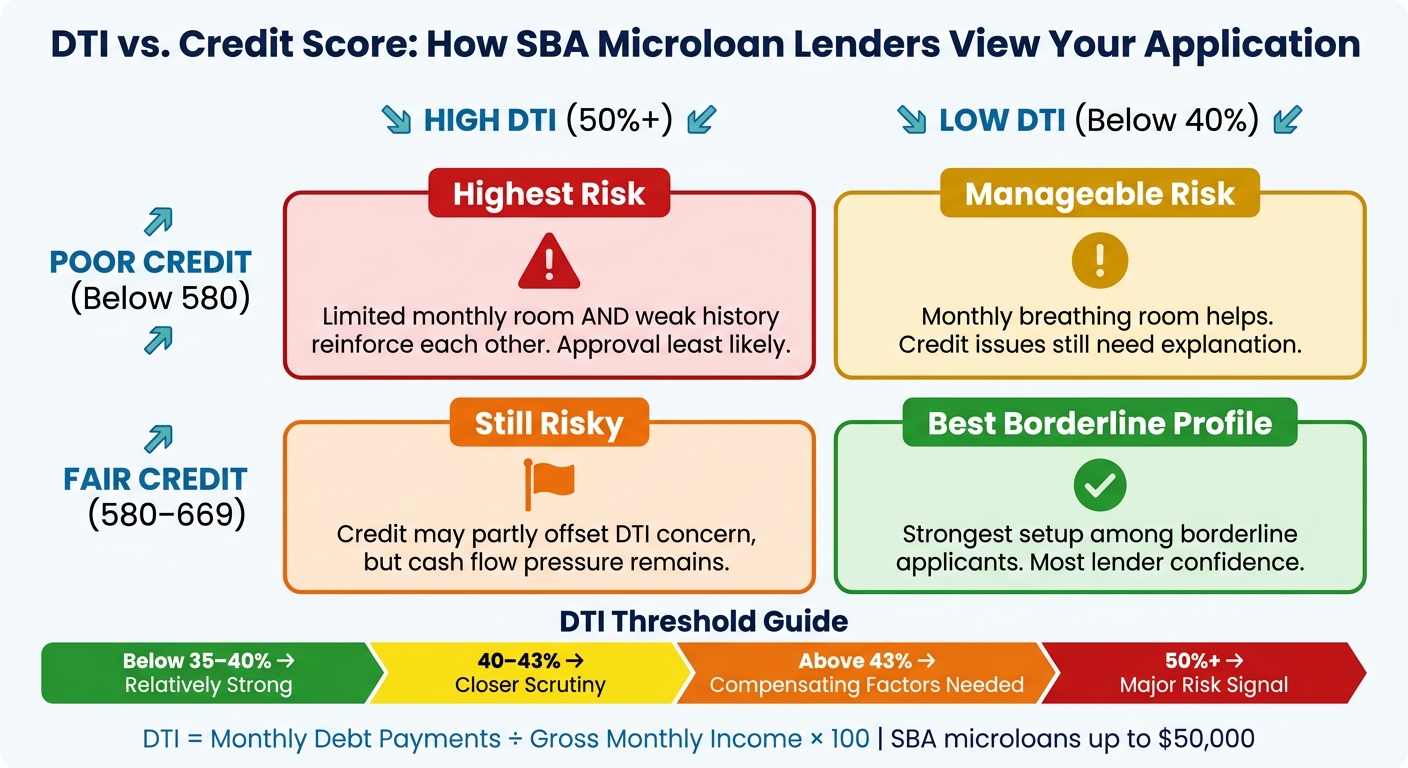
DTI vs. Credit Score: How SBA Microloan Lenders View Your Application
High DTI and weak credit tend to stack the odds against you. Lenders look at the full file and weigh strong points against risk. A solid credit profile, a long payment record, or steady business cash flow can sometimes make up for a weaker spot. But when your DTI climbs above roughly 40% to 50% and your credit score falls below about 580 to 620, those offsets start to disappear.
A high DTI tells the lender your monthly budget is already under pressure. A weak or thin credit file suggests you may have had trouble keeping up with past bills, or that there just isn’t much history to review. Put those together, and the lender sees two problems at once: limited room to take on new debt and less confidence in repayment. That mix can make even a small microloan much harder to approve.
Once DTI moves past the range lenders see as manageable, weak credit gets a lot harder to ignore.
How high DTI and low credit reinforce lender concerns
If your business doesn’t show strong cash flow, lenders often look even more closely at your personal finances. And if that picture shows a heavy monthly debt load plus a credit file with gaps or negative marks, there isn’t much left to balance things out.
In plain English, high DTI says, “There’s not much room left.” Low or limited credit says, “There’s not much proof here.” That’s a tough combo for any underwriter to get comfortable with.
Why a lower DTI can strengthen a borderline application
A lower DTI – ideally below 35% to 40% – won’t erase a poor credit score. But it does show that you still have space in your monthly budget. That extra room can signal better financial control and may improve your shot at a conditional approval.
The gap is pretty clear in practice. A 55% DTI leaves little room for another monthly payment. A 30% DTI gives the lender more breathing room. On a borderline file, that one difference can tip the decision.
| Scenario | DTI | Credit | Likely Lender View |
|---|---|---|---|
| High DTI + poor credit | 50%+ | Below 580 | Highest concern; limited room and weak history reinforce each other |
| High DTI + fair credit | 50%+ | 580–669 | Still risky; credit may partly offset, but cash flow concern remains |
| Low DTI + poor credit | Below 40% | Below 580 | More manageable; monthly room helps, though credit issues still need explanation |
| Low DTI + fair credit | Below 40% | 580–669 | Best-looking setup among borderline profiles |
That’s why DTI is often one of the first numbers worth lowering before you apply. Along with improving your numbers, ensure your business plan is ready for the application process.
How to improve your DTI before applying for an SBA microloan
If your DTI is too high, give yourself some runway before you apply. In most cases, 3–6 months is a reasonable window to cut recurring payments and show stronger income on paper. That matters even more if you have thin credit. When a lender doesn’t have many credit signals to look at, these changes can carry more weight.
Pay down debt and avoid new borrowing before you apply
The fastest path to a lower DTI is simple: shrink your monthly debt payments. Revolving debt, especially credit cards, is often the first place to start. If you can pay off a small installment loan or a low-balance card, you may remove that monthly payment altogether. And if you pay down card balances before the statement closing date, the next statement may show a lower minimum payment.
At the same time, try not to add any new debt before applying. A new personal loan, auto loan, credit card, retail credit account, or buy now, pay later plan can push your DTI in the wrong direction right when you want it looking its best.
Increase verifiable income and organize your documents
DTI isn’t only about debt. Income matters too. But lenders can only use income they can verify. If money comes in as cash and there’s no paper trail, it usually won’t help your application. If you take on extra W-2 hours, a part-time job, or steady freelance work, make sure that income is deposited into your bank account and reported on tax returns or 1099s. Aim to show at least 12 months of documented side income before you apply.
Clean paperwork can also help the process move along with fewer hiccups. Have these ready:
- Recent pay stubs
- Two years of federal tax returns
- 3–6 months of bank statements
- A personal financial statement
- A debt schedule listing each account’s balance, rate, and minimum payment
Verbal estimates won’t do the job.
Build a stronger full application, not just a better ratio
A lower DTI works best when the rest of your file also shows that you can handle repayment. Put together 12–24 month cash flow projections that include the monthly loan payment. Those projections should also show that the business can still cover expenses if revenue slows.
It also helps to be very clear about how you’ll use the money. Lenders usually have an easier time with uses like equipment, inventory, marketing, and working capital when each one connects to a plain repayment plan. If you’re asking for funds under the SBA microloan cap of $50,000, every dollar should tie back to revenue or cash flow in a direct way.
Conclusion: Use DTI as a starting point for SBA microloan preparation
DTI is a snapshot, not a verdict. For microloan applicants, it’s the first sign of how much pressure your monthly debt puts on repayment. If your ratio is high, the next step is simple: make room in your monthly budget.
That becomes even more important when your business doesn’t have much history yet. Startups often face more scrutiny on personal DTI because there isn’t much business track record for lenders to review. And when high DTI shows up alongside poor credit, approval gets tougher. On a borderline file, that mix can lead to a decline.
Of course, lenders need to see those changes in black and white. Lower your monthly debt, hold off on new borrowing, and make your income easy to verify before you apply. And even then, the rest of your file still needs to show that repayment makes sense.
SBA50K can help pull those pieces together into a stronger application. SBA50K helps applicants prepare stronger microloan files with funding guidance, lender connections, application support, and business plan writing.
DTI is where the review starts. It’s not where it ends.
FAQs
Does SBA microloan DTI include business debt?
Not as a standard SBA-calculated metric. With SBA microloans, the SBA sets broad guidelines, but intermediary lenders decide how they judge creditworthiness and your ability to repay.
That review may include your finances and current business obligations. So yes, business debt may factor into the decision, depending on the lender.
Can I still qualify with a high DTI?
Yes. You can still qualify for an SBA microloan even if you have a high debt-to-income (DTI) ratio or a weak credit history.
Here’s why: SBA microloans come from nonprofit intermediary lenders, not banks. That often means they look beyond your credit score. In many cases, they pay closer attention to whether your business makes sense and whether you can repay the loan.
SBA50K can help you put together an SBA-approved business plan that lays out realistic financials, clear market awareness, and a specific use for the funds.
How long does it take to lower DTI?
The search results don’t say how long it takes to lower a debt-to-income ratio.
If you’re getting ready to apply for an SBA microloan of up to $50,000, SBA50K can help you through the process. That includes help with business plan writing and loan application preparation so you can put together a stronger application.

Leave a Reply