

_If you borrow up to _$50,000_ through an SBA microloan, collateral and a personal guarantee do different jobs._* Collateral is property the lender can take and sell if the loan goes unpaid. A personal guarantee is your promise to pay the debt yourself if the business cannot.
Here’s the short version:
- Collateral = assets on the line
- Personal guarantee = you on the line
- SBA microloans can be as high as $50,000
- For many microloans, owners with 20% or more of the business usually must sign a personal guarantee
- Even when collateral is light, a lender may still look at cash flow, credit, and SBA microloan requirements
- If the business defaults, collateral may cover only part of the balance, and the lender may then try to collect the rest from the owner
That’s why this topic matters. Many borrowers think, “If I don’t have much property, I can’t get the loan.” But that’s not always true. In many cases, the bigger issue is whether I can show a clear path to repayment.
Quick comparison:
| Item | Collateral | Personal Guarantee |
|---|---|---|
| What it is | Specific business or personal property pledged for the loan | A legal promise by the owner to repay |
| What’s at risk | Equipment, inventory, vehicles, cash, or real estate | Personal income, bank funds, and other non-exempt personal property |
| What happens after default | Lender may take and sell pledged property | Lender may seek payment from the owner for any unpaid amount |
| Common in SBA microloans? | Sometimes, based on lender rules | Often required from 20%+ owners |
My takeaway: this is not just a legal detail. It’s a risk question. Before I sign, I need to know which assets secure the loan, who must guarantee it, and what happens if the business falls short.
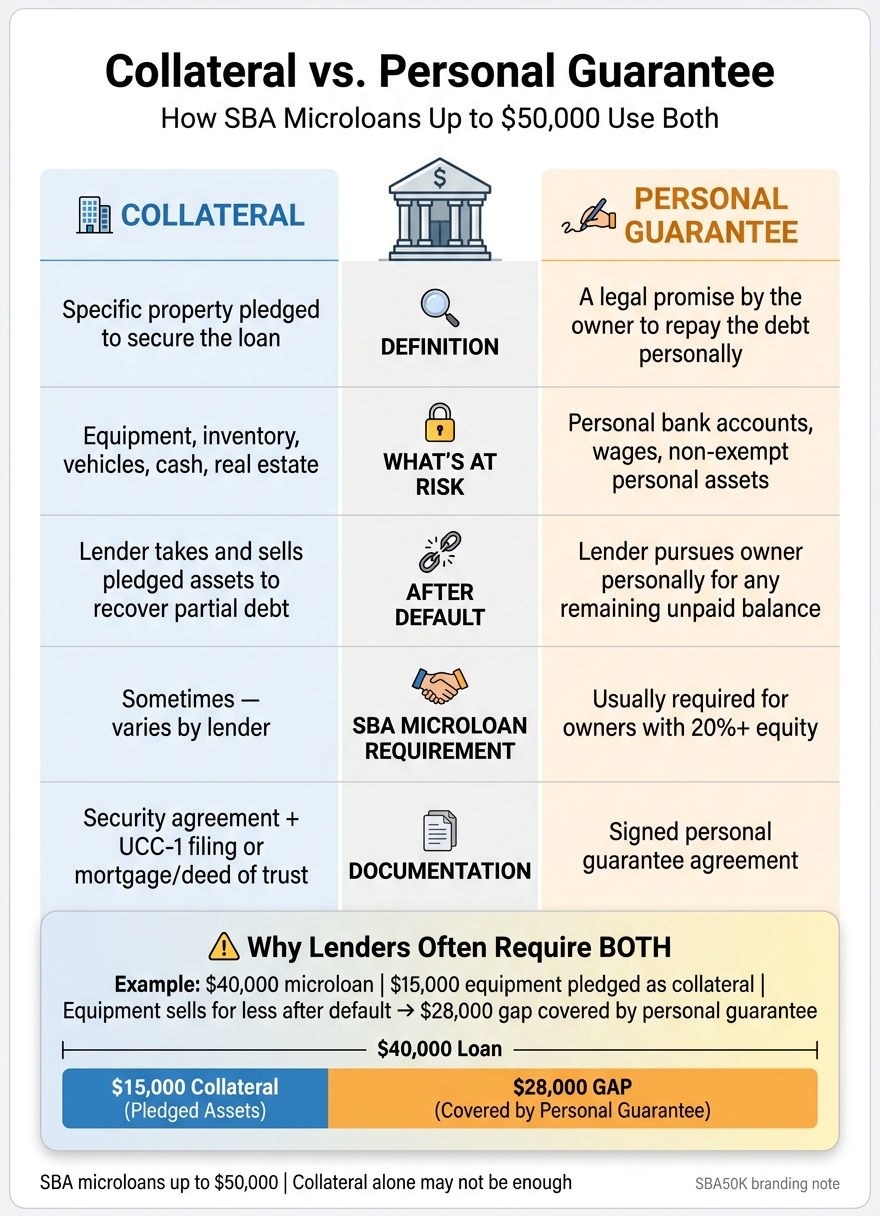
Collateral vs Personal Guarantee: SBA Microloan Breakdown
Do SBA Loans Require a Personal Guarantee
sbb-itb-1eb586e
Collateral in SBA Microloans: What It Is and What Can Be Pledged
Collateral is a specific asset you pledge to secure a loan. If you default, the lender has a legal claim on that asset and can use it to recover part of what you owe. In plain English: lenders want assets they can identify, put a number on, and sell without a lot of trouble.
For SBA microloans, common forms of collateral include equipment, inventory, receivables, vehicles, cash, and real estate. SBA rules leave these calls to intermediary lenders, so the exact requirement can change from one lender to another.
How Lenders Evaluate Collateral on Small Loans
Lenders don’t focus on what you paid for an asset. They look at what they could get for it in a quick sale. That number is called liquidation value.
And that number can be a lot lower than borrowers expect. Some lenders apply steep discounts: new equipment may count for up to 75% of cost, used equipment for about 50% of book value, and inventory or receivables for far less. So if you spent $25,000 on equipment, the lender may assign a much lower collateral value.
They also look at the asset’s condition and how easy it would be to resell. Old, outdated, or highly specialized equipment is tougher to move, so lenders usually give it less weight as collateral. Even when collateral looks strong on paper, it doesn’t wipe out lender risk. This risk profile is a key factor when you compare SBA microloans and bank loans. That’s why many lenders still want another backstop.
What Happens to Collateral After Default
If a borrower defaults, the lender can enforce its lien, take the asset, and sell it to recover part of the debt. In many cases, the sale covers only part of the balance.
That’s why collateral often goes hand in hand with a personal guarantee.
Personal Guarantees in SBA Microloans: Who Signs and What They Promise
If collateral doesn’t fully cover the lender’s risk, the personal guarantee covers the owner’s side of the deal. A personal guarantee is a written promise from an owner to repay the loan if the business can’t. And that matters because a guarantee can reach past any asset that was pledged upfront.
For SBA microloans, owners with 20% or more equity usually have to sign. If no one owns that much, at least one owner must sign.
Why Personal Guarantees Are Required Even for LLCs and Corporations
An LLC or corporation doesn’t protect an owner from signing a personal guarantee. With SBA microloans, lenders often want owners with meaningful ownership stakes to stand behind the debt. The reason is pretty simple: newer businesses applying for the SBA microloan program may not have much financial history or many assets for the lender to lean on.
Even if the business has collateral, the personal guarantee is still usually a standard requirement for owners with 20% or more ownership. Lenders also generally can’t skip that requirement just because the business is set up as a corporation or has strong credit.
How Lenders Enforce a Personal Guarantee
Collateral points to a specific asset. A guarantee doesn’t. If the business defaults, the lender can go after the guarantor’s personal assets, often starting with a demand for payment. The default can also hurt the guarantor’s credit and lead to a lawsuit, along with collection actions like bank levies, wage garnishment, or liens on nonexempt property.
In some cases, the guarantee may also be backed by a lien on a personal asset, such as a home. If that happens and the guarantor doesn’t pay, the lender may get foreclosure rights.
The guarantee stays in place until the debt is paid. That’s why lenders often want both collateral and a personal guarantee. Next, compare collateral and personal guarantees side by side.
Collateral vs Personal Guarantee: Key Differences and Why Lenders Often Require Both
Collateral limits loss to specific assets. A personal guarantee pushes that risk to the owner as well.
Collateral vs Personal Guarantee at a Glance
The difference is easier to see when you look at what each one secures and what each one puts on the line. Side by side, it becomes pretty clear why lenders often want both.
| Feature | Collateral | Personal Guarantee |
|---|---|---|
| Definition | Specific assets pledged to secure the loan, such as equipment, inventory, or real estate | A legal promise by the owner to repay the debt personally if the business cannot |
| What Is at Risk | The pledged assets, up to their liquidation value | Personal bank accounts, wages, and non-exempt personal assets |
| Documentation | A security agreement and related filings, such as a UCC-1 filing or mortgage/deed of trust | A signed guarantee agreement |
| After Default | Collateral narrows recovery to pledged assets | A guarantee lets the lender pursue any unpaid balance |
Why One SBA Microloan Application May Include Both
In plain terms, lenders use both tools to cover the gap between what the collateral may sell for and what the borrower still owes. Say a borrower pledges $15,000 in equipment for a $40,000 microloan and later defaults. If that equipment is sold and $28,000 still remains unpaid, the personal guarantee gives the lender a legal way to go after that balance under the guarantee terms.
This comes up most often when a borrower doesn’t have much collateral to pledge, which leads to the next issue.
Applying for an SBA Microloan When You Have Limited Collateral
If collateral is thin, lenders usually look harder at one thing: your ability to repay.
SBA guidance says a loan should not be declined only because collateral is inadequate. Lenders also look at cash flow, credit history, and the strength of the business plan. Put simply, when there isn’t much collateral to work with, repayment ability carries more weight.
Lenders usually ask for a few core documents:
- A personal financial statement for each owner with 20% or more ownership
- A business debt schedule that lists current loans and monthly payments
- An asset list for equipment, inventory, and vehicles
- Financial projections that show how the business will make the loan payments
For startups, many microloan intermediaries also want 1 to 3 years of projected profit and loss, with the first year broken down month by month.
Here’s one smart move: include any assets you plan to buy with the loan itself. SBA guidance tells microlenders to be flexible about what can count as collateral, and equipment or inventory bought with loan proceeds can often be used for that purpose.
How SBA50K Can Help Borrowers Prepare a Stronger Application
If you need help putting together a limited-collateral file, SBA50K can help. SBA50K helps borrowers with limited or poor credit prepare SBA microloan applications up to $50,000, including business plans, projections, collateral details, and lender-ready documents.
Conclusion: The Simplest Way to Think About the Difference
Collateral covers assets; a personal guarantee covers the owner.
FAQs
Can I get an SBA microloan with no collateral?
Yes, in many cases, you can get an SBA microloan without collateral.
This program is built with startups and underserved entrepreneurs in mind, so lenders often look more closely at your business plan, cash flow projections, and your ability to repay.
That said, each intermediary lender sets its own rules. Some may still ask for collateral or a personal guarantee based on your situation. SBA50K can help you get your application and business plan ready.
Does a personal guarantee put my home at risk?
Yes. A personal guarantee can put your home at risk if the lender ties the loan to personal assets like your house.
Here’s the plain-English version: with a personal guarantee, you agree to pay back the loan if your business can’t. If the loan goes into default, the lender may go after your personal property, which can include your home.
That said, not every loan works the same way. Some SBA microloan programs may be more flexible and look more closely at your business plan and cash flow instead.
Who has to sign the personal guarantee?
For SBA microloans, anyone who owns 20% or more of the business usually needs to sign a personal guarantee. In plain English, that means they agree to back the loan with their own responsibility on the line.
That said, intermediary lenders set their own rules, so the exact requirement can change from one lender to another. Still, the 20% ownership threshold is a common standard.
Leave a Reply