
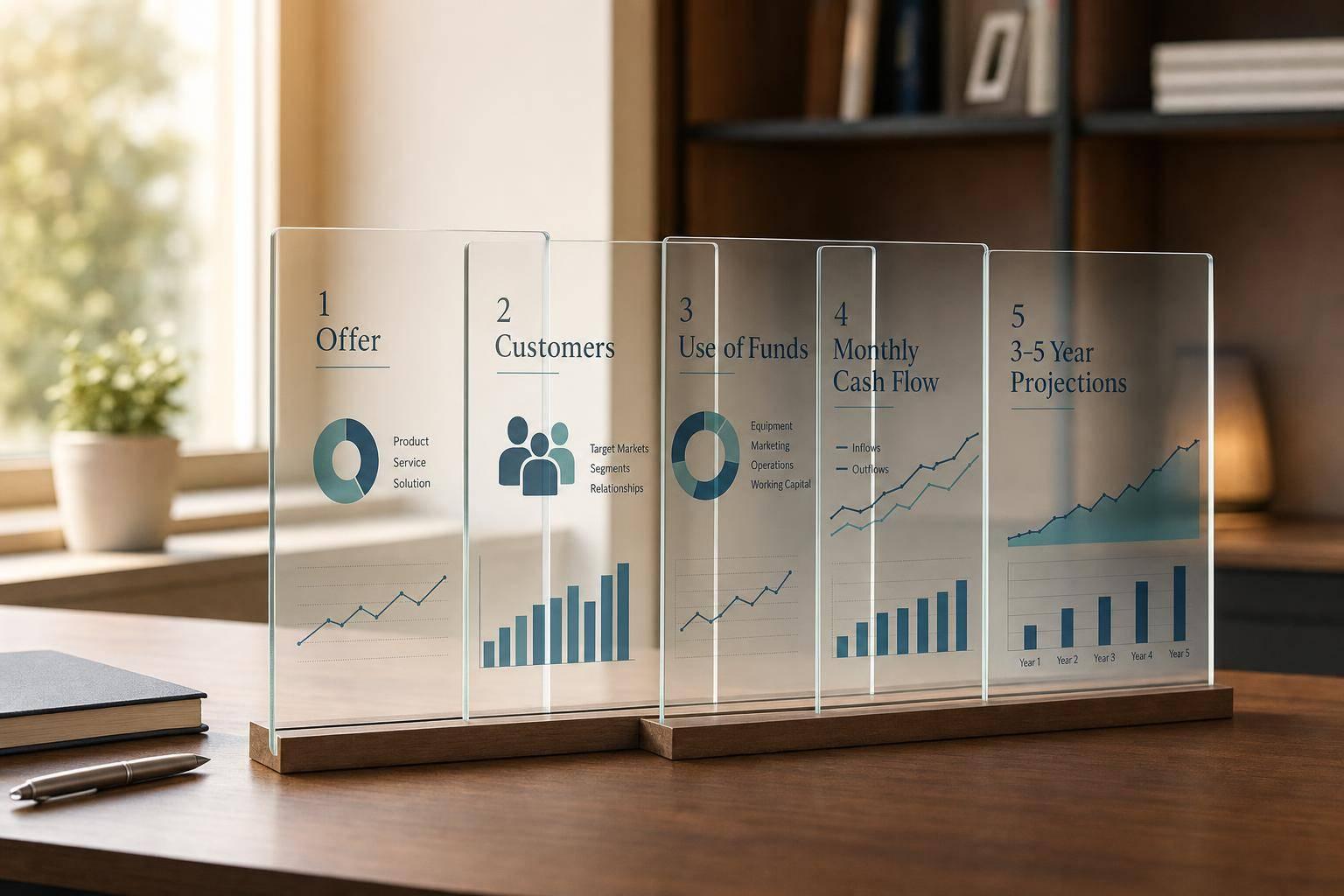
If I want a lender to say yes, I need more than a loan amount. I need a plan that shows how my business will make money, use the funds, and pay the loan back.
In simple terms, this article shows that a business plan does two jobs at once: it helps a lender judge risk, and it helps me test whether my business makes sense before I borrow. It covers the parts lenders look at most – my offer, customer, market, spending plan, monthly cash flow, and repayment math – plus the mistakes that can weaken an application.
Here’s the short version:
- A loan request says how much I want. A business plan shows how the business works.
- Lenders care most about repayment, not just the idea.
- My plan should explain:
- what I sell
- who buys it
- how I’ll get sales
- where each loan dollar goes
- how monthly cash flow covers costs and debt
- For startups, 3- to 5-year projections and a monthly cash flow forecast help support the case.
- A short plan – often 10 to 20 pages – can be enough if the numbers match and the assumptions are clear.
- Common problems include vague use of funds, weak sales forecasts, low cost estimates, and mismatched numbers.
- The fix is simple: use quotes, local market data, monthly assumptions, and conservative projections.
One point stands out: even if I ask for $10,000 for inventory or $50,000 for working capital, the lender is still asking the same question – <u>can this business make the monthly payment on time?</u>
That’s what the rest of the article helps answer.
Why you need a customized business plan for your SBA loan
sbb-itb-1eb586e
Why Lenders Need More Than a Loan Request
A loan request tells the lender how much you want. A business plan shows how the business works, where the money will come from, and how the loan gets paid back.
That difference matters. Lenders usually focus on three things: the market, the funding request, and the cash flow behind repayment.
"To the lenders, what matters most is the ability of the borrower to pay back the loan… The question they ask you is, ‘Can you pay back the loan on time?’"
What the Business Sells, Who the Customer Is, and How Revenue Will Be Generated
Lenders want a clear picture of what the business sells, who buys it, and what facts support the revenue forecast. That means the plan should show market analysis, including customer demographics and competitor data, so the numbers come from research instead of guesswork.
If the sales model is easy to follow, the lender can see how revenue is expected to come in. And once that part makes sense, the next step is simple: does the loan request fit the plan?
How the Loan Will Be Used and Why the Amount Requested Makes Sense
A lender reviewing the request needs to see a detailed use of funds. Each dollar should connect to a clear business need. For example, $12,000 for equipment and $6,500 for inventory.
The plan should also explain why those expenses matter for growth and whether they fit approved uses. SBA microloan funds can’t be used to buy real estate or refinance current debt. They’re meant for working capital, inventory, supplies, furniture, fixtures, machinery, and equipment.
How the Business Will Cover Expenses and Repay the Debt
Revenue, profit, and cash are not the same thing. A business can post solid sales and still fall behind on payments if costs hit at the wrong time or get underestimated.
That’s why lenders want a cash flow forecast that lays out monthly income against monthly costs, including rent, payroll, utilities, supplies, and loan payments. For startups, 3- to 5-year projections help show how the business plans to bring in enough cash to repay the loan.
Each financial piece answers a direct lender concern:
| Financial Element | What It Proves |
|---|---|
| Monthly revenue projection | The business can generate steady income |
| Operating expense estimate | The owner understands actual costs, not just sales |
| Cash flow forecast | The business can stay liquid during slower months |
| Use of funds breakdown | The loan amount is justified and tied to business growth |
Getting these numbers right, and showing how you arrived at them, is often what separates a solid loan request from one that feels more like wishful thinking.
The Parts of a Business Plan That Support Loan Approval
For a microloan application, a few sections do most of the heavy lifting. Each one needs to answer a lender’s basic question: who you are, who will buy from you, how you’ll make sales, and how you’ll pay the loan back.
Business Overview, Ownership, and Management Background
This section tells the lender who’s running the business and whether that person is ready for the job. Include the legal structure – sole proprietorship, partnership, or corporation – and the owner’s background.
Lenders often want to see at least two years of related industry experience. If the owner has certifications, has run similar operations before, or brings specialized knowledge to the business, include that here. Those details help show the business isn’t being built from guesswork alone.
Market Analysis, Marketing Plan, and Operations Plan
This part needs to show that the market is there – not just in theory, but in your area and for your customer. Use local demand data, competitor research, and industry trends to make that case. Then define the target customer and value proposition, and explain how marketing and operations will turn demand into revenue.
The marketing plan should answer a simple question: how will you reach customers within a set budget, and what will it cost? Lenders put more weight on realistic sales projections tied to a clear customer acquisition plan than on sweeping claims about a big market.
Then comes the day-to-day side of the business. The operations plan should spell out how the business will run, including:
- suppliers
- equipment
- staffing needs
- facility details
- licenses or permits needed to operate legally
Taken together, these sections show the business can work in practice, not just on paper.
Funding Request, Use of Proceeds, and Financial Projections
This is where the numbers have to line up. The funding request should state the exact dollar amount you need and tie it straight to the use of proceeds – a line-by-line breakdown of where every dollar will go.
Use 3- to 5-year projections to support repayment, especially if you’re a startup without revenue yet. The key document here is the monthly cash flow statement. That’s what shows whether the business can cover operating costs and loan payments at the same time.
A basic break-even analysis helps too. It shows how much the business needs to sell to cover all costs, which gives the lender a clearer picture of risk.
Use the table below to see what each section needs to prove:
| Business Plan Section | What Lenders Look For |
|---|---|
| Business Overview & Management | Legal structure, owner experience, and daily operations roles |
| Market Analysis | Local demand data, competitor research, target customer needs, value proposition, and industry trends |
| Marketing Plan | How you’ll get customers, pricing, and realistic sales projections |
| Operations Plan | Supplier list, equipment needs, staffing, and licensing requirements |
| Funding Request & Use of Proceeds | Exact loan amount with an itemized spending breakdown |
| Financial Projections | 3–5 year outlook, monthly cash flow, and break-even point |
For most microloan applications, a concise plan of 10 to 20 pages is usually enough. What matters most is being clear, specific, and direct.
Common Business Plan Problems and How to Fix Them
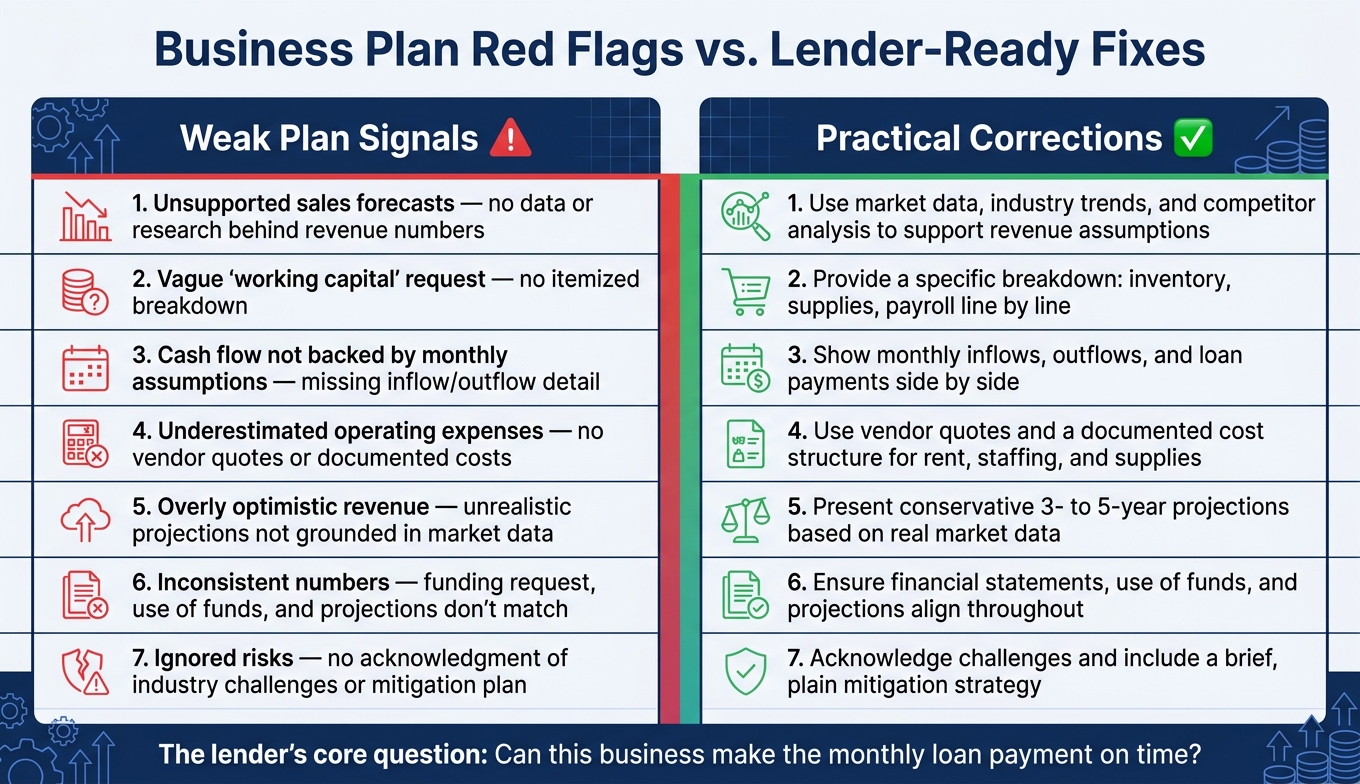
Business Plan Sections: What Lenders Look For vs. Common Mistakes
Once the plan structure is set, lenders look at one thing fast: do the numbers make sense?
A plan can read well and still fall apart here. If the math is shaky, the costs look too low, or the repayment case feels thin, lender trust drops. They want honest assumptions, accurate cost estimates, and loan repayment math that holds up.
Plan Weaknesses That Reduce Lender Confidence
Most weak plans miss the basics. Sales forecasts have no support. Funding requests are too vague. Expenses are set far too low. To a lender, that often signals the owner doesn’t fully understand what it takes to run the business month to month.
Another red flag is inconsistency. If the funding request says one thing, the use-of-proceeds table says another, and the cash flow statement says something else, lenders will spot it. Fast. Those gaps make the plan look rushed instead of well prepared.
These problems usually show up in the funding request, financial projections, and cash flow section.
| Weak plan signal | Practical correction |
|---|---|
| Unsupported sales forecasts | Use market data, industry trends, and competitor analysis to support revenue assumptions |
| Vague "working capital" request | Provide a specific breakdown of expenses like inventory, supplies, and payroll |
| Cash flow unsupported by monthly assumptions | Show monthly inflows, outflows, and loan payments side by side |
| Underestimated operating expenses | Use vendor quotes and a documented cost structure for supplies, rent, and staffing |
| Overly optimistic revenue | Present conservative 3- to 5-year projections based on market data |
| Inconsistent numbers | Ensure financial statements, use of funds, and projections align throughout |
| Ignored risks | Acknowledge industry challenges and include a brief mitigation strategy |
The answer isn’t piling on more detail just to look thorough. It’s showing better proof.
Simple Fixes That Make Projections More Believable
Swap vague assumptions for documented costs, quotes, and cautious sales estimates. Itemize expenses. Tie each dollar to a clear business purpose. If the business is already running, include current cash flow. If you are funding your startup business, conservative 3- to 5-year projections often build more trust than optimistic ones.
It also helps to show what happens if sales come in below plan. Can the business still make the monthly loan payment? That’s the kind of question lenders ask, so your math should answer it before they have to.
Be open about risks and challenges, too. A lender doesn’t expect a business with zero problems. They want to see that you understand what could go wrong and have a plain plan for dealing with it. Clear numbers, backed by plain evidence, make that case much stronger.
Use these fixes before the final review.
How to Get Your Plan Lender-Ready and Move Forward
Final Review Checklist Before Submitting a Loan Application
After you tighten the numbers, do one last review before you submit.
Check five core points:
- what you sell
- who buys it
- how you’ll use the funds
- how cash will come in
- how the debt will be repaid
Make sure the loan amount matches the use-of-proceeds table. Also include the actual monthly loan payment in your cash flow projections.
Strip out jargon, fix spelling and grammar issues, and make sure your financial statements, use-of-funds table, and projections all tell the same story.
When to Get Help Putting the Plan Together
If any of those pieces are still unfinished, get help before you apply.
Startups without a revenue history often hit a wall here. It’s one thing to make assumptions. It’s another to turn them into projections a lender can take seriously. If that part feels shaky, bring in help to turn your draft into a lender-ready plan.
SBA50K can draft the business plan, organize the numbers, and guide the microloan application.
Conclusion: A Clear Business Plan Improves Funding Readiness and Decision-Making
A clear plan does more than support the application. It pushes you to prove there’s real demand, estimate what it will cost to run the business, map out month-to-month cash flow, and show – with math – that the loan can be repaid.
When owners write the plan, they often spot weak assumptions, cash gaps, and repayment risk before they borrow. That’s what funding readiness looks like.
FAQs
Do I need a business plan for a small loan?
Yes. A business plan is a required part of an SBA microloan application. Lenders use it to look at how your business works, how well you know your market, and whether you can handle financial risk.
Your plan should clearly explain your goals, target market, day-to-day operations, financial projections, and how you’ll use the funds. It should also show whether your cash flow can cover repayment.
What financial statements should I include?
Include financial statements that show you can repay the loan, such as current profit and loss statements and balance sheets.
You should also include:
- 3- to 5-year financial projections
- Monthly cash-flow projections for the first 12 to 24 months
- 2 to 3 years of tax returns
- 3 to 6 months of bank statements
- A detailed breakdown of how you plan to use the loan funds
How detailed should my cash flow forecast be?
Lenders usually want monthly cash flow projections for at least the first 12 months, and in many cases up to 24 months. That month-by-month view in year one matters because it shows whether your business can handle operating costs and loan payments during both busy seasons and slower stretches.
Your projection should include:
- Revenue
- Cost of goods sold
- Gross margins
- Operating expenses
- Net operating cash flow
Use conservative, realistic assumptions. And make sure those assumptions line up with your startup cost worksheet, business plan, and loan-use statement. If those numbers don’t match, lenders will notice fast.
Leave a Reply