
You can fund a startup through loans, crowdfunding, investors, or grants. I’d start with how much you need and whether you can afford monthly payments – not the biggest amount available.
SBA microloans offer up to $50,000. Investors exchange money for ownership or future equity rights. Grants usually don’t require repayment, but they fund specific work – not just any startup expense.
Here’s how I’d sort the nine options:
Quick Comparison
| Funding source | Best fit | Main cost or obligation | Where to start |
|---|---|---|---|
| SBA microloans | Smaller startup expenses | Interest, repayment, and usually a personal guarantee | SBA-approved nonprofit intermediaries |
| Community and nonprofit lenders | Founders seeking local support | Loan payments; credit and collateral rules vary | Local CDFIs and nonprofit lenders |
| Banks and credit unions | Founders with strong finances or collateral | Interest, fees, and possible guarantees | Business-lending offices |
| Rewards-based crowdfunding | Products with an audience | Campaign fees and delivering rewards | Rewards crowdfunding platforms |
| Equity crowdfunding | Startups ready for public investment | Possible dilution, disclosures, and reporting | Registered funding portals or broker-dealers |
| Angel investors | Early-stage businesses built to grow | Negotiated ownership or future equity rights | Angel networks and introductions |
| Venture capital | Businesses targeting large markets | Dilution, investor control rights, and growth expectations | VC firms |
| SBIR/STTR funding | Qualifying research projects | Research milestones and award rules | SBIR.gov and issuing agencies |
| State, local, nonprofit, university, and industry grants | Projects matching a program’s purpose | Spending limits, reporting, and possible matching funds | Official grant portals |
My rule: compare what you keep with <u>what you owe or give up</u>. Before applying, check eligibility, permitted expenses, funding timing, fees, guarantees, and ownership terms – and confirm that the program is currently accepting applications.
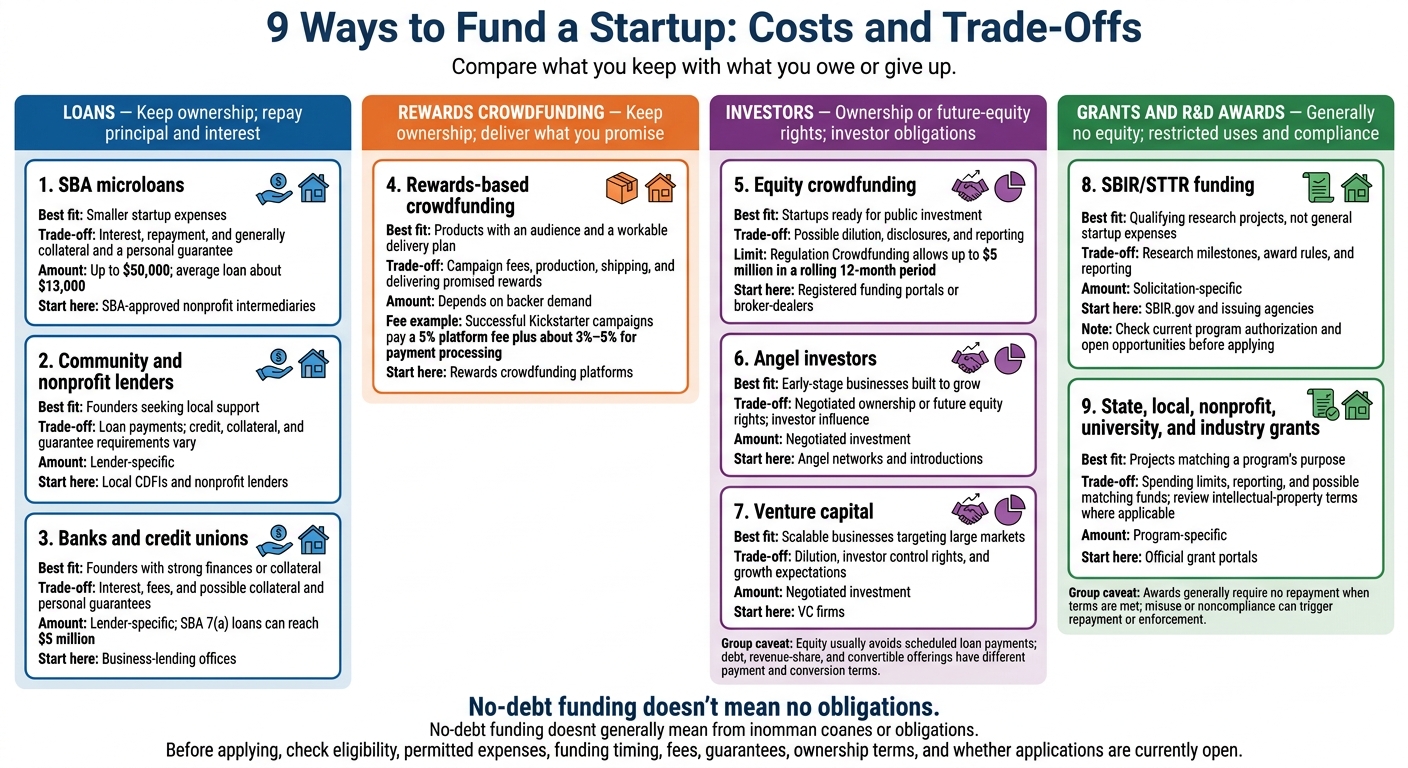
9 Ways to Fund a Startup: Costs and Trade-Offs
1. SBA Microloans Through Approved Intermediaries
Funding Amounts and Timing
For small startup expenses, microloans are often a good place to start comparing debt options. The average loan is about $13,000. Counseling, underwriting, and closing requirements can affect how long funding takes. Ask your intermediary for separate estimates for application review and disbursement, and don’t commit to purchases until funding is confirmed.
Eligibility and Underwriting
New and existing U.S.-based, for-profit small businesses may qualify if they meet SBA size standards and operate in eligible business categories. There’s no program-wide minimum credit score. Each intermediary sets its own standards and generally requires collateral and a personal guarantee.
Before applying, confirm that the intermediary serves your area and accepts startups. Ask whether business counseling is required. Have your business plan, startup budget, bank statements, tax returns, and cash-flow projections ready.
Repayment and Ownership
You keep full ownership of your business, but a personal guarantee can leave you personally liable for the loan. The intermediary sets your interest rate and repayment schedule within program rules.
Get written details on fees, liens, late charges, prepayment rules, and personal-guarantee obligations. Then check whether realistic sales projections will cover the proposed payments.
Allowed Uses and Applications
You can use the funds for working capital, inventory, supplies, furniture, fixtures, machinery, and equipment. Real estate purchases and refinancing existing debt are generally not allowed. Tie every dollar you request to a specific expense.
Use the SBA directory to find an SBA-approved nonprofit intermediary. Ask whether it offers free counseling or help with your application.
If you need a different mix of flexibility, local support, and underwriting, compare community and nonprofit lenders next.
sbb-itb-1eb586e
Best & Worst Business Funding Options For A Startup Company
2. Community and Nonprofit Business Lenders
If a microloan isn’t the right fit, community lenders may offer more flexible underwriting and local support. Loan terms vary, so check each program’s requirements.
Funding Amounts and Timing
CDFIs and nonprofit loan funds offer loans ranging from a few thousand dollars to much more. Ask for separate estimates for approval and closing so you know what timeline to expect.
Eligibility and Underwriting
Not every startup lender funds businesses that haven’t earned revenue yet. Some programs require operating history and revenue. Others weigh industry experience, owner investment, purchase orders, and projected cash flow alongside credit. Before applying, confirm that the lender serves your location and business stage.
Repayment and Ownership
Flexible underwriting doesn’t mean a loan comes without interest, fees, collateral requirements, or a personal guarantee. Get the total repayment amount, payment frequency, first payment date, and default terms in writing – not just the advertised interest rate.
Allowed Uses and Applications
Each institution sets its own rules for loan use. Equipment, inventory, marketing, leasehold improvements, and working capital may qualify. Refinancing, real estate purchases, and owner distributions are often restricted. Get written approval for your planned expenses and keep receipts.
Find certified institutions through the U.S. Treasury CDFI Fund. Then check each lender’s website for its service area, minimum revenue, time-in-business requirements, and fees. Ask whether free or low-cost technical assistance continues after funding.
3. Banks and Credit Unions
Funding Amounts and Timing
Banks and credit unions are worth comparing if you need a larger loan and can meet stricter underwriting requirements. SBA 7(a) loans can reach $5 million, though they often take longer to close than conventional loans.
Eligibility and Underwriting
Each lender sets its own standards for conventional loans. Startups can apply, but businesses with stronger financials generally have an edge. Lenders review personal credit, owner investment, industry experience, repayment projections, collateral, and cash flow.
Have your business plan, startup budget, tax returns, financial statements, and collateral details ready. There’s no universal minimum credit score.
Repayment and Ownership
Neither conventional nor SBA-backed loans give the lender an ownership stake. Compare fixed and variable rates, total interest, prepayment terms, and lender or SBA fees. SBA-backed financing isn’t automatically cheaper.
You may need collateral. SBA rules also generally require personal guarantees from owners with at least 20% ownership. Participating lenders issue SBA-backed loans, and the SBA guarantee protects the lender, not you.
Allowed Uses and Applications
Depending on the loan agreement and any SBA rules, funds can cover equipment, inventory, a business purchase, commercial real estate, or qualifying debt refinancing.
Apply directly through a bank or credit union. SBA Lender Match can help you find participating lenders. Before applying, ask whether the lender funds startups and what it requires for time in business, revenue, collateral, personal guarantees, and owner cash contributions.
If you need capital without loan payments, compare rewards-based crowdfunding next.
4. Rewards-Based Crowdfunding
Funding Amounts and Timing
Rewards crowdfunding turns early demand into startup cash through a pre-sale model. You get capital without loan payments or giving up ownership.
How much you can collect depends on backer demand, not a preset loan cap. Allow 1–3 months for prep, plus time for the campaign and payout. Kickstarter uses all-or-nothing funding: if you miss your goal, backers aren’t charged. Successful campaigns pay a 5% platform fee plus about 3%–5% for payment processing. Production, shipping, taxes, and refunds come out of what’s left.
Eligibility and Underwriting
You generally don’t need established business credit, but expect identity, bank, tax, and project checks. This option works best for consumer-facing products that already have early interest.
Bring an audience to launch day; platform traffic rarely carries a campaign on its own. Have a tested prototype, supplier quotes, reward tiers, and a realistic delivery schedule ready.
Repayment and Ownership
Backers receive a product, service, or experience – not interest or equity. Rewards are fulfillment obligations, not free money.
Budget for packaging, shipping, defects, replacements, customer support, and possible refunds. More pledges mean more rewards to deliver, so exceeding your funding goal can also increase your costs.
Allowed Uses and Applications
Depending on platform rules, campaign funds may cover development, manufacturing, inventory, and fulfillment. Apply through the platform’s project submission process.
Before submitting, check prohibited products, IP rules, supported delivery countries, payout timing, and cancellation terms. Publish delivery risks and refund terms before accepting pledges.
If your startup needs larger checks or long-term backing, compare equity crowdfunding and investors next.
5. Equity Crowdfunding
Funding Amounts and Timing
Reg CF lets eligible companies secure up to $5 million in a rolling 12-month period. How much you receive depends on investor demand. Launch timing depends on legal preparation, intermediary review, and the live campaign.
Budget for legal, accounting, intermediary, processing, and marketing costs on top of your funding goal. If the campaign doesn’t reach its minimum target, investors get their money back.
Eligibility and Underwriting
Check eligibility before spending money on campaign production. Prepare a pitch deck, realistic projections, an ownership table, a use-of-funds budget, and risk disclosures.
Form C covers management, ownership, offering terms, and financial condition. You may also need reviewed or audited financial statements. Investors assess your product, market, traction, valuation, and founder credibility.
Once you know you qualify, consider how much ownership you’re willing to give up.
Repayment and Ownership
Equity crowdfunding usually means no monthly debt payments, but it dilutes your ownership. Debt, revenue-share, and convertible offerings come with different payment and conversion terms.
Before accepting terms, review voting rights, information rights, payout priority if the business is sold, and future dilution with securities counsel. Then check which expenses the funding can legally cover.
Use of Proceeds and Filing Steps
Proceeds can fund development, inventory, hiring, marketing, rent, and working capital, as long as spending matches the disclosed uses.
For Reg CF, verify SEC registration, select one FINRA-registered funding portal or broker-dealer, complete its review, and file Form C through EDGAR before launch.
Also budget for investor communications, ownership records, and reporting. Companies generally must file Form C-AR within 120 days after fiscal year-end until they meet an applicable condition for ending that reporting requirement.
If you want private capital without a public crowdfunding campaign, compare angel investors next.
6. Angel Investors
Funding Amounts and Timing
Angel investors offer private funding for founders who want capital without a public crowdfunding campaign. They invest their own money in startups, usually in exchange for equity or a convertible security. Fundraising often takes months, especially when working with angel groups.
Commitments vary widely. Base your funding target on startup costs, how long the money needs to last, and the milestones you plan to reach.
Eligibility and Underwriting
Angels typically back early-stage startups with early customer demand, a team they can trust, and clear room for growth. They rarely suit owner-operated businesses with limited growth potential.
Prepare a concise pitch deck, financial model, ownership table (cap table), customer or market evidence, and a product demonstration when applicable. Organize incorporation records, contracts, and intellectual-property documents in a data room.
Once you’ve confirmed that an investor is a good fit, review how the deal will work.
Repayment and Ownership
Angel deals usually exchange ownership for capital. Before signing, review valuation, liquidation preferences, board rights, voting rights, and veto rights. For convertible securities, compare valuation caps and discounts, and clarify any board seats or observer rights. Have a startup attorney and accountant review the terms.
Allowed Uses and Applications
Angel capital generally pays for product development, hiring, marketing, operations, and working capital. Agree on a milestone-based budget, track spending against it, and keep detailed business records.
Find angels through warm introductions from founders, advisers, attorneys, accountants, incubators, accelerators, universities, and industry groups. Check each group’s industry focus, startup stage, geography, application process, and typical check size.
In your outreach, briefly explain your company, traction, funding need, planned use of the money, and why the investor is a good fit. Ask for references from founders they’ve backed, including those whose companies struggled or failed.
If you need more capital and are ready for faster growth expectations, compare venture capital next.
7. Venture Capital
Funding Amounts and Timing
For startups that need larger checks and can show traction, venture capital (VC) may be the next step. Check sizes vary by funding round. Tie your ask to one measurable milestone, such as launching an MVP, growing your customer base, or reaching a revenue target.
Eligibility and Underwriting
Unlike debt financing or small local loans, VC focuses on a startup’s potential to scale. It suits businesses with large markets, scalable products, and a realistic exit path – and founders willing to give up some ownership for faster growth. It usually isn’t a fit for local businesses built to provide steady owner income.
Investors put the team, market, product, traction, projections, and business model ahead of personal credit or collateral. Prepare a pitch deck, cap table, financial model, customer or revenue metrics, IP records, incorporation documents, and a use-of-funds plan.
Repayment and Ownership
VC is equity financing, so there are no scheduled debt payments. Instead, you give up some ownership and grant investors control rights. Model how option-pool increases and future funding rounds could change your ownership stake.
Term sheets may address valuation, liquidation preference, anti-dilution protection, board rights, voting rights, information rights, founder vesting, and investor approvals. Even minority investors may hold veto rights.
Allowed Uses and Applications
VC funding commonly pays for product development, engineering, hiring, sales, regulatory work, and working capital needed to reach milestones. Financing documents set the rules for spending. VC also comes with milestone tracking, reporting requirements, and investor oversight.
Before approaching a firm, check its investment stage, sector, geography, portfolio, and ability to invest in later rounds. Then reach out through website submissions or warm introductions. Be ready to explain the problem, your solution, market size, traction, potential to scale, business model, team, funding request, and the milestones that money will support.
8. SBIR and STTR Funding
Federal R&D awards can help research-driven startups fund technical development without debt or dilution. SBIR and STTR are options only if your startup has a defined research project.
Funding Amounts and Timing
SBIR and STTR pay for research – not everyday startup costs and requirements. SBIR.gov lists typical SBIR awards of $50,000–$323,000 for Phase I feasibility work lasting 6–12 months and $650,000–$2.2 million for Phase II research lasting about 24 months.
Check the active solicitation for award amounts and deadlines rather than relying on the program summary. Reviews can take several months, and a Phase I award does not guarantee Phase II funding.
Eligibility and Underwriting
Applicants must be U.S.-based, for-profit small businesses that meet size, ownership, and control rules. Reviewers assess technical merit, your team, facilities, budget, and commercialization potential – not personal credit.
STTR also requires a qualifying nonprofit research partner, with defined research duties and intellectual-property terms. Match your project to a specific agency topic before you start writing.
Repayment and Ownership
Awards usually require neither repayment nor equity. Grants pay for approved research, while contracts require deliverables and acceptance.
Allowed Uses and Applications
Funds may cover approved research wages, laboratory materials, prototype development, testing, and, for STTR, the required research-institution workshare. They do not cover inventory, personal expenses, or broad marketing. Tie every budget item to a technical milestone.
Verify current program authorization and open opportunities through SBIR.gov and the issuing agency before applying. Complete the required Company Registry registration early. Department of Defense proposals go through the Defense SBIR/STTR Innovation Portal. Many other applications use Grants.gov or agency-specific systems.
Before accepting an award, review its intellectual-property terms, reporting duties, and milestone obligations. Keep records, report required changes, and seek agency approval for material project changes. Misusing funds or violating rules can lead to repayment or enforcement.
If your project does not fit federal research programs, compare state, local, nonprofit, university, and industry grants next.
9. State, Local, Nonprofit, University, and Industry Grants
If your startup doesn’t fit federal research programs, look for grants tied to your location, mission, or industry. The SBA does not offer grants for typical startups, and most federal grants won’t fund a general launch. These awards usually pay for a specific project – not your entire startup budget.
Funding Amounts and Timing
Awards range from a few hundred dollars to tens or hundreds of thousands, depending on the program. Before adding a grant to your launch plan, check the deadline, decision date, and payment schedule. Some programs pay upfront; others reimburse approved spending.
Eligibility and Review
State and local grants often support jobs, storefront improvements, or designated neighborhoods. Nonprofits may focus on underserved owners, while universities may require a student or faculty connection. Industry grants usually serve a single sector.
Check the rules for location, industry, ownership, business stage, and project purpose first. Reviewers usually put more weight on project fit, feasibility, and impact than on credit scores.
Repayment and Ownership
Most grants don’t require repayment or an equity stake. But matching funds, spending limits, reporting, and milestones still come with costs.
Read the agreement for repayment triggers, such as spending without permission or missing milestones. University and industry grants may also include intellectual property terms.
Allowed Uses and Applications
Grants may cover equipment, signage, training, or product development. They may exclude owner draws, debt repayment, and expenses incurred before approval. Create a line-item budget, and keep receipts and progress records.
Search official state commerce offices, local economic-development sites, university innovation offices, and industry association portals. Then confirm current availability, matching requirements, eligible expenses, and the application portal with each program administrator. Avoid guaranteed-grant offers or upfront fees.
Compare Funding Costs and Requirements
Compare the cash you’ll receive, not the headline amount. Fees reduce loan proceeds, campaign costs eat into crowdfunding funds, and grants or investments may arrive in stages.
Use these tables to compare amounts, requirements, and costs before weighing each option’s pros and cons in the next section.
Funding Amounts and Timing
| Funding source | Amount or program limit | Timing factors | Startup fit |
|---|---|---|---|
| SBA Microloan | Up to $50,000 | Underwriting, complete documents, and available lending capital | Small startup expenses |
| Community or nonprofit lender | Lender-specific | Document review, coaching, and underwriting | Founders who want local guidance |
| Bank or credit union | Lender-specific | Financial review, collateral checks, and closing | Borrowers with stronger cash flow |
| Rewards crowdfunding | Funding amount is uncertain | Campaign length, audience response, and payout rules | Consumer products with clear demand |
| Equity crowdfunding | Up to $5 million in a rolling 12-month period under Regulation Crowdfunding | Disclosures, intermediary review, and fundraising | High-upside startups |
| Angel investors | Negotiated investment | Due diligence and negotiations; funds may arrive in stages | High-growth companies |
| Venture capital | Negotiated investment | Extensive due diligence and closing; funds may arrive in stages | High-growth companies |
| SBIR/STTR and other grants | Solicitation-specific | Deadlines, award decisions, and payment schedules | Research-driven or project-specific work |
Eligibility, Credit, and Collateral
No single credit score decides every option. Credit matters for loans. For crowdfunding, investors, and grants, fit and traction matter more.
To narrow your choices, check whether you can repay debt, show customer demand for a rewards campaign, offer growth potential to investors, or meet grant eligibility rules.
| Lender type | Likely borrower profile | Typical loan size | Underwriting factors | Collateral expectations | Repayment structure | Application location |
|---|---|---|---|---|---|---|
| SBA-approved intermediary | Eligible startups with repayment capacity | Up to $50,000 | Credit, projections, experience, and cash | Generally collateral and a personal guarantee | Principal and interest; up to seven years | SBA-approved intermediary |
| Community or nonprofit lender | Founders seeking local guidance | Lender-specific | Cash flow, credit, experience, and alternative financial evidence | Lender-specific; ask about guarantees | Scheduled loan payments | Lender’s website or office |
| Bank or credit union | Often businesses with operating history and revenue | Institution-specific | Cash flow, credit, and debt-service capacity | Product- and borrower-specific | Institution-specific terms | Business-lending application page |
Repayment, Ownership, and Control
Cash now can mean payments, less ownership, or less control later. Loan payments come due even before your business turns a profit. If you default, collateral and personal assets covered by guarantees may be at risk.
SBA guidance generally lists Microloan rates of 8%–13% and terms up to seven years, but intermediaries set actual pricing. Ask for fees, total repayment, guarantees, and default terms in writing.
Equity usually avoids scheduled loan payments. In exchange, you give up some ownership and take on investor return expectations.
| Funding source | Main obligation | Distinguishing risk or trade-off |
|---|---|---|
| Rewards crowdfunding | Deliver promised rewards | Fulfillment costs can exceed campaign proceeds |
| Equity crowdfunding | Meet security terms and reporting requirements | Public fundraising adds recurring compliance costs |
| Angel investors | Grant negotiated ownership or future-equity rights | Investor rights can limit founder influence |
| Venture capital | Accept dilution and formal governance | Growth and exit expectations can constrain decisions |
Weigh these pros and cons before choosing a funding source.
Allowed Uses and Where to Apply
Once you’ve compared costs, control, and eligibility, check how you’re allowed to spend the money.
SBA Microloans cannot fund real estate purchases or existing debt. Other programs set their own use-of-funds rules. Regulation Crowdfunding requires one SEC-registered broker-dealer or funding portal.
| Grant category | Eligibility | Repayment | Ownership impact | Competition | Permitted use | Application source |
|---|---|---|---|---|---|---|
| SBIR/STTR | Qualifying R&D companies meeting solicitation rules | Funds may need to be repaid for misuse or noncompliance | Generally no equity transfer | Technical merit and solicitation fit | Approved R&D | SBIR.gov, then issuing agency |
| State and local | Location, business, and project qualifications | Conditional on compliance | Generally no equity transfer | Program-specific review | Approved economic-development costs | Official agency or grant administrator |
| Nonprofit, university, and industry | Mission, affiliation, ownership, or sector requirements | Award-specific conditions | Review intellectual-property terms | Program-specific selection | Approved project expenses | Issuer’s official portal |
For grant applications, prepare milestones, a budget justification, required registrations, and supporting letters. Check matching-fund requirements and payment schedules before counting an award as cash you can spend.
Pros and Cons of Each Funding Source
Use this comparison to narrow your options based on cost, eligibility, and repayment risk. Funding without debt payments still has costs: ownership dilution, fees, fulfillment, or reporting.
| Funding source | Main advantages | Main limitations | Best-fit situation |
|---|---|---|---|
| SBA microloans | Access for startups, technical assistance, and no ownership dilution | $50,000 cap; underwriting, guarantees, repayment, and limits on how funds can be used | Modest equipment, inventory, or working-capital needs |
| Community and nonprofit lenders | Flexible underwriting and local guidance | Loans may be smaller or carry higher rates; training requirements vary | Founders with limited credit history who can repay a loan |
| Banks and credit unions | Potentially lower-cost debt and larger loans | Stricter underwriting; collateral, guarantees, and pressure to make payments | Well-qualified founders with reliable repayment capacity |
| Rewards-based crowdfunding | Tests customer interest without giving up ownership | Fees, production, shipping, and refunds reduce net proceeds | A defined product, an audience, and a workable delivery plan |
| Equity crowdfunding | Access to a broad pool of investors | Ownership dilution, legal costs, disclosures, and recurring reporting | Businesses with a strong public pitch and the capacity to maintain investor relations |
| Angel investors | Funding, mentoring, and industry introductions | Selective fundraising; ownership and investor influence must be negotiated | Early-stage companies that need capital and guidance |
| Venture capital | Larger investments and support for fast expansion | Highly selective; ownership dilution and pressure to grow fast | Scalable businesses pursuing a large market |
| SBIR/STTR funding | R&D funding without selling equity | Demanding applications; strict eligibility and research milestones | Technology that matches an agency’s research topic |
| State, local, nonprofit, university, and industry grants | Generally no repayment or equity cost when terms are met | Narrow eligibility, spending restrictions, possible matching funds, and reporting | A project that matches the award’s purpose |
For SBA microloans, weigh the help you’ll get from counseling against the personal-guarantee risk. Check that permitted uses also fit your budget.
Your startup stage, cash flow, and growth goals will help determine which funding source fits best.
Choose Funding That Fits Your Startup
Start with your funding gap: startup costs + 3 to 6 months of operating expenses + a contingency reserve. Then subtract available cash, confirmed customer deposits, and other committed funds. Let that number – not the biggest advertised amount – guide your search.
Use the comparison above to weigh what each source asks in return: repayment, a share of ownership, or compliance with grant rules.
| Your situation | Best sources | Key trade-off | Next step |
|---|---|---|---|
| Funding amount | SBA microloan intermediaries for smaller needs; banks or credit unions for larger needs | The maximum loan size does not guarantee approval. | Request written terms that match your use-of-funds budget. |
| Business stage, credit, and ability to repay | Community lenders, nonprofit lenders, or microloans for early operations or limited credit; banks for stronger financial records | A business plan alone does not prove you can repay a loan. | Prepare a 12-month cash-flow forecast and proof of demand. Check credit, collateral, and guarantee requirements. |
| Need no-debt capital | SBIR/STTR for research projects; project-specific grants for defined uses | Each award has its own eligibility and spending rules. | Check the current notice, research topic, deadline, and reporting rules. |
| Willingness to share ownership | Angels, venture capital, or equity crowdfunding for startups built to scale | Investor rights can affect your control and future fundraising options. | Model dilution and have investment documents reviewed. |
| Intended use | Microloans or business loans for equipment and inventory; rewards crowdfunding for pre-sales | Loans limit how you spend the money; pre-sales commit you to delivering orders. | Check that your expenses are permitted. Account for production, shipping, fees, and refunds. |
No-debt funding doesn’t mean no obligations. You may still need to file grant reports, fulfill rewards, or meet responsibilities to investors. SBA intermediaries also set their own credit standards within program rules, so check terms directly with each lender.
Before applying, gather your budget, 12-month cash-flow forecast, tax records, and bank statements. Compare the full cost of capital – not just the amount offered – including fees, collateral, guarantees, dilution, and compliance. Confirm eligibility, terms, and deadlines, and weigh each offer against your cash flow, business stage, growth plan, and willingness to share ownership or take on compliance duties.
FAQs
Can I combine a startup loan with a grant?
Yes, you can combine a startup loan with a grant to cover business expenses, but you’ll need to apply for each separately.
Grants typically pay for specific project costs or approved budget items. Microloans can cover a broader range of business needs. Use the grant for approved expenses and the loan to cover the remaining gap.
Never use grant funds to repay loan debt or charge the same expense to both funding sources.
Will applying for business funding hurt my credit?
Applying for startup funding usually involves a credit check. A hard inquiry may cause a small, temporary dip in your credit score. To limit the impact, avoid opening multiple credit accounts or triggering several credit checks in the months before you apply.
After approval, making your loan payments on time can help build or improve your business credit score over time.
Can I get startup funding after a loan denial?
Yes. A loan denial doesn’t have to end your search for startup funding. Each lender has its own eligibility requirements, so a rejection from one doesn’t automatically rule you out elsewhere.
Review your business plan and repayment projections. You might cut launch costs, request a smaller loan, correct errors on your credit report, pay down debt, or find a cosigner. Personal savings, crowdfunding, and competitive grants are other funding options to consider.
Leave a Reply