
I’d start with your funding gap – not a loan application. Add up launch costs and a cash reserve, then subtract money you’ve secured. For smaller gaps, SBA microloans offer up to $50,000, with rates typically around 8%–13%; other options trade repayment costs for personal risk, delivery duties, or ownership.
Here’s how I’d compare the seven options:
Quick Comparison
| Funding option | Best suited to | Main cost or trade-off |
|---|---|---|
| Personal savings | Small launches with cash available | Your money is at risk; keep household emergency savings separate |
| SBA microloans | Startup needs up to $50,000 | Interest, lender requirements, and possible collateral or guarantees |
| Bank or credit union loans | Applicants with strong credit and repayment records | Harder approval for businesses without revenue |
| Online business loans | Businesses with revenue that need funds soon | Often higher costs and frequent payments |
| Crowdfunding | Products with an audience or businesses seeking investors | Campaign costs, fulfillment duties, or securities rules |
| Grants | Projects that meet specific program rules | Restricted spending, reporting, and uncertain payment timing |
| Angel investment | Startups built for high growth | Ownership dilution, investor rights, and deal costs |
Before choosing, I’d check eligibility, amount, funding date, total cost, payment schedule, collateral, guarantees, and ownership terms. Approval isn’t cash in hand, and <u>fast funding doesn’t mean affordable funding</u>.
My starting rule: protect your household cash, test payments against lower sales, and commit to spending only when the funds are available.
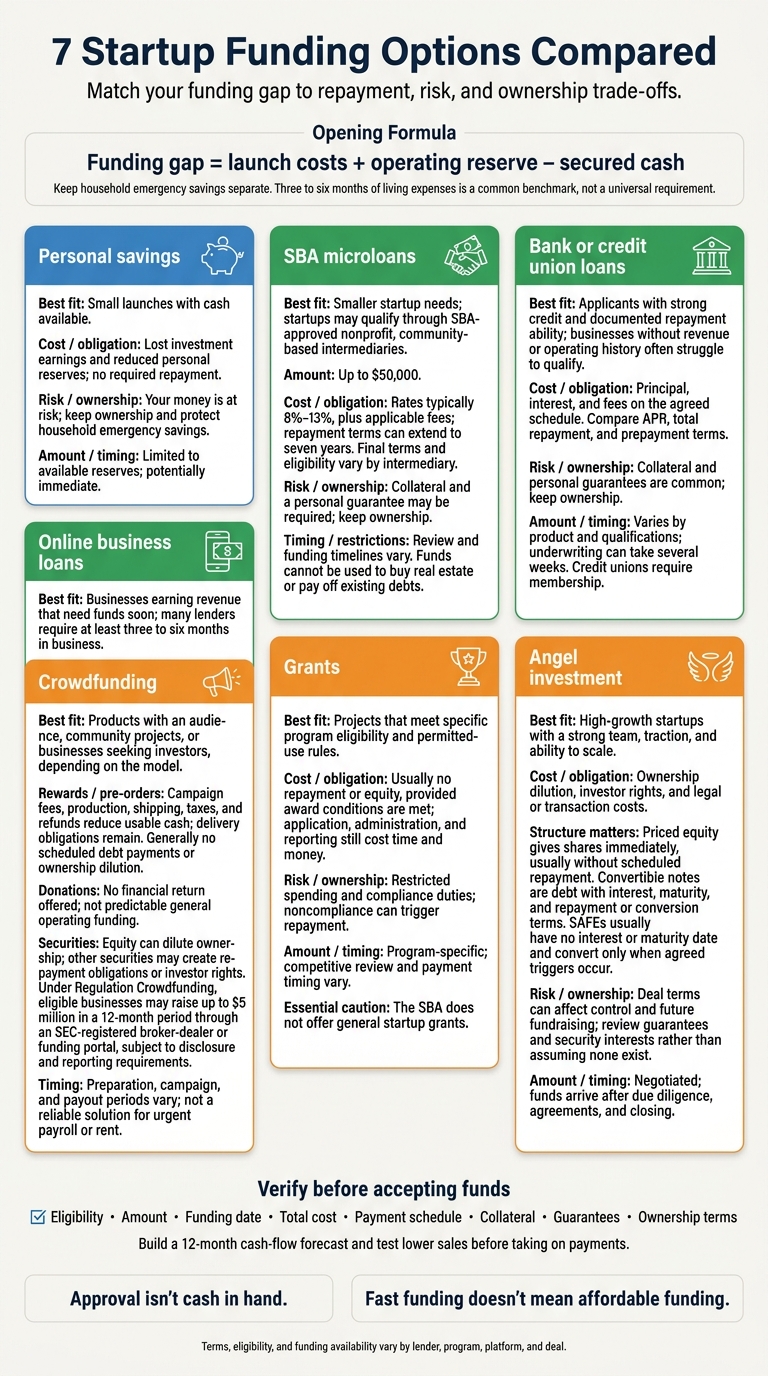
7 Startup Funding Options Compared
Best & Worst Business Funding Options For A Startup Company
sbb-itb-1eb586e
1. Personal Savings
Using your own money puts you in control of when and how you spend it. Start with the smallest launch expenses you can pay for right away.
Savings can cover formation fees, permits, initial inventory, equipment deposits, insurance, rent, and software. Separate one-time startup costs from monthly operating costs to work out how much cash you’ll need and when. Track each expense and its due date in a spreadsheet so a single purchase doesn’t drain the cash needed to keep the business running.
Before spending, set a firm limit on what you can afford to lose. Keep personal emergency savings separate; three to six months of living expenses is a common benchmark. Your savings may also limit the size of your launch. You might not recover the money you invest, and you give up any returns it could have earned elsewhere – what’s known as opportunity cost.
Pay for required permits, equipment you need to operate, and inventory needed to fulfill orders first. Hold off on optional upgrades until sales can cover them. Transfer the funds to a business checking account, keep receipts, and record the money as an owner contribution or owner loan. If your savings cover only part of the launch, the next section explains when an SBA microloan can fill the gap.
2. SBA Microloans
SBA microloans offer up to $50,000 through SBA-approved nonprofit, community-based intermediaries. Startups may qualify, but each lender sets its own requirements for credit and time in business.
You can use the funds for day-to-day operating cash, inventory, supplies, furniture, fixtures, machinery, and equipment. Check with your lender before using the money for rent, payroll, utilities, or other early operating expenses. You cannot use it to buy real estate or pay off existing debts. Unlike a revolving line of credit, a microloan doesn’t let you borrow the money again once you repay it. It can suit a smaller startup budget that needs extra cash to cover launch costs.
Before applying, check that the lender serves your area and ask for its application checklist. Have these documents ready:
- A business plan, use-of-funds budget, vendor quotes, and 12-month cash-flow projections
- Identification, business formation documents, and licenses
- Bank statements, tax returns, and details of your debts
Relevant industry experience and proof of your personal investment can help strengthen your startup application.
Repayment terms can extend to seven years, though the lender sets your final term. Interest rates typically range from 8% to 13%, and rates and fees differ by lender. Get the APR, fees, total repayment amount, prepayment terms, and any required training costs in writing.
Some intermediaries may require collateral or other security, plus a personal guarantee that makes you personally liable for the loan. Ask about underwriting and funding timelines weeks before you need the money, since there’s no standard approval timeline. If you need more than $50,000 or a different repayment structure, compare bank and credit union business loans next.
3. Bank and Credit Union Business Loans
Bank and credit union loans can cover larger startup costs when a microloan isn’t enough. Use a term loan for a one-time purchase and a line of credit for recurring cash gaps. Term loans pay for equipment, vehicles, or renovations through scheduled payments. Reusable lines of credit help cover inventory or payroll gaps. You pay interest only on the amount you draw, though annual line fees may apply.
First-time founders often struggle to qualify without revenue or an operating history. Lenders review personal credit, revenue, cash flow, and time in business, but requirements vary by product. Before applying, ask about minimum credit, revenue, and time-in-business requirements. If you don’t have a sales history, support your application with documented industry experience, personal investment, customer commitments, and a 12- to 24-month cash-flow forecast. Credit unions require membership, and their approval standards aren’t automatically less strict.
How much you can borrow depends on your ability to repay and your collateral. If you need money before sales begin, ask how long underwriting and closing will take. Approval can take several weeks, especially if appraisals or legal reviews are involved. Confirm application review, closing, and funding dates before committing to equipment delivery or an inventory order.
Compare APR or total borrowing cost – not just the advertised rate. Check origination fees, closing costs, annual line fees, and prepayment penalties. Fixed-rate term loans offer predictable payments. Variable-rate lines can cost more when market rates rise. Also ask whether a line requires renewal or a large final payment: revolving credit doesn’t necessarily stay available permanently.
You keep ownership of your business, but you still owe payments if sales fall short. After default, collateral can be seized, while a personal guarantee creates separate personal liability. Ask whether the lender requires an unlimited guarantee or a lien on all business assets. Borrow only what conservative cash flow can support. If banks and credit unions are too slow or strict, the next option is online business loans.
4. Online Business Loans
When banks and other lenders move too slowly or set strict requirements, online loans may offer faster funding at a higher cost. They can suit startups that earn revenue but have a short operating history. Online lenders may review bank feeds or accounting data when you apply. Many require at least three to six months in business, and projections usually can’t replace revenue history.
Loan amounts and funding speed depend on the product, your revenue, and your credit profile. Get written confirmation of when you’ll receive usable funds – not just an approval decision. Faster funding can mean higher costs and shorter repayment terms, so review the price carefully.
Check whether the lender quotes an APR, a flat fee, or a factor rate. A factor rate is a repayment multiplier, not an APR. Ask for the total repayment amount, any fees deducted before funding, and whether paying early lowers the cost. Federal Reserve research found that online lenders differ greatly in how clearly they explain pricing and repayment terms.
The payment schedule matters just as much as the rate. Daily or weekly withdrawals can drain cash before customers pay, especially while startup sales are still uneven. Add the actual withdrawal schedule to your cash-flow forecast. Then test whether slower sales would leave enough to cover loan payments, inventory, payroll, rent, and taxes. Short-term debt is better suited to a documented, near-term repayment source than to covering repeated losses or funding an untested idea.
You keep ownership, but unsecured doesn’t mean free of personal risk. Get written details about personal guarantees, blanket liens, and default triggers. These terms may appear in the contract even when the marketing sounds borrower-friendly. If repayment relies on optimistic sales forecasts or more borrowing, the loan is too risky for your current cash flow. If debt payments don’t fit your launch plan, crowdfunding may offer a nondebt path.
5. Crowdfunding
Rewards and preorders can fund equipment or inventory launches in exchange for a product or perk. Both let you test demand, but you still have to deliver what you promise. Donation-based crowdfunding offers no financial return. It may fit community projects, charitable efforts, or mission-driven businesses, but it’s less predictable for routine operating expenses. These models usually avoid scheduled debt payments and ownership dilution, which can help founders with limited credit or no operating history.
Equity crowdfunding offers a path to more capital if you’re willing to accept investor rights and possible ownership dilution. It sells securities, not products. Selling shares reduces your ownership stake; other securities may come with different payment terms or investor rights. Under Regulation Crowdfunding, eligible businesses can raise up to $5 million in 12 months through an SEC-registered broker-dealer or funding portal. You must file Form C, disclose financial information and terms, follow investor limits, and meet reporting requirements after the offering. Budget for legal and accounting help before taking this route.
Build an audience before you launch. Collect contacts who have opted in, test your offer, and prepare a prototype or demo. Set your funding target and deadline using supplier quotes and the smallest version of the project you can deliver. Explain how you’ll spend the proceeds on equipment, inventory, or other expenses allowed by the platform and offering rules. Be clear about whether you keep the money if you miss your target, how you’ll spend any surplus, and when collected funds become available to use.
Your campaign total isn’t cash you can freely spend. Subtract platform and processing fees, marketing, taxes, production, shipping, refunds, and a contingency reserve. For preorders, check that each sale covers its delivery costs.
Crowdfunding fits planned launches, not urgent payroll or rent. Preparation and fundraising take time, campaigns can miss their goals, and successful preorders still leave you with orders to fulfill. If you need funding that doesn’t require repayment and can meet stricter eligibility rules, review grants next.
6. Grants
Grants usually require no repayment or equity, but competition is stiff and funding isn’t guaranteed. Eligibility and payment schedules vary, so grants are better suited to approved project costs than general launch cash. Eligibility may depend on your industry, location, ownership status, research goals, or export activity. Some awards pay in stages. Don’t commit to purchases while your application is still pending.
The SBA does not offer general startup grants. Its supported programs fund specific activities. SBIR/STTR support qualifying research and development, while entrepreneurship-promotion grants fund organizations that provide training and assistance. STEP funds state and territory governments that help eligible businesses export – not ordinary startup operating expenses. Every expense must meet the award’s terms.
Before applying, check eligibility, matching-fund requirements, payment timing, and allowed costs. Prepare a project plan, budget, timeline, and milestones. Keep separate spending records, including applications, award documents, invoices, receipts, and payroll records. Equipment, materials, and technical labor must support the approved project and be expressly allowed. Ordinary inventory or rent doesn’t automatically qualify.
No interest doesn’t mean no cost. Budget for reporting, recordkeeping, staff time, and audit readiness. Federal award records generally must be kept for at least three years after the final expenditure report, though exceptions apply. Unapproved spending, unsupported costs, inaccurate certifications, or unmet conditions can result in suspended payments, disallowed costs, or repayment demands. Get written approval before changing the funded work or budget. If grant rules are too restrictive, angel investment is the next equity-based option.
7. Angel Investment
If grants aren’t a fit, angel funding is the next equity-based option for high-growth businesses. Angel investors put their own money into startups in exchange for equity. They focus more on your team, market, traction, business model, and ability to scale than on your credit history. That makes angel funding a better fit for scalable startups than local businesses needing a small equipment or inventory purchase – or cash for permits and rent. First-time founders can strengthen their pitch with relevant industry experience, clear co-founder roles, proof of customer demand, and a 12- to 24-month cash forecast.
Funding takes negotiation and investor review. Cash arrives only after that review, legal paperwork, and closing. Angels want proof of traction, not just projections. Before seeking funding, prepare your ownership records, contracts, financial statements, and IP assignments. These documents help investors assess the deal’s risk and structure. Don’t commit to spending money based on an unsigned investment.
The financing structure determines what you give up and what you owe:
- Priced equity gives investors shares immediately, usually without scheduled repayment, collateral, or personal guarantees.
- A convertible note is debt. It generally includes interest, a maturity date, and repayment or conversion terms.
- **A SAFE – Simple Agreement for Future Equity – ** usually has no interest or maturity date. It converts to equity only when agreed triggers occur.
Have an attorney review any security interests, guarantees, and repayment provisions.
Model dilution before accepting an offer. Your ownership table, or cap table, should account for employee options, outstanding SAFEs and notes, and a likely future funding round – not just today’s ownership split. Compare valuation caps, conversion discounts, liquidation preferences, and voting rights. Investors may also ask for reporting rights, approval rights, the right to invest in future rounds, or a board seat. Unlike ordinary debt, these terms can affect your control, ownership share, and future fundraising.
Budget for legal, accounting, and securities-compliance work. Those costs leave less cash to run the business. An experienced angel may also offer customer introductions, industry advice, and hiring help. Ask for founder references, check for portfolio conflicts, and agree on how involved the investor will be. Include those expectations and deal terms when comparing angel funding with other options.
Compare Funding by Startup Need and Financial Terms
Match each funding source to what your startup needs, when you need the money, and how much repayment or ownership dilution you can accept.
| Startup need or constraint | Realistic options | What to verify |
|---|---|---|
| Equipment | Personal savings, SBA microloan, bank or credit union loan, online business loan | Get an equipment quote. Lenders may require collateral, a down payment, or a personal guarantee. |
| Inventory | Personal savings, SBA microloan, bank or credit union loan, online business loan, pre-order crowdfunding | Document supplier costs and margins. Pre-orders come with delivery and refund obligations. |
| Early rent, payroll, and insurance | Personal savings, SBA microloan, working capital loan | Businesses without revenue may struggle to qualify. Check whether cash flow can cover recurring payments. |
| Product testing | Personal savings, rewards or pre-order crowdfunding, eligible grants | Campaign costs reduce the cash you can use. Grants must fund a specific eligible project. |
| Limited credit or no operating history | Personal savings, SBA microloan intermediaries, crowdfunding, grants, some angel investors | Approval still depends on repayment ability, traction, or program rules. |
These examples show how the amount and purpose can change which funding source fits best.
- $8,000 equipment: Include sales tax, delivery, and installation in the quote before deciding how much to borrow.
- $25,000 inventory and working capital: Test whether a slow sales month leaves enough cash for payments. With pre-orders, reserve money for production, shipping, taxes, and refunds.
- Product or software development: Separate launch costs from growth capital and cash to operate while building the product. Pursue research grants only for eligible work; consider angel investment or securities crowdfunding when growth potential justifies dilution and compliance costs.
Eligibility and Credit Requirements
| Option | What qualification depends on |
|---|---|
| Personal savings | Available personal cash, with no credit check. Keep an emergency reserve. |
| SBA microloan | An intermediary reviews credit, your business plan, experience, and repayment ability. Requirements vary. |
| Bank or credit union loan | Often personal and business credit, financial records, operating history, collateral, and guarantees. |
| Online business loan | Commonly personal credit, revenue, bank activity, and time in business. Startups without revenue do not automatically qualify. |
| Crowdfunding | Rewards/pre-orders: audience demand and a realistic delivery plan. Securities: required disclosures and regulated offering procedures. |
| Grants | Program-specific eligibility and permitted activities. Federal grants generally do not fund an ordinary business launch. |
| Angel investment | Growth potential, traction, team, valuation, and investor due diligence – not conventional credit underwriting. |
Funding Amount and Timing
| Option | Available amount | Time until funds are available |
|---|---|---|
| Personal savings | Limited to available reserves | Potentially immediate |
| SBA microloan | Up to $50,000 | Varies with intermediary review and whether documentation is complete |
| Bank or credit union loan | Varies by product and qualifications | Underwriting time varies |
| Online business loan | Varies by lender and cash flow | May be faster; check approval and disbursement terms |
| Crowdfunding | Rewards/pre-orders depend on demand; Regulation Crowdfunding allows up to $5 million in a 12-month period | Preparation, campaign, and payout periods vary |
| Grants | Program-specific | Competitive review and payment schedules vary |
| Angel investment | Negotiated | Depends on due diligence, agreements, and closing |
Wait until funds are available before committing to necessary spending. That applies even after a successful campaign, grant award, or signed investment agreement.
Costs and Repayment
| Option | Cost to compare | Repayment or cash obligation |
|---|---|---|
| Personal savings | Lost investment earnings and reduced personal reserves | No required repayment |
| SBA microloan | Interest and intermediary fees; SBA guidance generally describes rates around 8%–13% | Scheduled payments; maximum term generally seven years |
| Bank or credit union loan | APR, fees, total repayment, and prepayment terms | Principal and interest on the agreed schedule |
| Online business loan | APR where available, fees, total repayment, and term | Check whether payments are daily, weekly, or monthly |
| Crowdfunding | Platform/payment fees, marketing, taxes, production, shipping, and refunds | Rewards/pre-orders require fulfillment; securities may create debt payments or equity obligations |
| Grants | Application, administration, and compliance costs | Usually no repayment if award conditions are met; noncompliance can trigger repayment obligations |
| Angel investment | Equity given up and transaction costs | Priced equity and SAFEs generally have no scheduled payments; convertible notes carry debt terms. |
A $10,000 advance at a 1.25 factor rate requires $12,500 in repayment before fees.
Collateral and Ownership
| Option | Personal liability or collateral | Ownership and other obligations |
|---|---|---|
| SBA microloan | Collateral and a personal guarantee may be required | Keep ownership; default can create personal liability |
| Bank or credit union loan | Collateral, guarantees, or both are common | Keep ownership; pledged assets may be at risk |
| Online business loan | May involve a guarantee, blanket lien, or linked bank account | Keep ownership; review default remedies |
| Crowdfunding | Rewards/pre-orders create fulfillment obligations; debt-based securities may carry repayment terms | Rewards/pre-orders generally avoid dilution; equity offerings dilute ownership |
| Grants | Noncompliance can trigger repayment | Usually no dilution; spending restrictions and reporting requirements apply |
| Angel investment | Depends on the financing structure | Dilution and investor rights can affect control and major decisions |
Pros and Cons of Each Funding Option
Compare cost, speed, control, and fit before applying for a start-up business loan for equipment, inventory, or operating expenses.
| Funding option | Main advantage | Main disadvantage | Best fit |
|---|---|---|---|
| Personal savings | No borrowing costs or approval delays. | If the business fails, you lose your money. Using emergency savings can also leave you short during a personal crisis. | Modest launches that leave emergency reserves intact. |
| SBA microloans | Smaller loans, with guidance available from some lenders. | You still need to show you can repay the loan. | Businesses with limited history and a realistic plan. |
| Bank and credit union loans | Often lower costs and longer repayment terms. | Startups often need strong credit, collateral, cash flow, and a detailed plan. | Well-prepared applicants who can wait for funding. |
| Online business loans | Fast applications that may use digital business data to assess borrowers. | Funding is often faster but usually costs more. | Businesses earning revenue that need cash urgently. |
| Crowdfunding | Tests demand while bringing in funds. | Running the campaign and fulfilling orders take time. | Products with an engaged audience. |
| Grants | Usually no repayment or loss of ownership. | Competition is tough, and funds are limited to specific uses. | Projects that match a program’s rules. |
| Angel investment | Capital plus an investor’s expertise. | You give up ownership and some control. | Scalable companies that need more capital than savings or small loans can provide. |
When cash is tight, speed matters. But easy access doesn’t mean easy repayment. In the Federal Reserve’s 2024 Small Business Credit Survey, online-loan applicants most often cited high interest rates and weak repayment terms.
Look beyond the money, too. Campaign management, grant reporting, and investor negotiations all take time and should factor into which option fits your business.
Choose Your Next Funding Step
Narrow your funding options by how much cash you still need and how soon you need it.
Calculate your startup gap: equipment, initial inventory, and an operating reserve, minus committed cash. Get vendor quotes and decide how many months of runway your reserve should cover. Count only money you’ve already secured, and keep household emergency savings separate from your business contribution.
Build a 12-month cash-flow forecast that tests lower sales, slower customer payments, and higher costs. Check whether cash left after expenses can cover proposed payments, plus a buffer for surprises. If it can’t, borrow less, put off purchases, or rethink the launch plan.
Match each option to your credit, revenue, and collateral. Gather your formation papers, licenses, bank statements, tax returns, business plan, and projections.
Your first funding source should also fit what you’re paying for: equipment, inventory, or early operating costs. Use this shortlist to decide where to start.
| Your circumstances | Option to investigate | Verify before committing |
|---|---|---|
| Small gap; savings available | Personal savings | Household emergency reserves stay untouched. |
| Eligible project | Grants | Eligibility, deadlines, permitted expenses, and reporting. |
| Limited history; need up to $50,000 | SBA microloan | Approved nonprofit intermediary’s credit rules, collateral, guarantees, and term. |
| Strong credit and documented revenue | Bank or credit union loan | Written terms, collateral, and total cost. |
| Need speed; steady revenue | Online business loan | Total repayment and whether daily or weekly payments fit cash flow. |
| Clear audience | Crowdfunding | Fees, production, shipping, refunds, and any securities requirements. |
| High-growth business seeking a large amount of capital | Angel investment | Valuation, dilution, voting rights, and future fundraising terms. |
Screen debt offers by total repayment – not just the headline rate. Then compare APR or factor rate, fees, payment frequency, term, collateral, guarantees, and whether paying early reduces costs. A personal guarantee can put your personal assets at risk even if your business is an LLC.
Combining sources means more repayment schedules, compliance duties, and possible ownership trade-offs. Before accepting funds, document what each source will pay for and what you’ll owe or agree to in return. Check demand, pricing, and margins separately; extra funding won’t fix weaknesses in those areas.
FAQs
Can I get startup funding with bad credit and no revenue?
Yes, you can get startup funding with bad credit and no revenue. One option is an SBA microloan of up to $50,000. These loans serve newer businesses, and lenders may consider applicants with limited or poor credit. You’ll still need a solid business plan and realistic projections that show how you’ll repay the loan – not just a record of past revenue.
Other options include business credit cards for small, short-term funding gaps, friends-and-family funding, crowdfunding, and grants if you meet the program’s rules.
Will applying for business funding hurt my personal credit?
Applying for business funding can cause a small, temporary dip in your personal credit score, since lenders typically run a hard credit check. The impact depends on the lender and how many checks occur. To limit it, avoid opening new credit accounts or submitting several applications close together.
If you’re approved, on-time loan payments can help build business credit, even if the lender checked your personal credit to qualify you.
Can I combine an SBA microloan with a grant?
Yes. You can use a grant to cover eligible project costs and an SBA microloan for remaining expenses, such as working capital, inventory, equipment, or supplies. Combining the two can reduce the amount you need to borrow.
Apply separately for each funding source, and plan to repay the microloan with interest. Track and document how you spend both sources of funding. Misusing grant funds can lead to legal issues or loss of the award.
Leave a Reply