

Your SBA business plan needs to answer 3 things fast: Is the business real? What, exactly, will the money pay for? Can cash flow cover the loan payment? If I miss one of those, the plan gets harder to approve.
Here’s the short version:
- I start with a one-page summary of the business, loan request, and payback source
- I explain who owns the business, how it works, and whether it meets SBA rules
- I show what I sell, how I price it, and how sales turn into cash
- I back that up with market demand, competitors, and management experience
- I spell out how customers find me and how sales happen
- I give an exact funding amount with a line-by-line use-of-funds list
- I include financial projections that show monthly cash flow can handle the payment
- I add an appendix with bank statements, tax returns, resumes, quotes, and licenses
For SBA microloans, the amount can go up to $50,000, and terms can run up to 6 years. That means the plan can’t be vague. Every number needs to connect – from marketing to sales to cash flow to repayment.
At its core, an SBA business plan is simple: it shows the business can make money, use the loan for allowed costs, and pay the lender back.
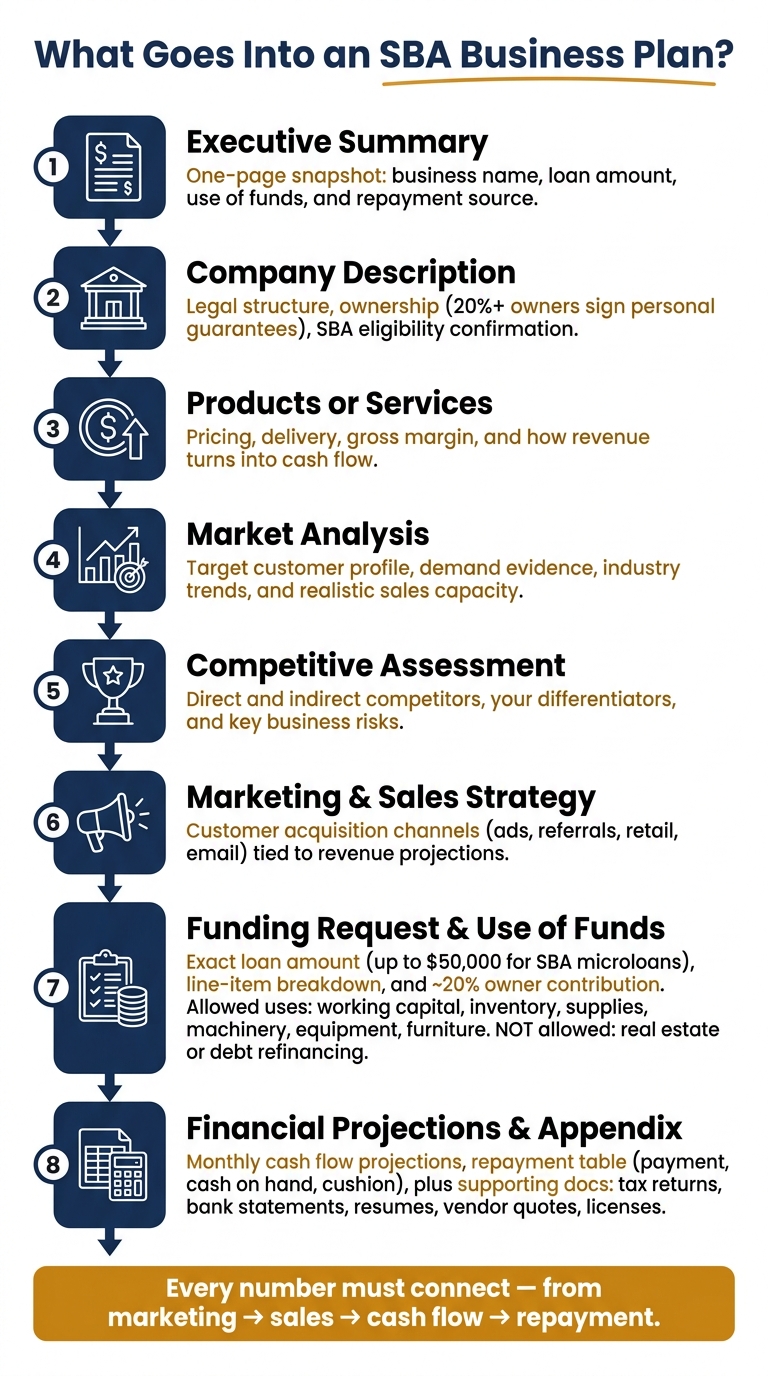
SBA Business Plan: 8 Sections Lenders Need to Approve Your Loan
How to Write an SBA-Ready Business Plan in 1 Day (Guide included)
sbb-itb-1eb586e
Section 1: Business Overview Sections Lenders See First
These first three sections shape a lender’s first impression of the business. They show who owns it, how it makes money, and whether repayment looks realistic. Start with the executive summary, then move into ownership and revenue details.
Executive Summary: The Full Loan Request on One Page
Write the executive summary last, but place it first. That sequence matters. You can’t sum up financial projections, use of funds, or repayment sources with any accuracy until the rest of the plan is done.
When it’s ready, include the business name, location, legal structure, ownership, business stage, target customer, competitive edge, funding amount, owner contribution, use of funds, repayment source, and a short snapshot of revenue and cash flow.
Think of it as the one-page version of the full loan request.
Company Description: Ownership, Operations, and Eligibility
This section goes deeper into who owns the business and how it runs day to day. If you are still in the planning stages, there are many reasons why you should start your small business now. Cover the legal structure – sole proprietorship, LLC, or corporation – along with each owner’s background, experience, and any personal money already put into the business. Lenders want to see clear owner buy-in, plus personal guarantees from anyone who owns 20% or more of the business.
Then move beyond ownership. Describe the business location, suppliers, and staffing. This is also where you confirm SBA eligibility: the business must be for-profit and meet SBA size standards. If you’re a startup and don’t have current cash flow yet, say that plainly and show whether repayment will come from existing cash flow or projected cash flow.
This section makes one thing clear: who is in charge, and who is responsible for getting the plan done.
Products or Services: What the Business Sells and How It Earns Revenue
Spell out exactly how the business makes money. For each product or service, explain pricing, delivery, and gross margin. If revenue comes from one-time jobs, recurring service contracts, retail sales, or repeat purchases, say so directly. Don’t leave the lender to connect the dots.
Lenders are looking for grounded sales assumptions, not a polished pitch. Back up your numbers with market data. If you expect sales to grow by month three, explain why that makes sense based on local demand, your pricing, and how customers will find you. Pricing and sales volume assumptions feed straight into repayment capacity.
These revenue details should line up with the sales assumptions you use later in the financial projections.
Section 2: Market Demand, Competition, and Management
This part of the plan gets at the two things lenders care about most: Is there real demand? And can this team carry out the plan? The best business plans don’t just say yes. They prove it with facts.
Market Analysis: Who the Customer Is and Why Demand Is Real
Start by defining your target customer in plain terms. Then support that with hard evidence of demand and current industry conditions or trends that point to growth. Lenders want projections backed by data, not broad claims about market size without proof.
Your sales projections also need to stay grounded in reality. They should match your actual service area, your capacity, and the cash flow needed to repay the loan. If you can only serve a certain number of customers each week, the numbers should reflect that. The same goes for pricing and revenue. Demand, pricing, and your revenue model all need to line up.
Competitive Assessment: What Sets the Business Apart
List both your direct and indirect competitors, and be honest about where your business stands. This isn’t about pretending there’s no competition. It’s about showing that you know the market and can explain why a customer would pick your business instead.
Tie each advantage to a clear customer need. Maybe you offer faster service, a better location, lower prices, deeper subject-matter knowledge, or a more focused product mix. Whatever the edge is, spell it out clearly.
You should also name the main risks and explain how the business will deal with them. That shows you’ve thought past the upside and understand what could go wrong.
Organization and Management: Why the Team Can Run the Business
Lenders also want to know who’s running the business day to day. Describe each owner’s management role, along with the experience, time commitment, education, and any licenses or certifications tied to the business. Keep the focus on experience that fits the role.
It also helps to mention key employees and outside support, such as a bookkeeper, CPA, or attorney. That gives lenders a clearer picture of how the business will actually operate.
Once demand and management are clear, the next step is showing how customers will find the business and how the loan funds will be used.
Section 3: Marketing Plan, Funding Request, and Use of Funds
Once you’ve shown there is demand and that the business can be run well, the next step is simple: explain how people hear about you, how they buy, and how the loan helps make that happen. Lenders want to see a straight line from marketing to sales to funding use.
Marketing and Sales Strategy: How Customers Find and Buy
Spell out the path a customer takes from first hearing about the business to making a purchase. That means covering your marketing channels, sales process, pricing, and how leads turn into paying customers.
This section should connect each sales channel to the revenue numbers in your financial projections. If you expect sales from online ads, referrals, retail traffic, email, or direct outreach, say so clearly and show how those channels support your forecast. It should also show how the business can add more sales capacity over time.
After the sales plan explains how revenue grows, the funding request should explain what the business needs in order to make that growth happen.
Funding Request: The Exact Amount and Eligible Purpose
State the exact dollar amount you’re asking for, then break it down by purpose.
When comparing SBA microloans vs bank loans, note that microloans can be used for:
- working capital
- inventory
- supplies
- machinery
- equipment
- furniture and fixtures
They cannot be used for real estate purchases or to refinance existing debt.
Show the owner’s cash contribution as its own line item. In many cases, that’s about 20% of total project costs. Lenders want to know the owner has money in the deal too, not just the bank.
Use-of-Funds Table: Line Items Lenders Can Verify
A use-of-funds table should match each expense with a category, dollar amount, and business purpose. The clearest way to do that is with a line-item table. When you can, support the numbers with vendor quotes or estimates.
Here’s an example of what a clean use-of-funds table looks like:
| Expense Item | SBA Category | Estimated Cost | Business Purpose |
|---|---|---|---|
| Equipment Purchase | Equipment | $12,000 | Enables in-house production to increase margins |
| Initial Inventory | Inventory | $5,000 | Required to meet first-quarter sales targets |
| Office Desks/Chairs | Furniture & Fixtures | $3,000 | Necessary for onboarding 2 new sales staff |
| Marketing Campaign | Working Capital | $4,000 | Lead generation to support projected revenue growth |
| Total Request | $24,000 |
Each line item should tie back to a clear revenue driver or operating need.
Section 4: Financial Projections, Supporting Documents, and Final Review
Financial Projections and Repayment Plan: The Numbers Behind the Plan
After the funding request, the plan needs to show one thing plainly: the business can pay back the loan.
That means including revenue, expense, and cash flow projections, plus a plain-English explanation of the assumptions behind those numbers. Don’t just drop in a spreadsheet and hope it speaks for itself. Show how projected revenue connects to benchmarks, market research, and clear pricing or sales volume assumptions.
A repayment table is a must. It should lay out:
- The expected monthly loan payment
- Projected cash on hand
- The cash cushion left after payment
That cushion matters. It shows the business can handle a slow month without falling behind. For startups that don’t have current cash flow, these projections are the main way to show repayment ability.
Once the numbers point to repayment capacity, the next step is backing up those assumptions with documents.
Supporting Documents: The Appendix That Backs Up the Application
Use the appendix to support the claims made in the plan.
| Document Category | What to Include |
|---|---|
| Management | Resumes, proof of relevant industry experience |
| Financials | Cash flow projections, profit/loss expectations, bank statements |
| Loan Support | Vendor quotes, owner contribution proof, collateral records |
| Legal/Security | Licenses, permits, tax returns, personal financial statements |
One issue trips up a lot of applicants: names, ownership percentages, and dollar amounts need to match exactly across the business plan, the financial tables, and the formal loan application.
Even a small mismatch can create doubt. If the plan says one thing and the application says another, the lender is left sorting out a problem that shouldn’t exist in the first place.
The last step is checking that every section and attachment tells the same story.
Conclusion: What Makes an SBA Business Plan Lender-Ready
Each section should point to the same idea: the business is viable, and the loan can be repaid. When the funding request, projections, and appendix line up, the lender can review the application without gaps.
"A strong business plan won’t just help you secure an SBA microloan – it’ll serve as your roadmap as you navigate the highs and lows of entrepreneurship. It proves to lenders that you’re not just chasing a dream; you have a plan to make it work." – SBA 50K
FAQs
How long should an SBA business plan be?
The SBA does not require a set page count or one fixed business plan template.
For most SBA microloan applications, 10 to 20 pages is usually enough. What matters more is clarity, specific details, and numbers that hold up. So aim for a polished plan that shows your business can work and that you can repay the loan.
What financial statements should I include with my plan?
Include the financial records lenders look at to judge repayment ability and whether the business makes sense on paper:
- Current year-to-date profit and loss statement
- Balance sheet dated within the last 60 to 90 days
- 2 to 3 years of personal and business tax returns for owners with 20% or more equity
- 3 to 6 months of recent business bank statements
- 3- to 5-year financial projections, including monthly cash-flow forecasts for the first 12 to 24 months, plus a detailed use of funds
This mix gives a lender a clear view of where the business stands now, how it has performed in the past, and how you expect the money to be used going forward.
How detailed should my use-of-funds list be?
Make it specific and itemized, with exact dollar amounts for each expense. Skip vague phrases like "growing the business." Instead, spell out what each item is for.
Back up major line items with documents like vendor quotes, purchase contracts, or lease agreements. Your total loan request should match the breakdown exactly.
Leave a Reply