
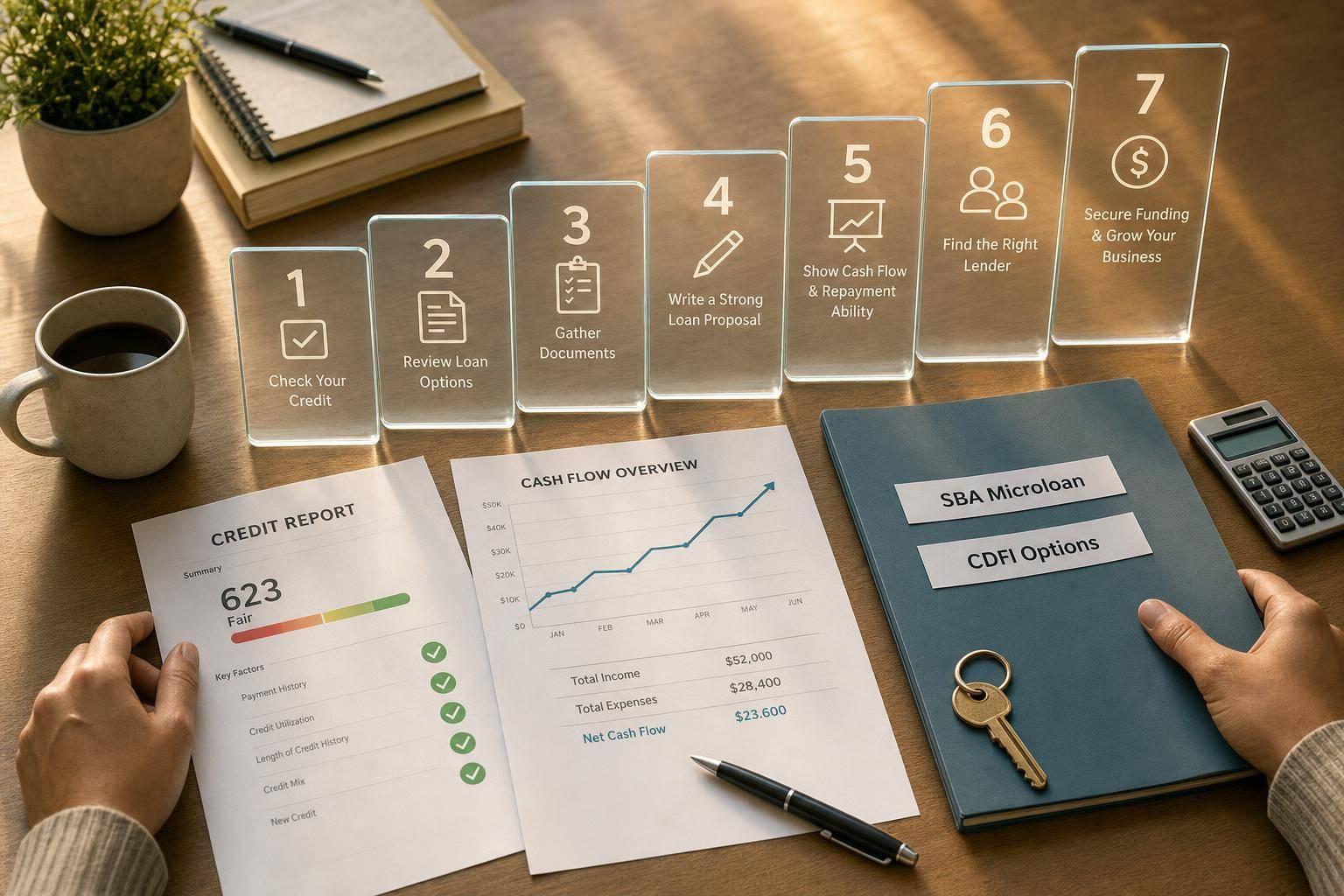
Yes, I can still get a small business loan with poor credit – but I need to win on cash flow, paperwork, and lender fit. If my FICO score is under 670, many banks may say no. But some lenders look harder at revenue, time in business, collateral, and whether my cash flow covers debt by about 1.25x.
Here’s the short version:
- I should pull personal and business credit reports first
- I should fix the biggest problems, like high card balances, past-due accounts, and errors
- I need to show 3–6 months of bank statements, tax returns, a P&L, balance sheet, and 12 months of cash flow projections
- I should ask for a loan amount that clearly fits repayment
- My best options may include SBA microloans up to $50,000, CDFI loans, equipment financing, secured loans, revenue-based financing, and invoice factoring
- I may improve approval odds with collateral, a personal guarantee, or a co-signer
- I should apply only to lenders that work with lower-credit borrowers, not everywhere at once
A few numbers stand out:
- SBA microloans: up to $50,000
- Typical SBA microloan rates: about 6% to 13%
- Repayment term: up to 6 years
- Some lenders may work with scores as low as 525–550
- Invoice factoring advances: about 70% to 90% of receivables
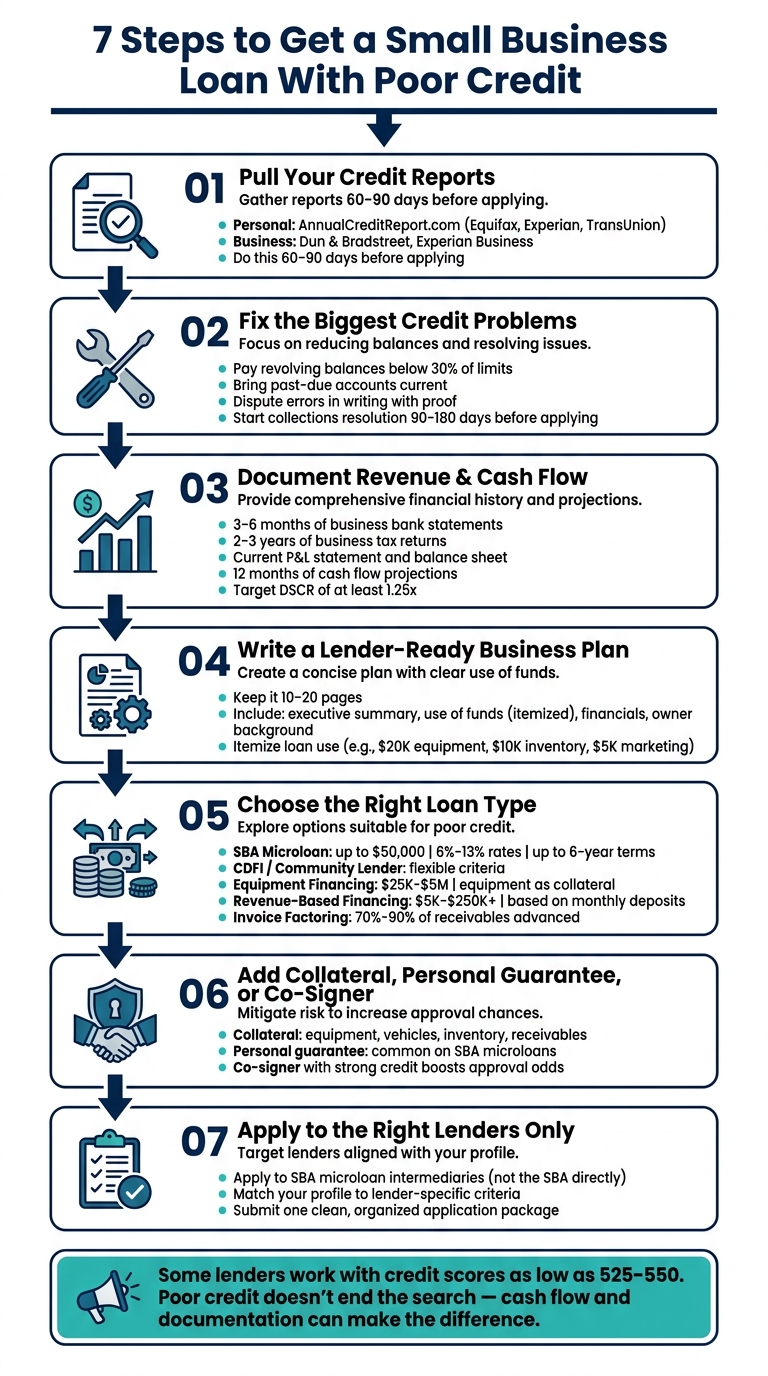
7 Steps to Get a Small Business Loan With Poor Credit
SBA Business Plan Q&A: Bad Credit, Realistic Projections & Competitor Mistakes
sbb-itb-1eb586e
Quick Comparison
| Option | Best for | What lenders focus on | Typical range |
|---|---|---|---|
| SBA microloan | Startups, inventory, working capital, small equipment buys | Repayment ability, business plan, owner history | Up to $50,000 |
| CDFI loan | Owners turned down by banks | Business performance, lender rules | Varies |
| Secured loan | Businesses with assets to pledge | Collateral, revenue, time in business | About $10,000 to much more |
| Equipment financing | Buying machines, vehicles, or tech | Equipment value and revenue | About $25,000 to $5,000,000 |
| Revenue-based financing | Strong monthly sales | Deposits and revenue | About $5,000 to $250,000+ |
| Invoice factoring | B2B firms waiting on customer payments | Customer credit and invoice quality | 70%–90% advance |
The main point: poor credit does not end the search. If I clean up my reports, show steady deposits, and choose the right lender, I may still have a path to funding.
Steps 1–2: Check your credit and fix the biggest problems first
Step 1: Pull your personal and business credit reports
Before anything else, look at the same reports a lender will review. That means pulling both your personal and business credit reports, not just one.
For personal credit, start with AnnualCreditReport.com, the federally authorized source for free reports from Equifax, Experian, and TransUnion. Pull your reports 60–90 days before you apply so you have time to dispute mistakes. The point is simple: find the items most likely to get your application turned down.
For business credit, review your files with Dun & Bradstreet and Experian Business. A D-U-N-S Number identifies your company in D&B’s system, and your Paydex score shows how fast your business pays vendors. These reports may also show trade credit history and public records. Lenders may check both, and they often price the loan based on the weaker file.
| Report Type | Where to Get It | What It Shows | How It Affects Approval |
|---|---|---|---|
| Personal credit report | AnnualCreditReport.com | Payment history, balances, inquiries, collections, and public records | Many lenders use it to assess borrower-level risk, especially when a personal guarantee is required |
| Business credit report | Dun & Bradstreet, Experian Business | Vendor payment history, trade lines, days past due, and business public records | Helps lenders judge how the business handles obligations; a strong business score can help offset weaker personal credit |
As you go through each report, flag the problems that stand out right away:
- Incorrect late payments
- Collections you don’t recognize
- Accounts that aren’t yours
- High revolving balances
- Hard inquiries you did not authorize
Those are some of the biggest warning signs lenders look for. Start with the heaviest negatives first: balances, late payments, and collections.
Step 2: Fix weak credit areas before you apply
Once you know what’s on your reports, focus on the changes that can improve your file the fastest. One of the fastest moves is paying down revolving balances to below 30% of your credit limits. In many cases, that can help within a single billing cycle.
If you have past-due accounts, bring them current before you apply. A 30-day or 60-day late mark still tells a lender you had trouble repaying, even if the account is current now. Bringing it current won’t wipe out the old late history, but it does show better recent behavior.
For collections, contact the creditor or collector directly. Smaller balances are often easiest to pay in full. Bigger ones may call for a settlement or payment plan. Try to start this process 90–180 days before you apply.
If a negative item is wrong, dispute it in writing and include proof such as:
- Bank statements
- Payment confirmations
- Creditor letters
You can submit disputes online or by certified mail, but keep copies either way. If the credit bureau can’t verify the item, it must be corrected or removed.
| Common Credit Problem | Corrective Action | Realistic Timeline |
|---|---|---|
| High revolving balances | Pay down to under 30% of limits | Often within 30–45 days |
| Past-due accounts | Bring current immediately | Usually visible within about 30 days |
| Inaccurate negative items | File disputes with bureaus and furnishers | About 30–45 days |
| Unresolved collections | Pay, settle, or enter a payment plan | Start 90–180 days before applying |
| Business bank overdrafts | Keep statements clean and balances positive | At least the most recent statement period |
| Recent hard inquiries | Avoid new credit applications | Until after you apply |
Lenders also check bank statements for overdrafts and NSF fees, so keep your recent activity clean. Once your reports look better, the next job is showing that your revenue and cash flow can support repayment.
Steps 3–4: Prepare the documents lenders use to judge risk
Once your credit file looks better, the next job is simple: prove you can repay the loan.
Step 3: Document your revenue, cash flow, and repayment ability
For loans under $50,000, many lenders, including CDFIs and SBA microloan intermediaries, care a lot about cash flow, business performance, and clean paperwork. If your credit is weak, strong numbers can help balance that out.
Your goal is to show three things:
- where money comes in
- where money goes out
- how the new loan payment fits into the picture
Lenders usually want 3–6 months of business bank statements, 2–3 years of business tax returns, personal tax returns for owners with 20% or more ownership, a current profit-and-loss (P&L) statement, a balance sheet, and at least 12 months of cash flow projections.
Business bank statements from the last 3–6 months, and sometimes up to 12 months, show actual cash coming in and going out. They also show average monthly balances and whether the business has had overdrafts or NSF fees. Business tax returns help confirm reported income and show whether revenue is rising, flat, or falling. Lenders often compare tax returns with bank deposits to see if the story matches.
You’ll also need a current profit-and-loss (P&L) statement, a balance sheet, and monthly cash flow projections for at least 12 months. Those projections matter even more if your revenue is seasonal or uneven. They give you space to show that, after expenses, the business still has enough cash to make the loan payment.
| Document | What it tells the lender |
|---|---|
| 3–6 months of business bank statements | Confirms real cash inflows and outflows, average monthly revenue, and whether the business has overdrafts or negative balances |
| 2–3 years of business tax returns | Verifies reported income, profitability trends, and consistency with bank deposits |
| Personal tax returns for owners with 20% or more ownership | Shows the owner’s financial strength and ability to support the business if needed |
| Profit-and-loss (P&L) statement | Shows whether operating margins are sufficient to support additional debt service |
| Balance sheet | Reveals existing liabilities, available assets, and overall leverage |
| Monthly cash flow projections (12 months) | Demonstrates a clear repayment path, including the new loan payment, month by month |
When you build your projections, start with the last 6–12 months of actual bank statement averages. Then adjust for seasonality and add the proposed loan payment as a fixed monthly expense. Lenders often look for a Debt Service Coverage Ratio (DSCR) of at least 1.25, which means cash flow covers total debt payments by 125% or more.
If you make assumptions, explain them in plain English. Maybe you’re counting on a new supplier contract. Maybe sales usually jump during a busy season. That’s fine. Just tie each assumption to supporting documents so it doesn’t look like guesswork.
With the numbers in order, the next move is to shape them into a plan a lender can review fast.
Step 4: Write a lender-ready business plan
For a poor-credit loan request, a business plan needs to answer one thing: Can this business repay this loan? Keep it to 10–20 clear pages.
Start with the sections that show repayment ability. Your executive summary should spell out the loan amount, what the money is for, and the short case for why the business can handle the debt. The owner background section matters more than many borrowers think. If you have solid industry experience or a track record of running day-to-day operations well, that can help soften concerns about a low credit score.
The use of funds section is where many applications slip. Don’t ask for vague “working capital.” Break the request down line by line. For example: $20,000 for equipment, $10,000 for inventory, and $5,000 for marketing. Lenders like specific uses tied to more sales or lower costs.
| Business plan section | What lenders look for |
|---|---|
| Executive summary | Loan amount, purpose, and a brief case for repayment ability |
| Business model | How the business makes money, its cost structure, and sustainability |
| Customer demand & market analysis | Sales history, signed contracts, or market data supporting revenue projections |
| Pricing and margins | Gross margins sufficient to cover operating costs plus loan payments |
| Operations | Day-to-day processes, staffing, and supplier reliability |
| Owner background & management | Industry experience and skills that reduce perceived management risk |
| Loan amount & use of funds | Itemized breakdown of every dollar and how it supports the business |
| Financials & cash flow projections | Current financial health plus a month-by-month repayment path |
Use SBA50K planning resources to line up your plan with SBA microloan expectations. SBA microloan lenders want to see cash flow, feasibility, and owner commitment, so your plan should reflect that.
Before you send anything out, check every number. Your P&L, tax returns, bank statements, and projections should all match. If they don’t, lenders will notice. And for poor-credit applicants, even small gaps can become big red flags.
With the package ready, the next step is matching it to the right loan type and lender.
Steps 5–7: Pick the right loan options and submit a stronger application
Step 5: Focus on loan types that work for poor-credit borrowers
Not every business loan is built for someone with weak credit. At this stage, the smart move is to focus on loan products that look beyond the score and pay more attention to repayment ability, cash flow, collateral, or the strength of the business itself.
SBA microloans are often one of the best places to start. They go up to $50,000, usually come with interest rates around 6% to 13%, and offer repayment terms of up to 6 years. The average loan size is about $16,000. These loans tend to weigh repayment ability and business viability more than credit score alone. Some intermediaries work with borrowers in the mid-500s, and a few go as low as 525.
CDFIs and community lenders can also be a strong fit. They often serve borrowers who can’t get approved at banks, and many of them also work as SBA microloan intermediaries. On top of funding, they may offer technical assistance and business coaching.
Other loan types can make sense too, depending on what your business looks like on paper.
- A secured term loan can be a good option if you have equipment, vehicles, inventory, or another asset to pledge. Collateral helps lower the lender’s risk, which matters a lot when credit is weak.
- Equipment financing is worth a close look if you’re buying machinery, vehicles, or tech. The equipment itself acts as collateral, and some lenders may work with scores around 550 if revenue is steady and the asset has decent resale value.
- Revenue-based financing leans heavily on bank deposits and monthly revenue instead of credit. Minimum scores often start around 500+, with minimum monthly deposits of about $15,000.
- Invoice factoring can work well for B2B companies. Instead of judging your credit, the factor looks at your customers’ creditworthiness and may advance 70% to 90% of your accounts receivable.
| Loan Type | Typical Loan Size | Main Approval Factor | Best Use Case |
|---|---|---|---|
| SBA Microloan | Up to $50,000 (~$16K average) | Business plan, repayment ability, character | Startups, working capital, inventory, equipment |
| CDFI / Community Lender | Varies | Community impact, business viability, lender criteria | Borrowers shut out of banks who benefit from coaching |
| Secured Term Loan | $10,000 to several hundred thousand dollars+ | Collateral value, revenue, time in business | Expanding operations or buying major assets |
| Equipment Financing | $25,000 to $5,000,000 | Equipment value and resale potential | Purchasing machinery, vehicles, or technology |
| Revenue-Based Financing | $5,000 to $250,000+ | Monthly revenue and bank deposits | Strong-sales businesses needing fast working capital |
| Invoice Factoring | 70% to 90% of accounts receivable | Customer creditworthiness and AR volume | B2B businesses waiting on slow-paying clients |
Step 6: Add collateral, a personal guarantee, or a co-signer
Once you’ve picked the loan type, the next job is simple: make the lender feel safer. That usually comes down to three things – collateral, a personal guarantee, or a co-signer.
Collateral means you pledge a specific asset, such as equipment, a vehicle, inventory, or receivables. If you default, the lender can take and sell that asset. That extra security can improve your approval odds and may help you get a larger loan or better terms.
A personal guarantee is common on small business loans, including SBA microloans. When you sign one, you’re saying you’ll repay the debt yourself if the business can’t. That also means the lender can go after your personal assets if the business falls short.
A co-signer brings another layer of support. If that person has stronger credit, approval odds may improve. But there’s a catch: both people are legally on the hook, and both credit profiles can take a hit if payments go sideways.
| Scenario | Approval Strength | Interest Rate Impact | Loan Size Potential |
|---|---|---|---|
| No collateral | Lower; approval odds are limited for poor-credit borrowers | Higher rates due to unsecured risk | Often capped by revenue or other underwriting limits |
| With collateral | Higher; lender has an asset to recover if you default | Lower rates than comparable unsecured options | Can support larger amounts tied to asset value |
| No co-signer | Standard; based on owner’s credit and business profile | Market rate for your credit tier | Based on owner’s repayment capacity |
| With co-signer (strong credit) | Significant boost for poor-credit borrowers | May qualify for more competitive rates | Can increase total borrowing power |
After you lower the lender’s risk, the next move is to be picky. Send your application only to lenders that actually work with borrowers in your range. Spraying applications everywhere usually just wastes time.
Step 7: Apply through SBA microloan and community-based lenders
At this point, fit matters more than volume. Apply only to lenders whose underwriting lines up with your revenue, time in business, and credit profile. SBA microloan intermediaries set their own rules, so one lender may want 6 months in business, while another may care more about community impact and business viability. Matching your file to the right lender can save a lot of back-and-forth.
When you apply, submit one clean package. Include the lender’s required financials, credit reports, business plan, bank statements, collateral details, and co-signer information, in the exact order the lender asked for. That kind of organization can move underwriting along faster and shows you’re prepared.
It’s also worth being clear on how SBA microloans work: they run through nonprofit intermediary lenders. You apply to the intermediary, not directly to the SBA. Use SBA50K to see which intermediaries are active in your area, then verify their eligibility rules before you submit.
Conclusion: The 7-step path from poor credit to a funded loan application
Poor credit can shrink your choices. But it doesn’t shut the door. Lenders still approve borrowers who can show they can pay the money back.
The best way to improve your odds is simple: fix credit first, then prove repayment ability.
Use Steps 1–4 to offset weak credit with clean reports, solid records, and a clear repayment story. That’s what helps build a file lenders can trust. Then get your paperwork in order before you apply, including your bank statements, P&L, tax returns, and cash flow projections.
Once your documents are ready, line them up with loan options that are built for borrowers with lower credit scores. That can include SBA microloans, CDFI loans, equipment financing, secured loans, and revenue-based financing when revenue is steady and the business has enough time in operation. The key is to pick the loan that fits your collateral, cash flow, and stage of business.
You can also make the application stronger with collateral, a personal guarantee, or a co-signer. From there, apply through SBA microloan intermediaries and community-based lenders that look at cash flow and business performance, not only credit score.
Lenders want proof that repayment is likely. Consistent deposits, clean documentation, and a loan amount that makes sense can go a long way toward offsetting poor credit. Start now: pull your personal and business credit reports, then gather your most recent bank statements.
FAQs
Can I qualify with a credit score under 600?
Yes. You may still qualify for a small business loan with a credit score under 600.
Many banks treat a score below 600 as a red flag. But that doesn’t mean you’re out of options. A lot of SBA-approved intermediary lenders are more flexible and look beyond your credit score. They often pay close attention to whether your business can make money and whether the loan has a clear purpose.
To improve your chances, come prepared with:
- a professional, SBA-compliant business plan
- a clear explanation of how you’ll use the funds
- a co-signer or collateral, if you can offer either
That extra prep can go a long way when a lender is deciding whether to bet on your business.
How much revenue do I need to get approved?
There’s no fixed revenue minimum to qualify for an SBA microloan.
Instead, lenders look at whether your business can repay the loan. That means they care more about your overall financial health than hitting a set sales number.
If your startup isn’t making a profit yet, solid financial projections can help make your case. If you already run an existing business, be ready to share current cash flow statements.
Your business plan matters too. It should clearly lay out your costs, expected revenue, and how the loan fits into the bigger picture.
What if I have no collateral or co-signer?
You still have options. SBA microloans from nonprofit, community-based intermediaries can be more flexible than bank loans, though each lender sets its own rules.
Another path is equipment financing. Since the equipment serves as collateral, it can be easier to get than some other loan types.
That said, a polished, SBA-compliant business plan still matters. It helps show lenders that your business can make money and stay on track.
Leave a Reply