

Here’s the short answer: there is no public SBA dataset that shows microloan approvals by business plan quality. What the data does show is program size, average loan amounts, and loan terms. What approval decisions usually come down to is the intermediary lender’s review of your plan, your cash-flow forecast, and whether your file is complete.
If I boil the article down, this is what matters most to you:
- SBA microloans go up to $50,000
- Average loan size has often been about $13,000 to $16,500
- Intermediary lenders – not the SBA – make the approval call
- There is no SBA-wide approval rate for “good” vs. “bad” business plans
- Lenders often want 12 to 24 months of cash-flow projections
- Many lenders look for DSCR around 1.15x to 1.25x
- Missing documents can slow, pause, or stop a file
- Research outside SBA microloans points the same way: written, well-supported plans tend to do better than weak or missing plans
Put another way: a strong plan does not come with a published SBA approval score, but it still matters a lot in lender review. The article shows that plan quality is less about length and more about whether your story, numbers, tax records, bank statements, and use of funds all match.
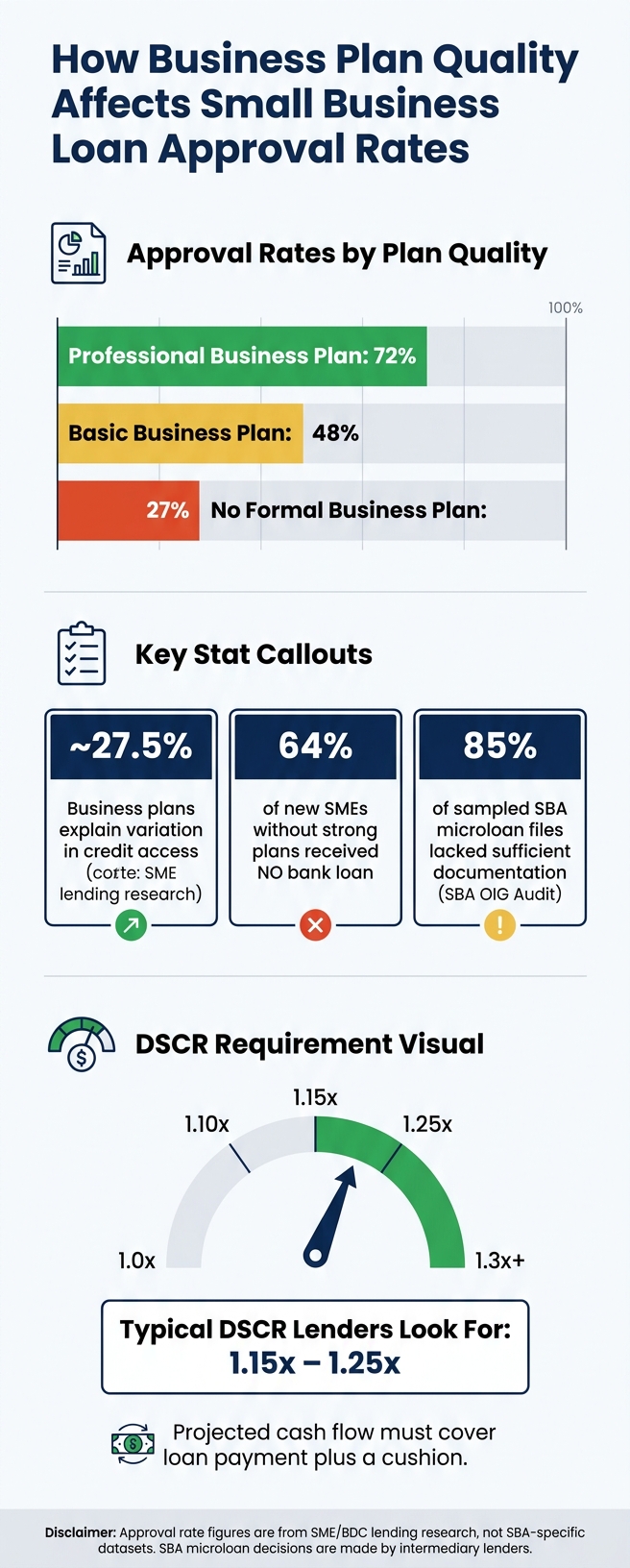
A few numbers stand out. Some non-SBA lending research cited in the article found rough financing rates of 72% for professional plans, 48% for basic plans, and 27% for no formal plan. The article also notes an SBA OIG audit finding that 85% of sampled microloan files lacked enough documentation to show they were originated and closed under SBA rules. That does not mean 85% were denied. It means paperwork problems were common.
If I were applying, my takeaway would be simple: focus less on making the plan long and more on making it clear, supported, and complete. That means a written plan, monthly projections, a plain use-of-funds breakdown, tax returns, bank statements, and numbers that line up from one document to the next.
| What the article answers | Short takeaway |
|---|---|
| Does SBA publish approval data by business plan quality? | No |
| Who decides approval? | Intermediary lenders |
| What matters most in review? | Plan quality, cash flow, file completeness |
| Is there proof from SBA-only data? | No direct SBA dataset |
| What does outside research suggest? | Written, well-supported plans tend to get better lending outcomes |
So the core message is simple: there’s no public SBA formula for business plan approval, but better-prepared applications tend to move through underwriting with fewer problems.
3 "Don’ts" When Writing a Business Plan for an SBA Loan
sbb-itb-1eb586e
SBA Microloan Program Basics and Why Documentation Matters
The SBA funds nonprofit intermediary lenders, but those lenders make the actual approval call. In plain English: there isn’t one master federal checklist that decides every microloan.
Each intermediary can set its own documentation rules, credit standards, and review process, as long as it stays within SBA program rules and uses prudent lending practices. That freedom leads to a lot of variation. Federal oversight reports have repeatedly pointed out that underwriting and documentation standards differ across the program. So when you apply, the lender’s review of your file often matters more than any single SBA form.
What SBA Guidance Says About Business Plans and Projections
SBA guidance tells borrowers to bring a written business plan, a use-of-funds statement, detailed startup or operating costs, and multi-year financial projections. SBA planning materials also recommend forecasted income statements, balance sheets, cash-flow statements, and capital expenditure budgets. These documents help lenders judge whether the business can repay the loan.
For startups, cash flow is the main source of repayment. That’s why lenders often want at least 12 months of monthly cash-flow forecasts with clear assumptions. The SBA does not set a fixed page count or a required template for microloan business plans, but it does expect the numbers to support the story. Those projections go straight into the intermediary’s ability-to-repay review.
What Intermediary Lenders Typically Review
Requirements change from lender to lender, but most microloan intermediaries look at the same core areas:
- Business purpose and use of proceeds
- Owner background and experience
- Credit history
- Ability to repay from cash flow
- Collateral
- Whether the application file is complete enough to underwrite
A typical intermediary checklist includes a business plan, a use-of-funds statement, 12 to 24 months of cash-flow projections, and the assumptions behind those numbers. Lenders also often ask for owner resumes and personal tax returns for the past two to three years.
Because lender rules differ, a complete file can make the difference between an application that moves forward and one that stalls out. A clear business plan, a line-by-line expense breakdown, and realistic projections often give the lender enough to underwrite the deal. That’s why plan quality matters more than format by itself.
What Research Says About Business Plan Quality and Approval Likelihood
Business Plan Quality vs. Loan Approval Rates: SBA Microloan Insights
There’s no SBA-only formula that tells you exactly how much a business plan shifts microloan approval odds. But across SME and microfinance research, the pattern is pretty clear: written business plans are linked to better approval odds and larger loan amounts. The catch is that most of this evidence is correlational, not causal. Even so, it matters because lenders often treat the plan as proof that the business can repay the loan.
Written Plan vs. No Written Plan
Small-business lending research keeps pointing in the same direction: firms with written business plans are more likely to get credit than firms without them. One SME study found that the business plan explained about 27.5% of the variation in credit access, ahead of collateral, financial reporting quality, and owner qualifications. Another found that 64% of new SMEs without strong plans received no bank loan, with weak business plans named as a main reason for rejection.
A lender-focused analysis based on BDC data put it even more plainly. It estimated that businesses with a written plan were 30% to 60% more likely to secure financing, with rough approval rates of:
- 72% for professional plans
- 48% for basic plans
- 27% for no formal plan
That said, these numbers come from other lending settings, not SBA microloan portfolios. So the safest read is this: a written plan can change how lenders see an application in a meaningful way.
Why Plan Quality Matters More Than Plan Length
Lenders usually start with one simple issue: Can this loan be repaid? They want to know how much money you’re asking for, what you’ll use it for, and how repayment will happen.
From there, underwriters look for solid assumptions behind the numbers. That includes a market analysis that makes sense, clear risks and ways to deal with them, and consistency between the written story and the financials. If the narrative says one thing but the projections say another, that’s a problem. The same goes for vague forecasts or round-number estimates. Those tend to signal that the borrower hasn’t fully worked through the model.
A shorter plan with sharp assumptions will usually beat a longer one filled with weak projections. In plain English: clarity beats bulk.
Limits of the Available Evidence
There’s an important limit here. Public SBA microloan data do not break out business-plan quality, projection realism, or document completeness as separate measured fields. SBA reports include basic loan data, but they do not give a standard score for whether a borrower submitted a written plan or how strong that plan was.
So any claim about business plan quality and SBA microloan approval is, by nature, an extrapolation from broader SME lending research and lender guidance, not an SBA-specific math formula.
For SBA microloans, that means lenders will usually lean toward written plans that are accurate, internally consistent, and easy to verify. Those same traits come up again when lenders review cash-flow projections and check whether the file is complete.
Financial Projections and Complete Files in SBA Microloan Reviews
Cash flow and paperwork often decide whether a good plan makes it through underwriting. Once the story makes sense, lenders turn to the numbers and the file behind it.
Cash-Flow Projections and Ability-to-Repay Analysis
When comparing SBA microloans vs bank loans, cash flow is the main source of repayment for the SBA option. So in practice, the projection does a lot of the heavy lifting.
Intermediary lenders usually want monthly cash-flow projections for at least the first 12 months, and often 24 months. Those projections should show revenue, cost of goods sold, gross margin, operating expenses, and net operating cash flow. For startups or business acquisitions, lenders often want to see cash flow turn positive within two years, with month-by-month detail for year 1 and, when needed, year 2.
Many lenders also look for a DSCR of at least 1.15x to 1.25x. Put simply, projected cash flow needs to cover the loan payment and still leave some cushion.
The strongest projections connect the loan directly to repayment. Show how the funds will increase revenue or lower costs, then build in a monthly loan payment that the business can support.
What tends to slow things down? A few patterns come up again and again:
- Revenue jumps with no clear reason
- Expense cuts that aren’t explained
- Margins far above normal industry ranges
- Projections that don’t match tax returns or bank statements
If your tax returns show flat or falling revenue, but your projection assumes strong growth right away, expect follow-up questions. In some cases, the lender may also use more cautious underwriting assumptions.
Complete Documentation and Review Outcomes
A complete file gives the lender what they need to run the full credit review without stopping to hunt down missing items. When the file is incomplete, delays become more likely. Some applications are paused or declined because there isn’t enough information to support a credit decision.
The same logic applies to every document in the file: each one should back up the repayment story. Along with the business plan and projections, lenders usually ask for three years of business and personal tax returns for owners with 20% or more equity, a current year-to-date profit and loss statement and balance sheet, recent bank statements, lease or site records, collateral details, and use-of-funds support like vendor quotes or purchase contracts.
Complete files matter after closing too. Intermediaries use the original projections and business plan as a benchmark when they compare actual results with what was expected. They also use use-of-funds records to confirm that loan proceeds were spent as agreed.
Document Type and Its Role in the Review Process
Different documents matter in different ways, depending on the stage of review. Here’s how the main pieces of the file usually function during screening and underwriting.
| Document | Role in Approval Review | Impact on Underwriting Speed |
|---|---|---|
| Business Plan | Main blueprint showing the business model, loan purpose, and growth strategy | High; a clear, organized plan cuts down on follow-up questions |
| Cash-Flow Projections | Main tool for DSCR analysis and ability-to-repay review | Critical; must match the monthly payment schedule |
| Tax Records | Confirms past income, expenses, and tax compliance | Moderate; gives a checked baseline for projection assumptions |
| Financial Statements | Shows current assets, liabilities, and operating results | Moderate; should reconcile with tax returns to avoid inconsistency flags |
| Bank Statements | Confirms actual cash-flow patterns and deposit regularity | High; used to compare projection assumptions with day-to-day activity |
| Use-of-Funds Documentation | Shows that loan proceeds tie to specific business needs | High; helps avoid delays by linking capital to defined expenses |
When the plan, projections, and records line up, underwriting usually moves with fewer interruptions.
Key Takeaways for Reading SBA Microloan Approval Data
What the Evidence Most Consistently Supports
Once you look at how lenders review files and check documents, one point stands out: the clearest signals don’t come from one national dataset. They come from lender guidance, program audits, and small-business lending research.
Across those sources, the same three patterns show up again and again. A structured, credible business plan helps lenders feel more comfortable moving forward. Realistic projections help show repayment ability, and many lenders look for a DSCR of about 1.15 to 1.25. A complete file also matters more than it may seem. An SBA Office of Inspector General audit found that 85% of sampled microloan files did not include enough documentation to show they were originated and closed under SBA requirements.
For borrowers with thin credit files, this matters even more. If credit history leaves gaps, a clean file and a convincing plan often do the heavy lifting. They give the lender something concrete to review instead of guesswork. SBA50K helps applicants prepare SBA-aligned business plans and organize loan files.
The pattern across the evidence is pretty clear: better preparation cuts down underwriting friction.
Summary of the Article’s Main Points
Put together, the main takeaway for applicants is straightforward: SBA microloan approval decisions are made mainly by local intermediary lenders, not by the SBA directly. In practice, approval turns on intermediary underwriting, not one SBA scoring rule.
The evidence also points in the same direction on outcomes. Applicants tend to do better when they come in prepared. A structured business plan, defensible cash-flow projections, and a complete application package make it easier for lenders to judge repayment ability and move through underwriting with fewer follow-up requests. That is the most dependable takeaway from the evidence available.
FAQs
How do lenders judge plan quality?
Lenders read your business plan as a signal. It shows whether you’re ready to run the business, understand the market, and have a handle on risk.
They want a plan that is clear, professional, well organized, and free of mistakes. They also look for realistic financial projections, a specific use for the funds, and a solid understanding of your customers and competitors.
Honesty matters too. If you clearly spell out risks and challenges instead of glossing over them, that can make your application stronger.
What documents are most often missing?
Applicants often send in a package that’s missing key paperwork. And that can slow things down fast.
The items lenders most often don’t get are:
- Personal and business tax returns from the past 2–3 years
- Recent bank statements from the last 3–6 months
- Current profit and loss statements or balance sheets
Some lenders also ask for a 12-month cash flow projection, a summary of current debts, and a clear breakdown of how you plan to use the loan funds.
What makes cash-flow projections look realistic?
Realistic cash-flow projections show that you understand how money moves through your business. Lenders want to see enough income to cover day-to-day costs and the new loan payment, with a debt-service coverage ratio of about 1.15 to 1.25.
If your business is seasonal, spell that out with month-by-month projections for both busy and slow periods. Back those numbers up with bank statements and profit-and-loss reports. Stick with conservative estimates based on normal performance, not best-case scenarios.

Leave a Reply