
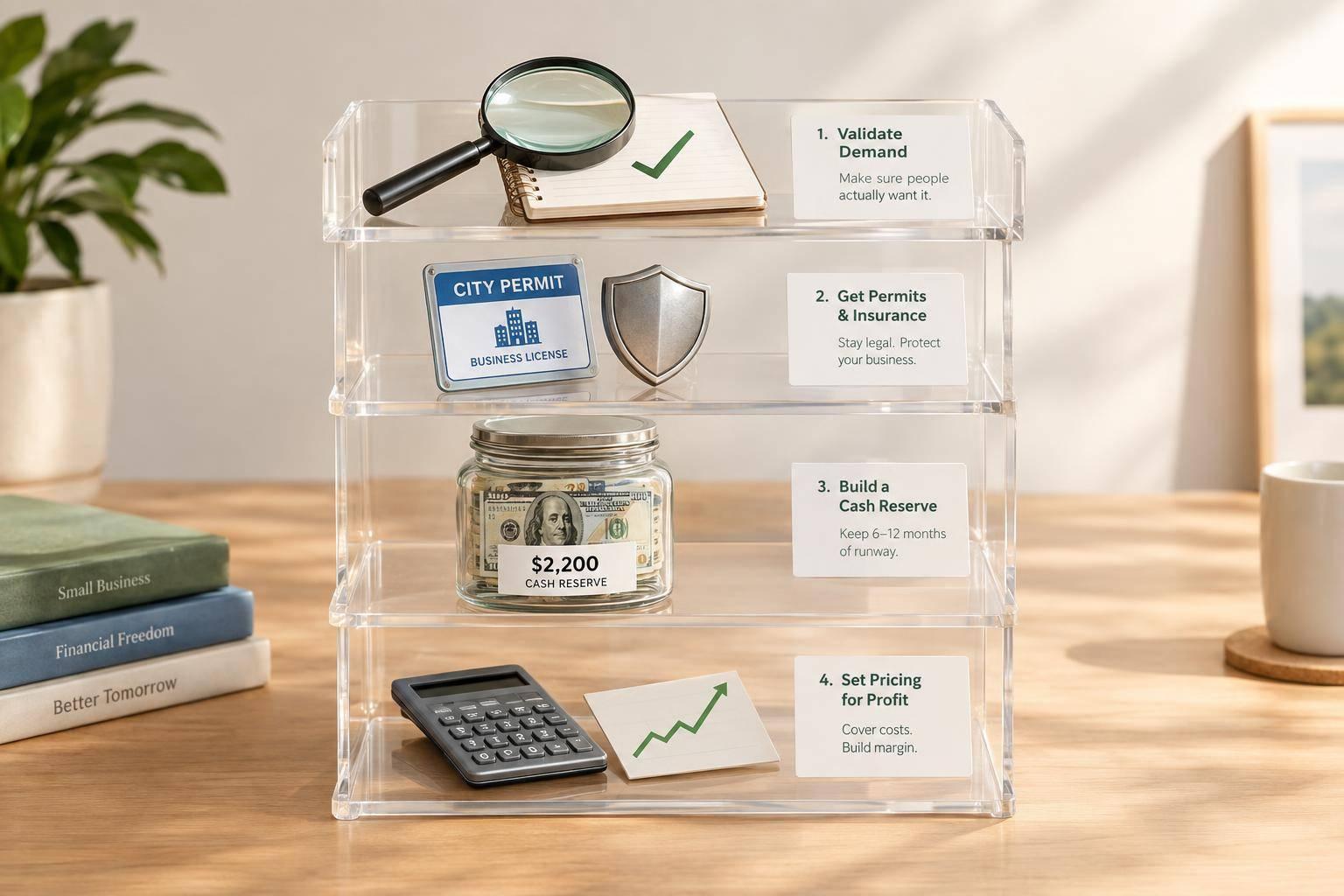
With $5,000, I’d start a service business using skills and equipment I already have – not spend the whole budget on gear. I’d compare residential cleaning, freelancing, and mobile car detailing, then test whether customers will book before buying supplies.
My plan would be simple:
- Check demand: Offer one service to one customer group at a clear price.
- Handle the paperwork: Confirm local requirements, get insurance, and separate business finances before taking paid work.
- Protect cash: The sample cleaning budget keeps $2,200 – 44% of the total – as a reserve, assuming I already own a vehicle and phone.
- Price for profit: Calculate jobs needed to cover monthly costs, then account for owner pay, taxes, and startup spending.
- Find customers: Follow up on quotes, ask for referrals, and track which jobs make money.
My rule: <u>buy only what booked jobs require</u>. I’d reinvest profits when a purchase solves a clear problem – not use my reserve to expand.
Don’t Start a Business Until You Have $5,000 and This Plan
sbb-itb-1eb586e
2. Handle Registration, Insurance, and Records
Once you have proof of demand, get compliance in place before spending on equipment.
Check Registration and Permit Requirements
Choose your business structure. Then check name availability, DBA requirements, licenses, and permits with your state, city, or county offices before accepting paid work. Add every confirmed fee to your $5,000 budget.
Get an Employer Identification Number (EIN) if your business structure or tax setup requires one.
Separate Business Finances and Get Insurance
Open a separate business bank account for customer payments and business purchases. Before booking work, review general liability insurance for service work, professional liability insurance for freelance work, and commercial auto or business-use coverage if you drive for jobs.
Track income, expenses, receipts, invoices, and taxes from day one. These records show what customers owe, what you’ve collected, and where your cash flow stands. Insurance protects the business; records help you keep tabs on the cash.
Keep one compliance checklist for renewals, insurance payments, and recordkeeping. Include both upfront and recurring compliance costs when building your $5,000 budget – before buying equipment.
3. Plan Your $5,000 Budget and Cash Reserve
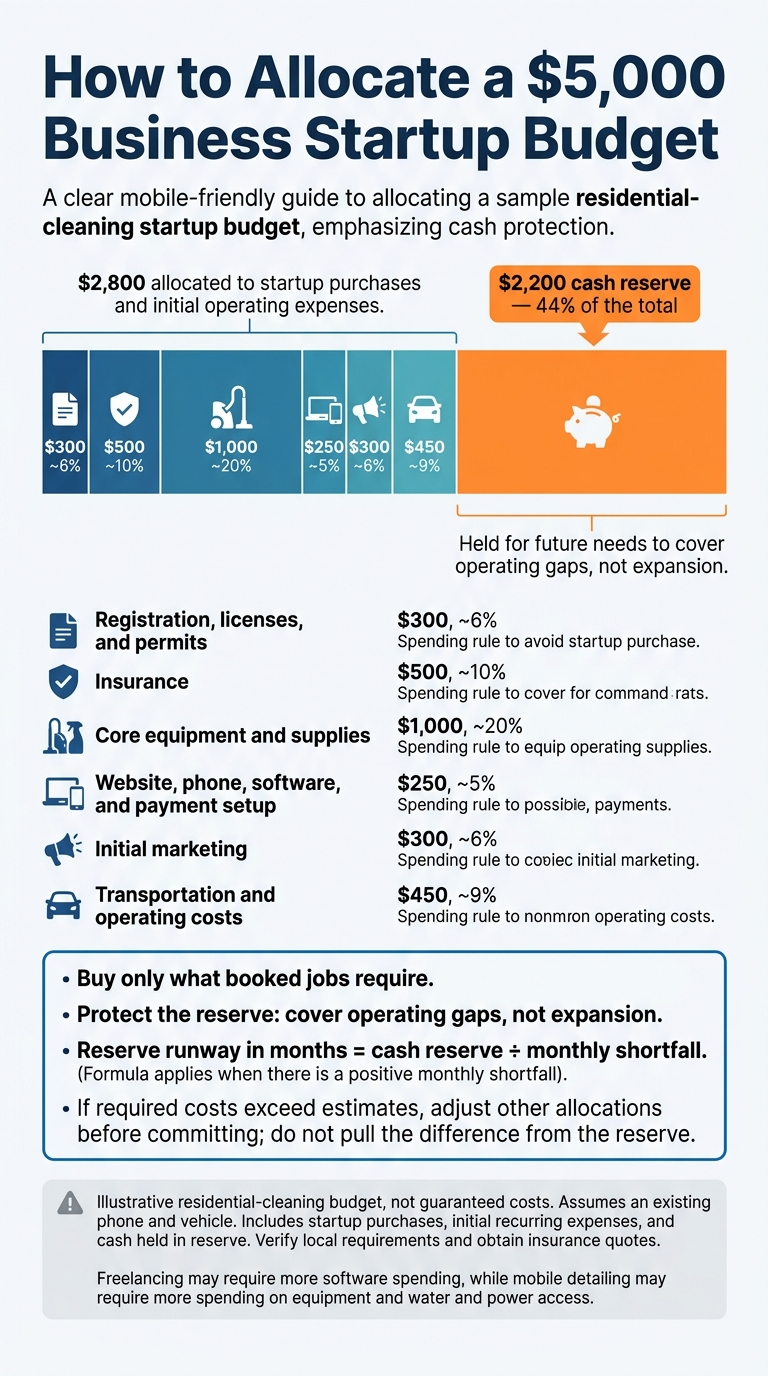
How to Allocate a $5,000 Business Startup Budget
Once you know your compliance costs, give every dollar a job before buying equipment.
Build a Budget That Totals $5,000
Use this sample budget to plan your first service, then adjust the allocations to fit your business.
This residential-cleaning budget assumes you already have a phone. These planning estimates cover startup purchases, initial recurring expenses, and money set aside as a reserve.
Category Allocation Timing Spending rule Registration, licenses, and permits $300 Initial; renewals may apply Verify required costs locally Insurance $500 Initial payment; recurring Get quotes before committing Core equipment and supplies $1,000 Initial; supplies recur Buy only what the first booked jobs require Website, phone, software, and payment setup $250 Setup and recurring use Use basic tools; transaction fees are separate Initial marketing $300 Initial; optional later spending Test marketing in small amounts first Transportation and operating costs $450 Recurring Assumes an existing vehicle Cash reserve $2,200 Held for future needs Cover operating gaps, not expansion Total $5,000
Treat this as your starting point. Freelancing may need more money for software, while detailing may need more for water and power access.
To estimate how many months your reserve will last, divide the cash reserve by your monthly shortfall.
Adjust Costs Without Exceeding $5,000
Trim optional spending – not safety, required coverage, or quality. Buy equipment for the first booked jobs and test marketing with small amounts. Office space, extensive branding, bulk inventory, and custom vehicle graphics can wait.
If required costs come in above your estimates, adjust the other allocations before you commit. Don’t pull the difference from your reserve.
For freelancing, use computer equipment you already own. For mobile detailing, put required equipment, water and power access, and compliance first.
4. Set Prices and Sales Targets
Use the fixed costs in your $5,000 budget to set a break-even target. This target shows whether your business can cover its costs before the $5,000 runs out.
Revenue is the money customers pay you before expenses. Variable costs increase with each job, such as supplies, fuel, and fees. Fixed costs, such as insurance and software, stay the same even when bookings slow. The amount left from each job after variable costs – called contribution margin – helps cover fixed costs and recover startup spending.
Calculate Jobs Needed to Break Even
Break-even jobs = monthly fixed costs ÷ profit per job after variable costs.
This calculation tells you how many jobs you need to cover monthly fixed costs. It doesn’t include owner pay, taxes, or startup recovery.
Set Weekly Sales and Cash Goals
Once you know your break-even number, use it to build a monthly sales target. Include your owner pay goal, tax set-asides, and the amount of startup spending you want to recover.
Recover startup spending from profit, not reserve cash. Divide your monthly sales target into weekly goals, then check cash each week to make sure customer payments cover costs. If sales fall short, adjust your prices, costs, or number of jobs per week.
5. Find Customers and Reinvest Profits
With your break-even target set, focus on turning that goal into booked jobs.
Sell One Service to a Clear Customer Group
Start with one service for one customer group within your chosen low-overhead model. Each week, contact potential customers in that market, follow up on open quotes, and ask for referrals. Track inquiries, quotes, and paid bookings so you can see which efforts lead to sales.
Before each job, put the scope, price, payment terms, cancellation policy, and customer responsibilities in writing. After a successful job, ask for a review and one referral.
Review Sales Before Seeking Funding
Once inquiries are steady, check which channels bring in profitable bookings. Revenue alone doesn’t tell the whole story: account for job costs and the time you spend. Adjust pricing, scheduling, or targeting before spending more.
Reinvest only when a purchase solves a clear bottleneck – and leave your cash reserve intact.
Launch Checklist: Test Demand and Protect Cash
- Follow up on open quotes each week.
- Ask satisfied customers for a review and one referral.
- Review booking profitability before reinvesting.
FAQs
How can I test demand before registering my business?
Use market research to test your assumptions against data on your target market and competitor activity. Letters of intent or signed contracts from potential customers can show lenders that there’s real interest in your offer.
For a consumer product, reward-based crowdfunding can help test demand and build early interest. Base your estimates on market research – not gut feelings.
Can I start with $5,000 if I don’t own a vehicle?
Yes, you can start a business with $5,000 without owning a vehicle. Low-overhead options like freelance services or home-based e-commerce don’t need a vehicle as a primary asset.
If your business does need a vehicle, consider equipment financing that uses the vehicle itself as collateral. Put personal savings toward branding, website setup, or business registration to keep costs low and avoid borrowing for those expenses.
How do I price jobs to cover my own pay?
Add up your monthly fixed and variable costs, including your pay, taxes, and loan repayments. Then use a 12-month cash flow projection to set prices that keep revenue above those expenses – even in slower months, not just when business is at its best.
Lenders typically expect a debt service coverage ratio of 1.15 to 1.25. That means $1,150 to $1,250 in profit for every $1,000 in debt payments.
Leave a Reply