
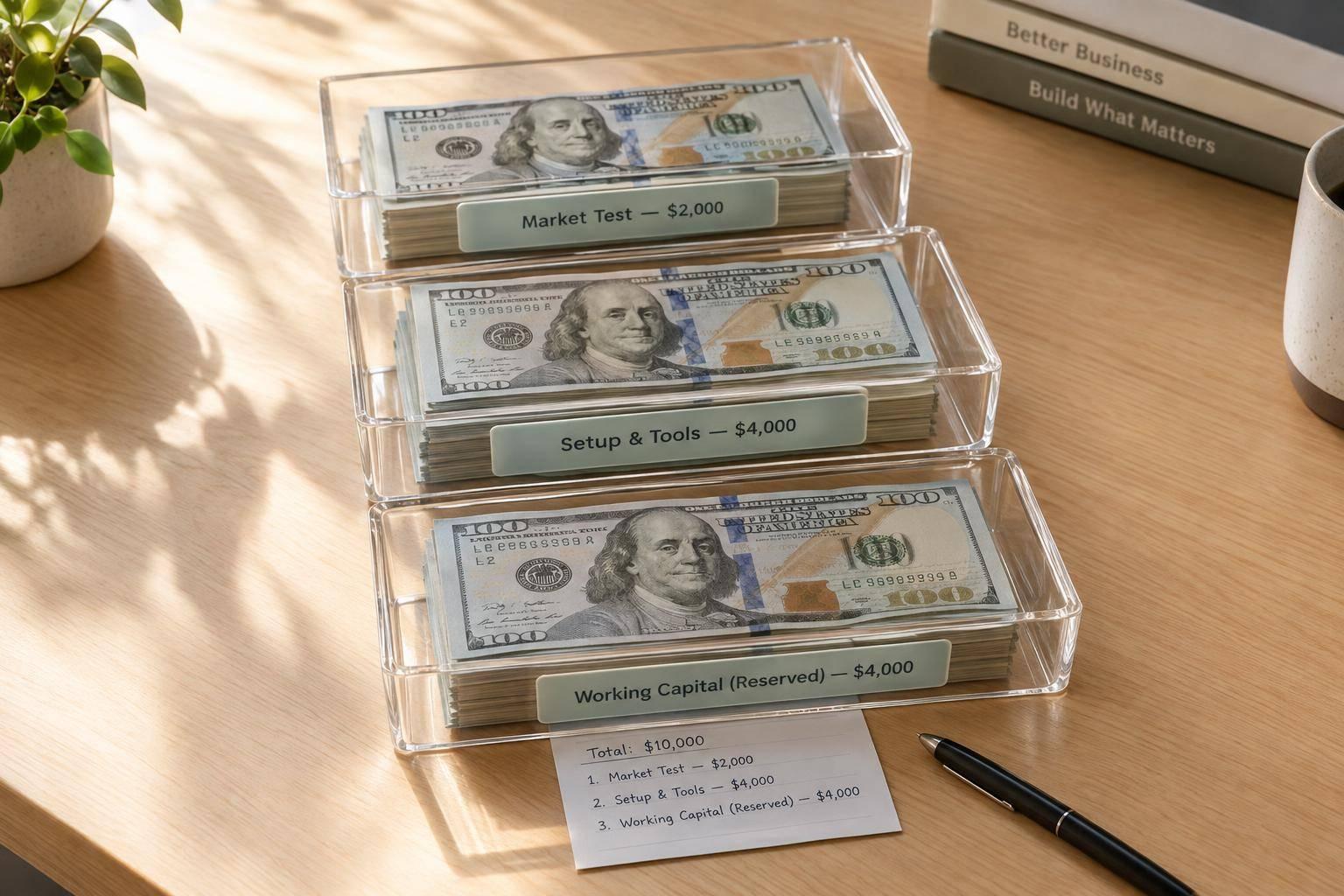
I’d start a business with $10,000 by testing a low-cost service before buying equipment – and keeping cash for bills. For example, spending $5,500 to launch leaves $4,500, or 45%, in reserve. Your costs and customer payment dates should guide that split.
Here’s the plan I’d follow:
- Choose a service: Cleaning, freelancing, mobile detailing, pet care, light property maintenance, or online services can fit the budget when you already have some skills or tools.
- Test the price: Use a small pilot to check what customers will pay, what each job costs, and how many jobs you need to cover monthly bills.
- Plan the cash: Get quotes, forecast three months of payments, and test whether you can handle insurance, fuel, and supply costs rising 20%.
- Set up before paid work: Check registration, permits, insurance, banking, taxes, and customer terms.
- Sell, then review: Track paying customers, marketing costs, and cash collected. Consider a microloan only for a defined gap you can repay – not to exceed the not to exceed the $10,000 plan.0,000 plan, or explore startup small business loan options if you need more capital.
My rule: <u>keep personal emergency savings separate</u>, buy only what you need, and let paid demand guide your next purchase.
How to Split a $10,000 Startup Budget
1. Choose a Business and Test Demand
Compare 6 Businesses You Can Start With $10,000
Start with a service business that uses skills, space at home, or a vehicle you already have. With a $10,000 budget, focus on businesses that need little inventory. Get actual quotes for equipment, registration, insurance, and marketing before spending money. Compare the options below to find one you can sell quickly without going over budget.
| Business | Primary requirements | Focus area |
|---|---|---|
| Residential cleaning | Basic supplies and an existing vehicle | Repeat bookings and routine tasks |
| Freelance bookkeeping, design, writing, or consulting | Computer and existing skills | Low overhead and home-based work |
| Mobile car detailing | Existing vehicle and portable gear | Fast payment and local demand |
| Dog walking and pet care | Minimal gear and local outreach | Low entry cost and repeat customers |
| Light property maintenance | Basic tools and an existing vehicle | Labor-heavy work and minimal inventory |
| Online services | Computer and specialized knowledge | High margins and no premises needed |
Check the requirements and payment terms for your service and location.
Test Your Offer Before Buying Equipment
Define exactly what you’ll sell, then test demand through interviews, local price research, direct outreach, and conditional reservations. Ask whether people would book at your stated price, not just whether they like the idea.
When possible, run a small pilot using equipment you already own. Track what customers paid, how long each job took, which supplies you used, how far you traveled, and when payment arrived.
Move ahead only if the pilot supports your price and launch costs leave enough working capital to keep the business running. Once you have real interest or paid test jobs, use those numbers to build your launch budget.
Set Prices and Monthly Sales Targets
Your prices need to cover supplies, travel, payment fees, overhead, taxes, and profit. Use these formulas to check the numbers:
Contribution per job = price minus variable cost per job. Monthly break-even jobs = fixed costs ÷ contribution per job.
With $600 in monthly fixed costs and $100 contribution per job, you need 6 jobs – before owner pay and income taxes.
Compare that sales target with your pilot results. Rule out any business that requires more jobs than you can deliver, and use the target to decide how much of your $10,000 to keep in reserve.
sbb-itb-1eb586e
If I Had $10,000 Today, This Is How I’d Turn It Into a Business
2. Plan Your $10,000 Startup Budget
For a low-inventory service business, give one-time costs, recurring bills, and cash reserves their own budget lines. Treat $10,000 as your limit – not a spending target.
Divide $10,000 Between Startup Costs and Cash Reserves
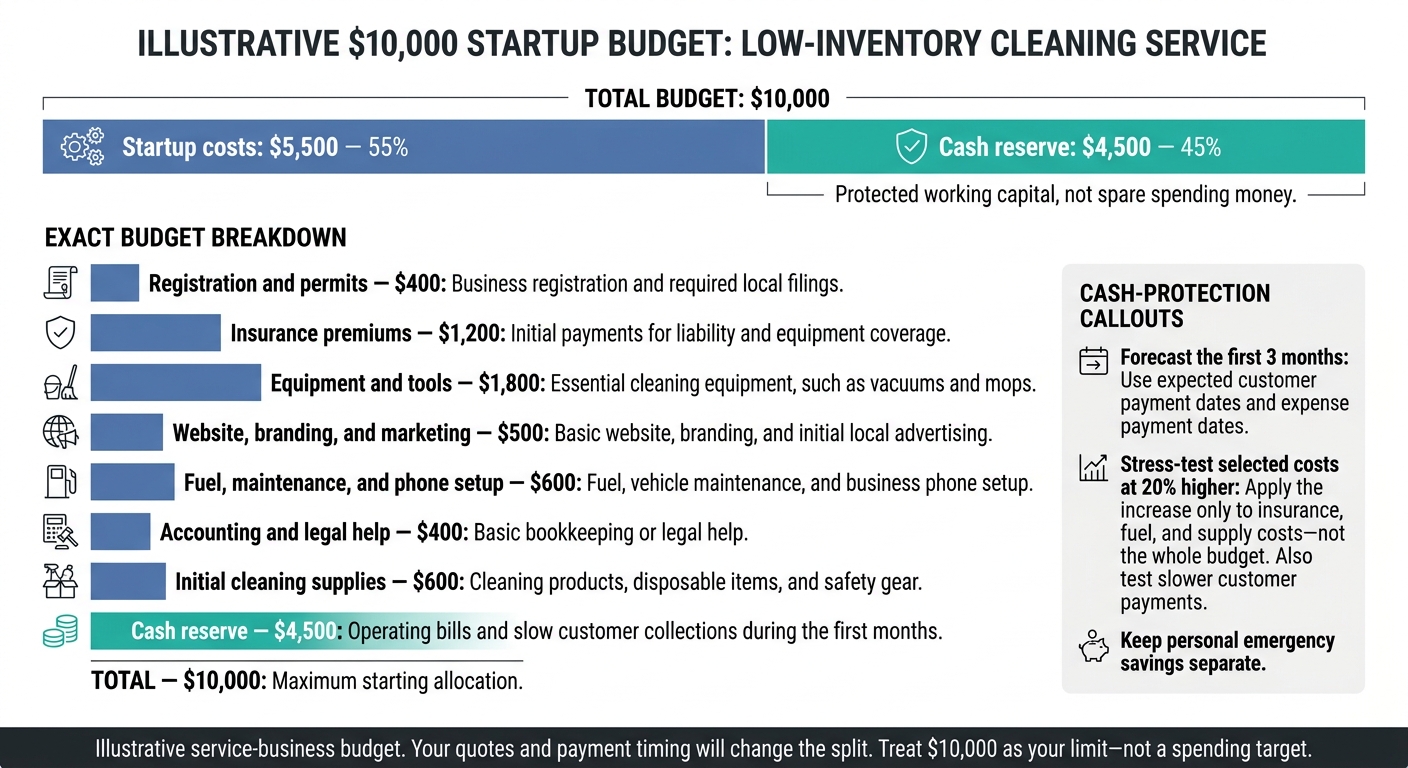
This sample service-business budget keeps $4,500 in reserve. Your quotes and payment timing will change the split.
Expense Allowance What it covers Registration and permits $400 Business registration and required local filings Insurance premiums $1,200 Initial payments for liability and equipment coverage Equipment and tools $1,800 Essential cleaning equipment, such as vacuums and mops Website, branding, and marketing $500 Basic website, branding, and initial local advertising Fuel, maintenance, and phone setup $600 Fuel, vehicle maintenance, and business phone setup Accounting and legal help $400 Basic bookkeeping or legal help Initial cleaning supplies $600 Cleaning products, disposable items, and safety gear Cash reserve $4,500 Operating bills and slow customer collections during the first months Total $10,000 Maximum starting allocation
Next, assign each expense a payment date so you can see how long your reserve will last.
Track Payment Dates and Protect Working Capital
Link each worksheet entry to a quote, invoice, or contract so you can trace every dollar. Keep one-time costs separate from recurring bills. After each payment, record the actual cost and update your remaining balance.
| Worksheet field | What to record |
|---|---|
| Expense | Specific item or service |
| Estimated cost | Quoted or budgeted amount |
| Payment date | Date cash will leave the account |
| One-time or recurring | Whether the payment repeats |
| Required or deferrable | Whether you need it to launch |
| Actual cost | Amount paid |
| Remaining balance | Cash left after the payment |
Forecast collections and payments for the first 3 months, using the dates you expect customers to pay. Buy tools as you need them, and put off optional upgrades. Keep your personal emergency fund outside the business budget.
Stress-Test Your Budget
Create a second forecast with insurance, fuel, and supply costs 20% higher, plus slower customer payments. Apply that increase only to those expenses – not the whole budget.
If cash runs short, delay optional upgrades and trim your launch plans before drawing on the reserve. If the budget still works under those conditions, move on to registration, insurance, and customer outreach.
3. Set Up Your Business, Find Customers, and Assess Funding
Once you’ve confirmed demand and set your budget, it’s time to register the business, meet legal requirements, and bring in customers.
Complete Legal, Insurance, and Financial Setup
Keep your launch within $10,000 by doing things in order: confirm demand, choose a business structure, register, secure licenses and permits, and get insurance. Then open a business bank account, set up bookkeeping, and write your customer terms. Buy only the equipment you need that’s already in your budget before taking paid jobs.
A sole proprietorship offers simplicity, while an LLC separates business and personal liability. Check state and local requirements, and review tax, administrative, and property-damage risks with a qualified legal or tax professional.
Ask a licensed insurance professional about general liability, business-use vehicle coverage, equipment coverage, and workers’ compensation if you’re hiring. Your written customer terms should spell out scope, exclusions, pricing, approval for extra work, payment dates, deposits, cancellations, access, damage reporting, and refunds.
Keep business and personal transactions separate. Save receipts, invoices, and mileage records. Get an EIN if required, and set aside money for taxes. Self-employed owners generally must make estimated federal tax payments if they expect to owe $1,000 or more when filing, subject to IRS rules.
Find Your First Customers and Track Results
Turn your tested offer into paid jobs by focusing on a narrow customer group and service area. Start with neighborhood outreach, referrals, and relationships with property managers or local businesses. Your website can be simple, but it should explain your services, where you work, how to request a quote, and how to book. Offer a limited paid trial with a clear scope and end date.
Review leads, sales, and cash collected each week. Track these three metrics:
- Conversion rate: paying customers ÷ qualified leads.
- Customer acquisition cost: marketing and sales spending ÷ new customers.
- Average transaction value: sales ÷ completed jobs.
Put your effort into channels that bring in profitable, paid jobs – not just inquiries. If sales are coming in but one required purchase leaves a cash gap, consider financing only for that gap.
Consider an SBA Microloan for a Defined Funding Gap
Use financing only when a specific approved expense exceeds your remaining cash. The loan should replace part of your cash contribution, not push your total budget above $10,000.
SBA Microloans offer up to $50,000 through approved nonprofit lenders. Eligible uses include working capital, inventory, supplies, furniture, fixtures, machinery, and equipment – not real estate or repayment of existing debt. SBA lists typical interest rates of 8%–13%, with repayment terms of up to seven years. The lender sets eligibility requirements and actual terms.
| Factor | Owner cash | SBA Microloan |
|---|---|---|
| Uses | Registration, insurance, required equipment, initial marketing, and cash reserve | Approved working-capital and equipment needs |
| Repayment | No scheduled loan payment | Principal, interest, and applicable fees |
| Risks | Personal savings are exposed | Payments reduce cash flow; collateral or personal guarantees may be required |
To apply for the remaining gap, prepare a business plan, an itemized use-of-funds budget, financial information, projections, proof of demand, registration and insurance records, and details of your relevant experience.
Check credit requirements, permitted uses, fees, collateral, guarantees, repayment terms, and funding timing directly with the lender. Don’t count on the money before it’s disbursed. Borrow only if projected cash collections can cover running costs, taxes, and loan payments during slower months.
Conclusion: Start Small and Keep Cash Available
Once you’ve tested demand and set your budget, start with just what you need. Choose one low-overhead service, get local quotes, and complete your $10,000 budget worksheet. Check legal and insurance requirements before taking paid work. Your cash reserve is working capital – not extra spending money.
Let cash flow guide expansion. Repeat sales need to cover operating costs while leaving enough cash for upcoming bills and other obligations.
If you still have a funding gap after cutting optional purchases, use a microloan checklist. Borrow only enough to close that gap, and keep your launch within the $10,000 limit.
FAQs
Can I start with $10,000 while keeping my job?
Yes, you can start a business with $10,000 while keeping your current job and running it part-time.
Choose a business with low startup costs that fits around your work schedule. Your paycheck can cover living expenses, leaving more of your $10,000 for equipment, licenses, and marketing – and a cash reserve to keep the business running.
How do I budget for paying myself?
Treat your pay as a fixed or variable expense in your monthly operating budget. Include wages, owner draws, and any applicable payroll taxes.
Build your pay into your 12-month cash flow projections to check whether you can cover it along with rent, loan payments, and inventory. Back up your numbers with personal tax filings or financial projections. Include these recurring costs in the working capital portion of your funding request.
When should I stop testing an unprofitable idea?
Stop testing when your monthly cash-flow forecast shows you don’t have enough cushion to cover obligations if sales come in late or fall short. Profit on paper doesn’t mean you have cash to pay the bills. A business can still fail when cash runs low, so base your forecasts on realistic expectations – not best-case scenarios.
If your projections leave no room for error or show you can’t make debt payments during slower periods, scale back the launch or drop the idea.
Leave a Reply