
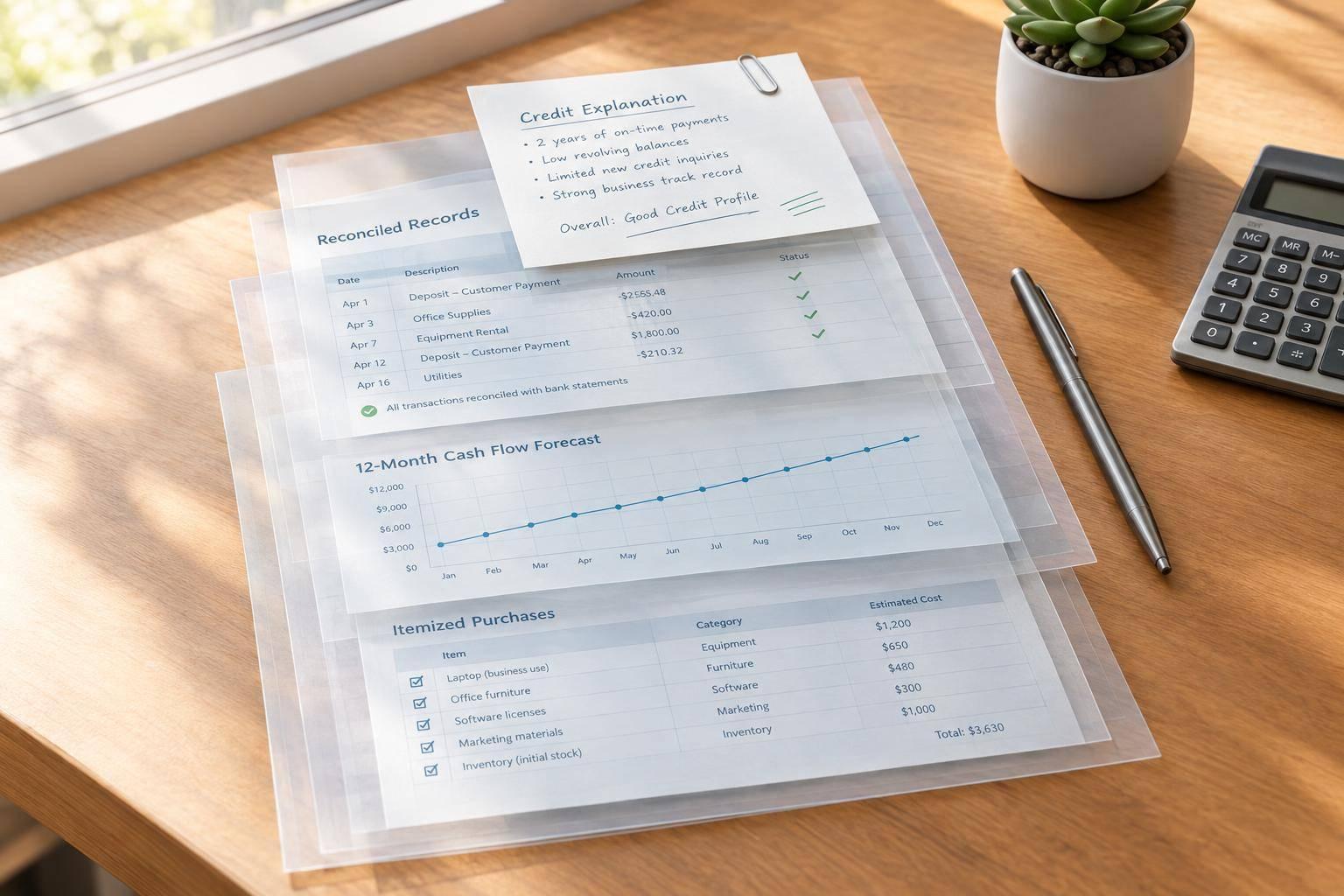
A stronger SBA microloan application shows exactly how much the business needs – and how it will repay it. For loans up to $50,000, start with the nonprofit intermediary lender’s checklist, itemize eligible expenses, and prepare a 12-month cash-flow forecast.
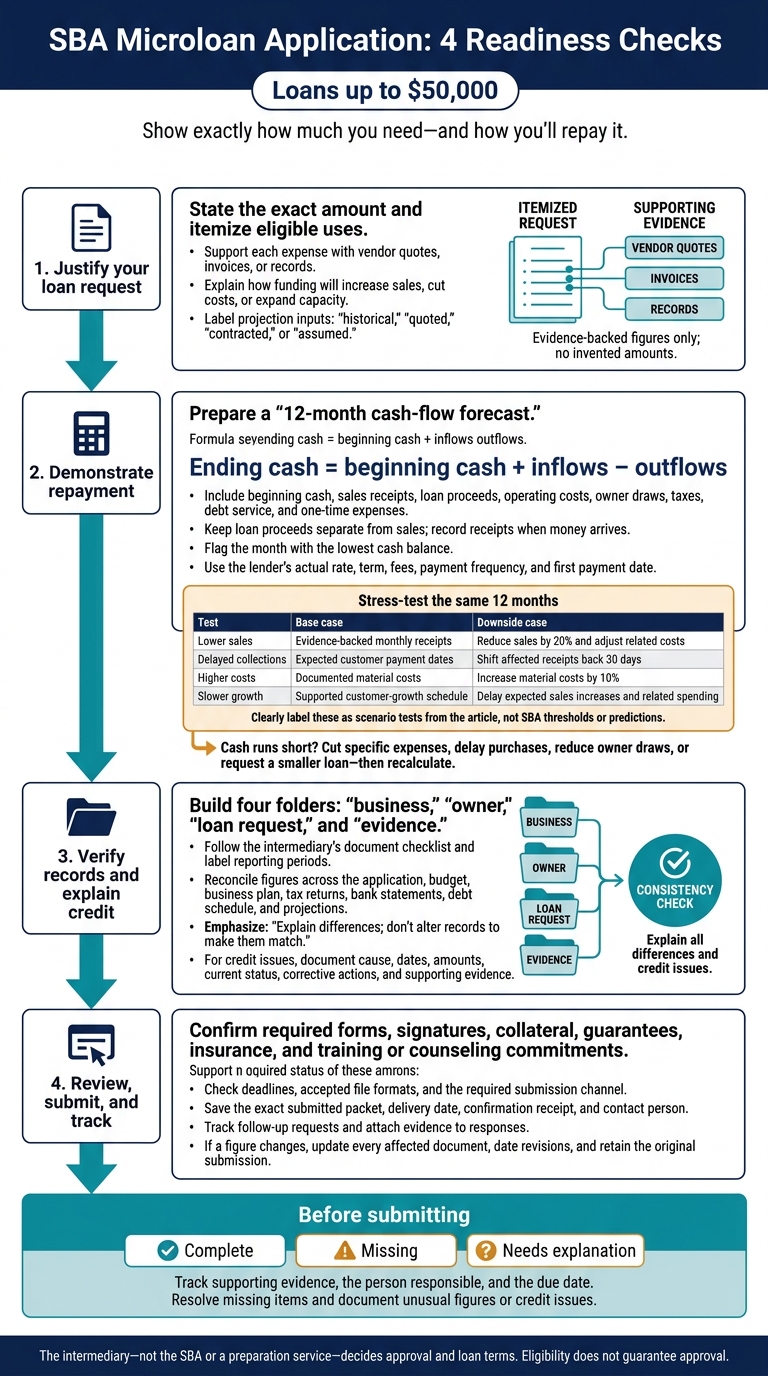
Build the application around four checks:
- Loan request: Support each expense with quotes or records.
- Repayment: Show monthly cash after expenses and loan payments. Test lower sales, late customer payments, and higher costs.
- Records and credit: Match figures across documents, explain gaps, and document credit problems and steps taken to resolve them.
- Submission: Confirm forms, signatures, collateral, guarantees, and training requirements. Save the submitted packet and track follow-up requests.
Application help can support preparation, but the intermediary – not the SBA or a preparation service – decides approval and loan terms.
SBA Microloan Application: 4 Readiness Checks
SBA Microloans: A Complete Guide for Startups and Small Businesses
sbb-itb-1eb586e
Step 1: Support Your Business Plan With Cash-Flow Projections
Show the lender how you’ll use the funding – and how your business will repay it – with numbers they can check.
Write a Business Plan That Answers Lender Questions
Explain your business model, customers, competition, pricing, marketing, operations, and ownership. Include the owner’s experience and investment. Show how the loan will increase sales, cut costs, or expand capacity. Each claim should help the lender assess the funding request and your ability to repay.
Label each projection as historical, quoted, contracted, or assumed. Back up demand with purchase orders, repeat orders, or documented sales conversations. Established businesses should base projections on past financial statements. Startups should provide the data behind their pricing, customer volume, and growth assumptions.
Use those assumptions to build your monthly cash-flow forecast.
Project Monthly Cash Flow and Loan Payments
Prepare a 12-month cash-flow forecast, then add annual projections for the period your intermediary requests. Show beginning cash and all inflows and outflows: sales receipts, loan proceeds, operating costs, owner draws, debt service, and one-time expenses. Keep loan proceeds separate from sales.
Calculate ending cash as beginning cash plus inflows minus outflows, and flag the month with the lowest cash balance.
Use the lender’s actual rate, term, fees, payment frequency, and first payment date. Record receipts when the money arrives – not when you send the invoice. Account for seasonal demand and collection delays, and check that your staffing, equipment, inventory, and production capacity can support projected sales. Explain how recurring business receipts will cover loan payments.
Next, test how the same forecast holds up when sales fall or costs climb.
Test Repayment Under Lower Sales and Higher Costs
Run downside cases for the same 12 months. For each case, show monthly receipts, expenses, debt payments, and ending cash. Make cash left after expenses and debt payments easy to see, and include taxes and owner draws.
If cash runs short, name the changes you’ll make: cut specific expenses, delay purchases, reduce owner draws, or request a smaller loan. Then recalculate the forecast rather than inflate sales estimates.
| Test | Base case | Downside case |
|---|---|---|
| Lower sales | Evidence-backed monthly receipts | Reduce sales by 20% and adjust related costs |
| Delayed collections | Expected customer payment dates | Shift affected receipts back 30 days |
| Higher costs | Documented material costs | Increase material costs by 10% |
| Slower growth | Supported customer-growth schedule | Delay expected sales increases and related spending |
Step 2: Organize Financial Records and Explain Credit Issues
Create a Labeled Document Folder
Use the intermediary’s checklist to build your packet. Each file should back up the numbers from Step 1 and the claims you made about cash flow and loan use.
Create four folders: business, owner, loan request, evidence. Gather the requested application packet, tax returns, financial statements, business and personal bank statements, debt schedule, registration, licenses, leases, ownership information, government-issued identification, collateral details, and vendor quotes.
Name files consistently and label each statement with its reporting period:
Business P&L – Jan. 1–Sept. 30, 2025
Use this table to track your records:
| Requirement | File name | Reporting period | Source | Purpose | Status | Explanation needed |
|---|---|---|---|---|---|---|
| Business bank statements | Business checking statements.pdf | April–September 2025 | Bank portal | Verify deposits and cash flow | Complete | No |
| Vendor quote | Equipment quote.pdf | Dated September 18, 2025 | Vendor | Support use of proceeds | Missing | Yes – request updated quote |
| Debt schedule | Debt schedule.xlsx | As of September 30, 2025 | Bookkeeper | Show existing obligations | Needs review | Explain remaining balance |
Check each document against the figures in your forecast.
Fill Record Gaps and Reconcile Figures
The lender should be able to trace every number through your records. Explain any differences, check that all pages are readable, and include every page – even those showing no activity. Make sure reporting periods meet the lender’s requirements.
Check that legal names, addresses, ownership percentages, tax identification details, dates, and signatures match across records. Reconcile monthly bank deposits with reported revenue, separating owner contributions, account transfers, sales tax, and collection timing differences.
Compare figures across the application, budget, plan, tax returns, statements, debt schedule, and projections. Explain differences; don’t alter records to make them match.
Attach a memo for unusual cash deposits, overdrafts, returned payments, or large one-time expenses. Include the date, amount, source or recipient, purpose, whether the item will recur, and records that verify it.
Next, address the credit issues the lender will see.
Document Credit Problems and Resolutions
List each credit issue, what caused it, its current status, and how you’ve addressed it. Review your personal and business credit reports and record the creditor, amount, and date for each issue.
For accurate negative entries, explain the cause, the fix, the current status, and steps to prevent it from happening again. Include payment histories, settlements, payoff confirmations, or payment arrangements.
For errors, identify the disputed account, explain what’s wrong, and request a correction. Include the relevant report pages and supporting records, such as paid bills or cleared checks. Send copies only. Keep the originals and proof of submission.
Check these details before submitting:
- Disputes: Creditor, bureau, date, confirmation number, evidence, and outcome.
- Taxes: Unpaid amounts, requested returns, payment arrangements, and payment evidence.
- Existing debt: Creditors, original and remaining balances, payments, maturity dates, collateral, and payment status.
- Collateral: Ownership, estimated value, liens, and verification records.
- Owners and guarantors: Legal names, ownership, contact information, identification, requested financial and debt details, and signatures.
If your credit history is limited, explain why. Provide records the lender can verify, such as on-time rent or vendor payments, consistent deposits, signed contracts, or owner capital contributions. Ask your intermediary which records it accepts or compare SBA microloans and bank loans to see if a different lender fits your profile better.
Before submitting, verify your totals, assumptions, and required forms.
Step 3: Review and Submit Your Application
Verify Totals, Assumptions, and Required Forms
Once your numbers reconcile and your records are complete, check the package against the intermediary’s current forms and instructions. Recalculate your request and confirm that total funding matches the project cost. Review ownership percentages, evidence supporting sales assumptions, and whether your assumptions, forecast periods, and payments support repayment. Projected payments must use the lender’s quoted rate, term, fees, payment frequency, and first-payment date – not an estimate.
Confirm all required signatures, certifications, collateral and personal-guarantee details, insurance, and training or counseling commitments. Ask the intermediary to clarify any unclear requirements before you submit. Check its deadline and accepted file formats, too. Eligibility does not guarantee approval; the intermediary still decides based on repayment ability.
Label your files to match the intermediary’s checklist and submit them through its required channel. Save the exact package, delivery date, confirmation receipt, and contact person. Answer follow-up requests in order, attach evidence to each response, and confirm whether anything remains outstanding. If a figure changes, update every affected document, date the revisions, and keep the original submission.
Use preparation help to improve your package – not to replace lender review.
Get Application Preparation Help From SBA50K
SBA50K can help organize documents, revise materials, and prepare responses to lender questions based on your intermediary’s requirements. Ask which documents, revisions, and follow-up support are included. Do not present SBA50K materials as SBA-approved; only the intermediary decides approval and terms.
Conclusion: Finish Your One-Page Application Checklist
Request only what you can justify and repay. Use this final check to spot gaps before your intermediary reviews the packet.
Track readiness across your funding request, cash flow, records, and credit explanations. Mark each row Complete, Missing, or Needs explanation. Add the supporting file or explanation, the person responsible, and the due date.
| Category | Required item | Status | Evidence or explanation | Owner | Due date |
|---|---|---|---|---|---|
| Funding request | State the exact amount, itemize its uses, and include vendor estimates or invoices tied to revenue or cost savings. | ____ | ____ | ____ | ____ |
| Business plan | Describe your customers, pricing, operations, management experience, and the problem the loan will solve. | ____ | ____ | ____ | ____ |
| Projections | Support monthly cash-flow assumptions with records. Confirm that cash stays positive after the proposed payment, even with lower sales and higher costs. | ____ | ____ | ____ | ____ |
| Financial records | Include all requested records, label them clearly, and explain any differences. | ____ | ____ | ____ | ____ |
| Credit explanations | Document each issue’s dates, amounts, status, supporting evidence, and corrective actions. | ____ | ____ | ____ | ____ |
| Intermediary requirements | Address your intermediary’s application, forms, credit criteria, collateral or guarantee rules, fees, and counseling requirements. | ____ | ____ | ____ | ____ |
| Final checks | Match totals across documents, complete all required fields, confirm that files open properly, and have a second reviewer check the package. | ____ | ____ | ____ | ____ |
Fix incomplete items before submitting, and set due dates for missing records. If a gap affects eligibility, repayment, or confidence in your application, ask the intermediary for guidance or reduce the request to an amount your records support. Submit only when every item is complete and every unusual figure or credit issue has a written explanation.
FAQs
Can I qualify for an SBA microloan with bad credit?
You may qualify with bad or limited credit if your business meets SBA eligibility requirements and your application shows you can repay the loan. The nonprofit intermediary lender makes the decision.
Build your application around cash-flow projections, an SBA-compliant business plan, organized documents, and a brief explanation of your credit issues. Show how you’ll use the funds for eligible expenses – not real estate or debt refinancing.
Collateral or a co-signer may help. Aim for a debt service coverage ratio (DSCR) of at least 1.15, meaning $1.15 in income available for debt payments for every $1 owed.
How can I prove repayment ability as a startup?
If you don’t have historical results, use conservative financial projections to show you can repay the loan. Build a month-by-month cash flow forecast for the next 12 months, and include the proposed loan payment. Support your assumptions with signed contracts, customer interviews, supplier quotes, or pricing research.
Calculate your debt service coverage ratio (DSCR), aiming for at least 1.15x. Then test revenue at 10%–20% below your forecast to see whether you can still make payments.
What if I have no collateral?
You may qualify for an SBA microloan without collateral. Requirements depend on the nonprofit intermediary lender, loan amount, and your credit profile. Some smaller loans may be unsecured.
To strengthen your application, include a detailed business plan, cash-flow projections showing you can make payments, and a co-signer if possible. Contact your chosen lender early to confirm its collateral requirements.
Leave a Reply