

You can fund a U.S. startup without giving up ownership. I’d start by calculating the cash gap, setting a savings limit, and subtracting customer payments after fulfillment costs and taxes.
Here’s the funding path I’d follow:
- Savings and early sales: Use only cash you can spare, protect your household emergency fund, and accept orders you can deliver.
- SBA microloans: Borrow up to $50,000 through an approved intermediary if your cash flow can cover payments.
- Grants: Apply when your project fits the rules, but don’t budget around an award you haven’t received.
- Larger SBA loans: Compare 7(a) and 504 financing when you need more money, checking upfront costs, fees, collateral, and guarantees.
Before applying, I’d prepare a business plan, lender documents, and a monthly cash-flow forecast. SBA50K can help with preparation, but the lender decides whether to approve the loan.
My rule: <u>fund the smallest launch you can afford</u>, and test whether you can still pay the bills if sales arrive late.
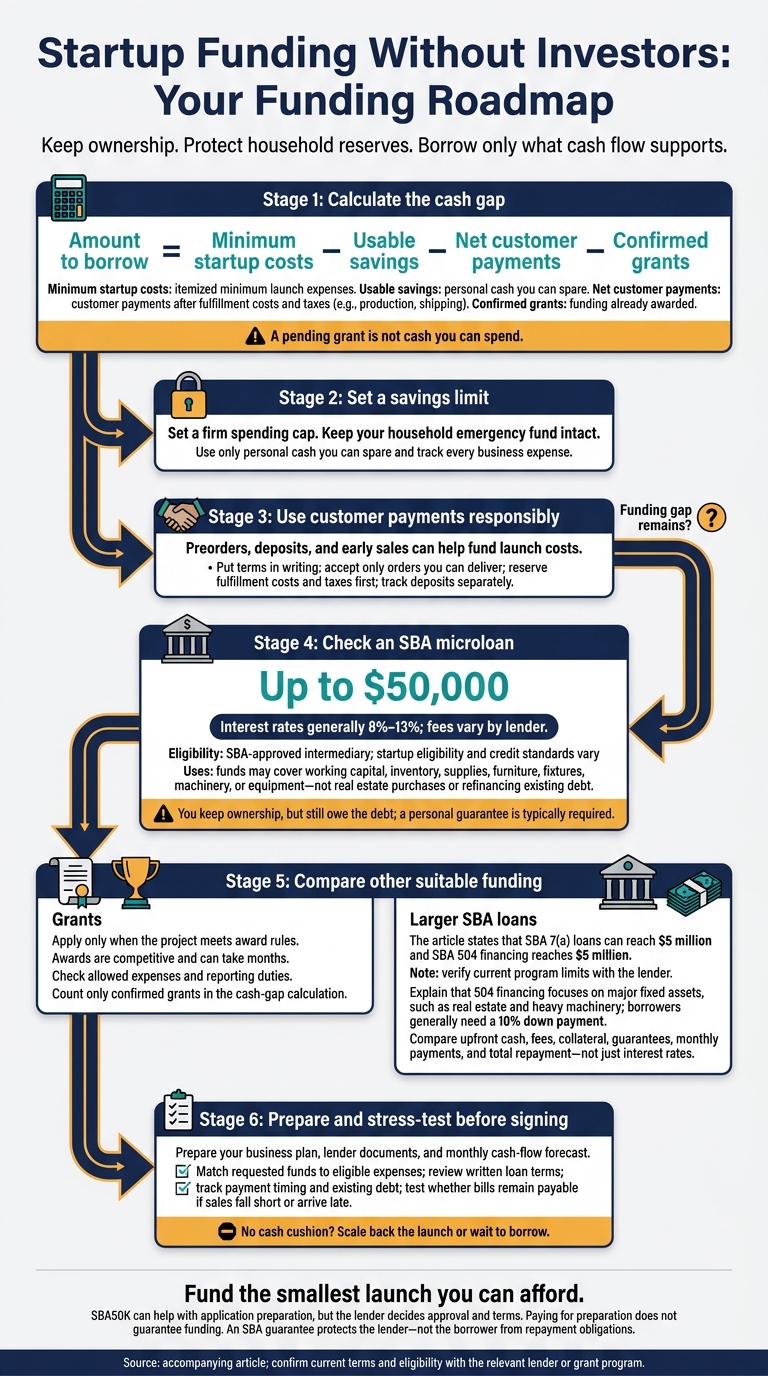
Startup Funding Without Investors: Your Funding Roadmap
Start With Savings and Customer Payments
Set a Limit on Personal Spending
Personal savings can cover early purchases, but set a firm spending cap that leaves your household emergency fund intact. Cover only the part of your funding gap you can afford to pay yourself.
Write down what the money will cover and track every business expense. If costs pass your cap, consider a microloan rather than taking more from household reserves.
Use Preorders, Deposits, and Early Sales
Accept preorders only when you can deliver the product or service on schedule. Before taking payment, put the terms in writing. Account for registration, licensing, and tax requirements, too – they affect how much cash you can use.
Customer payments aren’t all yours to spend. Treat them as restricted cash: set aside fulfillment costs and taxes first, then use what’s left for startup expenses. Track deposits separately so you know what you still owe customers.
Time deposits to match upfront costs. If a deposit won’t cover the early work, use another cash source. Take only as many orders as you can fulfill, and keep working capital available for spikes in demand.
If savings and customer payments leave a funding gap, look next at a low-cost loan option.
sbb-itb-1eb586e
SBA Microloans: A Complete Guide for Startups and Small Businesses
Apply for an SBA Microloan of Up to $50,000
If savings and customer payments leave a funding gap, an SBA microloan can help cover it without giving up equity.
Check Microloan Eligibility, Uses, and Costs
SBA microloans offer up to $50,000, and poor credit doesn’t automatically rule you out. Some intermediaries accept scores as low as 550, but each lender sets its own credit standards and checks your ability to repay. Your business must also meet SBA size and industry rules.
You can use the money for working capital, inventory, supplies, furniture, fixtures, machinery, or equipment – not real estate purchases or refinancing existing debt. Some lenders waive collateral for smaller loans, but they typically require a personal guarantee.
Interest rates generally range from 8% to 13%, with fees varying by lender. Repayment terms are generally up to six years, though equipment loans can run up to eight years. You keep ownership of your business, but you still owe the debt. Before signing, get the monthly payment, total repayment amount, fees, and any prepayment conditions in writing.
Follow the Microloan Application Steps
First, check that both the loan and lender fit your business. Review your location, business type, SBA size and industry rules, and the lender’s credit standards. Ask about collateral, personal guarantees, required documents, and training. Confirm that the intermediary funds startups.
Build your loan request around your startup budget and supplier quotes. Each dollar you request should cover an eligible expense. Then use the SBA website or a partner like SBA50K to find a local SBA-approved intermediary lender that serves your area.
Submit the records your intermediary requests, including your business plan, projections, tax returns, bank statements, licenses, and debt schedule. Be ready to explain your sales assumptions and owner experience, along with how the loan amount, payments, and repayment term fit your projected cash flow.
Before signing, check the interest rate, fees, payment dates, total repayment amount, guarantees, and any collateral you’re pledging.
Get Application Help From SBA50K
SBA50K can help organize your application, prepare your business plan and supporting documents, and connect you with local intermediary lenders. Before paying, ask which services your package includes and confirm its current price and scope.
SBA-approved intermediary lenders – not SBA50K – decide whether to approve your loan and set its terms. Paying for application preparation does not guarantee funding.
If a microloan still leaves a funding gap, compare grants and larger loans next.
Compare Funding Options
Match each funding option to your funding gap, timeline, and ability to repay. Rule out options that provide too little money, take too long, or carry more risk than you can accept.
| Funding option | How it works | Ownership impact | Suitable uses | Application effort | Funding speed | Primary risks |
|---|---|---|---|---|---|---|
| Personal savings | No repayment | No equity | Startup costs | Low | Immediate | Lost safety net |
| Customer preorders | Fulfill orders | No equity | Production | Moderate | Variable | Unfulfilled orders |
| Grants | No repayment if conditions are met | No equity | Award-approved projects | High | Often months | – |
| SBA microloans | Up to $50,000 | – | – | Moderate | 30–90 days | – |
| SBA 7(a) and 504 loans | Principal and interest payments | No equity | Larger purchases, real estate, and expansion | High | Longer | Personal guarantee and high debt load |
Check Grant Eligibility and Requirements
The SBA does not offer direct startup grants. It backs loans through intermediary lenders. Look for federal and private grant programs that fit your business, but apply only when your project meets the award rules and the timing works for you. Matching a grant’s theme does not guarantee funding.
Before applying, check the deadline, allowed expenses, and reporting duties. Prepare a project budget that explains exactly what the money will accomplish. A pending grant is not cash you can spend – awards are competitive and can take months.
If grants don’t fit your budget or timeline, look at loans with written terms.
Review Loans for Larger Funding Needs
If a microloan won’t cover your startup’s needs, compare SBA 7(a) and 504 loans against your cash flow. SBA 7(a) loans can reach $5 million. SBA 504 financing also reaches $5 million and focuses on major fixed assets, such as real estate and heavy machinery. Borrowers generally need a 10% down payment for 504 loans.
Ask whether your startup qualifies before completing a full application. Credit standards, collateral, guarantees, required documents, loan amounts, rates, fees, and terms vary. Compare written offers for how much cash you’ll need upfront, not just the interest rate. An SBA guarantee protects the lender; you still owe the debt if your business fails.
Review each offer’s monthly payment, total cost, and collateral requirements before choosing.
Choose a Funding Path You Can Afford
Match Funding to Your Credit and Cash Flow
After comparing your options, choose a funding mix that covers the gap with the least debt. Fund the smallest viable launch. Start with savings and customer payments. Borrow only what’s still needed, using the lowest-cost option your cash flow can support.
If your credit is limited or poor, review your credit reports and correct any errors. Show relevant industry experience and support your projections with conservative sales estimates. Intermediary lenders review your credit reports, tax returns, and income records. If cash flow won’t cover payments, request a smaller loan or wait to borrow.
Complete Your Funding Worksheet
Record these fields in dollars, using formatting such as $10,000:
Use the worksheet to check whether each funding mix leaves enough cash to make payments.
| Worksheet field | What to record |
|---|---|
| Minimum startup costs | Itemized launch expenses; note which qualify for your intended loan |
| Personal funds | Savings committed to the launch |
| Net customer payments | Expected payments minus production, shipping, and other fulfillment costs |
| Secured grants | Confirmed grants |
| Minimum startup costs minus usable savings, net customer payments, and confirmed grants | Amount to borrow |
| Monthly debt payments | Proposed loan payments plus existing debt payments |
| Monthly revenue needed | Sales needed to cover operating costs and debt service, accounting for sales margins |
| Cash left after launch and upcoming obligations | Remaining cash reserves |
Build a monthly cash-flow forecast alongside the worksheet. Track when customers pay, not just when sales happen. Test whether you’d still have enough cash for payments if sales fall short or arrive late. Keep a debt schedule listing existing and proposed obligations. If the forecast leaves no cushion, scale back the launch.
FAQs
Can I get a startup loan before making sales?
Yes. Banks often ask for years of business records and established cash flow. But the SBA Microloan program supports new entrepreneurs and startups, even without a long business history.
To qualify, you’ll need a solid business plan that explains your market, how you’ll run the business, and how you expect to make a profit. Lenders review your business idea, personal credit, and ability to repay – not just past revenue.
Can I combine grants with an SBA microloan?
Yes, you can use a grant alongside an SBA microloan to cover different business needs. Grants don’t need to be repaid, but competition can be tough. They’re also often restricted to certain industries or projects.
Put the grant toward costs it allows, and use the microloan for remaining expenses, such as working capital, inventory, equipment, or supplies. This combination can help you borrow less and put your business on firmer financial footing.
What happens if my startup can’t repay its loan?
If your startup defaults on an SBA-backed loan, the government pays the lender a portion of the loan – but you’re still responsible for repayment. To check whether you can repay, lenders review your business plan, cash flow projections, and financial statements.
To lower your repayment risk, set aside money for unexpected expenses. Keep your loan amount in line with your startup costs and projected revenue.
Leave a Reply