

You can get business funding with bad credit – but I’d start with what you can repay, not what you can borrow. Check your personal and business credit reports, fix errors, and calculate your funding need. SBA microloans offer up to $50,000, though each lender sets its own approval rules.
Here’s how I’d compare the options:
- Start with SBA microloans: Check allowed uses, collateral, and personal guarantees. SBA50K can help prepare documents, but it doesn’t guarantee approval.
- Compare other funding: Look at community lenders, equipment financing, crowdfunding, and invoice financing. Treat merchant cash advances as high risk.
- Prepare your application: Gather financial records, explain credit problems, and show how you’ll repay.
- Test each written offer: Compare fees, total repayment, payment dates, liens, and guarantees. Check whether payments still fit with 10%–20% lower sales and customer payments arriving 30 days late.
My bottom line: <u>Approval isn’t proof you can afford the funding.</u> Borrow only what your cash flow can support during slower months.
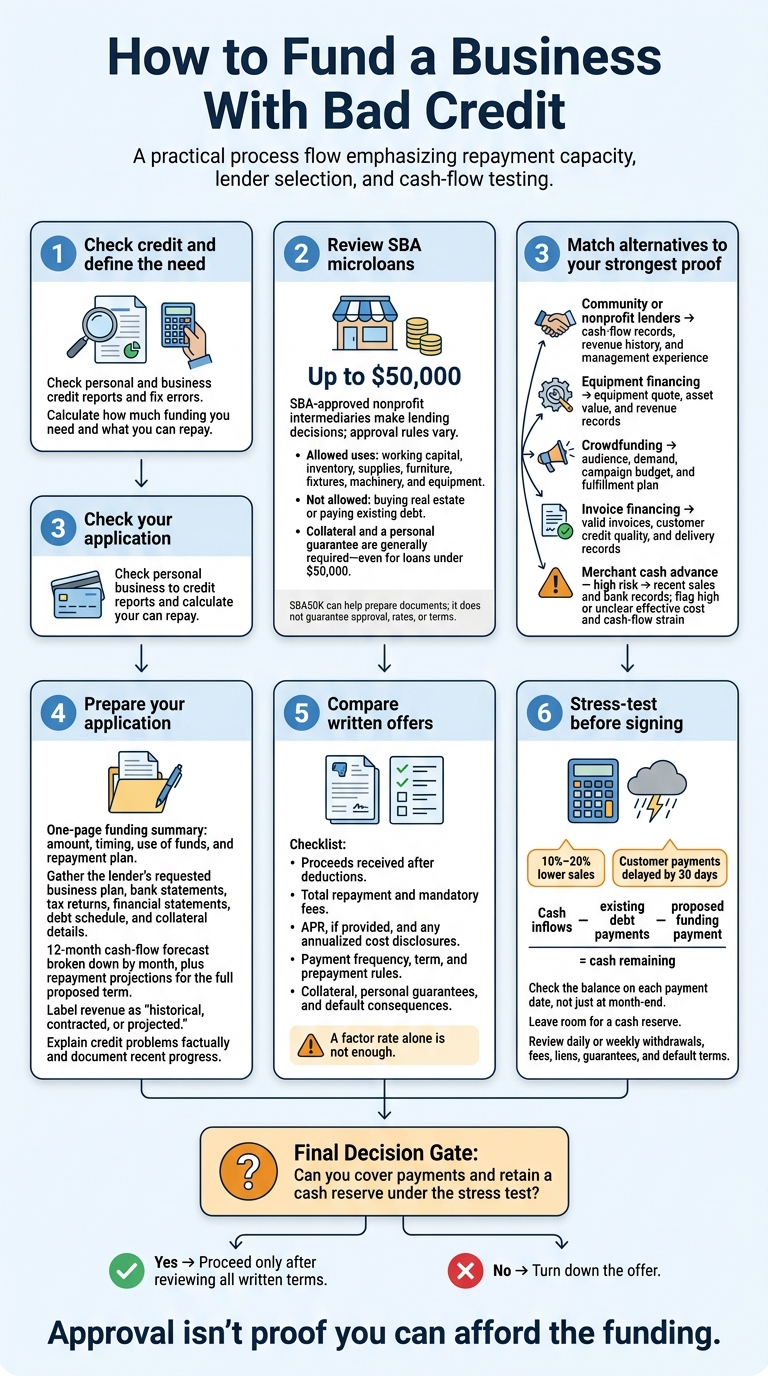
How to Fund a Business With Bad Credit
SBA Microloan Approval: What I’d do in 3 Situations #sbaloans #businessfunding #smallbusiness
sbb-itb-1eb586e
Start With SBA Microloans
If you need less than $50,000, SBA microloans are the next funding option to review. These loans provide up to $50,000 for smaller business needs. The SBA funds approved nonprofit intermediaries that issue and service the loans. Approval depends on the intermediary’s underwriting and assessment of your ability to repay.
Check Eligibility and Allowed Uses
U.S.-based, for-profit small businesses and certain nonprofit child-care centers generally qualify to apply. Startups may qualify, too. You can use the funds for working capital, inventory, supplies, furniture, fixtures, machinery, and equipment, but not to buy real estate or pay existing debt. Before applying, compare these program rules with the intermediary’s own checklist.
Check the Intermediary’s Loan Requirements
Ask an SBA-approved intermediary serving your area about its credit standards, startup eligibility, required documents, interest rate, fees, and any required business training. Each intermediary makes its own lending decisions and sets borrower terms within program rules.
Collateral and a personal guarantee are generally required – even for loans under $50,000. Ask which assets will secure the loan and which owners must guarantee repayment. A personal guarantee makes you personally liable if the business defaults. Confirm the repayment term in the intermediary’s written offer.
Prepare Application Documents With SBA50K
Use SBA50K to prepare your application, refine your business plan, and gather the required documents. It does not guarantee approval, rates, or terms.
Your application checklist should include:
- A business plan and an itemized breakdown of how you’ll use the loan
- Personal and business bank statements, plus requested tax returns
- A profit-and-loss statement, balance sheet, and debt schedule
- Historical cash-flow records and projections
- Collateral details and ownership documents
- A clear explanation of credit problems and the steps you’ve taken to address them
Match your application package to the intermediary’s checklist. Explain when you’ll use the funds and how your cash flow will cover repayment.
Compare Other Funding Options
If SBA microloans aren’t a fit, compare funding options based on what you can show lenders or backers. Match the funding to your strongest proof: cash flow, equipment, unpaid invoices, or an audience ready to buy.
| Funding category | Best use | What they require | How it’s secured or repaid | Main risk |
|---|---|---|---|---|
| Community or nonprofit lenders | Working capital, startup costs, or expansion when you need flexible underwriting | Cash-flow records, revenue history, and management experience | Usually fixed monthly installments; collateral and personal guarantees vary | Longer review times, possible collateral requirements, and personal liability |
| Equipment financing | Buying a specific vehicle, machine, or technology asset | Equipment quote, asset value, revenue records, and projected business gains | The equipment usually secures the financing; a down payment may be required | Repossession, outdated equipment, overpayment, or a balance still owed after liquidation |
| Crowdfunding | Product launches or projects with a built-in audience | Campaign budget, audience reach, demand, and a fulfillment plan | Rewards, preorders, donations, or investor obligations, depending on the model | Failed campaign, fees, fulfillment costs, or securities compliance |
| Invoice financing | Covering a cash gap while waiting for business customers to pay | Valid invoices, customer credit quality, delivery records, and receivables aging | Advances against invoices; repayment is tied to customer payments | Fees, slow-paying customers, recourse liability, and customer-notification issues |
| Merchant cash advance – high risk | Short-term needs only when revenue is predictable and safer funding is unavailable | Recent sales, bank statements, and processing records | An upfront advance with a fixed total payback, usually collected through revenue-based or fixed withdrawals | High or unclear effective cost, cash-flow strain, personal liability, and aggressive default terms |
Once you’ve narrowed your options, check the written terms. For equipment financing, compare the repayment term with how long you expect the asset to remain useful. For invoice financing, ask whether you must repay the advance if your customer never pays. Even nonrecourse terms may have limits. For crowdfunding, calculate what’s left after processing fees, marketing, and fulfillment – not just whether you can hit the campaign target.
Compare net cash received, total repayment, payment frequency, expected payoff date, and collateral in writing. If a merchant cash advance (MCA) uses a factor rate, ask for the total payback and annualized cost. Avoid confession-of-judgment clauses; they can allow a judgment against you without the usual chance to defend yourself in court.
Prepare and Submit Your Application
Once you’ve chosen a funding source, gather the facts and records the lender will check.
Document Your Funding Need and Repayment Plan
Write a one-page funding summary that explains how much you need, when you need it, and how you’ll repay it. Attach a use-of-funds schedule and the core financial statements the lender requests.
Include a 12-month cash-flow forecast broken down by month, plus repayment projections for the full proposed term. Label revenue as historical, contracted, or projected. Signed contracts and forecasts aren’t cash in hand.
Explain Credit Problems and Recent Progress
Keep your credit explanation short and factual. State the event, date, amount, cause, resolution, and steps you’ve taken to prevent it from happening again. Attach proof of paid debts, settlement agreements, payment arrangements, reduced balances, canceled collection accounts, or recent on-time statements. Explain unusual deposits, overdrafts, transfers, or revenue declines so the lender can match your account of events to your records.
Check your package against the lender’s checklist before submitting. Before pledging assets, confirm what the lien covers, what you could owe under the guarantee, and what happens if you default.
Once your file is complete, compare only written offers and their full repayment costs.
Compare Written Funding Offers
Fill in one row for each actual written offer. Compare the proceeds you’ll receive after deductions, total repayment, mandatory fees, payment frequency, term, and default terms. Leave any unknown fields blank. A factor rate is a payback multiplier.
| Written offer | Proceeds received | APR, if provided | Total repayment | Fees | Payment frequency | Term | Prepayment rules | Collateral | Personal guarantee | Default consequences |
|---|---|---|---|---|---|---|---|---|---|---|
| Offer 1: ___ | ___ | ___ | ___ | ___ | ___ | ___ | ___ | ___ | ___ | ___ |
| Offer 2: ___ | ___ | ___ | ___ | ___ | ___ | ___ | ___ | ___ | ___ | ___ |
| Offer 3: ___ | ___ | ___ | ___ | ___ | ___ | ___ | ___ | ___ | ___ | ___ |
Use these numbers to check whether you can cover the payment in your weakest month.
Check Affordability Before Accepting Funding
Test the Payment Against Lower Cash Flow
Use the written offer’s payment schedule to see whether you can afford the loan during a weak month. Approval does not mean the payment fits your cash flow. Build a monthly forecast from actual bank statements and financial records. Start with expected cash inflows, then subtract operating costs, payroll and taxes, rent, utilities, insurance, inventory, debt payments, subscriptions, and the proposed loan payment. Leave room for a cash reserve – not just enough to make the payment.
Run the numbers again with 10%–20% lower sales and customer payments delayed by 30 days. Check your balance on each payment date, not just at month-end. Turn down any offer that only works with optimistic projections, skipped taxes, delayed payroll, or more borrowing.
Review Fees, Withdrawals, and Default Terms
Once you confirm that the payment fits, review the full cost and default terms. Daily or weekly withdrawals could overdraw your account before customer payments arrive.
Compare total repayment amounts and any annualized cost disclosures. A factor rate alone is not enough. Add origination and broker fees, late charges, prepayment costs, and required insurance or collateral-related costs to your cash-flow test. Before paying any upfront fees, get written terms naming the lender, amount financed, total repayment, payment schedule, fees, collateral, guarantees, and cancellation or refund terms.
Watch for blanket liens, broad personal guarantees, accelerated repayment after default, and confession-of-judgment clauses, which can waive important legal protections. Consider whether these terms could drain your cash or put assets your business depends on at risk if you fall behind. Have counsel review unfamiliar terms before you sign.
Bad-credit funding may cost more or require stronger security. Limit the amount you borrow to what a conservative forecast supports.
FAQs
Can I qualify for an SBA microloan after bankruptcy?
Yes, you may qualify, depending on the intermediary lender’s rules and how recently you filed for bankruptcy. The SBA microloan program generally requires no bankruptcies or foreclosures within the past one to two years. An older bankruptcy may therefore improve your chances.
Lenders also review your cash flow or projections to judge whether you can repay the loan. They may ask for an explanation and documents showing that the issue has been resolved.
Will applying for business funding hurt my credit?
Applying for startup funding usually involves a credit check. This may result in a hard inquiry and a small, temporary drop in your credit score. To limit the impact, avoid multiple credit checks or opening new credit accounts in the months before you apply.
Once you’re approved, making loan payments on time can help build or improve your business credit over time.
Can on-time business loan payments improve my credit?
Yes. Paying your business loan on time can help build or improve your business credit over time. Lenders and credit bureaus look for a steady record of on-time payments.
SBA microloan guidance also notes that addressing negative marks, such as recent late payments, can help strengthen your credit profile. That goes hand in hand with a pattern of on-time payments and enough cash flow to cover the monthly payment.
Leave a Reply