
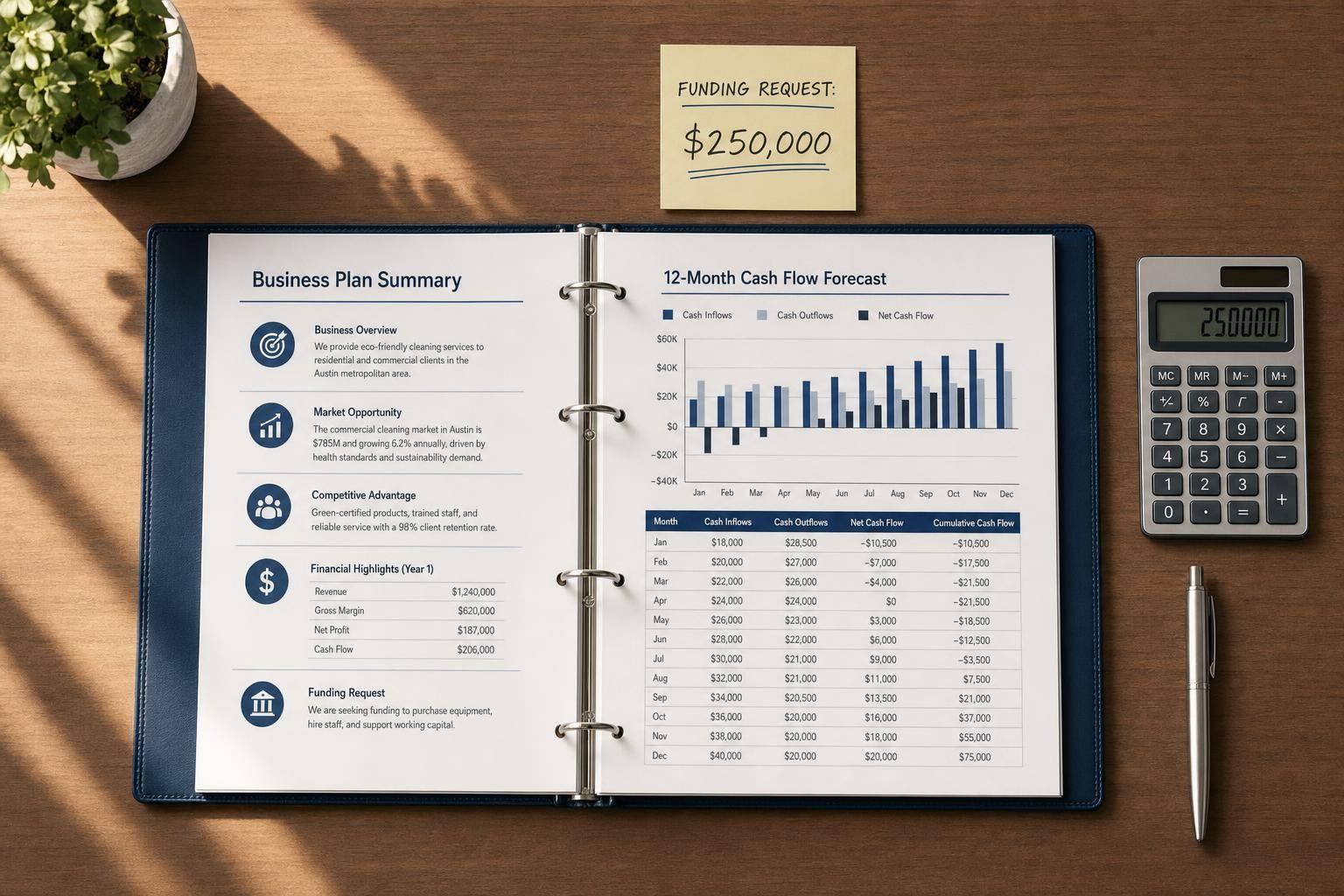
If I want SBA funding, my business plan has one job: show how the loan gets paid back. For most applicants, that means a clear plan of about 10–20 pages, a loan request with an exact dollar amount, and numbers that match across every document. If I’m applying for an SBA microloan, I also need to stay within the program limit of up to $50,000 and use the money only for approved costs like working capital, inventory, equipment, supplies, or payroll.
Here’s the short version:
- Start with documents first. I gather tax returns, bank statements, leases, supplier quotes, permits, and owner records before I write.
- Ask for a precise amount. I don’t give a range. I list each cost, such as $15,000 for equipment and $8,500 for opening inventory.
- Keep the plan focused. I explain demand, pricing, day-to-day work, owner experience, and how the business will make enough cash to cover the loan payment, especially when comparing an SBA microloan vs bank loan.
- Build the numbers around repayment. I include a 12-month cash flow forecast, profit projections for 3–5 years, startup costs, and a break-even analysis.
- Avoid banned uses. SBA microloan funds can’t be used for real estate or debt refinancing.
- Match the lender’s checklist. Microloan intermediaries set their own rules, so I check their document list before I submit anything.
A lender usually looks for three things:
- Demand: Are customers there?
- Execution: Can I run the business well?
- Cash flow: Will the business cover expenses and loan payments?
That’s the full formula. If my plan, numbers, and records all tell the same story, I give the lender a much better reason to say yes.
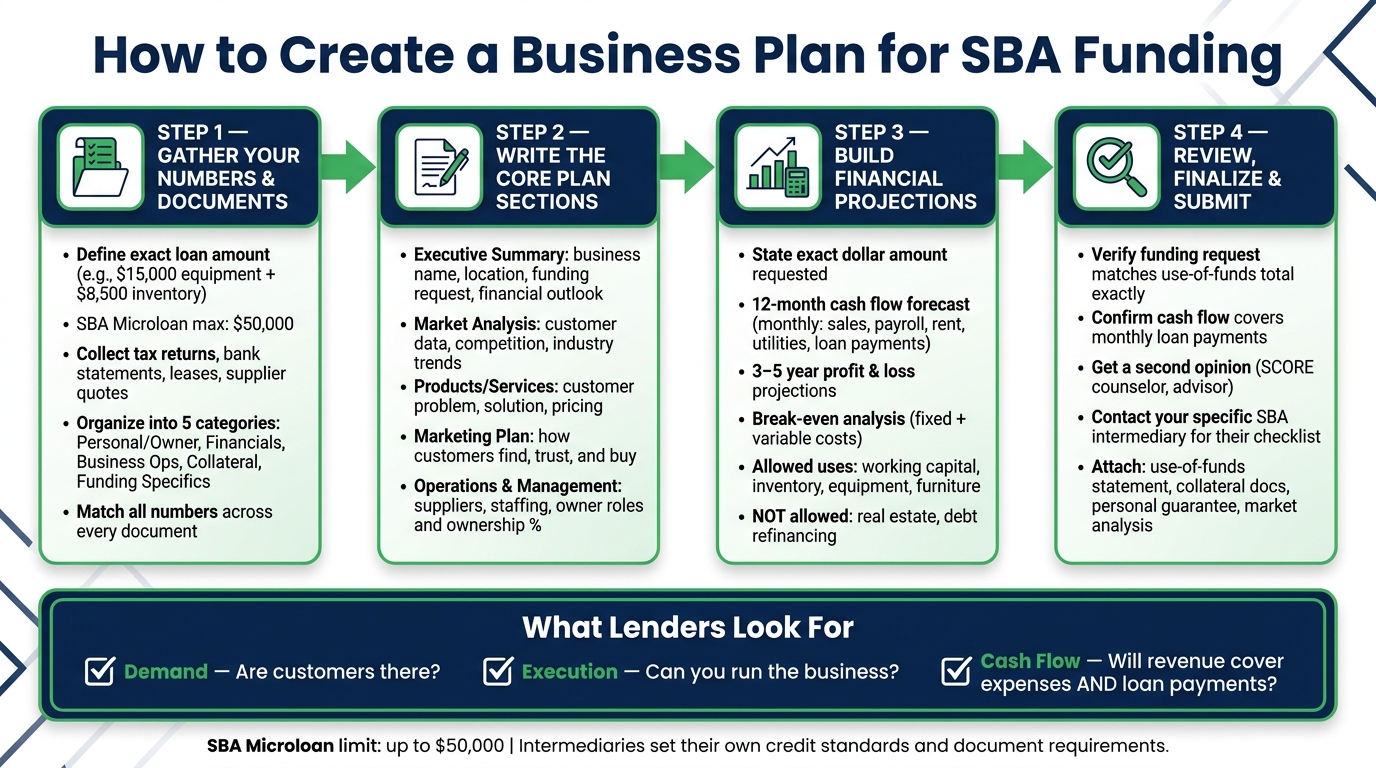
How to Write an SBA Business Plan: 4 Steps to Funding Approval
Why you need a customized business plan for your SBA loan
sbb-itb-1eb586e
Step 1: Gather Your Numbers and Documents Before You Write
Before you write, pull together the numbers that show the business can repay the loan. Lenders will check your plan against records like leases, supplier quotes, tax returns, and bank statements. If your plan says one thing and your paperwork says another, confidence drops fast. These numbers drive every section that comes next.
Define the Funding Purpose and Exact Dollar Amount
The SBA Microloan program offers up to $50,000. Lenders don’t want a rough range. They want a clear, exact request.
List each expense the loan will cover, and support every line with a supplier quote or similar proof. For example: $15,000 for equipment and $8,500 for opening inventory. Spell out where each dollar is going and show how the loan fits into your budget.
There’s one catch: SBA Microloans can’t be used to buy real estate or refinance current debt. Your request needs to stay within allowed uses like working capital, inventory, equipment, supplies, and payroll.
Collect the Supporting Records Lenders Often Request
Once your funding breakdown is set, gather the records that back it up. Most lenders ask for documents in a few common groups:
| Document Category | What to Collect |
|---|---|
| Personal/Owner | Resumes, personal financial statements, proof of at least 20% ownership stake, and work authorization documents, if applicable |
| Financials | Tax returns, bank statements, current financial statements, and any existing projections |
| Business Operations | LLC or corporation formation documents, leases, supplier quotes, and permits |
| Collateral | Real estate titles, vehicle titles, equipment lists, and accounts receivable records |
| Funding Specifics | Itemized use-of-funds list and proof of any personal investment |
Use the same assumptions in every document. If one record shows a different rent or payroll number than another, that mismatch can slow the review. When these records are ready, writing the main sections gets a lot easier because you’re working from facts, not guesswork.
Step 2: Write the Core Sections of the Business Plan
Now that your numbers and documents are in place, write the parts of the plan that show the business can bring in enough demand and cash flow to pay back the loan. This section should make three things clear: there’s demand, the business can be trusted, and the day-to-day setup is ready to work. Start with a short executive summary, then move from market demand into operations.
Executive Summary and Company Description
The executive summary appears first, but it’s often easiest to write last. Include the business name, location, ownership, target customer, funding request, use of funds, and a basic financial outlook.
The company description should explain what the business does, when it will launch or expand, and how it plans to compete in the local market. This is where you show how the business can get to revenue fast enough to support loan repayment. It also helps to highlight the owner’s background and experience, since lenders look at that closely when deciding whether a business is likely to succeed and repay debt. If you don’t have direct experience in one area, say so plainly and explain how you’ll cover that gap.
After you sum up the business, the next job is to show that real demand exists.
Market Analysis, Products or Services, and Marketing Plan
The market analysis should rely on specific data: who your customers are, what the competition looks like, and which industry trends point to demand. Skip vague claims and use facts that support your assumptions. That market proof should also connect to your pricing and sales estimates.
Your product or service section should spell out the customer problem and your solution. Then tie that value proposition to pricing and sales projections so the lender can see a clear path to revenue.
Your marketing plan should explain how people will find the business and how you’ll turn interest into customers. Keep it grounded in actual buying behavior. In plain English: how will someone hear about you, trust you, and make a purchase?
Then connect that demand to the way the business runs each day.
Operations and Management
The operations section should explain how the business works in practice, including suppliers, vendors, staffing, and the workflow used to deliver the product or service. Show where the loan fits in. If the money will be used for equipment, inventory, or working capital, explain how that supports output, inventory movement, or day-to-day cash needs. Lenders want to see that the funds don’t just sit there – they help the business produce and sell more.
The management section should lay out the owners’ stakes, experience, and roles in the business. Be direct about ownership percentages, since lenders often require a personal guarantee from anyone who owns 20% or more. If the team is missing a skill set, explain how you’ll handle it through hiring or advisory support. You can also mention any management training or outside guidance you plan to use.
Once the business model is clear, the next move is to connect it to the funding request and the projections.
Step 3: Build the Funding Request and Financial Projections
Use the assumptions from your market, operations, and staffing sections to build these numbers. This is the part where the plan has to prove the loan can be repaid.
Write a Clear Funding Request and Use-of-Funds Statement
State the exact dollar amount you’re asking for. Then break that amount into clear spending categories. Every dollar should tie back to a specific expense.
The table below shows which uses are allowed and which are off-limits for SBA Microloan funds:
| Use of Funds Category | Allowed? | Examples |
|---|---|---|
| Working Capital | Yes | Payroll, rent, utilities, office supplies |
| Inventory | Yes | Raw materials, finished goods for resale |
| Equipment | Yes | Machinery, computers, delivery vehicles |
| Furniture & Fixtures | Yes | Desks, shelving, lighting |
| Real Estate | No | Land purchase, building acquisition |
| Debt Refinancing | No | Paying off existing loans or credit cards |
Your use-of-funds totals must match the requested loan amount exactly. No gaps. No extra dollars. It sounds basic, but this is where small math errors can trip people up.
Build 12-Month Cash Flow, Profit Projections, and Break-Even Analysis
If your business already brings in revenue, use your current cash flow statements to show repayment ability. If you’re a startup, your projections do most of the heavy lifting with the lender.
Build a 12-month cash flow forecast month by month using assumptions for:
- Sales
- Pricing
- Payroll
- Rent
- Utilities
- Loan payments
Then add a projected profit-and-loss statement for the next 3 to 5 years. You should also include a break-even analysis that shows the sales volume needed to cover all fixed and variable costs.
Taken together, the cash flow forecast and break-even analysis help show that the loan payment fits within the business’s actual cash position. They also give you a way to check your own plan before you submit it. If the numbers don’t line up here, a lender will spot it fast.
Tables to Include in the Financial Section
Include tables for startup costs, use of funds, 12-month cash flow, and break-even analysis. Under each one, add a short note that explains the main point.
| Table | What It Shows |
|---|---|
| Startup Costs | Itemized launch expenses – equipment, inventory, and initial fees |
| Use of Funds | Exact allocation of loan proceeds by category |
| 12-Month Cash Flow | Monthly cash in vs. cash out, including the loan payment |
| Break-Even Analysis | The revenue level at which the business covers all costs |
After each table, add 1–2 sentences that explain what matters most. For example, after the cash flow table, point out the first month the business expects positive cash flow and what causes that change. After the break-even table, state the monthly revenue target and how many units or sales that means.
These short explanations do more than fill space. They show the lender you understand your numbers, not just the spreadsheet.
Once the numbers are consistent, move to review, finalize, and submit the plan.
Step 4: Review, Finalize, and Submit the Plan
Before you send the plan, go through every section and make sure it tells the same story. Your written case and your financials need to point to the same repayment picture.
Check for Consistency Across the Full Plan
Start with the funding request. It should match the total in your itemized use-of-funds statement. Your revenue projections also need to make sense based on the market demand and operating capacity you described earlier. And if you mention a major expense in the narrative, that expense should show up in the financial projections too.
The cash flow forecast matters just as much. It should show enough leftover cash to cover the monthly loan payments across the term you’re asking for. If the plan says one thing and the numbers say another, lenders will spot it fast.
It also helps to get a second set of eyes on the plan. A mentor, advisor, or SCORE counselor can catch gaps, unclear wording, or jargon before you submit.
Once the numbers line up, attach the documents that back them up.
Attach the Right Documents and Tailor the Plan to the Lender
For SBA microloans, the intermediary – not the SBA – sets credit standards, rates, and terms. That means you should contact your specific intermediary before submitting the package, so you know what it wants to see. Many intermediaries also offer management and technical assistance, which can help you tighten up the plan before review.
Use the lender’s checklist to shape the package around its submission rules. These documents help the lender verify what your plan says.
| Supporting Document | Why Lenders Need It |
|---|---|
| Use of Funds Statement | Confirms exactly how the loan capital will be allocated |
| Owner background and experience | Establishes the owner’s industry experience and management capability |
| Collateral Documentation | Backs the loan |
| Personal Guarantee | Usually required for any owner with a 20% or greater stake |
| Market Analysis | Proves there is sufficient customer demand to support revenue assumptions |
Conclusion: The Sections That Matter Most for SBA Approval
When your narrative, use of funds, and financial projections line up, the lender can quickly see how the business plans to repay the loan. In plain terms, the plan needs to prove repayment first and completeness second.
FAQs
How detailed should my cash flow forecast be?
Lenders usually want monthly cash flow projections for at least the first 12 months. Many will ask for as many as 24 months. That month-by-month view helps them see if your business can cover day-to-day costs and loan payments during both busy seasons and slower stretches.
Your projection should include:
- Revenue
- Cost of goods sold
- Gross margins
- Operating expenses
- Net operating cash flow
Keep your assumptions conservative. In plain English, don’t bank on best-case numbers. And make sure those assumptions match your startup cost worksheet, business plan, and use-of-funds statement. If those documents tell different stories, lenders will notice fast.
What if I don’t have industry experience yet?
You can still qualify for an SBA microloan without direct industry experience if your business plan shows that you’ve done your homework and you’re ready to run the business.
Focus on the proof you do have. That can include relevant certifications, specialized knowledge, or past experience managing similar types of work, teams, or day-to-day operations. Lenders want to see that even if you haven’t worked in that exact field, you understand what the job takes.
Your plan should also make a clear case for repayment. Include detailed financial projections and show, with data, that you understand your market, your competitors, and how your business will make money. Support from mentors or counselors can help strengthen your application too, especially if they’ve helped you test your numbers and sharpen your plan.
Can I use an SBA microloan for rent and payroll?
Yes – usually yes, as long as those are allowed uses under your lender’s rules and your plan backs them up.
SBA microloans are meant for working capital and day-to-day business costs. That means rent and payroll can often be included in your 12-month cash flow forecast and your use-of-funds statement.
Your business plan should make the case in plain terms: show how those costs help the business bring in revenue and how the loan will be paid back from cash flow. One key limit: SBA microloan funds generally can’t be used for real estate or to refinance existing debt.

Leave a Reply