
You can get business funding before your first sale – but you need a way to repay it. I’d start with SBA microloans of up to $50,000, then compare startup term loans and equipment financing from lenders that accept zero-revenue businesses.
Here’s what I’d check before applying:
- Loan fit: Microloans cover eligible startup costs, term loans may offer more spending options, and equipment financing pays for specific assets. Cash advances and invoice financing generally need sales or unpaid invoices.
- Repayment: Prepare a startup budget and at least 12 months of monthly cash-flow forecasts, backed by savings, outside income, or other documented funds.
- Cost and personal risk: Compare rates, fees, payment dates, collateral, and personal guarantees – not just the monthly payment.
- Application rules: Confirm pre-revenue eligibility, gather the lender’s required documents, and check the written agreement before signing.
My rule: <u>borrow for documented needs, not hoped-for sales</u>. A lender may accept a startup application, but approval still depends on its requirements and your ability to repay.
How to Get a Startup Small Business Loan in a few Simple Steps! (No Revenue Needed)
sbb-itb-1eb586e
Step 1: Choose a Loan That Accepts Pre-Revenue Businesses
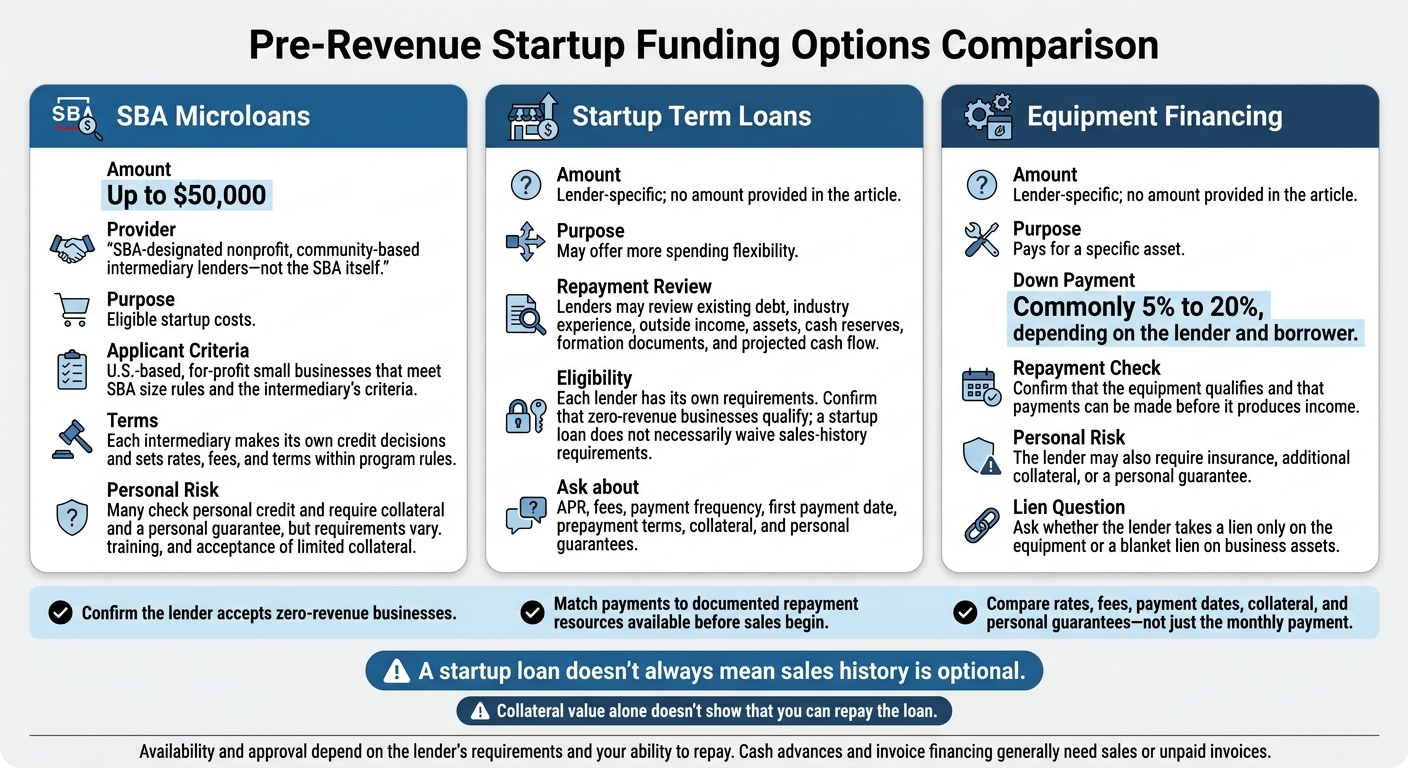
Pre-Revenue Business Funding Options Compared
Once you’ve picked a loan type, check whether lenders accept businesses with no revenue, what collateral they require, and how they assess your ability to repay. A startup loan doesn’t always mean sales history is optional. Before applying, ask whether the lender accepts zero-revenue businesses, considers projected revenue, or requires a minimum time in business.
SBA Microloans Through Participating Intermediaries
SBA-designated nonprofit, community-based intermediary lenders – not the SBA itself – accept applications and issue microloans of up to $50,000. Applicants must be U.S.-based, for-profit small businesses that meet SBA size rules and the intermediary’s criteria.
Each intermediary makes its own credit decisions and sets rates, fees, and terms within program rules. Many check personal credit and require collateral and a personal guarantee, but requirements vary. Ask whether you’ll need technical assistance or training and whether the lender accepts limited collateral.
If the intermediary’s terms are too restrictive, compare the underwriting requirements for startup term loans or equipment financing.
Startup Term Loans and Equipment Financing
Startup term loan lenders may review your existing debt, industry experience, outside income, assets, cash reserves, formation documents, and projected cash flow. Each lender has its own requirements. Before moving ahead, ask about the annual percentage rate, fees, payment frequency, first payment date, and prepayment terms.
Review equipment financing separately because the funding is tied to a specific asset. Check that your equipment qualifies and that you can make payments before it starts producing income. Down payments commonly range from 5% to 20%, depending on the lender and borrower.
The lender may also require insurance, additional collateral, or a personal guarantee. Collateral value alone doesn’t show that you can repay the loan.
Compare Loan Uses, Requirements, and Personal Risk
A microloan may fit eligible startup costs if you meet the intermediary’s criteria. A startup term loan offers more spending flexibility, while equipment financing pays for a specific asset. For each option, match payments to documented repayment resources you can access before sales begin, and compare collateral and personal guarantee requirements.
Before pledging assets without sales to support repayment, ask whether the lender will take a lien only on the equipment or a blanket lien on business assets.
Step 2: Show How You Will Repay the Loan
Once you know which lenders accept pre-revenue applications, show them exactly how you’ll repay the loan.
Write a Business Plan With a Clear Loan Request
Build your business plan around repayment before revenue starts. Describe your product, target customer, pricing, sales channels, launch timeline, and day-to-day operations. Include your experience and role as a founder, the exact loan amount and term, how you’ll spend the money, and where repayment funds will come from.
Document cash sources such as founder income, savings, or committed funding. Before counting personal cash toward repayment, subtract taxes, household expenses, and existing debt payments. Keep cash you already have separate from expected customer payments or funding that isn’t committed.
Then turn those assumptions into monthly numbers the lender can check.
Build Monthly Cash-Flow and Break-Even Forecasts
Prepare monthly forecasts for at least 12 months and annual projections for five years. Include projected income statements, balance sheets, cash flow, and capital spending.
Explain your assumptions about customer numbers, pricing, sales timing, and costs. Account for payroll, taxes, inventory, overhead, equipment purchases, and loan payments. Record customer payments in the month you expect to collect them – not simply when you make the sale.
Calculate monthly cash break-even as (fixed operating costs + loan payments) ÷ (selling price − variable cost per sale). Check taxes and other cash obligations separately in your cash-flow forecast.
Test what happens if your launch is delayed, sales fall short, or customers take longer to pay. Identify the first month of negative cash flow. Then name the documented cash source – or specific spending cut – that would keep loan payments covered.
Match Every Loan Dollar to a Startup Cost
Create a sources-and-uses budget that shows loan proceeds, owner contributions, and other committed funding adding up to total project costs.
Assign every loan dollar to a pre-revenue need. Separate must-have costs from optional purchases so the lender can see the minimum funding needed. Back each major item with a dated quote, invoice, or estimate, and explain how it supports launch, sales, or required pre-revenue expenses. Confirm that every expense is allowed under the loan’s terms.
Use this package to compare lenders and submit a focused application.
Step 3: Find a Lender and Apply
Find SBA Intermediaries and Check Their Requirements
With your repayment plan ready, focus on lenders that work with pre-revenue businesses. Use the SBA intermediary directory to find participating microloan lenders. Confirm that each lender accepts businesses without revenue and considers projected cash flow.
Ask for its credit standards, collateral and personal guarantee requirements, required owner contribution, and permitted loan uses. Also request rates, fees, payment schedules, loan terms, a document checklist, and an expected decision timeline.
Prepare Your Application Documents
Once you’ve chosen a lender, show how you’ll repay the loan before revenue starts. Follow the lender’s checklist. Include 12-month cash-flow and break-even projections, a personal financial statement, available tax returns, recent bank statements, and a schedule of existing debt. Add formation and ownership records, licenses, permits, lease terms, or equipment specifications as requested.
Keep the loan amount, owner contribution, start date, monthly payment, and break-even date consistent across every document. Answer requests for clarification promptly, and document any changes to your assumptions.
Review Loan Cost, Liens, and Guarantee Terms
Before signing, compare the agreement line by line with the quoted terms. Check how much money you’ll actually receive, whether the rate is fixed or variable, the APR where disclosed, how interest is calculated, and all fees. Review the payment frequency, first-payment date, loan term, total repayment, and prepayment rules.
Ask for written clarification of any missing costs, events that trigger default, time allowed to fix a default, and collection charges. Confirm which assets secure the loan, whether liens cover specific equipment or broader business assets, and when those liens can be released. Read the personal guarantee to understand what it covers, what triggers your obligation to pay, and the conditions for release.
Conclusion: Match the Loan to Your Repayment Plan
Once you’ve compared lenders and gathered your documents, choose financing that matches how you’ll repay it. Borrow only what you need to cover your documented launch costs. SBA microloans, some startup term loans, and some equipment financing may be available before sales begin.
Before applying, get written confirmation that the lender accepts pre-revenue businesses. Then submit a single, consistent package with your plan, budget, and cash-flow forecast. Document the owner contributions or other resources you’ll use to make payments before revenue stabilizes.
Use the SBA intermediary directory to find suitable lenders and prepare the required documents. Check every SBA microloan requirement, cost, and loan term directly with the intermediary.
FAQs
Can I qualify with no revenue and poor credit?
Yes, you can qualify for an SBA microloan with no revenue and poor credit, but approval depends on the nonprofit intermediary’s own standards. Lenders look at your full financial profile and ability to repay – not just your credit score.
Prepare a solid business plan, realistic 12- to 24-month financial projections, and a budget that shows exactly how you’ll use the funds. Collateral, a personal guarantee, or a co-signer may help your application. Before applying, check that the intermediary accepts businesses that haven’t started earning revenue.
How much should I borrow if sales are delayed?
Borrow only what you need for documented launch costs and working capital until revenue covers your bills. SBA50K’s rule of thumb: add 3 to 6 months of operating costs, then subtract committed cash or savings.
Before you apply, test your projections using conservative sales estimates. Lenders generally want monthly cash flow to cover loan payments at a debt service coverage ratio of around 1.15–1.25. Keep your loan request affordable even if sales fall below expectations.
Will applying for funding affect my personal credit?
Applying for startup funding usually involves a credit check. A hard inquiry may cause a small, temporary drop in your personal credit score. To limit the impact, avoid opening multiple credit accounts or triggering several credit checks in the months before you apply.
Once you receive funding, making loan payments on time can help build or improve your business credit score over the long term.
Leave a Reply