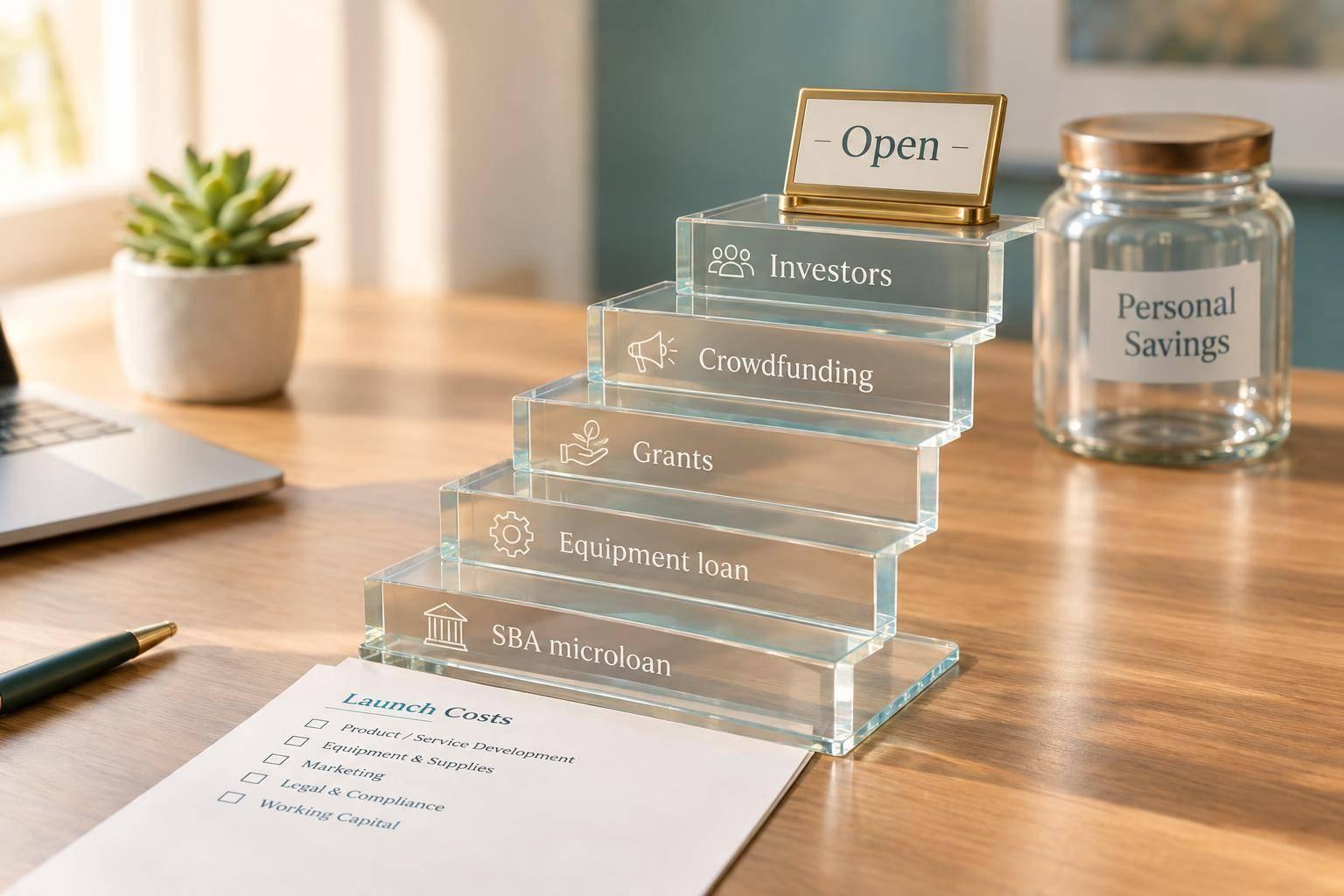
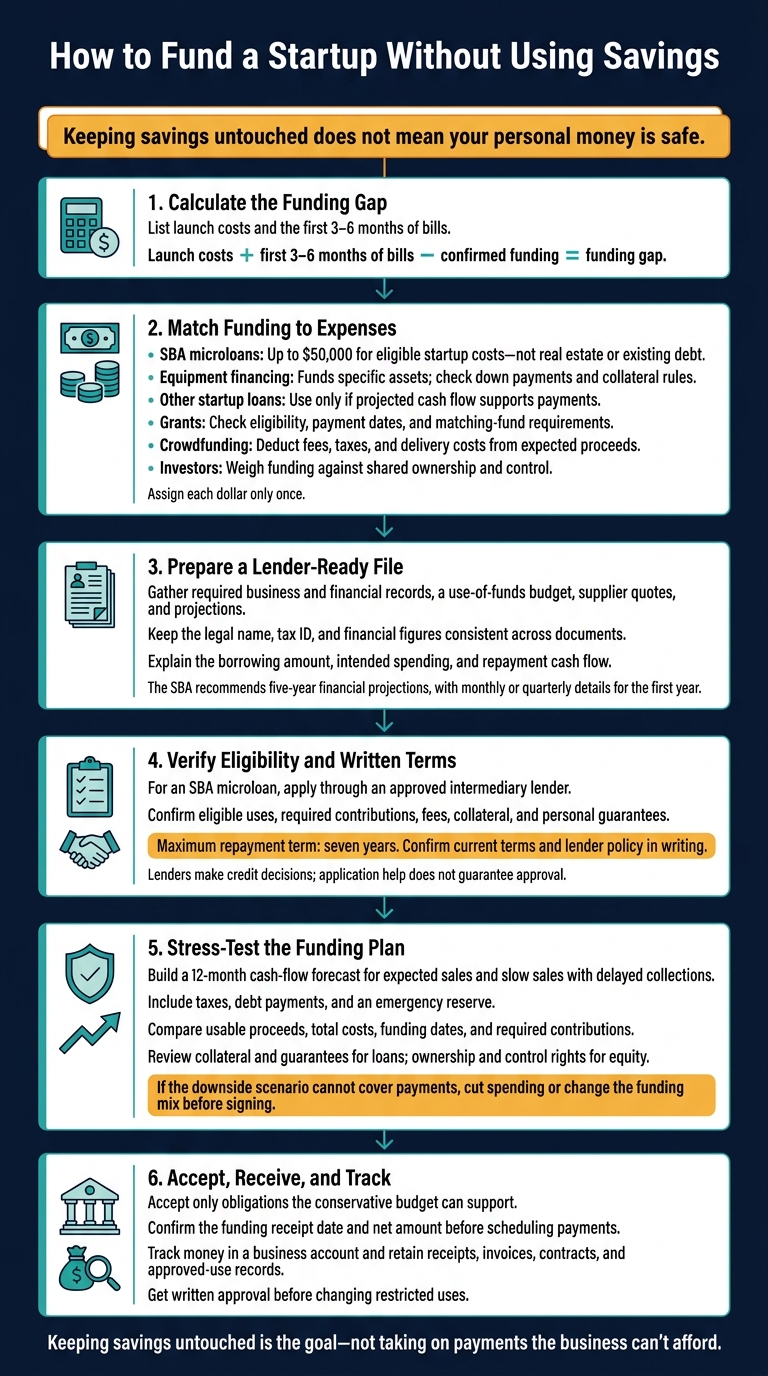
You can fund a new business without using savings – but that doesn’t mean your personal money is safe. I’d start by listing launch costs and the first 3–6 months of bills, then subtracting confirmed funding to find the gap.
Here’s how I’d compare the options:
- SBA microloans: Borrow up to $50,000 for eligible startup costs – not real estate or existing debt.
- Equipment financing: Fund specific assets, while checking down payments and collateral rules.
- Other startup loans: Cover business expenses if projected cash flow can support payments.
- Grants: Check eligibility, payment dates, and matching-fund requirements before counting on an award.
- Crowdfunding: Deduct fees, taxes, and delivery costs from expected proceeds.
- Investors: Weigh funding against shared ownership and control.
Before applying, I’d prepare the required records and test a 12-month cash-flow forecast against slow sales. My final check: compare usable cash, total costs, payment dates, collateral, and ownership terms. <u>Keeping savings untouched is the goal – not taking on payments the business can’t afford.</u>
How to Fund a Startup Without Using Savings
SBA Microloans: A Complete Guide for Startups and Small Businesses
sbb-itb-1eb586e
2. Prepare Your Financing Application
Once you know your funding gap, put together a lender-ready file that supports the amount you need.
Gather Business and Financial Records
Start with the lender’s checklist. Gather your business plan, expense sheet, vendor quotes, tax returns, bank statements, credit reports, licenses, permits, leases, and contracts.
Use the same legal name, tax ID, and financial figures across all documents. Make sure the records support your borrowing request and budgeted costs. If you don’t have business tax returns or a revenue history, say so clearly and provide substitutes the lender accepts.
The SBA recommends five-year financial projections covering income statements, balance sheets, cash flow statements, and capital spending budgets. Include monthly or quarterly details for the first year. Keep forecasts separate from past results, and back up your assumptions with quotes, contracts, or other records.
Show How You Will Repay the Loan
Explain how much you want to borrow, what you’ll spend it on, and which cash flow will cover repayment. Include resumes for owners and key managers that show their ability to run the business and handle the repayment plan. Lenders assess risk by reviewing credit history, collateral, and business experience, though requirements vary.
Check your credit reports and dispute factual errors before you apply. For accurate negative items, explain when they happened, what caused them, how they were resolved, and what you’ve done to prevent them from happening again.
Report your debts and available collateral accurately. Ask how the lender will value your collateral and whether you’ll need a personal guarantee.
Once your documents are ready, compare microloan requirements and apply through an intermediary lender.
Get Application Support From SBA50K
SBA50K offers funding guidance, business-plan help, application help, and lender connections. Before paying, confirm the price, what services you’ll receive, and whether revisions are included.
Use that help to organize your file – not to replace the lender’s review. Lenders – not SBA50K – make credit decisions. Application support doesn’t guarantee approval, funding, fewer documents, or faster decisions.
3. Apply for an SBA Microloan
With your budget and documents ready, use your funding gap to set a loan request of up to $50,000. Make sure each expense qualifies. SBA microloans can fund startup working capital, inventory, supplies, furniture, fixtures, machinery, and equipment. Approved intermediary lenders make these loans, set the terms, and disburse the money.
Check Eligible Expenses and Loan Requirements
You cannot use the money to buy real estate or repay existing debt. Match each eligible expense to your existing cost sheet. Then build a spending schedule backed by purchase quotes or other records.
Confirm that your business operates in the United States, meets SBA size limits for its industry, and has an eligible business purpose. You’ll also need to show creditworthiness and enough cash flow to repay the loan. Ask whether the lender funds pre-revenue startups, sets a minimum credit score or time in business, or requires you to cover part of the startup costs yourself.
If the loan fits your expense list, submit your package through an approved intermediary.
Apply Through an Intermediary Lender
Start with the SBA’s approved intermediary list and check which lenders serve your area. Before submitting your records and spending schedule, ask about startup lending, processing times, and required technical assistance.
If approved, review the written offer and required closing documents, including insurance, lien paperwork, and disbursement instructions. Compare the written terms with your repayment plan before signing.
Review Microloan Terms and Personal Liability
The SBA borrower guide lists a maximum repayment term of seven years. Confirm the current term and the lender’s policy in writing.
Request an amortization schedule that shows your payments and total interest so you can check whether the loan fits your budget. Review fees, prepayment provisions, and whether closing costs will reduce the amount available to spend. Identify every asset pledged as collateral and read any personal guarantee so you understand how default could leave you personally liable for the debt.
After closing, keep invoices, receipts, payroll records, and bank statements that document approved spending. Contact the lender promptly if repayment problems develop.
4. Match Funding Sources to Startup Expenses
Once you know your funding gap, match each expense to the lowest-cost source that can cover it. Choose one primary source for each expense, then record the amount, deadline, repayment terms, ownership impact, and a backup source.
Use this chart to compare your options, risks, and paperwork.
| Funding source | Best use | Funding structure | Repayment or ownership trade-off | Personal exposure | Application materials |
|---|---|---|---|---|---|
| SBA microloan | Inventory, supplies, working capital, furniture, fixtures, machinery, and equipment | Loan through an SBA-approved intermediary lender | Principal and interest payments; terms and rates vary by intermediary | Collateral and personal guarantees may be required | Business plan, use-of-funds budget, projections, credit and personal financial records, supplier quotes, and business formation documents |
| Equipment financing | Specific assets such as ovens, vehicles, or machinery | Asset-backed loan or lease | Scheduled payments; leases may require a buyout or final payment before ownership transfers | Equipment may serve as collateral; a down payment or personal guarantee may be required | Equipment quote, vendor information, business records, projections, insurance, and owner credit information |
| Other startup loans | Inventory, rent, payroll, marketing, utilities, and general operating expenses | Term loan, line of credit, or community-development loan | Principal and interest payments; fees, covenants, or variable rates may apply | Often requires collateral, a personal guarantee, or both | Business plan, cash-flow forecast, credit history, collateral details, proof of experience, and tax or bank records if available |
| Grants | Specialized research, technology commercialization, exporting, or local entrepreneurship programs | Award that does not require repayment if program rules are met | No ordinary loan repayment, but matching funds, milestones, reimbursement, and reporting may apply | Usually no collateral; failure to meet award terms can lead to repayment or compliance issues | Eligibility evidence, proposal, budget, milestones, registrations, matching-fund documentation, and reporting plan |
| Donation, reward, or preorder crowdfunding | Community-backed launches, product validation, and customer preorders | Contributions or customer payments collected through a platform | No scheduled loan payment, but platform fees, fulfillment costs, refunds, taxes, and reputational risk reduce usable funds | Usually no collateral or personal guarantee; the business must deliver promised rewards or products | Campaign narrative, budget, prototype or product details, fulfillment plan, terms, marketing assets, and risk disclosures |
| Outside investors | Product development, scaling, and hiring | Sale of equity, debt, or another security | Equity has no conventional scheduled loan payment, but ownership, profits, voting rights, and control may be shared; disclosure and investor reporting duties may apply | Usually no collateral; founders face dilution, governance duties, and legal obligations | Pitch deck, business plan, use-of-funds schedule, cash-flow projections, valuation assumptions, capitalization table, ownership records, formation documents, intellectual-property records, contracts, and licenses |
Consider Equipment Financing and Other Startup Loans
Equipment financing helps you buy an asset while keeping working capital available. Other startup loans can cover inventory, rent, payroll, marketing, and utilities. But before revenue starts coming in, lenders often want stronger credit, collateral, a down payment, or a personal guarantee.
Match the payment schedule to the asset’s useful life and your cash flow. Also flag any owner contributions you may need to cover from savings.
Ask both lenders whether they require a first-priority or blanket lien, a Uniform Commercial Code (UCC) filing, or permission before you take on more debt. Confirm collateral priority before signing. Separate security agreements alone do not prevent competing claims.
Check Grant Rules and Crowdfunding Costs
Federal grants generally do not fund ordinary business launches or expansion. The SBA does point to specialized options, including SBIR and STTR research-and-development programs. Other limited programs may support exporting, technology commercialization, local entrepreneurship, or economic development.
Check when the money becomes available. Some grants require you to spend upfront and seek reimbursement later. They may also require records, milestones, or matching funds.
Donation crowdfunding collects contributions, reward crowdfunding offers perks, and preorder campaigns sell products for future delivery. Campaign proceeds aren’t all spendable cash. Subtract platform fees, manufacturing, packaging, shipping, marketing, taxes, and refund reserves before using the balance for operating costs.
Securities-based crowdfunding follows separate rules. Under Regulation Crowdfunding, eligible companies can collect up to $5 million in a 12-month period through an SEC-registered broker-dealer or funding portal registered with FINRA. Required disclosures generally include an offering statement on Form C.
Weigh Investor Funding Against Shared Ownership
Equity avoids scheduled principal and interest payments, but you give up a share of ownership, future profits, and potentially control. It may suit a business with strong growth potential or uncertain early cash flow that cannot support loan payments.
Prepare valuation assumptions, a capitalization table, ownership records, and proposed securities terms. Before accepting funds, have a business attorney review term sheets, ownership terms, voting rights, exit terms, and securities filings.
5. Compare Offers and Finalize Your Funding Plan
Choose Funding by Expense, Timing, and Risk
Use your expense map and funding gap to rank each offer by cost, timing, and control.
- Expense type: Check that the offer covers the startup costs you’ve assigned to it.
- Time to funding: Confirm the money will arrive before bills come due.
- Total cost: Compare usable proceeds against repayment costs, fees, and required contributions.
- Control risk: Review ownership, voting rights, and limits on business decisions.
Test Your Budget and Compare Total Costs
Compare APR, net cash, fees, payment schedules, maturity dates, and prepayment terms. To calculate total borrowing cost, subtract net proceeds from total scheduled payments, then add required costs paid separately.
Check variable rates, collateral, guarantees, and default terms. These may include demands for immediate repayment or claims against guarantors. For equity, compare ownership and control rights – not APR.
Build a 12-month cash-flow forecast with two scenarios: expected sales, and slow sales with delayed collections. Include taxes, debt payments, and an emergency reserve. If the downside scenario can’t cover payments, cut spending or change your funding mix before signing.
Ask whether each offer requires a down payment, matching funds, prepaid costs, or reserves. Also ask whether another proposed funding source can cover those requirements. Get the answer in writing. Money set aside for a grant match can’t also count as available operating cash.
Once the numbers work, submit only applications that fit your budget and risk tolerance.
Submit Applications and Track Spending
Use this checklist to fund startup costs without drawing on savings while managing repayment, collateral, and ownership trade-offs:
- Confirm each expense, deadline, and eligible use. Assign each dollar only once.
- Gather formation records, ownership details, projections, bank statements, licenses, and supplier quotes as required.
- Verify eligibility and get complete written terms, including required contributions, guarantees, and investor rights.
- Follow the required application process. Accept only obligations your conservative budget can support.
- Confirm the funding receipt date and net amount before scheduling payments.
- Keep receipts, invoices, contracts, and approved-use records. Get written approval before changing restricted uses.
Track every dollar in a business account and keep proof of restricted spending.
FAQs
Can I get startup funding with no revenue or collateral?
Yes, but eligibility depends on the lender. Lenders may review your personal credit, industry experience, owner investment, and projected cash flow. Some SBA microloan intermediaries may waive collateral for smaller loans, but they typically require a personal guarantee.
Rewards-based crowdfunding or grants may provide funding without collateral or a revenue history. Check the lender’s requirements before applying.
Does an LLC protect my savings if I guarantee a loan?
No. An LLC typically protects you from personal liability, but signing a personal guarantee makes you personally responsible for the loan. If your business defaults, your savings and other personal assets could be at risk, regardless of your business structure. Read the guarantee’s terms carefully before signing: you’re taking on a direct personal obligation to repay the debt.
Can I combine startup funding sources without using savings?
Yes, you can combine startup funding sources without tapping your personal savings. Founders often use a mix of SBA microloans, grants, and crowdfunding to pay for different business needs.
For example, a grant can cover specific project costs, while a microloan can help pay for working capital, inventory, or equipment. This mix can lower the amount you need to borrow and give your business a firmer financial footing.
Leave a Reply