
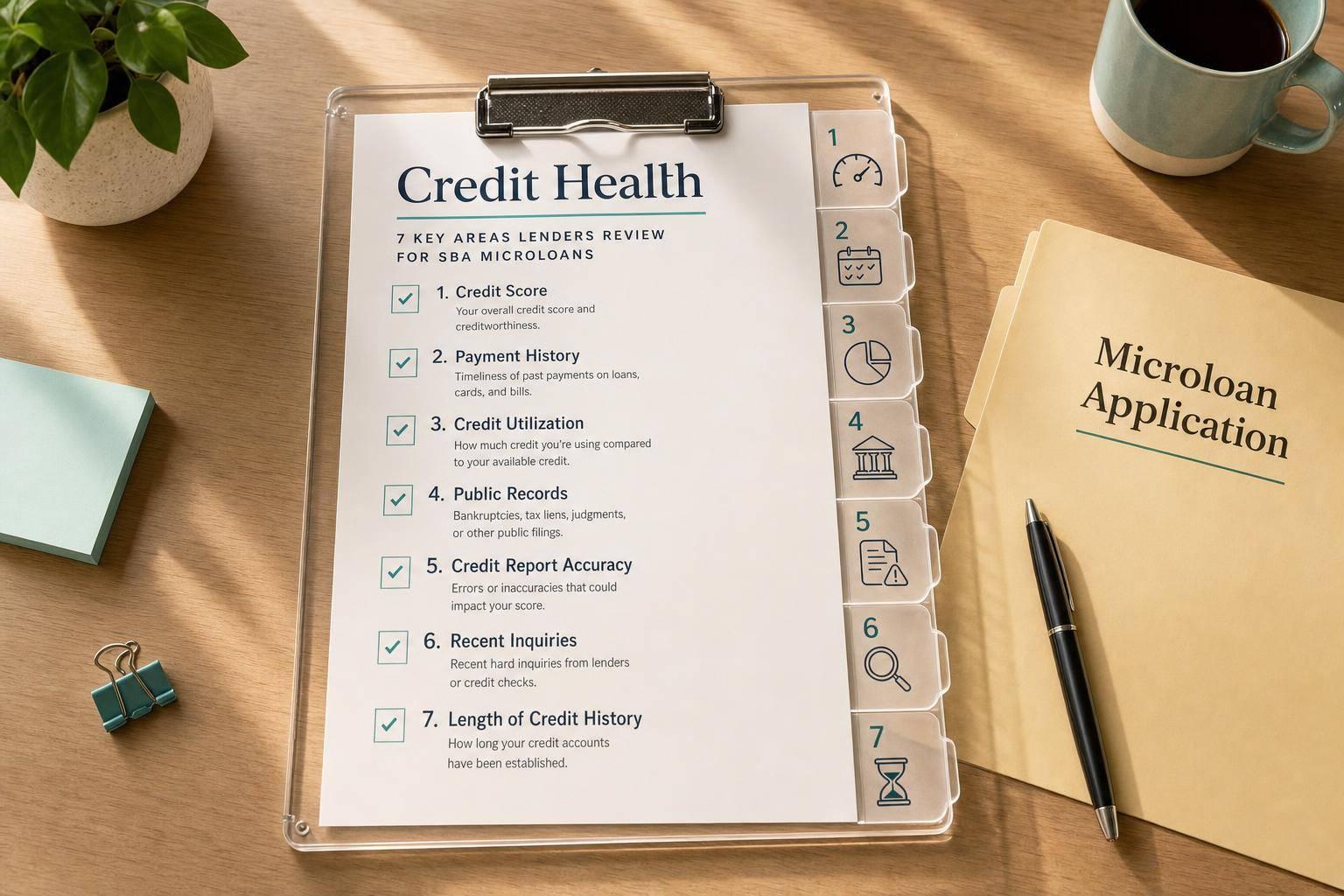
If I want a better shot at an SBA microloan, I check my credit before I apply. For loans up to $50,000, many lenders look hard at my personal credit, especially if I am starting a business with poor credit and have little business history yet.
Here’s the short version:
- I review my credit score from all three bureaus.
- I check for late payments, charge-offs, and collections.
- I look at credit card use and total debt.
- I scan for bankruptcies, judgments, tax liens, and federal debt problems.
- I fix report errors early, since disputes can take 30 days or more.
- I avoid new hard inquiries before applying. I also make sure my business plan is solid to show lenders I am a responsible borrower.
- I list old delinquent accounts and get records ready for anything still unpaid.
A few numbers matter right away:
- Many microloan lenders look for a score near 620 to 640
- Payment history makes up about 35% of a FICO score
- Card balances at 30% or more of the limit can hurt my file
- Negative items can stay on a report for up to 7 years
- Recent payment history over the last 12 to 36 months often gets the most attention
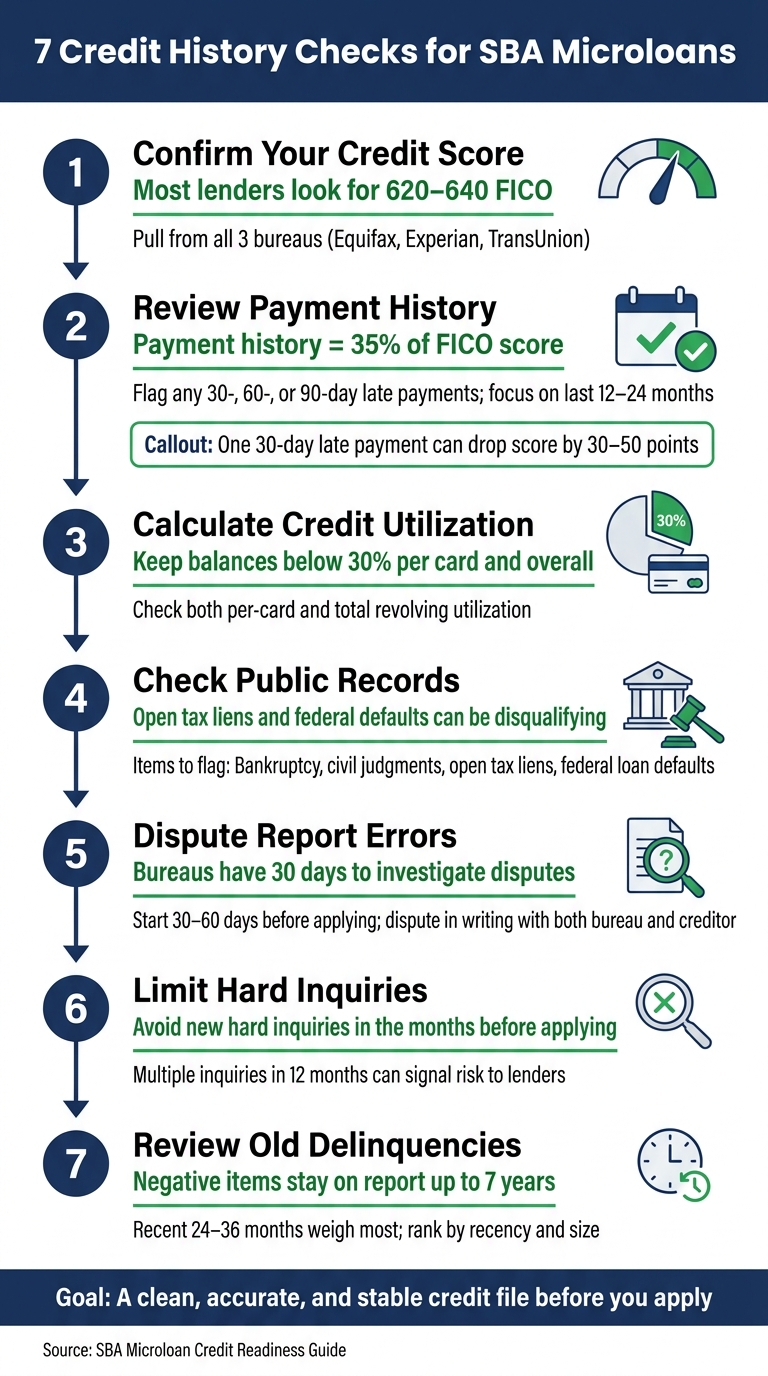
7 Credit History Checks Before Applying for an SBA Microloan
6 Qualifications for an SBA $50k Microloan #shorts
sbb-itb-1eb586e
Quick Comparison
| Check | What I look for | Why it matters |
|---|---|---|
| Credit score | Score range and bureau differences | Gives lenders a fast first read |
| Payment history | Late payments, charge-offs, collections | Shows how I handled past debt |
| Debt use | Per-card and total utilization | High balances can weaken my file |
| Public records | Bankruptcy, judgments, liens, federal defaults | These can block approval |
| Report errors | Wrong balances, false late marks, duplicate accounts | Bad data can hurt my odds |
| Recent credit activity | Hard inquiries and new accounts | Too much new debt can be a red flag |
| Old delinquencies | Age, balance, and status of unpaid debt | Lenders weigh recent unpaid debt more heavily |
My goal is simple: make sure my credit file looks clean, accurate, and stable before I submit the application. This is especially critical for specialized programs like the SBA micro loan for women entrepreneurs.
Checks 1–2: Confirm Your Score and Review Payment History
1. Confirm Your Personal Credit Score
Start with the number lenders often use as a fast filter. Pull your reports from Equifax, Experian, and TransUnion through AnnualCreditReport.com. Then compare each one line by line.
Look at:
- reported accounts
- balances
- payment status
- personal information
Why be so picky here? Because the same account can show up a little differently across bureaus. And the free score you see online may not match the score model a lender uses.
There isn’t one minimum score for every SBA microloan. Many intermediary lenders look for a FICO score around 620–640, but some mission-driven lenders will approve lower scores if the rest of the file looks solid.
Each owner with a 20% or greater stake should pull and compare their reports now.
If your score falls in that range, move to payment history.
2. Review Late Payments, Charge-Offs, and Collections
Your score matters, but payment history often tells lenders more. It makes up about 35% of a FICO score, so lenders pay close attention to it.
Review every account on all three reports. Flag any 30-, 60-, or 90-day late payments, the first missed-payment date, and whether any account is still past due, especially within the last 12 to 24 months. That recent stretch tends to matter most.
Even one 30-day late payment can drop a FICO score by about 30 to 50 points. That’s why lenders want to see recent on-time payments.
Charge-offs and collections point to longer repayment trouble. Roughly 35% of U.S. adults with a credit file have at least one debt in collections on their report.
As you review your reports:
- flag any wrong late mark for Check 5
- if a current account still shows an old late payment, ask the creditor for a goodwill removal
If recent payments look clean, the next step is to check how much debt is already using your available credit.
Checks 3–5: Debt Use, Public Records, and Report Errors
Once your payment history looks clean, lenders turn to the next big thing: how much credit you’re using and what else is showing up on your reports.
3. Calculate Credit Utilization and Total Debt Load
If your payment history seems under control, the next step is to look at how much debt you’re already carrying.
Credit utilization is your revolving balance divided by your credit limit. Check it two ways:
- Per card
- Across all revolving accounts
That second piece matters, but so does the first. One maxed-out card can pull your profile down even if your other cards barely have a balance.
| Situation | Example | Typical Effect on Loan Readiness |
|---|---|---|
| Low utilization | $1,000 balance on a $10,000 limit (10%) | Stronger readiness; signals responsible debt management |
| Moderate utilization | $3,000 balance on a $10,000 limit (30%) | Often still manageable, but near the upper end of the usual target range |
| High utilization | $8,000 balance on a $10,000 limit (80%) | Weaker readiness; signals strain and higher risk |
High debt can hurt your approval odds. If any card is at or above 30%, pay it down before you send in your application.
4. Check for Bankruptcies, Judgments, Tax Liens, and Federal Debt Issues
Next, review public records for bankruptcies, judgments, tax liens, and federal debt issues.
| Public Record Item | Typical Impact on SBA Microloan Eligibility |
|---|---|
| Bankruptcy | Major obstacle; often requires a waiting period or detailed explanation |
| Civil judgment | Major obstacle; signals unresolved court-ordered debt |
| Tax lien (open) | Major obstacle; must typically be resolved or on a payment plan before approval |
| Tax lien (released/paid) | Less damaging, but may still appear on reports for some time |
| Federal loan default | Often disqualifying for government-backed financing |
If something is still unresolved, gather the paperwork now. That may include repayment plans, discharge papers, or settlement letters.
And if a public record looks wrong or out of date, check it before you apply. A bad entry sitting there unchallenged can cause trouble fast.
5. Find and Dispute Credit Report Errors
Go through all three credit reports again and look for mismatched balances, late marks, and accounts that don’t belong to you. Common errors include wrong balances, duplicate accounts, false late marks, and accounts that do not belong to you. An error may show up on one bureau’s report and not the others.
Dispute errors in writing with both the credit bureau and the company that reported the item, and keep proof of delivery. Bureaus usually have 30 days to investigate and respond.
Save everything as you go: confirmation numbers, letters, screenshots, and any follow-up notes. If the bureau fixes the record, keep that resolution notice in your loan file.
Start this process at least 30 to 60 days before you plan to apply so any fixes have time to show up before your file gets reviewed.
After accuracy, review recent inquiries and new accounts.
Checks 6–7: New Credit Activity and Old Delinquencies
After you clear up report errors and public records, the next step is to look at two things: recent borrowing and older unpaid debt. This part tells you whether your file looks busy right now and which past problems are still following you.
6. Count Recent Hard Inquiries and New Accounts
A hard inquiry shows up when you apply for new credit. Each one can shave a few points off your score and suggest that you’re seeking more debt. A stack of inquiries within 12 months can draw extra attention, especially if those inquiries turned into new accounts.
Pull all three credit reports from AnnualCreditReport.com and check the inquiries section. Write down every hard inquiry from the last 12 months, including:
- The date
- The creditor name
- Whether it led to a new account
Then move to the accounts section and look for any credit cards, personal loans, or lines of credit opened during the past year.
If you’re getting ready to submit an SBA microloan application, stop applying for new credit in the months before you file. If you already have a cluster of recent inquiries, give your report time to settle. It also helps to have a short written note ready that explains the activity.
7. Review Old Delinquent Accounts and Collections
Next, check the age and current status of any delinquent debt that still hasn’t been cleared.
Most negative items can stay on your credit report for up to seven years. Older derogatory items usually carry less weight than newer unpaid debt, especially when the newer debt is still unresolved. Lenders also pay close attention to your payment history over the last 24 to 36 months.
Make a simple list of each negative account with its balance, date of first delinquency, and current status: unpaid, settled, paid, or in dispute. Then rank them by likely impact. Recent, larger, unpaid collections should come first, mainly if they involve taxes, federal debt, or housing. Those accounts often need action now through payment, a written payment plan, or a documented dispute. Smaller, older accounts that are close to the seven-year limit may be better settlement targets than full payoffs if a full payment would strain your cash flow.
Before you pay or settle anything, get the terms in writing. That should include the balance, the debt owner, and how the account will be reported. Keep every letter, receipt, and confirmation number.
These records give a lender a clearer picture of how you dealt with past credit trouble.
Conclusion: Use This Checklist Before You Apply
After you’ve worked through the seven checks above, use this recap to make sure you’re set to apply.
These seven checks cover the same credit factors a microloan intermediary will look at: your personal credit score, payment history, credit utilization, public records, report errors, recent hard inquiries, and old delinquent accounts. You don’t need perfect credit. But you do need to review your reports closely and clean up a few trouble spots before you send in an application.
Sometimes a single fix can make a difference. One lower balance or one resolved collection may help a borderline file look stronger. Microloan lenders often look at your recent behavior and the full story behind your credit, not just the score on the page.
SBA microloan intermediaries review the full file, so recent progress and a clear explanation can help.
If you still need help pulling the last pieces together, get application support before you submit. If you want help turning this checklist into a complete application package, SBA50K offers a step-by-step funding guide, intermediary lender connections, and SBA-approved business plan support.
Quick Credit Readiness Recap
Run through these seven checks before you submit anything:
- Score. Check your latest FICO or VantageScore and note any recent change.
- Payment history. Mark any late payments, charge-offs, and collections.
- Debt use. Get revolving balances below 30% before you apply.
- Public records. Find and resolve or explain bankruptcies, judgments, tax liens, and federal debt issues.
- Report errors. Dispute inaccurate items on reports from all three bureaus before you apply.
- Recent inquiries. Stay away from new hard inquiries in the months before your application.
- Old delinquencies. Prepare a short, factual explanation for any negative account still showing on your report.
Use this recap to submit a cleaner, more complete application.
FAQs
Can I get an SBA microloan with a credit score under 620?
Yes, you may still qualify for an SBA microloan with a credit score under 620. Credit standards are often more flexible than what you’d see at a bank, and many intermediaries work within a range of about 550 to 675.
That said, your score usually isn’t the whole story. Lenders may also look at other factors, especially if you have a solid, SBA-compliant business plan.
How long before applying should I dispute credit report errors?
The article doesn’t give a set timeline. What it does say is simple: clean up your credit and make sure your SBA microloan application is free of mistakes.
A practical next step is to dispute errors as soon as you find them so they can be fixed before you apply.
Should I pay off old collections before I apply?
Yes – if you have old collections, it makes sense to deal with them before you apply.
SBA microloan lenders look at your overall ability to repay and the strength of your business plan, not just whether your credit is spotless. Even so, taking care of delinquent accounts can give lenders more confidence and help your approval odds.

Leave a Reply