

If my credit score is under 600, I still have funding options in 2026 – but I’ll usually pay more, get less time to repay, or wait longer for approval.
Here’s the short answer: the best fit depends on how fast I need cash, what I need it for, and whether I have invoices, card sales, or equipment to back the deal. In this guide, I’d focus on 7 main options: SBA microloans, business lines of credit, equipment financing, invoice factoring, merchant cash advances, online bad-credit business loans, and community or nonprofit lenders.
What matters most:
- Lowest cost: SBA microloans and community/nonprofit lenders
- Fast cash: MCAs, online loans, some lines of credit, and factoring
- Best for startups: SBA microloans and nonprofit lenders
- Best for equipment: Equipment financing
- Best for unpaid B2B invoices: Invoice factoring
- Most expensive: Merchant cash advances, with effective APRs that can reach 40% to 350%+
- Smallest loan sizes: Microloans, usually $500 to $50,000
- Fast online funding: Often same day to 3 business days
- Slower lower-cost funding: Often 25 to 90 days
If I were comparing these options fast, I’d look at cost, funding time, credit score range, and repayment pressure first.
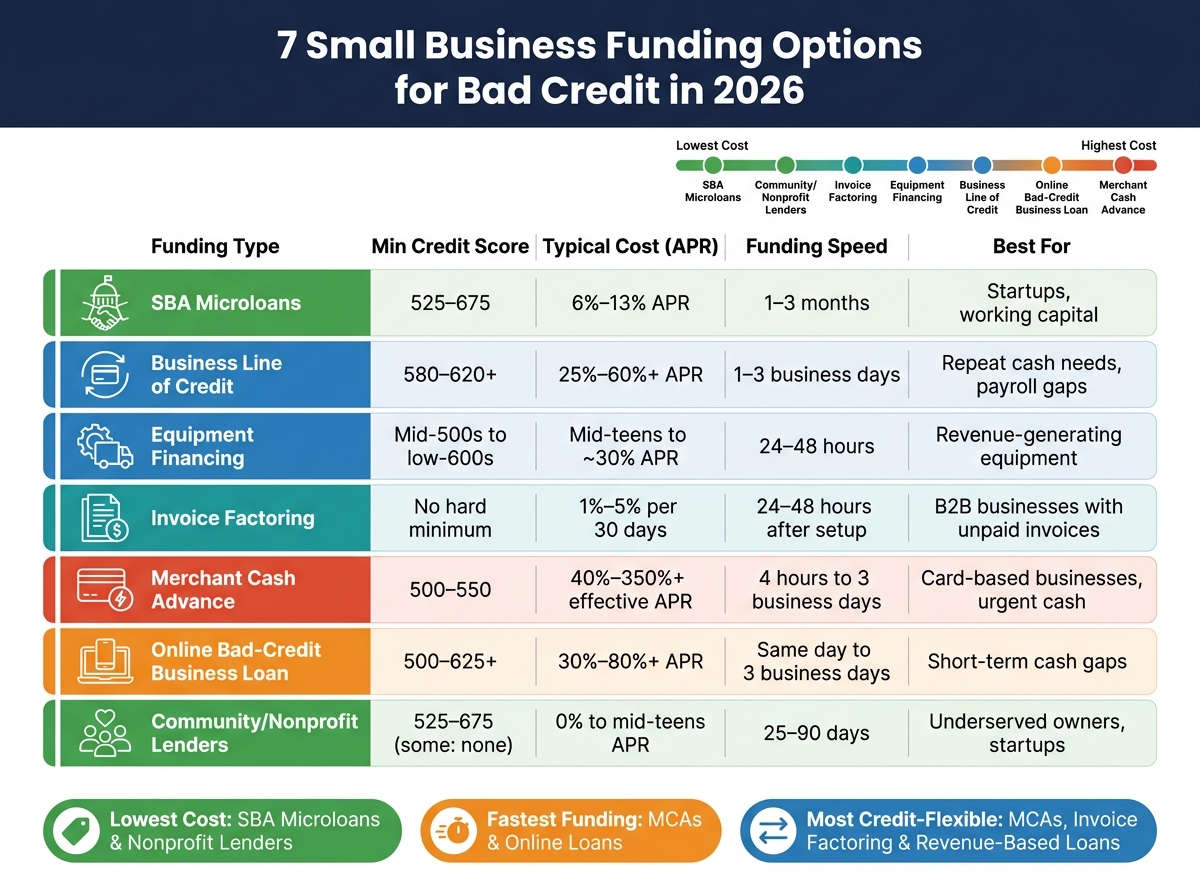
7 Small Business Funding Options for Bad Credit: Cost, Speed & Requirements (2026)
Bad Credit Business Loans (15 Ways to Get Funded Anyway)
sbb-itb-1eb586e
Quick Comparison
| Option | Best for | Credit flexibility | Typical cost | Funding time |
|---|---|---|---|---|
| SBA Microloans | Startups, small working capital needs | Mid | 6%–13% | 1–3 months |
| Business Line of Credit | Repeat cash needs | Mid | 25%–60%+ APR online | 1–3 business days |
| Equipment Financing | Buying revenue-producing equipment | Mid to high | Mid-teens to ~30% APR | 24–48 hours for some deals |
| Invoice Factoring | B2B invoices | High | 1%–5% per 30 days | 24–48 hours after setup |
| Merchant Cash Advance | Urgent cash for card-based businesses | High | 40%–350%+ effective APR | 4 hours to 3 business days |
| Online Bad-Credit Loan | Short-term cash gaps | High | 30%–80%+ APR | Same day to 3 business days |
| Community/Nonprofit Lenders | Lower-cost funding with weaker credit | Mid to high | 0% to mid-teens | 25–90 days |
Bottom line: if I can wait, I’d usually start with microloans or nonprofit lenders. If I need cash fast, I’d compare online loans, lines of credit, factoring, and MCAs – and check the full repayment cost before I sign anything.
1. SBA Microloans
SBA microloans are often the first place to look if you have bad credit and need a smaller loan at a lower cost. Loan amounts run from $500 to $50,000, and the average loan size is about $13,000 to $15,000. These loans come from nonprofit intermediary lenders, not straight from the SBA.
Some lenders may work with borrowers whose credit scores are as low as 525 to 550. That said, your score usually isn’t the whole story. Lenders often want to see a clear business plan, solid industry experience, a specific plan for how you’ll use the money, and a realistic way to repay the loan through cash flow or projections. The tradeoff is pretty simple: you may get easier approval terms and lower rates, but the loan amount will be smaller.
Most lenders still ask for collateral and a personal guarantee from owners with 20% or more ownership. Interest rates usually fall between 6% and 13%, with repayment terms of up to 6 years. Funding isn’t instant, though. It often takes 1 to 3 months.
These loans are a good fit for things like funding your startup business, working capital, inventory, supplies, equipment, and fixtures. They can’t be used to buy real estate or refinance debt. Another detail that sets them apart: lenders must also offer business training and technical help.
If you need repeat access to funds instead of a one-time loan, the next section covers business lines of credit.
| Feature | Details |
|---|---|
| Loan Range | $500 – $50,000 |
| Average Loan Size | $13,000 – $15,000 |
| Interest Rates | 6% – 13% |
| Repayment Term | Up to 6 years |
| Typical Credit Score | 525 – 675 |
| Funding Timeline | 1 to 3 months |
| Best For | Working capital, inventory, supplies, furniture, fixtures, and equipment |
| Not Allowed | Real estate purchases, debt refinancing |
2. Business Lines of Credit
If you need repeat access to cash instead of a one-time loan, a business line of credit is often the next place to look. The lender gives you a set limit – say, $25,000 – and you draw from it when cash gets tight. You pay interest only on the amount you use, then repay it to open that amount back up again. That setup makes a line of credit a good fit for recurring cash-flow gaps like payroll, slow customer payments, or seasonal inventory restocks.
For borrowers with bad credit, approval often leans more on revenue and cash flow than on credit score alone. Many online lenders work with scores around 580–620+ if the business brings in steady revenue and recent bank statements show money moving through the account. In plain English: solid cash flow can help make up for a weaker personal score.
The tradeoff is cost. Bad-credit business lines usually come with high APRs, so they make the most sense when you borrow for short stretches. Online lenders often charge 25%–60%+ APR, and some tack on draw fees, maintenance fees, or renewal fees. Used for a short-term gap, that can still work. But if you carry a balance month after month, the cost can snowball fast.
Speed is another big plus. Online lenders can often approve and fund a line of credit in 1–3 business days, and some offer same-day decisions for smaller credit limits.
On-time payments may also help rebuild your credit if the lender reports to business or personal credit bureaus.
If you need funding tied to a specific asset, the next option is equipment financing.
| Feature | Details |
|---|---|
| Credit Score Range | 580–620+ for many online lenders; 680+ for banks |
| Typical Credit Limit | $5,000–$50,000 for many bad-credit lines; some lenders go up to $100,000 |
| Interest Rates (APR) | 25%–60%+ for bad-credit online lines; 8%–18% for bank lines |
| Time in Business | 6–12 months minimum for many online lenders |
| Revenue Requirement | $10,000–$25,000/month |
| Funding Speed | 1–3 business days for online lenders |
| Best For | Payroll gaps, working capital, recurring inventory needs |
| Watch Out For | Draw fees, maintenance fees, renewal fees, and high APR on sustained balances |
3. Equipment Financing
If your business needs a specific piece of equipment, like a delivery truck, commercial oven, CNC machine, or dental chair, equipment financing is often one of the easier paths to funding when your credit isn’t in great shape. The reason is pretty simple: the equipment itself acts as collateral. If you stop making payments, the lender can repossess it and sell it to recover part of what you owe.
Because of that, lenders focus heavily on the equipment when they review the deal. Your credit score still matters, but usually less than the asset’s resale value and whether your business can handle the monthly payment. This setup tends to work best when the equipment can help pay for itself through new sales, jobs, or client work.
Some lenders may work with borrowers in the mid-500s to low-600s, especially when the equipment has solid resale value and the business brings in enough revenue to support the loan payment. That makes this option a good fit when the asset will directly bring in money. Rates are still higher than what borrowers with strong credit usually get, but they can be easier to manage than some other bad-credit funding products.
For weaker credit profiles, APRs often fall in the mid-teens to around 30%, and down payments usually range from 5% to 20%. If your credit profile is weaker, you’ll likely land closer to the high end of that down payment range. Repayment terms are often 24 to 84 months with fixed monthly payments, which can make planning a lot easier.
A strong asset that brings in revenue can help make up for weak credit, as long as the payment fits your current cash flow.
Some lenders can approve deals under $150,000 in 24 to 48 hours, with funding coming after document review is done. In most cases, you’ll need recent bank statements, a business tax return, and a detailed equipment quote. The main downside is direct and hard to miss: if you default, you could lose the equipment your business relies on. Some lenders may also require a personal guarantee.
The table below shows the key terms to compare.
| Feature | Details |
|---|---|
| Typical Minimum Credit Score | Often mid-500s to low-600s, depending on lender and collateral strength |
| Down Payment | 5%–20%; bad-credit borrowers usually see the higher end |
| Interest Rates (APR) | Mid-teens to around 30% for bad-credit profiles |
| Repayment Terms | 24–84 months, usually fixed payments |
| Approval Speed | 24–48 hours for some application-only deals under $150,000 |
| Best For | Revenue-generating hard assets such as trucks, machinery, and kitchen equipment |
| Main Risk | Equipment repossession if you default; a personal guarantee may also be required |
4. Invoice Factoring
If your business sends invoices to other businesses, invoice factoring can help you get paid without sitting around for Net 30 or Net 60 terms to run out. The idea is simple: you sell unpaid invoices to a factoring company at a discount, and in return, you get cash up front.
One reason factoring stands out is that approval leans more on your customers’ credit than on your own. That makes it a good match for B2B companies that work with slow-paying but creditworthy buyers, such as manufacturers, staffing firms, trucking companies, and IT consultants.
Here’s how it usually works. You send an invoice, pass it to the factoring company, and then receive 80% to 90% of the invoice amount up front. In some cases, that can go as high as 95% when the customer has strong credit. Funding often lands within 24 to 48 hours, though the first setup usually takes a few business days. After your customer pays the invoice, you receive the rest of the balance, minus the factoring fee.
That speed can be a lifesaver for cash flow. But there’s a catch: the price can add up fast. Factoring fees usually range from 1% to 5% per 30 days. And if an invoice pays late, your total cost climbs with it.
There’s also a risk split to watch. With recourse factoring, the nonpayment risk comes back to you. With non-recourse factoring, the factor takes on more of that risk, but you’ll usually pay more for it. That trade-off matters, especially if you work with buyers who tend to drag their feet.
Next, compare this with merchant cash advances, which also trade speed for higher cost.
| Feature | Details |
|---|---|
| Typical Minimum Credit Score | No hard minimum; approval is based mainly on customer creditworthiness |
| Advance Rate | 80%–95% of invoice value |
| Factoring Fee | 1%–5% per 30 days |
| Funding Speed | 24–48 hours after setup; initial onboarding takes a few business days |
| Best For | B2B businesses with Net 30/60 invoices and slow-paying but creditworthy customers |
| Main Risk | High effective cost if invoices pay late; recourse arrangements can create repayment obligations if the customer does not pay |
5. Merchant Cash Advances
If your business brings in money through card payments instead of invoices, a merchant cash advance can be a fast way to get cash. It’s often used when credit is weak but card sales are steady. With an MCA, you get cash up front and repay it through a fixed share of your future daily card sales, known as a holdback, until the advance plus fees is paid off. That holdback usually ranges from 5% to 20% of daily card receipts, so payments go up and down with sales volume.
This is one reason MCAs are often easier to qualify for than many other bad-credit funding options. Providers usually care more about card volume and monthly revenue than personal credit. Many look for a minimum credit score of about 500 to 550, at least 6 months in business, and monthly revenue of around $8,000 to $20,000 or more. For example, one MCA product may ask for 6 months in business, $20,000 in monthly revenue, and a 550+ credit score.
The big draw here is speed. The downside is cost.
MCA pricing uses a factor rate, not an interest rate. So if you take a $50,000 advance with a factor rate of 1.3x, you repay $65,000 in total. Factor rates often fall between 1.10x and 1.55x, and the effective APR can land anywhere from 40% to 350%+. That’s why it helps to look past the amount you receive up front. Focus on the full repayment amount and how the daily deductions will hit your cash flow.
MCAs tend to make the most sense for urgent, short-term cash needs when a business has steady daily or weekly card sales. That includes businesses like retail stores, restaurants, salons, auto repair shops, and service companies. They’re usually a poor fit for long-term purchases or businesses with thin margins, since the frequent repayments can eat into cash on hand fast.
| Feature | Details |
|---|---|
| Typical Minimum Credit Score | 500–550; approval is driven mainly by card volume, revenue, and time in business. |
| Factor Rate Range | 1.10x–1.55x. |
| Effective APR Equivalent | 40%–350%+. |
| Holdback Rate | 5%–20% of daily card sales. |
| Funding Speed | Approval in 4–24 hours; deposit in 1–3 business days, sometimes same day. |
| Best For | Retail, restaurants, salons, auto repair shops, and service businesses with steady card sales and urgent working-capital needs. |
| Main Risk | Very high effective cost; frequent repayments can strain cash flow. |
6. Online Bad-Credit Business Loans
Online lenders usually care more about your bank deposits, monthly revenue, and time in business than your FICO score. That can make a big difference if your credit is weak but your cash flow is steady. When a bank turns you down, online lenders are often the fastest practical backup. In that sense, they sit in the middle: more reachable than bank loans, but usually less harsh than the most expensive fast-cash products.
Most lenders want credit scores somewhere in the 500–625+ range. They also tend to ask for a few months in business and minimum revenue, such as about $10,000 in monthly deposits or around $30,000 in annual revenue. If your score is under 600, lenders that rely on bank statements or revenue-based underwriting are often the easiest to work with.
The catch is cost. Short-term online loans often fall in the rough 30% to 80% APR range, and some products can run even higher. Terms are usually short too, often three to eighteen months, which can push payments up fast. These loans make more sense for short cash gaps than for projects that may take a long time to pay off.
Before you apply, gather three to six months of bank statements and recent revenue records. Lenders pay close attention to steady deposits. If your sales go up and down from month to month, a repayment setup tied to revenue may feel easier than a fixed weekly or monthly payment.
If the price or payment setup still feels too tight, community-based and nonprofit lenders are usually the next place to look.
| Feature | Details |
|---|---|
| Typical Minimum Credit Score | 500–625+ depending on lender and product; revenue and deposits often matter more. |
| Typical APR Range | Roughly 30%–80%+, with some factor-rate or revenue-based products costing more depending on repayment speed. |
| Repayment Terms | 3–18 months; some products offer 12- or 24-week repayment schedules. |
| Funding Speed | Same day to 1–3 business days; some revenue-based products fund within 24–72 hours. |
| Best For | Inventory, payroll gaps, emergency repairs, marketing spend, short-term working capital. |
| Main Risk | High effective cost; short terms create repayment pressure if revenue dips. |
7. Community-Based and Nonprofit Lenders
When online loans cost too much, community-based lenders are often the next place to look. If banks say no and online lenders want too much in interest or fees, CDFIs and nonprofit lenders can be the lowest-cost path for borrowers with bad credit. The tradeoff is simple: less speed, lower cost.
These lenders are set up to serve people banks often pass over, including startups, low-income entrepreneurs, women- and minority-owned businesses, and owners with thin or damaged credit files. Instead of focusing mostly on your FICO score, they often spend more time looking at your business plan, cash-flow projections, and the effect your business may have on the local community.
Credit rules can also be looser here. Many CDFIs work with scores as low as 525 to 550, and some programs do not set a formal minimum at all. Kiva US stands out because it offers 0% interest, no fees, and no minimum credit score. There is a catch, though: before your loan goes public on the platform, you have to get support from friends, family, or customers first. That makes Kiva US a good fit for small startup costs or light working-capital needs. It takes more time, but the terms can be hard to beat.
If you need more than a small microloan, CDFIs can also offer fixed-rate term loans for working capital, inventory, and equipment. Groups like DreamSpring, Accion Opportunity Fund, TruFund, and ACE may also include free business coaching or technical help with the loan. That extra support can matter a lot, especially if you’re still figuring things out as you go.
The main downside is time. Total CDFI funding timelines usually run about 25 to 60 days. In some cases, approval can stretch to about 25 to 90 days, depending on the program and how fast you can get your documents in. You’ll usually need tax returns, bank statements, a use-of-funds plan, and cash-flow projections. So yes, there’s more paperwork. But if you can wait, the lower cost and softer underwriting may make these lenders a strong option for bad-credit borrowers.
| Feature | Details |
|---|---|
| Typical Minimum Credit Score | 525–675 depending on lender; some programs have no minimum. |
| Typical APR Range | Often in the single to mid-teens; Kiva US is 0% interest with no fees. |
| Microloans / Larger Loans | ~$500–$50,000 for microloans; up to $250,000–$350,000 via Community Advantage. |
| Repayment Terms | Up to 6 years for microloans; up to 10–25 years for Community Advantage loans. |
| Approval Timeline | Roughly 25–90 days depending on program and document readiness. |
| Best For | Startups, underserved owners, credit-building, working capital, inventory, equipment. |
| Main Tradeoff | Slower than online lenders; requires more documentation and may have local eligibility rules. |
Pros, Cons, and Tradeoffs by Funding Type
After looking at each option one by one, this table makes the day-to-day tradeoffs easier to see. It lines up the seven bad-credit funding options by speed, cost, and repayment pressure.
If you want the short version, this is the quickest way to compare what you’re giving up to get access to capital.
| Funding Type | Key Pros | Major Drawbacks | Risk to Borrower | Not a Fit For |
|---|---|---|---|---|
| SBA Microloans | More flexible than bank loans; lower rates around 8%–13% APR | Capped at $50,000; slower approval; requires business plan and documentation | Moderate – personal guarantee and sometimes collateral required | Businesses needing more than $50,000 or funding within days |
| Business Lines of Credit | Revolving access; borrow only what you need; often funded within 1–3 business days | Bad-credit lines carry high variable rates and fees; personal guarantee is common | Moderate to High – risk rises if heavily used at high rates | Owners who tend to overuse revolving debt |
| Equipment Financing | The equipment secures the loan; can finance up to 100% of equipment value | Restricted to equipment purchases; lender can repossess if you default; bad-credit rates run much higher than prime | Moderate – asset-backed, but default can disrupt operations | Businesses needing cash for payroll, rent, or operating costs |
| Invoice Factoring | Approval based mainly on your customers’ credit, not your own; funding often in 1–3 business days | Factor fees of 1%–5% per 30 days can erode margins; factor may contact your customers; only works for B2B invoicing | Moderate – recourse provisions can create unexpected repayment obligations | B2C businesses or operations that don’t issue invoices |
| Merchant Cash Advances | Very fast access, usually within 24–72 hours; flexible underwriting; payments adjust with daily revenue | Among the most expensive options, with effective APRs often around 40%–350%; daily or weekly debits can strain cash flow | High – expensive, fast-moving debt creates serious cash-flow pressure | Businesses with thin margins or uneven revenue cycles |
| Online Bad-Credit Business Loans | Fast online applications; funding in hours to a few days | APRs can be 30%–50%+ for subprime borrowers; short terms with frequent ACH debits | High – personal guarantees and frequent withdrawals increase personal and cash-flow risk | Businesses with structural cash-flow problems or very thin margins |
| Community-Based and Nonprofit Lenders | Lower cost; mission-driven underwriting focused on business potential; some programs cap rates around 7% and include technical assistance | Slower timelines; smaller loan sizes; eligibility may be tied to geography or mission criteria | Low to Moderate – patient terms, but default can still damage credit | Established businesses needing large capital fast |
Use this side-by-side view to narrow the field by price, funding speed, and how hard repayment will hit your cash flow.
Which Bad-Credit Funding Option Is Right for You in 2026?
The best choice depends on a few plain, practical questions: How fast do you need the money? How strong is your credit? What will you use the funds for? What can you pledge as collateral? And what can you comfortably repay each month? Once you answer those, the list usually gets much shorter.
If you need steady access to working capital, a business line of credit usually makes the most sense. Bank lines tend to favor borrowers with stronger credit, while fintech lines are often easier to get but come with higher costs.
If you’re running a startup or an early-stage business, SBA microloans and community lenders are often a better match. They work well for smaller funding needs and often use softer underwriting.
If speed matters most, look at merchant cash advances (MCAs) or online bad-credit loans. They can fund fast, but MCAs cost much more than microloans or community-based lending. If your problem is unpaid invoices, invoice factoring may be the better route because approval leans more on the quality of your receivables than on your personal credit score.
One more thing here: MCAs usually don’t report to credit bureaus, so they typically won’t help you build business credit over time. A business line of credit, if you repay it on time, can help on that front.
For equipment purchases, equipment financing is usually the cleanest fit because the equipment itself secures the loan.
Use this quick guide to narrow the field:
| Best fit | Top Funding Options | Main approval driver |
|---|---|---|
| Startups / Early-Stage | SBA microloans; community/nonprofit lenders | Business plan and cash-flow potential |
| Ongoing Working Capital | Business lines of credit | Revenue and bank deposits |
| Urgent cash gaps | Merchant cash advances; online bad-credit loans | Card volume or monthly revenue |
| Predictable monthly payments | SBA microloans; equipment financing; longer-term online loans | Asset value or business cash flow |
| Most credit-flexible | MCAs; revenue-based loans; invoice factoring | Cash flow or invoice quality |
| Equipment Purchases | Equipment financing; SBA microloans | Equipment value and repayment capacity |
A bad fit usually shows up in your cash flow almost right away. If the repayment starts squeezing your business before the money has time to earn its keep, the financing likely costs too much. In that case, waiting for a slower, lower-cost option like a microloan or equipment loan can be the smarter move.
FAQs
Can I get business funding with a credit score under 500?
Sometimes, yes. SBA-backed funding can still be on the table with a credit score below 500, especially through SBA Microloans.
These loans come from nonprofit intermediary lenders, so the rules can vary from one lender to the next. You’ll still need a strong, SBA-compliant business plan, along with the usual supporting documents.
Which option is safest if I need cash fast?
If you need cash fast, SBA Express loans are one of the main options to look at. They’re built for approval within 36 hours, which can make them a faster route to funding than standard SBA 7(a) loans. Those loans often come with more paperwork and a longer review process.
For smaller funding needs or startup costs, SBA microloans can also be easier to access. That said, approval often takes one to three months.
In both cases, a solid business plan and well-organized documents can help move things along faster.
What documents do I usually need to apply?
You’ll usually need a business plan that spells out your business model, your view of the market, and how you plan to use the money. You’ll also need financial details, such as personal and business statements, cash flow records, and projections.
Lenders often ask for proof that your business is properly set up, like an EIN, along with a business bank account. Some may also ask for a personal guarantee or collateral paperwork.
Leave a Reply