
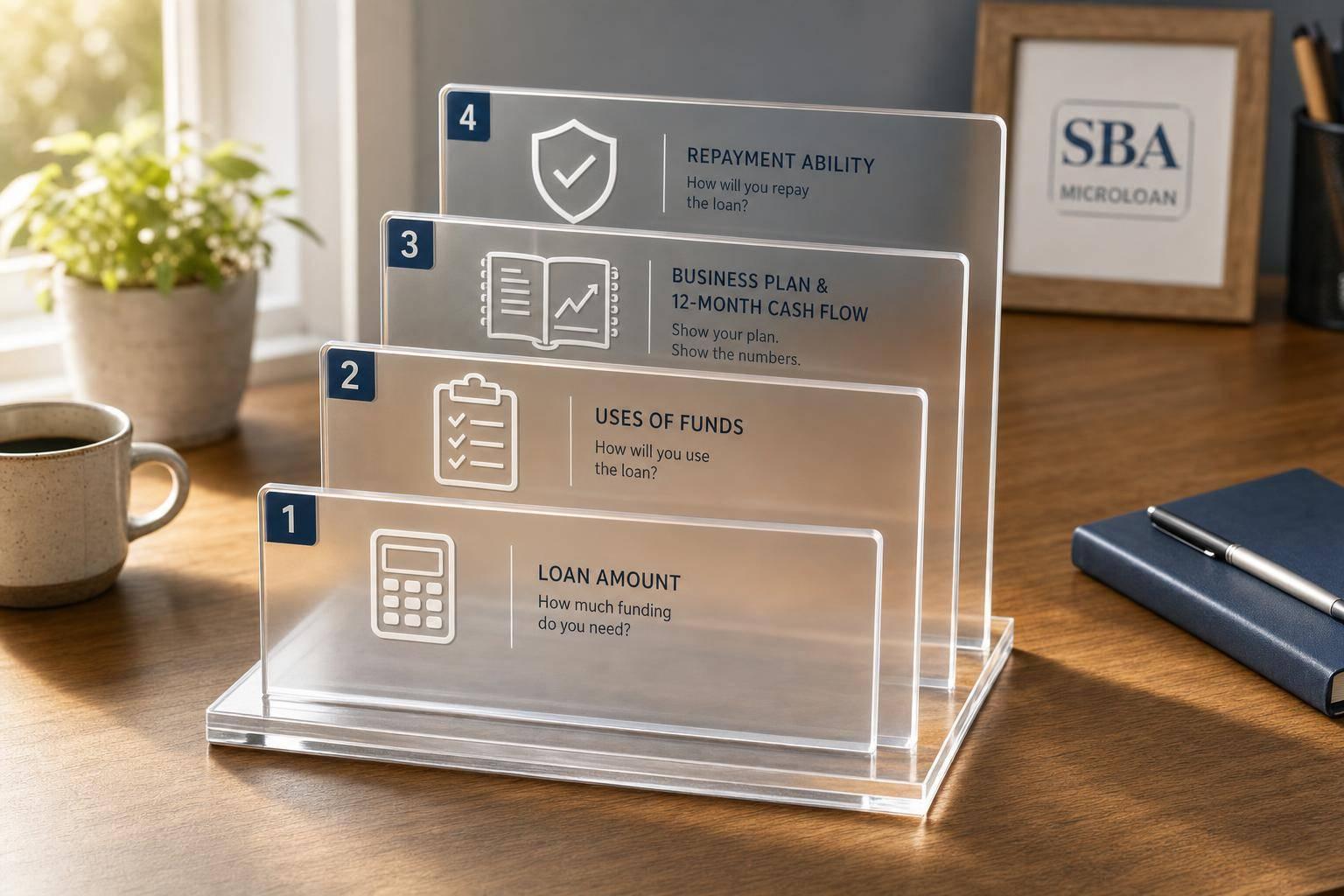
If I want a better shot at an SBA Microloan, I need to show three things fast: how much I need, what I’ll use it for, and how I’ll pay it back. The program offers up to $50,000, but most loans are much smaller, often around $13,000 to $15,000. That means a loose request can hurt the application.
Here’s the short version:
- I need to apply through an SBA intermediary lender, not the SBA itself.
- I should ask for a specific dollar amount tied to quotes, invoices, or estimates.
- I can use funds for things like inventory, equipment, working capital, rent, utilities, marketing, and startup costs.
- I can’t use the money for real estate or to pay off old debt.
- I need a business plan, a 12-month cash flow forecast, financial statements, and support for my spending plan.
- The lender may also check credit, experience, collateral, current debts, and a personal guarantee.
- Approval can take about 2 weeks to 3 months.
The bottom line is simple: I should keep the request clear, the paperwork complete, and the repayment plan easy to follow. That gives the lender what it needs to make a decision.
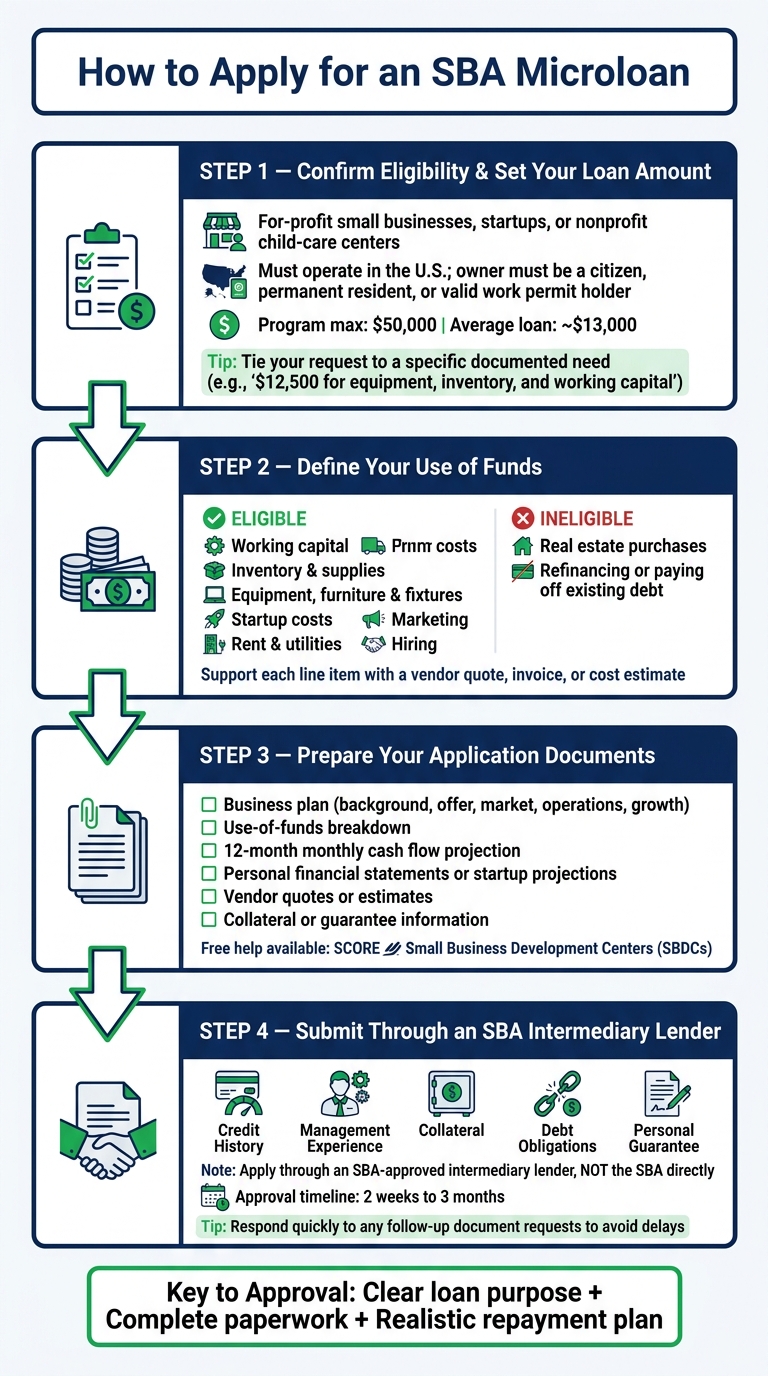
How to Apply for an SBA Microloan: Step-by-Step Guide
Confirm eligibility and choose a realistic loan amount
Check business status, location, size, and industry
Start by making sure your business fits the SBA Microloan program rules. The program is open to for-profit small businesses, startups, and certain nonprofit child-care centers.
Your business also needs to operate in the United States. Applicants must be U.S. citizens, permanent residents, or non-citizens with valid work permits. On top of that, the business must meet SBA size standards for its industry.
Once those basics check out, the next step is simple: tie your loan request to a clear business need.
Match the loan request to a documented business need
Lenders don’t want a random number. They want an amount that lines up with a clear use of funds.
The SBA Microloan program allows up to $50,000, but the average loan is about $13,000. That’s why it helps to ask for what you need, not just a round figure that sounds good on paper.
Instead of saying you’re requesting $15,000, spell it out. For example: $12,500 for equipment, opening inventory, and initial working capital. That level of detail shows exactly where the money will go and helps the lender judge whether the request makes sense.
Support each amount with a vendor quote or cost estimate. It’s a small step, but it can make your request look much more grounded.
sbb-itb-1eb586e
Define eligible uses of funds and build the loan request
Break the loan request into specific business expenses
Once you’ve set your loan amount, tie it directly to approved business uses. Then spell out exactly where the money will go. Break the request into clear line items, and attach a quote, invoice, or estimate for each expense.
Keep the total in line with your 12-month cash flow projection. That expense breakdown will also feed into your business plan and cash flow projection.
Eligible and ineligible SBA Microloan uses
Clear, documented expenses make the request easier to underwrite. But there are two hard limits: real estate purchases and refinancing or paying off existing debt are not allowed.
Eligible uses:
- Working capital
- Inventory and supplies
- Furniture and fixtures
- Equipment purchases or repairs
- Startup costs and franchise fees
- Marketing and advertising
- Rent, utilities, and operating costs
- Hiring employees or consultants
Ineligible uses:
- Real estate purchases
- Refinancing or paying off existing debt
Not sure if a certain expense fits? Check with your intermediary lender before adding it to the request. Intermediary lenders also look closely at credit and use-of-funds details.
After the use of funds is nailed down, the next step is the paperwork that shows the business can repay. Then you’ll connect those expenses to repayment in your business plan and monthly forecast.
Prepare the business plan, financial documents, and cash flow projection
Write a basic business plan that supports the loan request
Take your approved spending plan and turn it into a clear story a lender can follow. The goal is simple: show how the business will use the money and how it will pay the loan back. Keep the plan short and focused on the parts that matter most: your background, your products or services, your target customers, day-to-day operations, your growth plan, and what supports repayment.
Spell out how the expenses you’re asking to fund will lead to revenue. A lender wants to see the link between the money going out and the money coming in. If you’re asking for equipment, inventory, or working capital, explain how that spending helps generate sales and cover loan payments.
If you want help putting the plan together, SCORE and Small Business Development Centers (SBDCs) offer free guidance on business plans.
Build a 12-month monthly cash flow projection
If you’re a startup, use projections. If your business is already up and running, include recent financial results too. Then build a month-by-month forecast for the next 12 months using conservative assumptions. That forecast should cover projected revenue, major operating costs, and the loan payment.
This is where the numbers need to make sense on paper. The projection should show that repayment is doable without stretching the business too thin.
Once that picture is in place, pull together the rest of the documents for submission.
Put together a lender-ready document checklist
Use this checklist to build the full application package.
| Document | Notes |
|---|---|
| Business plan | Background, offer, market, operations, growth |
| Use-of-funds breakdown | How every dollar will be spent |
| Personal financial statements and business projections | Current financials or startup projections |
| 12-month cash flow projection | Monthly repayment evidence |
| Vendor quotes or estimates | Supports equipment or inventory requests |
| Collateral or guarantee information | Varies by intermediary |
Check the intermediary’s requirements now so nothing holds up the application later.
With these documents in place, the next step is to show repayment ability and submit the application through the intermediary lender.
SBA Microloans: A Complete Guide for Startups and Small Businesses
Show repayment ability and submit through an intermediary lender
Once your plan, projections, and use-of-funds breakdown are ready, the next thing a lender wants to know is pretty straightforward: can the business pay the loan back?
That’s the heart of the review. Credit score matters, sure. But intermediary lenders usually look at the whole file, not just one number, and many set their own minimum standards.
What intermediary lenders may review
Here’s what they may look at and what you should be ready to hand over:
| Evaluation Area | Evidence to Provide |
|---|---|
| Credit History | Personal and business credit reports; explanation letters for past issues |
| Management Experience | Resume showing relevant industry experience |
| Collateral | Business assets (equipment, inventory) or personal assets (vehicles, real estate) |
| Debt Obligations | Schedule of current loans and monthly payments |
| Personal Guarantee | Many lenders require a personal guarantee from owners with 20% or more equity |
A lender is trying to piece together a simple story: have you handled credit responsibly, do you know how to run this type of business, what assets back the loan, what debts are already on the books, and who stands behind the repayment if things get bumpy?
How to address credit problems in your application
Past credit problems don’t automatically knock you out. What matters is how you deal with them in the application.
Write a short explanation letter that says what happened, when it happened, and what’s different now. Keep it plain and honest. No need to dance around it. Then attach records that back up your explanation, such as a payment plan agreement, a resolved-account letter, or proof of stronger recent payment history. That helps show the lender the old issue doesn’t tell the whole story.
If your score still isn’t strong enough by itself, a cosigner with solid income and credit can help strengthen the file.
Final steps before submitting your application
Before you send anything in, find an SBA-approved intermediary lender and confirm exactly what documents it wants. Then complete the application, authorize the credit check, and submit the full package.
After that, stay on it. If the lender asks for follow-up documents, send them back fast. Delays often come from missing paperwork, not from the form itself. Approval can take anywhere from two weeks to three months, depending on the lender.
FAQs
How much should I ask for?
You can request up to $50,000, although most borrowers end up receiving around $14,000 to $15,000. Some lenders go as low as $500.
The amount you ask for should line up with your business plan and your use-of-funds statement. In plain English, the numbers need to make sense on paper. If you ask for too much without a clear reason, that can be a red flag.
Lenders also want to see that you can pay the money back. A common benchmark is a debt-service coverage ratio of 1.15x to 1.25x, backed by cash-flow projections that are realistic and grounded in how the business actually operates.
What if my credit is weak?
Weak or limited credit doesn’t automatically rule you out for an SBA microloan. Many intermediary lenders look at the full picture. That includes your business plan, cash flow projections, and your ability to repay the loan.
You can improve your odds by:
- Providing a strong business plan
- Offering collateral
- Using a cosigner with stronger credit
- Clearly explaining any past credit issues
A lower credit score can be a hurdle, sure. But it usually isn’t the whole story.
How long does approval usually take?
Approval for an SBA microloan usually takes 2 to 4 weeks.
Some applications move through in as little as 2 weeks. Others take several more weeks and, in some cases, up to 3 months, depending on the intermediary lender and its review process.
Leave a Reply