
If I want a lender to take my business idea seriously, I need more than a pitch. I need proof, a clear budget, and a plan to repay the loan.
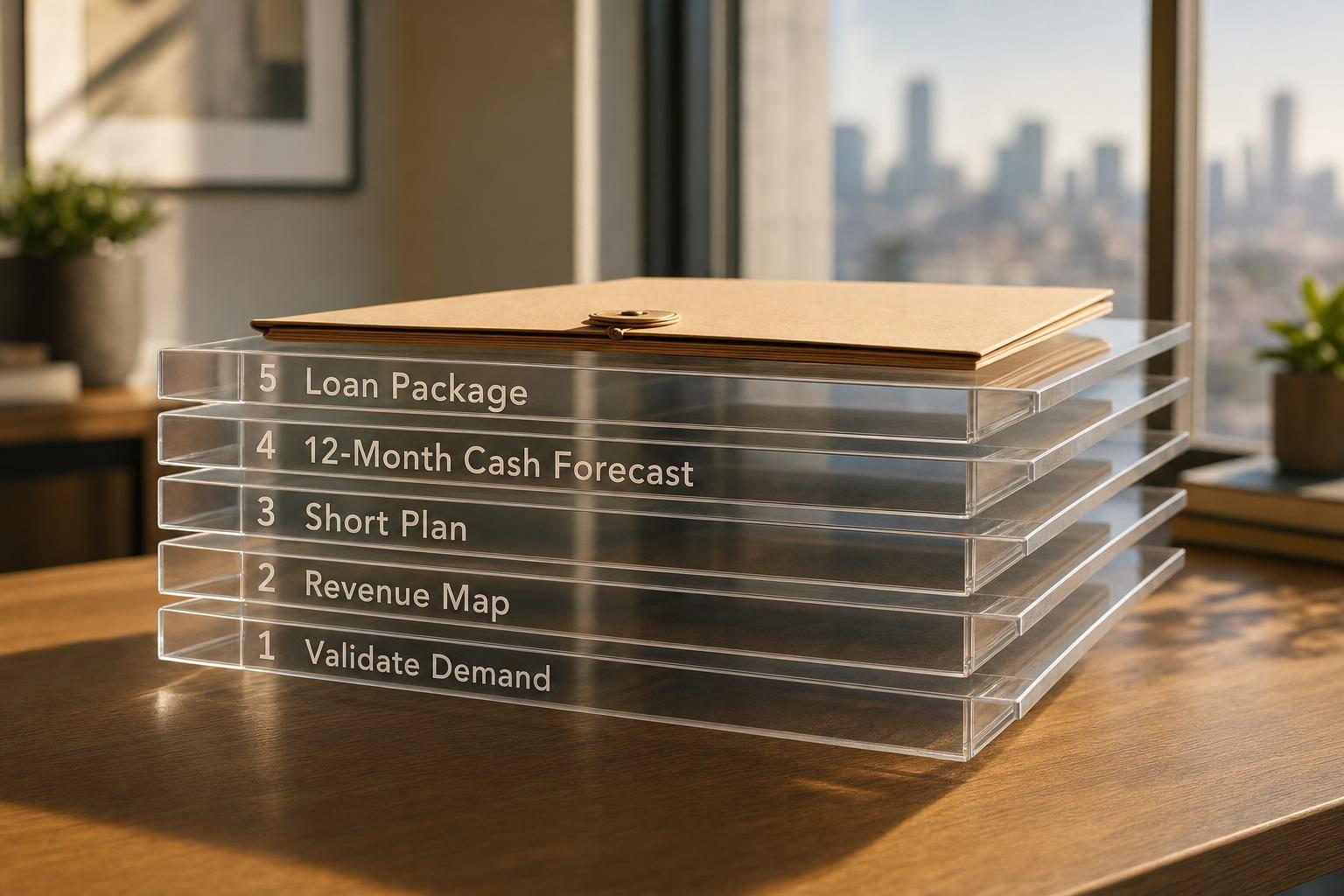
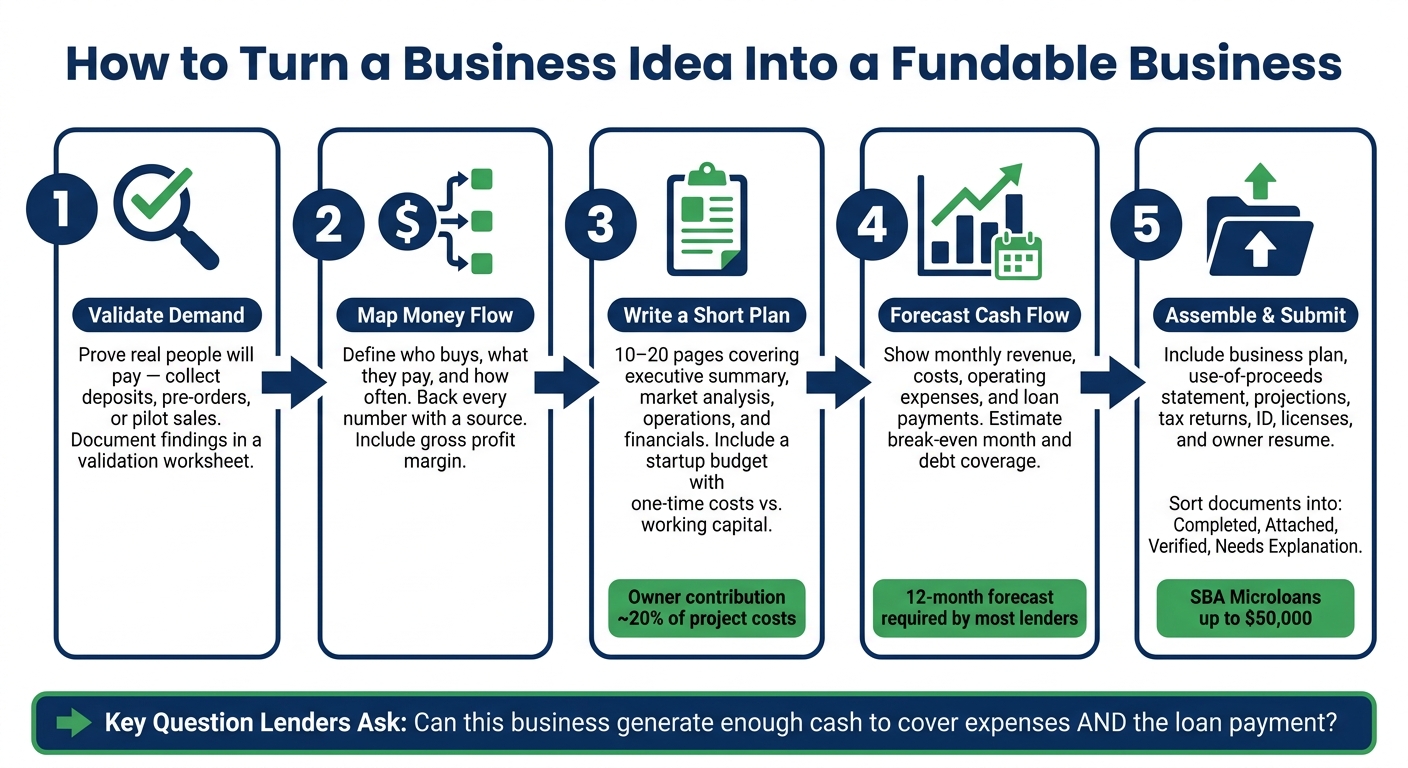
This article comes down to five steps: test demand, map how money comes in, write a short plan, build a 12-month forecast, and submit a clean loan package. It focuses on early-stage U.S. founders who may be looking at startup loans or SBA microloans up to $50,000.
Here’s the short version:
- I need to show that people will pay, not just say they like the idea.
- I need a business model that shows who buys, what they pay, and how often.
- I need a simple business plan, usually around 10 to 20 pages.
- I need a startup budget that separates one-time costs from working capital.
- I need a 12-month cash flow forecast that includes loan payments.
- I need a file with the main documents lenders ask for, from the plan to my financial statements.
A few numbers matter early:
- SBA microloans can go up to $50,000
- Some lenders want the owner to put in about 20% of project costs
- A 12-month forecast is often expected
- Industry experience and personal credit can affect approval
What matters most is simple: can this business make enough cash to cover its bills and the loan payment? That’s the question the article answers step by step.
How to Turn a Business Idea Into a Fundable Startup Loan Application
SBA Loans Explained (How to Actually Get Approved in 2026)
sbb-itb-1eb586e
1. Validate Your Idea With Evidence, Not Opinions
Validation turns a guess into evidence lenders can use. Before you write a business plan or estimate revenue, you need proof that real people will pay for what you’re selling.
That proof is the basis of your business model.
Define Your Customer, Problem, and Offer in One Sentence
Start with one clear sentence: who is your customer, what problem do they have, and what do you sell to fix it? Stick to one customer group, one problem, and one offer. If your description is too broad, it’s much harder to prove demand.
Test Willingness to Pay With Small, Concrete Proof
Compliments and likes don’t count as demand. Paid demand does.
You need small, concrete proof that people will open their wallets. That can be a deposit, a sale, or a paid pilot. If someone says your idea is great but won’t pay for it, that signal doesn’t help much.
Record Market Research in a Simple Validation Worksheet
Document your findings in a simple worksheet. Use it to record the evidence behind your revenue assumptions.
| Worksheet Element | What to Record | Why It Matters to Lenders |
|---|---|---|
| Target customer demographics | Age, location, income, buying habits | Confirms there is a reachable market |
| Competitor pricing/analysis | Price range, service tiers, gaps | Supports your pricing strategy |
| Evidence of demand | Pre-orders, deposits, pilot sales | Shows customers will actually pay |
| Current alternatives | Current alternatives or workarounds | Strengthens your value proposition |
Use this evidence to back up your pricing and revenue assumptions in the next section.
With demand documented, the next step is to show how the business will make money.
2. Build a Business Model That Shows How Money Flows
A business model explains what you sell, who buys it, and how money comes in. Lenders want to know who the customer is, what that customer pays, how often they buy, and whether that cash flow can cover the loan payment. Use the proof from your validation work to shape the revenue model a lender will review. In plain terms, your demand research should feed these numbers.
Map the Path From Customer to Cash Flow
Start with the path from a buying decision to money in your account. Lenders want each step spelled out, with clear assumptions and proof behind them.
| Business Model Input | Example | Why It Matters to Lenders |
|---|---|---|
| Customer segment | Defined local market | Confirms a reachable, defined buyer |
| Offer | Recurring product or service | Shows a repeatable revenue source |
| Average sale | Price per sale or subscription | Sets the revenue baseline |
| Purchase frequency | How often customers buy | Determines annual revenue per customer |
| Sales channel | Referrals, local ads, or direct outreach | Shows how customers are acquired |
| Direct costs | Labor and supplies per sale | Reveals gross profit margin |
From there, estimate annual revenue and gross profit using your average sale, purchase frequency, and direct costs. Gross profit is what helps pay overhead and debt. If that link is fuzzy, lenders will notice fast. They want to see the money trail without having to guess.
Once that revenue logic is on the page, move to the day-to-day details behind it.
List the Operating Details Behind the Model
After the money flow is mapped, lenders look at whether you can run the model in practice. That means laying out your suppliers, equipment, staffing, delivery process, and fixed costs like rent, insurance, software, and licenses. These details connect straight to repayment risk. If costs are missing or the setup looks thin, that can be a red flag.
Experience matters too. Some lenders put a lot of weight on at least two years of industry experience because it lowers execution risk. If you’ve done this kind of work before, say it plainly. If someone on your team brings that background, document it. A solid model on paper can still fall apart if the operator doesn’t look credible.
Use an Assumptions Table With a Source for Each Entry
Treat every number as an assumption until you can back it up. A simple two-column table that lists each assumption and its source helps turn rough guesses into inputs a lender can follow.
| Assumption | Source or Evidence |
|---|---|
| Target market | Validated demand evidence from prior research |
| Pricing | Confirmed by competitor pricing and pilot sales |
| Labor cost | Supplier or staffing quote |
| Monthly rent for storage | Lease terms or landlord quote |
| Owner manages operations | Resume and industry experience |
If a number isn’t verified yet, label it as an estimate and note what it’s based on – industry averages, similar businesses, or a quoted range. That kind of honesty goes a long way. Lenders would rather see a clear estimate than a padded number that doesn’t hold up.
With the model documented, the next step is turning it into a lender-ready plan and budget.
3. Turn Your Idea Into a Lender-Ready Plan and Budget
Once your business model is on paper, the next job is to turn it into something a lender can review with confidence. Keep the plan short. 10 to 20 pages is enough. Use your validation results and assumptions table so the plan feels like a direct next step, not a whole new set of guesses.
Write a Short Business Plan That Answers Lender Questions
A lender-ready plan needs to show one thing above all: the business can repay the loan with realistic cash flow.
Include these sections in this order:
- Executive summary
- Company description
- Market analysis
- Products or services
- Marketing and sales plan
- Operations
- Management profile
- Funding request
- Financial plan
- Risks and mitigation
Write the executive summary last. It should sum up the finished plan, not try to predict it before the work is done.
After the plan answers the lender’s main questions, turn those answers into numbers.
Calculate Startup Costs, Working Capital, and the Funding Request
Show the math behind your startup costs, working capital, and funding request.
Set the funding request with care. Ask for too little, and you leave a hole in the budget. Ask for too much, and the lender may dig into why. Split one-time startup costs from ongoing working capital, then add a small contingency buffer for overruns. Many microlenders also want borrowers to put in some of their own money, and startups are often expected to contribute about 20% of project costs as an owner contribution.
Add a Startup Budget and Use-of-Proceeds Table
The budget should show that the full request has been planned and that the full project is funded. Show each dollar by category, source, and purpose. The total amount assigned to loan use needs to match the amount you’re asking for.
| Expense Category | Estimated Amount | Basis for Estimate | Funding Source |
|---|---|---|---|
| Machinery/Equipment | $15,000 | Vendor Quote (XYZ Corp) | Loan |
| Initial Inventory | $5,000 | Supplier Price List | Loan |
| Furniture & Fixtures | $3,500 | Retail Catalog | Owner Contribution |
| Working Capital Reserve (3 months) | $12,000 | Operating Forecast | Loan |
| Licenses & Permits | $750 | Local Gov Fee Schedule | Owner Contribution |
| Total Project Cost | $36,250 |
Back every major cost with a vendor quote or a published price list. Sourced estimates carry more weight than round numbers. SBA microloan funds can be used for working capital, inventory, supplies, furniture, fixtures, machinery, and equipment, but they cannot be used to buy real estate or refinance existing debt.
Next, turn these startup costs into revenue and cash flow figures that show how the loan gets repaid.
4. Show That the Business Can Repay the Loan
Once you’ve mapped out startup costs, the next step is simple: show how the business will pay the loan back.
This is where many loan applications rise or fall. A startup can look promising on paper and still get turned down if the cash flow doesn’t support repayment. Lenders want to see the numbers, not just the idea.
Build a Basic 12-Month Revenue and Cash Flow Forecast
Start with your startup budget and turn it into a simple 12-month forecast. Lay it out month by month so a lender can see:
- revenue
- costs
- operating expenses
- loan payments
If the business doesn’t have an operating history yet, use projections. Just make sure each line is tied to a clear assumption. If you expect $8,000 in monthly sales by Month 3, explain why. Is that based on pricing, foot traffic, signed contracts, market research, or early demand?
That monthly view gives lenders the foundation they need to judge break-even timing and debt coverage.
Estimate Break-Even Sales and Debt Coverage
Next, plug the loan payment into the forecast. Then estimate two things:
- the sales level needed to break even
- the month when cash flow turns positive
This matters because revenue by itself doesn’t repay debt. What matters is the cash left after expenses. A business can bring in sales and still come up short if margins are thin or expenses hit too early.
Lenders will look for signs that the business can cover its monthly payment without running out of cash.
Common Projection Mistakes That Hurt Approval Odds
A few mistakes show up again and again:
- sales forecasts that are too high
- assumptions with no support behind them
- loan payments left out of the forecast
Use market research and data to back up your numbers. Be upfront about risk. If growth starts slowly, say so. If seasonality could affect cash flow, include it. That kind of honesty helps more than a polished spreadsheet built on shaky math.
Inflated projections can damage trust fast.
And if credit is weaker, this part matters even more. Clear projections and strong documentation can help offset concerns and give lenders more confidence in the application.
5. Assemble the Application Package and Do a Final Review
Gather the Documents Lenders Commonly Request
Once your plan, budget, and forecast are done, put everything into a lender-ready package. The goal is simple: make it easy for a lender to review your file without hunting for missing pieces.
Here’s what you’ll usually want ready:
| Document |
|---|
| Business plan |
| Use-of-proceeds statement |
| Startup budget |
| 12-month cash flow projection |
| Projected income statement |
| Projected balance sheet |
| Personal financial statement |
| Tax returns and bank statements, if requested |
| Government-issued ID and proof of U.S. work authorization, if applicable |
| Business registration and licenses |
| Lease agreements or contracts |
| Debt schedule |
| Owner resume(s) |
If your business is brand new and has no revenue yet, your financial projections matter even more.
Run Through a Lender-Ready Checklist Before Submitting
After you assemble the file, give it one last pass for consistency. A good way to do this is to sort each document into four buckets: completed, attached, verified, and needs explanation. It’s a simple system, but it helps you spot holes before a lender spots them.
Before you submit, check three things with extra care:
- The loan amount
- Your revenue assumptions
- Your monthly loan payments
Those three items should match across the package, be backed by facts, and show up clearly in the forecast.
Spell out how the loan will help the business grow and how the business will pay it back. Keep this part plain and direct.
If something in the package needs context, say so up front. Maybe your credit score is lower than you’d like. Maybe you don’t have much collateral. A short written note can help. Lenders usually respond better when you address an issue directly instead of leaving them to fill in the blanks.
Conclusion: The Shortest Path From Idea to Funding Readiness
Getting from a rough idea to a fundable business follows a clear path: validate demand, build a model that shows how money moves, write a focused plan, calculate how much you need and why, and show that the business can cover its payments.
Then submit a package that is complete, consistent, documented, and ready for lender review.
FAQs
How much proof of demand do I need?
You need more than guesswork. Lenders want hard proof that your business model can work and that your revenue forecasts make sense.
That means adding documents such as vendor quotes, signed customer contracts, letters of intent, and purchase orders. Your business plan should also spell out your target market, show what’s happening in your industry, and back up major expenses with documents that show both the cost and the expected effect on the business.
What if I have bad credit or no collateral?
You may still qualify for an SBA microloan if you have bad credit or no collateral. That’s because intermediary lenders are often more flexible than banks.
They’ll still check your credit. But they may put more weight on your business plan, your ability to repay the loan, and how your business makes money.
To improve your application, you can:
- Explain past setbacks and what changed
- Show recent on-time payments
- Add a co-signer with steady income and solid credit
How do I know how much money to request?
Build a detailed, line-item startup budget instead of guessing. List each one-time cost you’ll face before opening, like equipment, licenses, and opening inventory. Then add enough working capital to cover your first 3 to 6 months.
Next, subtract your personal equity and any other funding already committed. Your final loan request should line up with specific, documented costs, such as vendor quotes or a signed lease, so the amount looks necessary and realistic.
Leave a Reply