
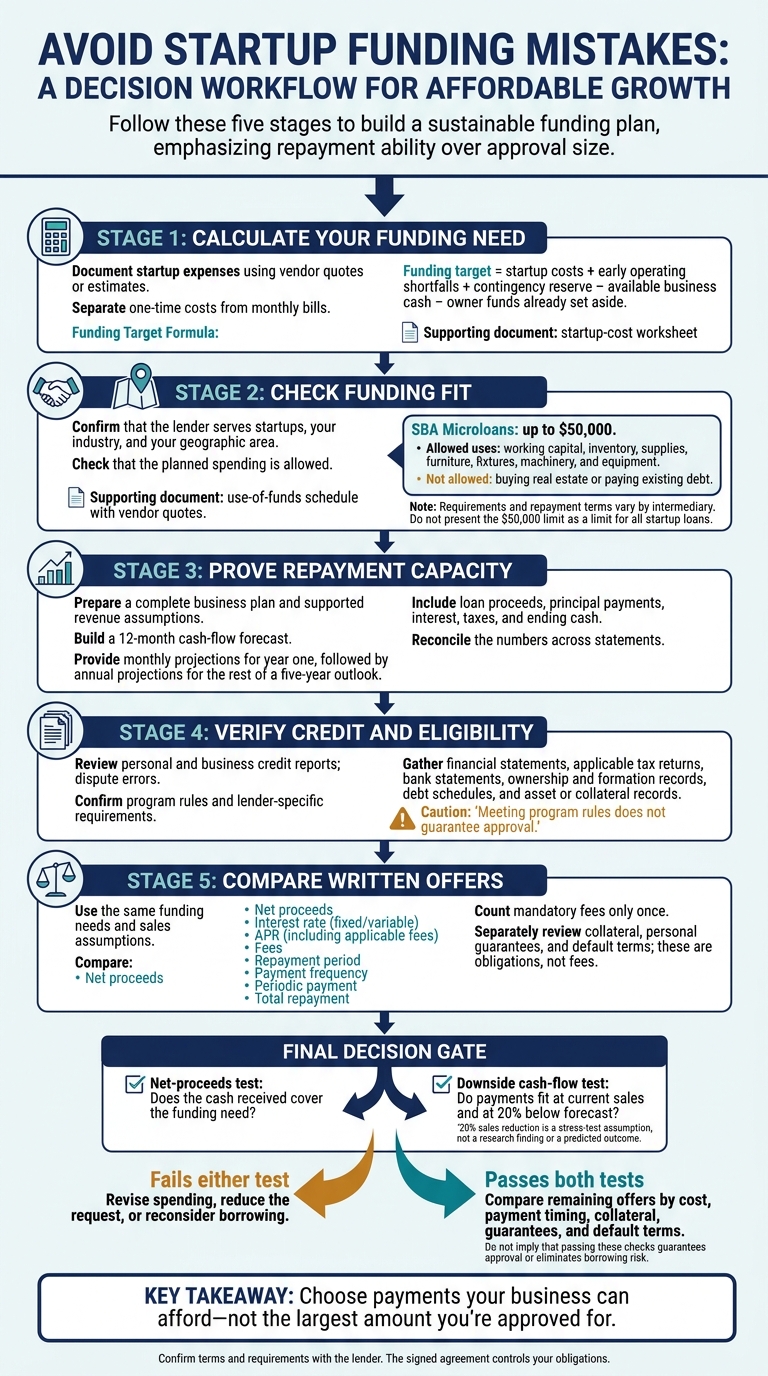
I’d judge startup funding by what I can repay – not what a lender approves. Before applying, I’d document my costs, build a 12-month cash-flow forecast, and check whether payments still fit if sales fall 20% below forecast.
Here are the five mistakes I’d avoid:
- Getting the amount wrong: Base the request on startup expenses, cash shortfalls, and a reserve.
- Choosing funding that doesn’t fit: Check whether the lender serves startups and allows the planned spending.
- Submitting incomplete plans or forecasts: Show how the business will earn money, pay bills, and repay debt.
- Skipping credit and eligibility checks: Review credit reports and confirm program rules and lender requirements.
- Overlooking borrowing costs: Compare fees, net proceeds, payment timing, collateral, and personal guarantees – not just rates.
My rule: <u>Check affordability before applying</u>, then compare written offers using the same funding needs and sales assumptions.
Startup Funding: 5 Checks Before You Borrow
Define Your Funding Needs Before You Apply
Before you apply, answer four questions: How much do you need? What will it cover? When do you need it? Can your cash flow cover repayment? Put the details in a worksheet with four columns: expense, amount, payment date, and business purpose. For major purchases, use vendor quotes or estimates – not guesswork.
Keep one-time costs, like equipment and permits, separate from monthly bills, like rent, payroll, and insurance. Add any early operating shortfalls and a contingency reserve. Then subtract available business cash and owner funds already set aside. That gives you a funding target based on what you’ll actually need.
Next, build a 12-month cash-flow forecast showing when bills come due and when you expect customer payments. If you plan to borrow, compare the proposed loan payment with the cash left after operating expenses, taxes, owner compensation, and existing obligations.
Test what happens if sales slow or costs climb, too. If loan payments leave no cash buffer, reduce your request, put off optional spending, or reconsider borrowing.
Startup costs deserve a closer look here: underestimating them is the next mistake to watch for.
sbb-itb-1eb586e
1. Miscalculating Your Funding Needs
Why this mistake matters
Borrow too little, and bills may come due before revenue arrives. Borrow too much, and you’ll pay more than you need to. Base your request on documented startup costs and cash needs – not the largest loan available.
How to fix it
Split your funding request into one-time startup costs, recurring operating costs, and working capital. This helps you match the loan amount to the cash your business will need.
Supporting calculations and documents
Back up your request with a startup-cost worksheet and a first-year cash-flow forecast that explain the loan amount. Document your assumptions about when customers will pay, seasonal changes, and refunds.
With that amount in hand, you can choose funding that fits your business stage and qualifications.
2. Choosing Funding That Does Not Fit Your Business
Why this mistake matters
Qualifying for funding doesn’t mean it fits your business stage, planned spending, or lender rules. A mismatch can mean rejection – or payments your business can’t afford.
How to fix it
SBA Microloans provide up to $50,000 for working capital, inventory, supplies, furniture, fixtures, machinery, and equipment. You cannot use them to buy real estate or pay existing debt.
Before applying, check that the intermediary serves startups, your industry, and your geographic area. Intermediaries decide whether to lend and set repayment terms, so requirements vary by lender. Ask about collateral and personal guarantees before you apply. Some lenders also provide business guidance or technical help.
Supporting calculations and documents
Prepare a use-of-funds schedule with vendor quotes, and check that every expense is allowed. Use your monthly cash-flow forecast to show how you’ll cover the proposed payment, including during slower sales periods. Ask the intermediary for its document checklist before submitting your application.
Next, show that your business plan and projections are complete.
3. Submitting an Incomplete Business Plan or Financial Forecast
Funding risk
Even the right loan can fall through if your plan and numbers don’t show how you’ll repay it. A sales forecast alone doesn’t prove repayment capacity. Missing expenses, unsupported assumptions, and conflicting figures make that harder for a lender to verify.
Practical correction
Explain your business model, products or services, target market, marketing strategy, operations, staffing, and management experience. Spell out how you’ll use the loan proceeds and repay the debt.
Back up revenue assumptions with pricing, demand, contracts, capacity, and collection timing – not just an annual sales target. Use a structured outline to organize your plan, projections, and repayment details.
Supporting calculations and documents
Include projected income statements, balance sheets, cash-flow statements, and an equipment and asset budget that shows purchase costs and timing. Provide monthly projections for year one, followed by annual projections for the rest of a five-year outlook. Show loan proceeds, principal payments, interest, taxes, and ending cash – not just revenue and operating expenses.
Before submitting, reconcile sales, payroll, equipment purchases, and debt service. Check that each month’s beginning cash matches the previous month’s ending cash.
Attach contracts, management résumés, and recent financial records to support your assumptions. Include a stress-case forecast showing how you’d cut costs or preserve cash if sales fall short.
4. Skipping Credit and Eligibility Checks
A funding source may fit your business, but missed credit or eligibility rules can still derail your application.
Funding risk
Meeting program rules does not guarantee approval. Lenders also review your credit history, collateral, and ability to repay. Requirements vary by lender and intermediary, so check them before you apply.
Practical correction
Check that your business meets the program’s rules for location, legal structure, profit status, and credit availability. Then confirm your industry’s size standard using receipts or employee count, including affiliates.
Startups are not automatically excluded if they meet eligibility requirements.
Review your personal and business credit reports. Dispute errors, prepare brief explanations for valid negative items, and ask about minimum credit standards and other lender-specific requirements.
Supporting calculations and documents
Build your eligibility file before applying. Gather:
- Personal financial statements, recent personal and business tax returns where applicable, and bank statements.
- Ownership and formation records, plus current debt schedules.
- Records of business and personal assets, including proof of available equity or a cash injection. For collateral, include ownership records, estimated values, and existing lien details.
Compare projected monthly debt payments with conservative cash-flow forecasts. Pay close attention to slower months, when payments may put more pressure on your budget.
Use this checklist to organize your documents, then ask the lender for its exact requirements, including the intended use of proceeds and any required cash injection. After confirming eligibility, compare rates, fees, and repayment terms before choosing.
5. Ignoring Loan Costs and Repayment Terms
Funding risk
A low rate doesn’t make a loan affordable. Fees can add to the cost, and weekly payments can leave less cash for payroll and rent. A longer term may lower payments but increase total interest. Collateral puts pledged assets at risk, while a personal guarantee can make you personally liable.
Practical correction
Once you confirm eligibility, compare the full cost of borrowing – not just the monthly payment. Start with offers for the same loan amount and term. Review the APR or interest rate, fees, payment frequency, collateral, and guarantee requirements. Check application and origination fees, closing costs, late charges, prepayment penalties, and required deposits. Get these terms in writing before moving forward.
If the terms differ, compare total costs rather than payment size alone. Choose payments your business can afford – not the largest amount you’re approved for. Ask how a variable rate could change your payments over time and whether paying early would reduce borrowing costs.
Supporting calculations and documents
Calculate the total cost by adding all scheduled payments and upfront and recurring fees. Use the lender’s amortization schedule to check each periodic payment. For weekly payments, add up a full year of withdrawals and check when they’ll hit your account.
Keep the written offer, fee disclosure, repayment schedule, and collateral and guarantee clauses together. Add the proposed payment to a 12-month cash-flow forecast alongside operating expenses and existing debt. Then test how slower sales or higher costs would affect your ability to pay. Use those numbers to compare offers side by side before committing.
Compare Loan Offers Before You Commit
Once you have written term sheets, compare them side by side, with one column per offer. Focus on what fits your cash flow, not just how much you’re approved to borrow. A lower rate won’t offset too little cash at closing or payments you can’t afford. Treat collateral and personal guarantees as obligations – not fees – and mark unconfirmed figures as estimates.
| Comparison item | Offer A | Offer B |
|---|---|---|
| Borrowing costs | ||
| Loan amount | $_____ | $_____ |
| Interest rate; fixed or variable | _____%; _____ | _____%; _____ |
| APR, including applicable fees | _____% | _____% |
| Fees; deducted at closing, financed, or paid separately | $_____; _____ | $_____; _____ |
| Estimated net proceeds | $_____ | $_____ |
| Repayment period | _____ months | _____ months |
| Payment frequency | _____ | _____ |
| Estimated periodic payment | $_____ per _____ | $_____ per _____ |
| Total repayment, including mandatory fees | $_____ | $_____ |
| Prepayment penalty | _____ | _____ |
| Cash-flow fit | ||
| Monthly cash remaining after payments – estimate | $_____ | $_____ |
| Monthly cash remaining at 20% below forecast – estimate | $_____ | $_____ |
| Collateral and personal obligations | ||
| Collateral pledged | _____ | _____ |
| Personal guarantee; limited or unlimited | _____ | _____ |
| Cross-collateralization or default terms | _____ | _____ |
| Other closing conditions | _____ | _____ |
Compare net proceeds, not the loan amount, and count mandatory fees only once in total repayment. Before comparing offers, test each one at current sales and at 20% below forecast.
Use the completed table to rule out offers that fail either the net-proceeds test or the downside cash-flow test. Then compare the remaining offers by cost, payment frequency, collateral, guarantees, and default terms.
Keep the table with your lender term sheets, calculations, and written clarifications. Ask the lender to confirm every estimate and disclosure in writing; the signed agreement controls your obligations.
Conclusion: Prepare Your Funding and Repayment Plan
Before you apply, make sure your funding request lines up with your documented startup costs, cash flow, lender fit, eligibility, and ability to repay.
Then build a 12-month cash-flow forecast that includes debt payments and a reserve for slower sales.
Getting approved is only part of the job. Accurate costs, suitable funding, complete documents, eligibility checks, and comparisons of all costs help make the funding work for your business.
With your numbers ready, gather your documents and compare terms in writing before applying. Use SBA50K’s funding checklists and document guides, then confirm loan terms and required documents directly with the lender.
FAQs
How much cash reserve should my startup keep?
Keep a separate reserve for at least two to three months of debt payments and required fixed expenses. Don’t count your personal emergency savings toward this amount. Use cautious, realistic cash-flow projections to set the target.
Plan funding for launch costs, three to six months of operating expenses, and a contingency reserve. When you finalize your loan request, include at least 12 months of working capital to help cover short-term cash-flow gaps.
Can I qualify for startup funding without revenue?
Yes, but requirements depend on the funding source. Lenders and investors may look at your personal credit, industry experience, and ability to repay – not just your past sales.
Back up your application with a strong business plan, realistic financial projections grounded in market research, and proof of demand. Show how your projected cash flow will cover debt payments. Before applying, check that the lender or program accepts businesses that haven’t earned revenue yet.
Will applying for funding hurt my personal credit?
Applying for startup funding usually involves a credit check. This may trigger a hard inquiry and cause a small, temporary drop in your personal credit score. To limit the impact, avoid opening multiple new credit accounts or undergoing frequent credit checks in the months before you apply.
Once you receive funding, making payments on time can help build or improve your business credit over time.
Leave a Reply